
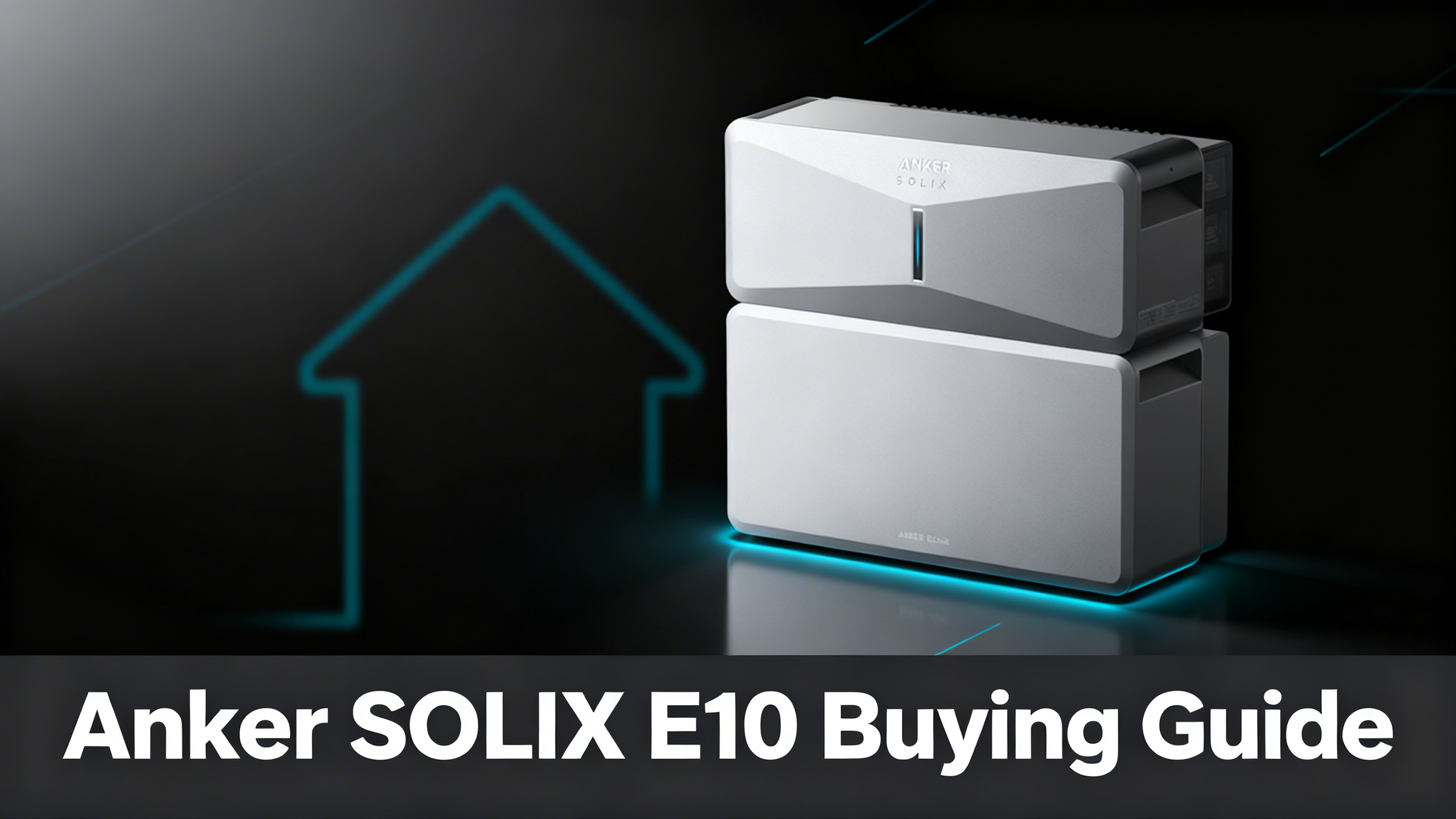
The E10 is not a single product. It is a modular home backup ecosystem with dozens of possible configurations, ranging from the $4,299 base unit to a fully expanded multi-module installation approaching $30,000. Most buying guides skip this complexity and point you toward a bundle without explaining what you are actually paying for. This one does not.
The goal here is straightforward: match your household size, budget, and backup priorities to the exact Anker SOLIX home backup configuration that makes sense, without overspending on capacity you will never use or underbuying and regretting it during the next extended outage. If you want deeper specs and performance analysis, start with the full E10 review before coming back here to choose your config.

Anker SOLIX E10 Whole-Home Backup
$4,299 Base configuration
- UL9540 & 9540A certified residential system
- Modular design: scale up to 5 B6000 batteries
- Pairs with Power Dock or Smart Inlet Box
Get our Black Friday alerts for Anker SOLIX
We track live prices on 40+ models from Jackery, EcoFlow, BLUETTI and Anker SOLIX. When a deal beats the lowest price we've recorded, you'll hear from us. During Black Friday week, one short recap a day at most.
Unsubscribe in one click. We may earn a commission when you buy through our links, at no extra cost to you. Privacy Policy
What Is the Anker SOLIX E10?
The Anker SOLIX E10 is a UL9540 and UL9540A certified residential home backup system, which separates it immediately from the portable power stations most people are familiar with. Certification under these standards means the E10 is approved for permanent building installation, not just outdoor or temporary use. For a broader look at the entire Anker lineup, the full Anker SOLIX brand review covers all current models and how they position against each other.
The architecture is modular by design. A single Power Module (the inverter and management brain of the system) pairs with one or more B6000 Battery Modules to deliver backup capacity. Connection to your home’s electrical circuits happens through a third component, either a Smart Inlet Box or a Power Dock, which is where most of the buying decision complexity lives.
Key E10 Components
Understanding what each component does is essential before comparing configurations. The system has four distinct hardware pieces:
- Power Module: The inverter and system controller. Every E10 system requires exactly one per installation (additional modules can stack for larger setups).
- B6000 Battery Module: Each module adds 6 kWh of capacity. A single Power Module supports up to five B6000s for a maximum of 30 kWh per unit.
- Smart Inlet Box ($399): Connects selected circuits to the E10 with manual switchover during an outage. Simpler installation, lower cost.
- Power Dock ($1,999): Provides automatic whole-home transfer in 30ms. Covers every circuit in the panel. Requires professional installation.
E10 Capacity by Battery Count
🔋
1x B6000
6 kWh
~12h critical circuits
🔌
2x B6000
12 kWh
~24h critical circuits
⚡
3x B6000
18 kWh
~36h critical circuits
🏠
5x B6000 (max)
30 kWh
~60h critical circuits
Runtime estimates based on 500W average critical load. Actual performance varies by household consumption.
Smart Inlet Box vs Power Dock: The Most Important Decision
This is the fork in the road. Before choosing any specific E10 bundle, you need to understand what connection hardware does and which type fits your situation. Get this decision wrong, and you will either pay for whole-home automation you did not need or discover mid-outage that only half your circuits have power. Our dedicated Power Dock vs Smart Inlet Box explained guide goes deeper on each option, but here is the essential breakdown.
The Smart Inlet Box ($399) and the Power Dock ($1,999) are fundamentally different products serving different needs. One is a manual, selected-circuit solution. The other is a fully automatic whole-home system. The $1,600 price gap between them reflects genuine capability differences, not just branding.


Smart Inlet Box vs Power Dock: Which Do You Need?
Smart Inlet Box ($399)
- Powers specific circuits only (HVAC, fridge, lights)
- Manual connection required during an outage
- Lower upfront cost, simpler installation
- Works with a portable generator as backup too
Power Dock ($1,999)
- Fully automatic 30ms switchover during outage
- Whole-home protection, every circuit covered
- Transfers back to grid automatically when power returns
- Requires licensed electrician for installation
When to Choose the Smart Inlet Box
The Smart Inlet Box is the right choice when your priority is keeping critical circuits running at the lowest possible entry cost. You pre-select which circuits it covers during installation, typically your refrigerator, essential lighting, HVAC, and a few outlets. When an outage hits, you connect the E10 to the SIB manually, similar to how a portable generator plugs into a transfer switch. It is not automated, but it is affordable and straightforward to set up.
It also doubles as a standard generator inlet, which means it retains value even if you later upgrade your backup system. For renters who plan to take the system to their next home, the SIB approach is significantly more practical than a fixed automatic transfer switch.
When to Choose the Power Dock
The Power Dock is for homeowners who want seamless, whole-home protection without any manual steps during an outage. Its 30ms transfer time is imperceptible: lights do not flicker, computers do not restart, and you do not need to be home when it kicks in. Every circuit in your electrical panel is covered automatically.
The trade-off is cost and installation complexity. The Power Dock itself adds $1,999 to the system price, and professional electrician installation is mandatory. In most jurisdictions, a permit is required as well. For homeowners with medical equipment, home offices, or simply a low tolerance for outage disruption, that premium is well justified. Before finalizing your order, review the installation requirements to confirm your home’s electrical panel is compatible.
Get our Black Friday alerts for Anker SOLIX
We track live prices on 40+ models from Jackery, EcoFlow, BLUETTI and Anker SOLIX. When a deal beats the lowest price we've recorded, you'll hear from us. During Black Friday week, one short recap a day at most.
Unsubscribe in one click. We may earn a commission when you buy through our links, at no extra cost to you. Privacy Policy
All E10 Configurations: Pricing and What’s Included
Anker SOLIX offers the E10 in six primary configurations, plus standalone component purchases for buyers who want to build incrementally. Configuration data confirms a straightforward pricing logic: each bundle adds specific hardware at a predictable cost premium. Understanding what each tier includes prevents both over-buying and costly gaps in your backup setup.
Budget for the full price: the federal tax credit for home batteries ended for systems installed after December 31, 2025, as our E10 tax credit guide explains. For pricing verification, the official E10 product page is the authoritative source.
Anker SOLIX E10: Configuration Overview
Best Value Bundle
E10 + Smart Inlet Box
$4,599
Includes SIB for selected-circuit backup
Base Configuration ($4,299)
The base E10 includes one Power Module and one B6000 Battery Module (6 kWh capacity). No connection hardware is included. This configuration makes sense for two types of buyers: those who already own a Smart Inlet Box or Power Dock from an existing generator setup, and those who plan to purchase connection hardware separately to take advantage of promotional pricing or to add a higher-capacity option later. Purchasing the base E10 and adding connection hardware later is possible, though bundled configurations typically offer better value than purchasing components separately.
E10 + Smart Inlet Box ($4,599)
At just $300 more than the base unit, the E10 + Smart Inlet Box bundle is the most accessible complete system in the lineup. The $300 premium for the SIB (compared to its $399 standalone price) represents genuine bundle savings. For most first-time whole-home battery buyers who want a UL-certified home battery backup system without the full-panel ATS complexity, this configuration is the logical starting point. This guide focuses on configuration, while our Anker home backup hub covers all Anker whole-home options side by side.
E10 + Power Dock ($5,799)
The Power Dock bundle steps up to whole-home automatic protection. At $5,799, the $1,500 premium over the SIB bundle purchases a fundamentally different experience: no manual steps, no partial coverage, and a 30ms transfer time that keeps sensitive electronics running without interruption. Configuration data confirms this is the right choice for households with medical equipment, home office workstations, or anyone who cannot afford even brief power interruptions during a switchover.
Extended Configurations ($6,599 to $29,999+)
The two-battery configurations (E10 + 2 Batteries + SIB at $6,599, and E10 + 2 Batteries + Power Dock at $7,799) double capacity to 12 kWh. Based on verified capacity specs, 12 kWh supports approximately 24 hours of runtime for a typical critical-circuit load of around 500W. Beyond these standard bundles, Anker supports configurations of up to three Power Modules and fifteen B6000 batteries for commercial-scale installations approaching $30,000.
How to Scale the E10 with B6000 Batteries
Capacity expansion is straightforward: see the complete breakdown on scaling with B6000 modules for full stack configurations. Each B6000 Battery Module adds 6 kWh to the system, and a single Power Module supports up to five of them, for a maximum of 30 kWh per unit. Additional Power Modules can stack beyond that for larger installations.
The pricing structure for B6000 modules is $2,499 for a standalone unit. Multi-pack purchasing often lowers the per-kWh cost. The capacity planning question comes down to your household’s average critical load: a 500W average draw (refrigerator, a few lights, phone charging, basic HVAC) uses roughly 12 kWh over 24 hours, meaning two B6000 modules cover a full day. Heavier loads, a larger home, or multi-day outage preparedness all push toward a larger stack.

One practical consideration: starting with one B6000 and adding more later is fully supported. Anker’s modular architecture means you are not locked into your initial capacity choice. However, purchasing batteries as part of a configured bundle typically costs less per kWh than adding them as standalone units. If you already know you will eventually want 12 kWh or more, buying the two-battery configuration upfront is the more cost-efficient path.
Add a Generator for Extended Backup
For households in areas prone to multi-day outages or with limited rooftop solar potential, the E10 + Smart Generator 5500 Tri-Fuel bundle ($5,899) offers a different kind of energy independence. The Smart Generator 5500 runs on gasoline, propane, or natural gas, and integrates directly with the E10 to extend backup duration as long as fuel is available. This removes the hard ceiling that battery-only systems face during extended blackouts.
The generator bundle is specifically suited to three scenarios: extended outages lasting three or more days where battery cycling alone is insufficient, locations where solar panel installation is impractical (dense urban areas, shaded roofs, rental properties), and households that want true fuel independence rather than grid or sun dependency. It is a more complex setup than a pure battery system, and ongoing fuel costs are a real factor to budget for.

Which Configuration Is Right for You?
The right E10 configuration depends on three variables: your home’s size and circuit count, your acceptable battery runtime during an outage, and your budget including installation costs. The profiles below apply verified pricing and capacity data to real-world homeowner scenarios.
For Apartments and Small Homes (Under 1,500 sq ft)
The E10 + Smart Inlet Box ($4,599) covers the critical circuits in most smaller homes with a 6 kWh battery providing 12 to 18 hours of runtime under typical loads. For apartments or condos where whole-panel integration may not be permitted or practical, the SIB’s selected-circuit approach is actually the better fit. Installation is simpler, electrician costs are lower, and the system can move with you if you relocate. Budget-conscious buyers can start here and add a second B6000 later to extend runtime.
For Medium Homes (1,500 to 3,000 sq ft)
Medium homes typically benefit from the E10 + Power Dock + 2 B6000 configuration ($7,799 plus electrician costs). The 12 kWh capacity supports approximately 24 hours of runtime across the full panel with the ATS handling automatic transfer. Homes in this size range often have higher HVAC loads, which the two-battery stack handles more comfortably than a single module. The whole-home automatic switchover also becomes more valuable as the number of sensitive circuits increases.
For Large Homes (Over 3,000 sq ft)
Homes over 3,000 sq ft have specific needs covered in our guide to best configurations for large houses. Generally, these homes require either a maxed-out single Power Module stack (5 B6000s, 30 kWh) or a multi-module installation. At this scale, budget expectations should start at $10,000 for the system and rise further with professional installation and permitting. The Power Dock is essentially required at this size, as manual switchover for a large home during an outage is impractical.

Federal Tax Incentives for the E10
From 2023 through 2025, the federal Residential Clean Energy Credit (Section 25D) covered 30% of the cost of home batteries of at least 3kWh, like the E10. The 2025 tax law known as the One Big Beautiful Bill Act ended it for systems installed after December 31, 2025.
The date that counts is when installation is completed, not when you pay. If your E10 was installed by the end of 2025, you can still claim the credit on your 2025 return. The E10 tax credit guide covers what changed and what’s left, including state and utility programs.
What You Need Before You Buy
The E10 is a residential-grade system, not a plug-and-play portable unit. Before placing an order, a few pre-purchase checks are worth completing. Your electrical panel needs to have sufficient space and capacity for the connection hardware: the Power Dock in particular requires a breaker position and appropriate amperage headroom. Older panels may need an upgrade before the system can be installed.
Permit requirements vary significantly by state and municipality. Some jurisdictions treat battery storage as a simple electrical addition; others require full building permits with inspections. Anker’s professional installation service handles the permitting process in most areas, which simplifies the process considerably for buyers who do not want to manage that themselves. Before finalizing your order, review the installation requirements to confirm your home’s electrical panel is compatible.
Final Verdict: Our Configuration Recommendations
Based on configuration data and verified pricing across the E10 lineup, the E10 + Smart Inlet Box ($4,599) is the right starting point for most homeowners. It delivers a complete, UL-certified home battery backup system without the Power Dock’s cost and installation complexity. The $300 bundle savings over purchasing components separately is real, and the SIB’s selected-circuit approach covers the circuits that actually matter during an outage for the majority of households.
Buyers who need whole-home protection and can absorb the installation costs should go straight to the E10 + Power Dock ($5,799). The 30ms automatic switchover and full-panel coverage are capabilities that the SIB simply cannot replicate, and for the right household, they are worth every dollar of the premium.
For capacity planning, start with the 6 kWh base (one B6000) and scale up based on your critical load calculation. Most households running refrigerator, lighting, and basic HVAC at 500W average need roughly two batteries for 24-hour coverage. If you are planning for multi-day outages from the start, buying the two-battery bundle upfront is more cost-efficient than adding batteries later.
Anker SOLIX E10 + Smart Inlet Box
$4,599
Best entry configuration for most homeowners
Price verified April 2026. Free shipping available
Frequently Asked Questions
What is included in the Anker SOLIX E10 base configuration?
The base E10 ($4,299) includes one Power Module and one B6000 Battery Module (6 kWh capacity). Connection hardware (Smart Inlet Box or Power Dock) and additional batteries are sold separately or in bundles. For most buyers starting fresh, the E10 + Smart Inlet Box bundle at $4,599 is the more practical entry point, as it includes the connection hardware needed for immediate home circuit integration.
What is the difference between the Smart Inlet Box and the Power Dock?
The Smart Inlet Box ($399) powers selected circuits and requires manual connection during an outage. The Power Dock ($1,999) provides whole-home protection with automatic 30ms switchover, but requires professional installation. Both are UL-listed for residential use. The key practical difference: the SIB requires you to physically connect the E10 when an outage occurs, while the Power Dock does everything automatically with no action required from you.
How many B6000 batteries can I add to one E10 Power Module?
Up to five B6000 Battery Modules per Power Module, providing a maximum capacity of 30 kWh per unit. Multiple Power Modules can be stacked for larger installations. Each B6000 adds 6 kWh, so the scaling math is straightforward: two batteries give 12 kWh, three batteries give 18 kWh, and so on up to 30 kWh at full capacity.
Does the Anker SOLIX E10 qualify for the federal tax credit?
Not if it’s installed in 2026. The Section 25D residential clean energy credit ended for systems installed after December 31, 2025. An E10 installed by then can still be claimed on a 2025 return. Our dedicated E10 tax credit guide covers the details.
Can I add the Power Dock or Smart Inlet Box later?
Yes. Purchasing the base E10 and adding connection hardware later is possible. However, bundled configurations typically offer better value than purchasing components separately. If you are confident you will eventually want the Power Dock, buying it as part of a bundle from the start is more cost-efficient. The same logic applies to additional B6000 battery modules.
Is professional installation required for the Anker SOLIX E10?
The Power Dock requires a licensed electrician for installation. The Smart Inlet Box is simpler and may be DIY-eligible in some jurisdictions, but local electrical codes vary. Anker offers a professional installation service for both components. Regardless of the hardware you choose, permit requirements differ by state and municipality, so checking local code before purchase is advisable.
Originally published: April 6, 2026