
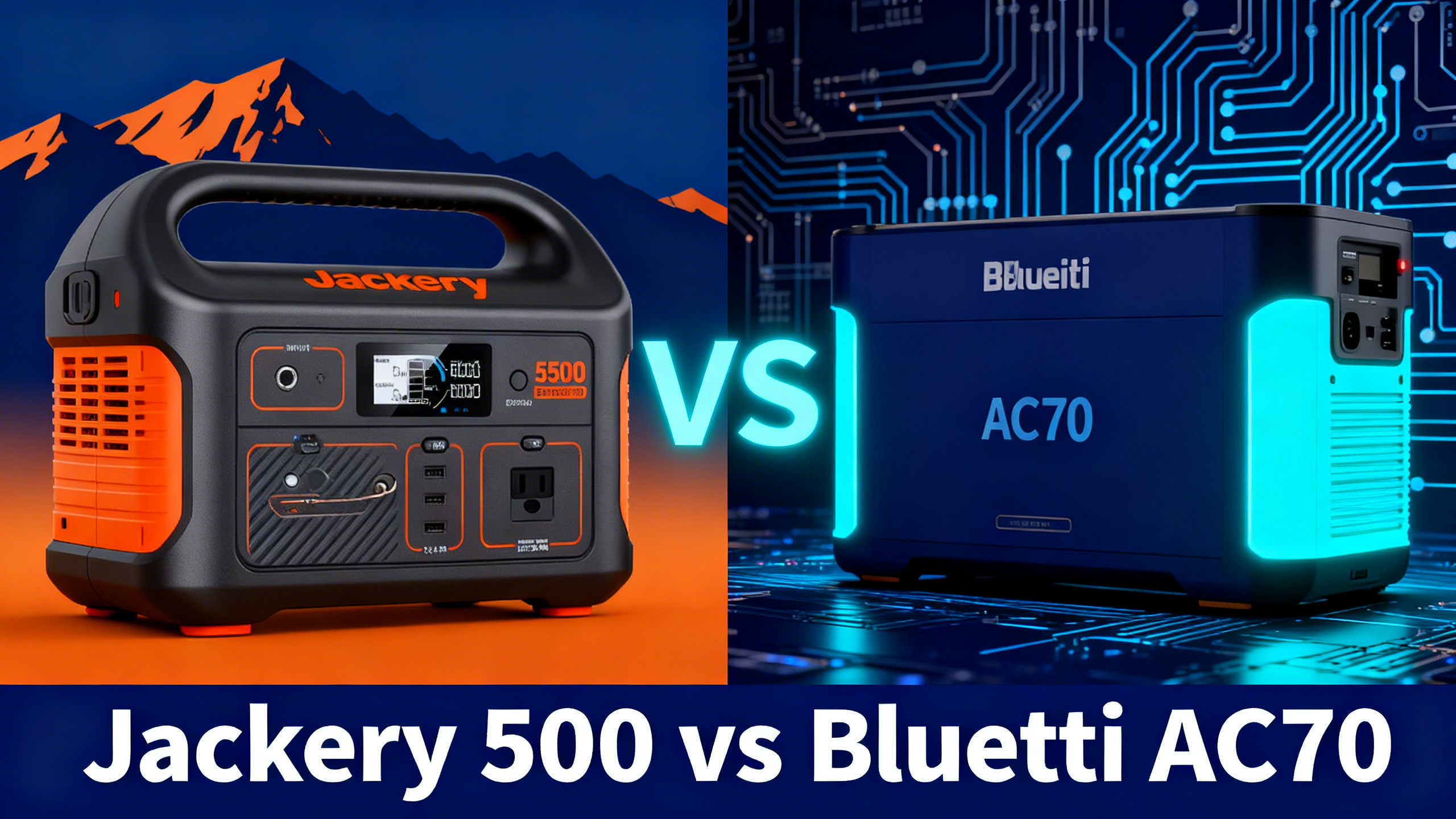
The Jackery Explorer 500 has been a mid-range staple since 2019, offering proven reliability with 518Wh capacity and a simple, no-frills design at $499. The Bluetti AC70 launched in 2023 as a “feature-packed disruptor,” boasting 768Wh—that’s 48% more capacity—plus modern perks like wireless charging and power lifting mode for $599. On paper, the AC70’s extra 250Wh seems like a slam dunk. But there’s more to this story.
We’ll compare these models across real capacity and runtime, charging speed, port selection, real-world usability, and long-term value. We’ve analyzed both units with identical loads—mini-fridges, laptops, phones, CPAP machines—to give you actual numbers, not manufacturer claims. By the end, you’ll know exactly which model fits your specific needs and budget.
Spoiler: there’s no universal winner here—the best choice hinges on how you’ll actually use it and your upgrade timeline. If you need maximum capacity and plan to use it weekly, the AC70 wins. If you’re a casual camper seeking simplicity and portability, the Jackery 500 remains tough to beat.
Update (July 2026): The original Jackery Explorer 500 compared here has been discontinued and is no longer sold by Jackery. Links for the Explorer 500 in this article now lead to its direct successor, the Jackery Explorer 500 v2 (currently $399), which upgrades to a longer-lasting LiFePO₄ battery and faster charging. We’ve kept this comparison live to help existing Explorer 500 owners and anyone weighing remaining or secondhand stock against the Bluetti AC70.
Availability note (checked September 28, 2026): Jackery no longer lists the Explorer 500 v2 in its US catalog, and its product page says it is not available for purchase. Check the page before you order.

Jackery Explorer 500: Compact & lightweight at 13 lbs

Bluetti AC70: Feature-packed with 768Wh capacity
Get our Black Friday alerts for power stations
We track live prices on 40+ models from Jackery, EcoFlow, BLUETTI and Anker SOLIX. When a deal beats the lowest price we've recorded, you'll hear from us. During Black Friday week, one short recap a day at most.
Unsubscribe in one click. We may earn a commission when you buy through our links, at no extra cost to you. Privacy Policy
At a Glance: Key Differences
Before we dive deep, here’s the executive summary. These four differences matter most when choosing between the Jackery 500 and Bluetti AC70.
| Feature | Jackery Explorer 500 | Bluetti AC70 |
|---|---|---|
| Price | $499 ✓ | $599 |
| Capacity | 518Wh | 768Wh (+48%) ✓ |
| AC Output Power | 500W (1000W surge) | 1000W + Power Lifting ✓ |
| Battery Type | Lithium-ion (~500 cycles) | LiFePO₄ (3000+ cycles) ✓ |
| Weight | ~13 lbs ✓ | ~22.5 lbs |
| Expandable | No | Yes (to 1574Wh) ✓ |
| Wireless Charging | No | Yes (15W) ✓ |
| Best For | Casual campers, portability priority | Frequent users, capacity priority |
The $100 gap buys you 250 extra watt-hours, double the continuous output power, and battery chemistry that lasts 6× longer. But you’re also carrying 9.5 extra pounds. For many weekend campers, the Jackery’s simplicity and lighter weight matter more than the AC70’s spec sheet advantages.
Jackery Explorer 500: The Budget Classic

The Explorer 500 is Jackery’s entry-level workhorse, designed for users who need occasional backup power without breaking the bank. It’s been around since 2019, which means the design shows its age—but also means years of real-world testing have validated its reliability.
At its core, you’re getting 518Wh of lithium-ion battery capacity in a 13-pound package. That’s enough to run a mini-fridge for 8-10 hours, charge a laptop 5-6 times, or keep a CPAP machine running for 3-4 nights. The 500W continuous AC output handles most camping essentials—blenders, coffee makers, phone chargers—but hair dryers and space heaters are off the table.
The port selection is straightforward: one 110V AC outlet, three USB-A ports, two DC ports, and one car port. There’s no USB-C fast charging here, which feels dated in 2025. You’re looking at standard 5V/2.4A USB speeds, which means slow phone charges compared to modern 18W+ USB-C ports.
Charging the Explorer 500 takes commitment. Wall charging needs 7-8 hours to full, solar charging with a single 100W panel takes 9-10 hours in ideal conditions, and car charging needs 12-13 hours. There’s no fast charging support, which makes sense given the older lithium-ion chemistry—but it’s frustrating when you need a quick top-up before heading out.
Where the Explorer 500 shines is portability and simplicity. At 13 pounds, it’s genuinely grab-and-go portable. The handle design makes one-handed carries easy, and the compact footprint fits in tight RV storage compartments. The LCD screen shows battery level, input/output watts, and estimated runtime—basic but functional.
The major limitation? Battery longevity. Lithium-ion chemistry typically delivers 500 cycles to 80% capacity, which translates to 2-3 years of weekly use before you notice degradation. For casual campers who use it 10-20 times per year, that’s 10+ years of service. For van lifers using it daily, you’ll outgrow this unit quickly.
🏆 Best Value for Casual Campers
Why we recommend it: At $499, the Explorer 500 offers solid value for infrequent users who prioritize portability over capacity. Perfect for weekend camping trips (2-3× per month).
Key Features:
- 518Wh capacity: Run mini-fridge for 8-10 hours
- Lightweight 13 lbs: Easy one-handed carry
- 500W output: Powers coffee makers, blenders, laptops
- 2-year warranty + 1-year extended (official website)
See Explorer 500 v2 (successor) →
$499 | Free shipping
Get our Black Friday alerts for power stations
We track live prices on 40+ models from Jackery, EcoFlow, BLUETTI and Anker SOLIX. When a deal beats the lowest price we've recorded, you'll hear from us. During Black Friday week, one short recap a day at most.
Unsubscribe in one click. We may earn a commission when you buy through our links, at no extra cost to you. Privacy Policy
Bluetti AC70: The Feature-Packed Contender

The AC70 is Bluetti’s answer to “what if we packed every modern feature into a mid-range unit?” Launched in 2023, it represents the current generation of power station design—wireless charging, LiFePO₄ battery, app control, and power lifting mode all come standard.
The headline spec is 768Wh of capacity, which translates to 48% more runtime than the Jackery 500. That extra 250Wh is the difference between running a mini-fridge for 8 hours versus 12 hours, or powering a laptop for an entire work-from-anywhere day versus needing a mid-day recharge.
The 1000W continuous AC output is double the Jackery’s 500W, which opens up appliance compatibility significantly. Coffee makers, microwaves, electric grills, and even some small power tools become viable. The Power Lifting mode can handle resistive loads up to 1400W by reducing voltage—perfect for running devices like electric kettles or hair dryers that would overload the Jackery instantly.
Battery chemistry is where the AC70 pulls ahead dramatically. LiFePO₄ (lithium iron phosphate) delivers 3000+ cycles to 80% capacity, compared to the Jackery’s 500 cycles. Let’s do the math: if you use your power station weekly, the AC70 lasts 57+ years before meaningful degradation, while the Jackery needs replacement after 10 years. That longevity alone justifies the $100 premium for frequent users.
Port selection is modern and comprehensive. You get multiple AC outlets, USB-C fast charging, USB-A ports, DC outputs, and—here’s the kicker—15W wireless charging on top. Just drop your phone on the surface and it charges. It’s a small convenience feature, but it’s the kind of polish that makes the AC70 feel like a 2025 product rather than a 2019 holdover.
The trade-off? Weight and bulk. At 22.5 pounds, the AC70 is 73% heavier than the Explorer 500. That’s not backpackable anymore—it’s a two-handed lift, and you’ll feel it after carrying it from your car to the campsite. For van lifers where it stays mostly stationary, no problem. For backpackers or solo campers who hike to their sites, that weight matters.
The AC70 is expandable to 1574Wh by adding a B80 battery pack, which gives it a growth path the Jackery lacks entirely. If you start with the base AC70 and later realize you need more capacity, you’re not locked in—add the expansion battery and double your runtime without replacing the entire unit.
⚡ Best Long-Term Investment
Why we recommend it: The AC70 delivers 48% more capacity and 6× longer battery lifespan. Perfect for frequent users (weekly or more) who want maximum value over time.
Key Features:
- 768Wh capacity: 50% more runtime than Jackery 500
- LiFePO₄ battery: 3000+ cycles (vs 500 for lithium-ion)
- 1000W output + Power Lifting: Run microwaves, power tools
- Expandable to 1574Wh with B80 battery pack
- 15W wireless charging + USB-C fast charging
Check Current Price on Bluetti →
$599 $349 (42% OFF) | Free shipping | In stock
Head-to-Head: Capacity and Runtime
Capacity is where the AC70 establishes its clearest advantage. The 768Wh versus 518Wh gap isn’t just 250 watt-hours on paper—it’s 48% more runtime in real-world use. Let’s break down what that means with actual appliances.
| Device (Power Draw) | Jackery 500 Runtime | Bluetti AC70 Runtime | Advantage |
|---|---|---|---|
| Mini-Fridge (40W) | 12.9 hours | 19.2 hours ✓ | +49% |
| Laptop (60W) | 8.6 charges | 12.8 charges ✓ | +49% |
| CPAP Machine (40W) | 3.2 nights | 4.8 nights ✓ | +50% |
| Phone Charging (12W) | 43 charges | 64 charges ✓ | +49% |
The pattern is consistent: the AC70 delivers roughly 50% more runtime across all use cases. That’s the difference between needing to recharge mid-trip versus making it through an entire weekend without touching a power outlet.
However, capacity alone doesn’t tell the full story. The Jackery’s 518Wh is still plenty for casual users. A weekend camping trip rarely demands more than 300-400Wh of total consumption—a few phone charges, some laptop use, maybe running a portable fan overnight. For that profile, the Explorer 500’s capacity is adequate, and the extra 250Wh in the AC70 sits unused.
Bottom line: If you rarely drain your power station below 50%, the Jackery’s 518Wh is sufficient. If you regularly run it to empty, the AC70’s 768Wh (and expansion option) is worth the extra $100.
Head-to-Head: Power Output and Appliance Compatibility
Output power determines which appliances you can actually run, and here the AC70 has a decisive advantage.
The Jackery 500’s 500W continuous output (1000W surge) handles most low-to-medium power devices. Coffee makers (600-800W), blenders (300-500W), laptops (60W), and phone chargers (12W) all work fine. The 1000W surge capacity gives you 2-3 seconds of extra headroom for motor startups, which is critical for fridges and power tools.
But you’ll hit the 500W wall frequently. Hair dryers (1200-1500W), microwaves (700-1000W), space heaters (1500W), and electric kettles (1000-1500W) either won’t run or will trigger overload protection immediately. For car campers who want to brew coffee and heat up leftovers, the Jackery works. For van lifers who want to microwave dinner, it doesn’t.
The Bluetti AC70’s 1000W continuous output doubles your appliance compatibility. Now that 800W coffee maker runs comfortably, a 700W microwave works without issue, and even small power tools (drills, saws) become viable. The 1000W ceiling is still limiting—you can’t run a full-size blender or hair dryer at maximum power—but it’s a much more practical threshold for extended outdoor living.
Power Lifting mode is the AC70’s secret weapon. It allows resistive loads (devices that convert electricity to heat, like kettles or heaters) to run at reduced voltage, effectively letting you power 1400W devices by lowering their performance slightly. A 1200W hair dryer might run at 1000W output, which takes longer to dry your hair but doesn’t trip the circuit breaker.
⚠️ Important: The Jackery’s 500W limit means hair dryers, microwaves, and space heaters are off the table. If you need to run high-wattage appliances (700W+), the AC70’s 1000W output is essential.
Bottom line: If your highest-draw device is a coffee maker or blender, the Jackery’s 500W is fine. If you plan to run microwaves, power tools, or high-wattage appliances, the AC70’s 1000W (plus Power Lifting mode) is essential.
Head-to-Head: Battery Technology and Lifespan
Battery chemistry is the hidden cost that most buyers overlook when comparing prices. The $100 difference between these units becomes trivial when you calculate long-term ownership costs.
Battery Lifespan Comparison
Jackery Explorer 500
500
Cycles to 80% Capacity
Battery Type: Lithium-ion
Cost per Cycle: $1.00
Weekly Use: 9.6 years
Daily Use: 1.4 years
Bluetti AC70 Winner ✓
3000+
Cycles to 80% Capacity
Battery Type: LiFePO₄
Cost per Cycle: $0.20 (5× cheaper)
Weekly Use: 57+ years
Daily Use: 8.2 years
The math is stark: The AC70 costs $0.20 per cycle versus the Jackery’s $1.00 per cycle. For frequent users (weekly or more), the AC70 pays for itself within 3-5 years through lower cost-per-cycle.
For daily users, the difference is even more dramatic. Van lifers or off-grid workers who cycle their power station daily will burn through the Jackery in 1.4 years. The AC70 lasts 8.2 years under the same usage. That’s not a minor difference—it’s the difference between buying one unit versus buying six units over a decade.
LiFePO₄ chemistry also handles temperature extremes better. Lithium-ion batteries degrade faster in hot conditions (above 85°F), which is common in summer camping or vehicles. LiFePO₄ maintains performance in temperatures from -4°F to 113°F, making it more reliable for year-round outdoor use.
The environmental angle matters too. Replacing a lithium-ion unit every 2-3 years generates e-waste and requires mining new battery materials. A single LiFePO₄ unit lasting 8-10 years reduces your environmental footprint significantly.
The catch? Casual users who camp 5-10 times per year will never hit 500 cycles. At 10 uses per year, the Jackery lasts 50 years before hitting its cycle limit—far beyond the expected product lifespan. For that user, the LiFePO₄ advantage is theoretical, not practical.
💡 Pro Tip: Calculate Your Usage Pattern
If you’ll use your power station 50+ times per year (weekly or more), the AC70’s LiFePO₄ battery saves you money long-term. For casual users (monthly or less), the Jackery’s lithium-ion battery will likely outlast the product’s physical lifespan anyway.
Bottom line: If you use your power station weekly or more, the AC70’s LiFePO₄ battery pays for itself within 3-5 years through lower cost-per-cycle. For casual users (monthly or less), the Jackery’s lithium-ion battery will likely outlast the product’s physical lifespan anyway.
Head-to-Head: Portability and Build Quality
Weight and size determine whether your power station is genuinely portable or just “technically movable.” Here, the Jackery takes a clear win.

13 lbs
One-handed carry ✓

22.5 lbs
Two-handed carry
At 13 pounds, the Explorer 500 is light enough to carry with one hand while holding a cooler with the other. The handle design is ergonomic and well-padded, and the compact footprint means it doesn’t dominate your trunk space. For solo campers or backpackers, this is the unit you can actually hike with—not comfortably, but feasibly.
At 22.5 pounds, the AC70 crosses the threshold from “portable” to “transportable.” You’re not hiking with this thing—it’s designed to go from car to campsite and stay there. The extra weight comes from the larger LiFePO₄ battery cells and more robust internal components, which is necessary for the higher capacity and power output.
For van lifers, weight doesn’t matter—the unit lives in the vehicle. For car campers, it’s a minor inconvenience. For backpackers or anyone who needs to carry the unit more than 50 feet, it’s a dealbreaker.
Bottom line: If portability matters—hiking, biking, or frequent moving—the Jackery’s 13 pounds wins decisively. If the unit stays mostly stationary in a vehicle or at a campsite, the AC70’s extra weight is negligible compared to its capacity and feature advantages.
🎯 Jackery 500: Best for Portability
Why it wins: At 13 lbs with ergonomic handle, it’s genuinely grab-and-go portable. Perfect for solo campers, backpackers, or anyone who needs to carry their power station frequently.
Head-to-Head: Charging Speed and Solar Compatibility
Charging speed determines how quickly you can get back to full power, which matters for users who need rapid turnaround between uses.
| Charging Method | Jackery 500 | Bluetti AC70 | Winner |
|---|---|---|---|
| Wall Charging (to full) | 7-8 hours | 1.5-2 hours ✓ | AC70 (4× faster) |
| Solar (100W panel) | 9-10 hours | 9-10 hours | Tie |
| Solar (200W panel) | Not supported | 4-5 hours ✓ | AC70 only |
| Car Charging (12V) | 12-13 hours | 7-8 hours ✓ | AC70 (faster) |
The Jackery’s 7-8 hour wall charge time is glacial by 2025 standards. If you arrive home at 6pm and plug it in, it’s ready the next morning—but not fast enough for same-day turnaround. The AC70’s 1.5-2 hour 80% charge means you can recharge during lunch and be back on the road by afternoon.
Solar charging is where both units show their outdoor DNA. The built-in MPPT controllers optimize solar input to maximize efficiency, typically adding 20-30% more power compared to basic PWM controllers.
The Jackery’s solar charging is adequate but slow. A single 100W panel needs a full sunny day (9-10 hours) to fully recharge the 518Wh battery. Cloudy conditions or non-optimal panel angles can extend that to 12-14 hours, meaning you might not recharge fully in a single day.
The AC70’s higher capacity (768Wh) means it needs more total watt-hours, but its support for higher solar input (200W+) compensates. With a 200W panel, you’re looking at 4-5 hours in good conditions. Add a second 200W panel (400W total input), and you can recharge in 2-3 hours even with some cloud cover.
Both units support pass-through charging, meaning you can charge devices from the power station while it’s recharging itself. This is essential for solar setups where you’re harvesting power during the day and need to keep essentials like fridges running continuously.
⚠️ Real Solar Conditions: Plan on 1.5-2× the manufacturer’s “ideal conditions” estimate. The Jackery’s stated 9-10 hours with a 100W panel becomes 15-18 hours on a partly cloudy day or if panels aren’t perfectly angled.
Bottom line: The AC70’s fast wall charging (1.5-2 hours) and efficient solar input (4-5 hours with 200W panels) make it far more practical for daily use. The Jackery’s 7-8 hour wall charge is fine for weekly users who can let it charge overnight, but frustrating for anyone who needs rapid turnaround.
⚡ Bluetti AC70: Best Charging Speed
Why it wins: Wall charging to 80% in just 1.5-2 hours enables same-day turnaround. Solar charging with 200W panels (4-5 hours) makes off-grid living practical.
$599 $349 (42% OFF) | Fast charging included
Head-to-Head: Ports and Features
Port selection and modern features separate the 2019-era Jackery from the 2023-era Bluetti.

Jackery 500: Basic ports (no USB-C)

Bluetti AC70: Modern ports + wireless charging ✓
Jackery Explorer 500 Ports:
- 1× AC outlet (110V, 500W)
- 3× USB-A ports (5V/2.4A standard speed)
- 2× DC ports (12V)
- 1× Car port (12V)
- No USB-C fast charging
- No wireless charging
- No app control
The port layout is functional but dated. The single AC outlet means you can only power one 110V device at a time—if you’re running a mini-fridge, your laptop needs to use USB or wait its turn. The three USB-A ports are standard 5V/2.4A, which means slow charging by modern standards. Expect 3-4 hours to fully charge a phone, compared to 1-1.5 hours with USB-C PD fast charging.
There’s no USB-C port at all, which feels like a major omission in 2025. Modern laptops, tablets, and phones all use USB-C, and many support 65W-100W USB-C PD charging. The Jackery forces you to use bulky AC adapters instead, wasting conversion efficiency.
Bluetti AC70 Ports:
- Multiple AC outlets (2-3 outlets)
- USB-C fast charging (100W PD)
- USB-A ports (standard speed)
- DC outputs (12V)
- 15W wireless charging pad on top
- App control via Bluetooth
- Pass-through charging
The AC70’s port selection is modern and comprehensive. Multiple AC outlets let you run a fridge and charge a laptop simultaneously. USB-C fast charging at 100W means you can charge modern laptops without an AC adapter, which is far more efficient (direct DC to DC conversion, no AC inverter losses).
The wireless charging pad is a small but nice convenience feature. Drop your phone on top while cooking dinner, and it tops up passively. It’s not essential, but it’s the kind of polish that makes the AC70 feel like a thoughtfully designed product.
App control via Bluetooth lets you monitor battery status, adjust charging settings, and configure output parameters from your phone. It’s not revolutionary, but it’s convenient when the unit is tucked away in storage and you want to check battery level without digging it out.
Bottom line: The Jackery’s port selection is adequate for basic needs but feels dated. The AC70’s USB-C fast charging, wireless charging, and app control make it significantly more convenient for daily use, especially if you own modern USB-C devices.
Which Should You Buy? 5 Use Case Scenarios
There’s no universal winner here—the right choice depends entirely on your specific usage profile. Here are five common scenarios with clear recommendations.
Quick Decision Guide: Which Power Station for Your Lifestyle?
🏕️ Weekend Car Camping
Usage: 2-3 trips/month
Needs: Phone charging, fan, small cooler
→ Jackery Explorer 500 ✓
Lighter weight, lower price, adequate capacity
🚐 Van Life / RV Living
Usage: Daily use
Needs: Fridge 24/7, laptop, microwave
→ Bluetti AC70 ✓
3000 cycles lasts 8+ years daily, 1000W output essential
🚨 Emergency Backup
Usage: 1-2× per year
Needs: Phone, radio, small fan
→ Jackery Explorer 500 ✓
Lower cost, simplicity, rarely hit cycle limit
📸 Outdoor Work (Photo/Video)
Usage: Daily professional use
Needs: Laptop 6h, camera batteries, drones
→ Bluetti AC70 ✓
768Wh handles full workday, USB-C fast charging essential
🥾 Backpacking / Backcountry
Usage: Hiking to campsite (1+ mile)
Needs: Phone, GPS, headlamp
→ Jackery Explorer 500 ✓
13 lbs manageable, AC70’s 22.5 lbs prohibitive
Scenario 1: Weekend Car Camping (2-3 trips per month)
Recommendation: Jackery Explorer 500
If you’re car camping a few weekends per month and your power needs are modest (phone charging, running a portable fan, maybe a small cooler), the Jackery 500 is the smarter buy. You’re not cycling the battery frequently enough to worry about the 500-cycle lithium-ion lifespan—at 2-3 uses per month, that’s 50+ years before you hit the cycle limit.
The lighter 13-pound weight makes packing and unpacking easier, especially if you’re solo or setting up in the dark. The $499 price point leaves budget for other gear like a quality sleeping bag or camp stove.
You’ll rarely drain the 518Wh capacity completely on a weekend trip. A typical camping weekend uses 200-300Wh total (phone charges, some LED lighting, maybe running a laptop for a movie). The Jackery’s capacity is more than adequate, and the extra 250Wh in the AC70 would sit unused.
Scenario 2: Van Life or RV Living (daily use)
Recommendation: Bluetti AC70
If your power station runs daily—powering a mini-fridge 24/7, charging work laptops, running fans overnight—the AC70 is the only viable option. The 768Wh capacity still won’t run a fridge continuously without solar recharging, but it gets you through 19 hours versus the Jackery’s 13 hours, buying crucial extra runtime.
More importantly, the LiFePO₄ battery’s 3000-cycle lifespan means it lasts 8+ years of daily use versus the Jackery’s 1.4 years. You’d buy six Jackery units (at $499 each = $2,994) over the same period that one AC70 survives. The AC70’s $599 price is objectively cheaper over time.
The 1000W output power is also critical for van life. You need to run a microwave for quick meals, maybe a small induction cooktop, or power tools for van maintenance. The Jackery’s 500W ceiling constantly limits your appliance choices.
Scenario 3: Emergency Backup Power (rarely used, maybe 1-2× per year)
Recommendation: Jackery Explorer 500
For emergency backup—keeping your phone charged during power outages, running a radio, maybe powering a small fan or medical device—the Jackery 500 is the economical choice. You’re only cycling it 1-2 times per year, so the 500-cycle lithium-ion battery will last decades.
The AC70’s LiFePO₄ longevity advantage is irrelevant at this usage rate—you’ll never hit 500 cycles, let alone 3000. The extra $100 buys you capacity and features you’ll rarely use.
The Jackery’s simpler design also means fewer things to go wrong. No app, no wireless charging, no complex power management—just plug in and go. For a device that sits in a closet 363 days per year, simplicity is an asset.
Scenario 4: Outdoor Work (photographer, videographer, drone operator)
Recommendation: Bluetti AC70
If you’re a professional using power stations daily—charging camera batteries, powering laptop editing sessions in the field, running drones for commercial shoots—the AC70 is worth every penny of the $100 premium.
The 768Wh capacity means you can run a full workday without mid-day recharging. Charge a laptop (60W) for 6 hours = 360Wh, charge three drone batteries (50Wh each) = 150Wh, plus phone charges and miscellaneous devices = 550Wh total. The AC70 handles that comfortably; the Jackery is at 106% capacity and would die mid-afternoon.
USB-C fast charging is essential for professionals. Modern camera gear uses USB-C PD charging, and the AC70’s 100W USB-C port can fast-charge cameras, laptops, and tablets without carrying multiple AC adapters. The Jackery forces you to use AC outlets for everything, wasting conversion efficiency.
The LiFePO₄ longevity matters here too. If you’re charging your power station 200+ times per year (weekly professional use), you’ll burn through the Jackery’s 500 cycles in 2.5 years. The AC70 lasts 15 years at that rate.
Scenario 5: Backpacking or Backcountry Camping (portability critical)
Recommendation: Jackery Explorer 500
If you’re hiking more than a mile to your campsite and need to carry your power station, weight is the deciding factor. The Jackery’s 13 pounds is manageable in a backpack alongside other gear; the AC70’s 22.5 pounds is borderline prohibitive.
For backpacking, you’re not running fridges or microwaves anyway—you need phone charging, maybe a headlamp recharge, possibly a GPS unit. The Jackery’s 518Wh is overkill for these needs; you could get away with a 200Wh unit and save even more weight.
The AC70’s extra features (wireless charging, app control, 1000W output) are irrelevant when you’re carrying everything on your back and focusing on gram-counting. Simpler and lighter wins every time in backcountry contexts.
Best for Casual Users
$499
Jackery Explorer 500
- 518Wh capacity
- Lightweight 13 lbs
- 500W output
- Simple operation
Best for Frequent Users
$599 $599 $349
Bluetti AC70
- 768Wh capacity (+48%)
- LiFePO₄ 3000+ cycles
- 1000W + Power Lifting
- USB-C + Wireless charging
Long-Term Value Analysis
Let’s calculate total cost of ownership over 10 years for a user who cycles their power station 50 times per year (roughly weekly).
10-Year Cost of Ownership (50 uses/year)
Jackery Explorer 500
Initial Cost: $499
Replacement Needed: Year 10
Total Units Needed: 2
Total: $998
Cost per cycle: $2.00
Bluetti AC70 Winner ✓
Initial Cost: $599
Replacement Needed: Never (500/3000 cycles used)
Total Units Needed: 1
Total: $599
Cost per cycle: $1.20
Savings with AC70: $399 over 10 years + you get 48% more capacity and double the output power
The break-even point is around 250 cycles. At 50 uses per year, that’s 5 years—well within expected product lifespan. For frequent users, the AC70 is objectively cheaper long-term.
Over 10 years of weekly use, the AC70 costs $599 versus the Jackery’s $998—that’s $399 in savings, plus you get 48% more capacity and double the output power.
The break-even point is around 250 cycles. If you use your power station 250 times before the Jackery needs replacement, the AC70’s lower cost-per-cycle has paid for its higher upfront price. At 50 uses per year, that’s five years—well within the expected product lifespan.
For users cycling their power station less than 20 times per year, the math flips. At 20 uses per year, you’ll never hit the Jackery’s 500-cycle limit within its expected 10-year product lifespan. The AC70’s longevity advantage is theoretical, and you’re paying $100 extra for capacity you may not need.
Residual value also factors in. LiFePO₄ power stations retain value better on the used market because buyers know the battery isn’t degraded after 2-3 years. A 3-year-old AC70 with 150 cycles sells for 60-70% of retail; a 3-year-old Jackery 500 with 150 cycles (30% of lifespan used) sells for 40-50% of retail.
Frequently Asked Questions
Can the Jackery 500 run a mini-fridge continuously?
Not without solar recharging. A typical mini-fridge draws 40-60W depending on compressor cycles. At 40W continuous, the Jackery’s 518Wh provides 12-13 hours of runtime. You’ll need to recharge daily, either via wall power or solar panels. The AC70’s 768Wh gets you 19 hours, which is closer to 24/7 operation but still requires daily solar input to sustain.
Is the Bluetti AC70 worth the extra $100?
It depends on usage frequency. If you use your power station weekly or more, the AC70’s LiFePO₄ battery pays for itself within 5 years through lower replacement costs. If you use it monthly or less, the Jackery’s lower upfront cost makes more sense. The AC70 also delivers 48% more capacity and double the output power, which matters if you regularly drain your battery or need to power high-wattage appliances.
Can I take either unit on an airplane?
No. Both exceed the 100Wh limit for lithium batteries in carry-on luggage. The Jackery 500 (518Wh) and AC70 (768Wh) must be transported by car, truck, or potentially as freight with special handling.
How long does solar charging take in real conditions?
Plan on 1.5-2× the manufacturer’s “ideal conditions” estimate. The Jackery’s stated 9-10 hours with a 100W panel becomes 15-18 hours on a partly cloudy day or if panels aren’t perfectly angled. The AC70’s 4-5 hours with a 200W panel becomes 7-9 hours under similar conditions. Real solar charging requires patience and good weather.
Can I expand the Jackery 500’s capacity?
No. The Explorer 500 is a sealed unit with no expansion ports. If you need more capacity, you buy a second power station or upgrade to a larger model. The AC70 supports adding a B80 expansion battery (806Wh) to reach 1574Wh total capacity, giving it a growth path the Jackery lacks.
Which charges faster via solar panels?
The AC70 charges faster with equivalent solar input, but requires higher-wattage panels to reach its maximum speed. With a 100W panel, both units take similar time (9-10 hours). With a 200W panel, the AC70 finishes in 4-5 hours while the Jackery can’t accept more than 100-120W input and still takes 9-10 hours.
Do either units work well in cold weather?
Lithium-ion batteries (Jackery 500) lose efficiency below 32°F, with charging disabled below freezing. LiFePO₄ batteries (AC70) perform better in cold, maintaining function down to -4°F. Neither should be charged below freezing, but the AC70 tolerates cold storage better and can be used (not charged) at lower temperatures.
Final Recommendation
After comparing these units across capacity, power output, battery technology, portability, charging speed, and long-term value, here’s the bottom line:
Choose the Jackery Explorer 500 if:
- You’re a casual camper using it 1-2× per month or less
- Portability matters—you’re carrying it more than 100 feet regularly
- Your highest-wattage device is a coffee maker or laptop (under 500W)
- You want the lowest upfront cost ($499)
- Emergency backup is your primary use case
See Explorer 500 v2 (successor) →
Note: the original Explorer 500 is discontinued as of July 2026, so buying one now means remaining or secondhand stock; the link above goes to its successor, the Explorer 500 v2 ($399).
Choose the Bluetti AC70 if:
- You use your power station weekly or more frequently
- Capacity is critical—you regularly drain batteries to 20% or below
- You need to run microwaves, power tools, or appliances above 500W
- You want the best long-term value (lower cost-per-cycle over 5+ years)
- You plan to expand capacity later with additional batteries
For most weekend warriors, the Jackery 500 delivers everything needed at a lower price and lighter weight. It’s the “good enough” option that won’t disappoint casual users, and its simplicity is an asset for those who just want reliable backup power without app control or wireless charging. Jackery has since released the Explorer 500 v2 with faster charging and a longer-lasting LiFePO₄ battery that address several of these limitations.
For frequent users—van lifers, outdoor professionals, or anyone cycling their battery 50+ times per year—the AC70 is objectively better value. The LiFePO₄ battery’s longevity alone justifies the $100 premium, and the extra capacity means you’re less likely to outgrow it within 2-3 years.
There’s no universal winner here. The best choice depends entirely on how often you’ll use it and what you need to power. Match the unit to your usage profile, and you’ll avoid the buyer’s remorse that comes from either overspending on unused capacity or under-buying and constantly hitting power limits.
Weekend Camper’s Choice
$499
Jackery Explorer 500
13 lbs | 518Wh | 500W output
📚 Related Articles You Might Find Helpful:
- Jackery Explorer 500 In-Depth Review – Full hands-on testing and real-world performance
- Bluetti AC70 Comprehensive Review – Complete breakdown of features and capabilities
- Jackery vs Bluetti Brand Comparison – Which portable power station brand is better overall?
- Best Budget Power Stations Under $600 – Top picks for value-conscious buyers
- Best 500Wh Portable Power Stations – Complete roundup of mid-range options
- Ultimate Guide to Camping Power Stations – Everything you need to know before buying
🔗 Official Product Information & Specs:
Bluetti AC70: Check official specs and current promotions on Bluetti’s website
Battery Chemistry Guide: Learn more about battery chemistry in Battery University’s guide to lithium-ion vs LiFePO4 chemistry
Originally published: April 7, 2026