
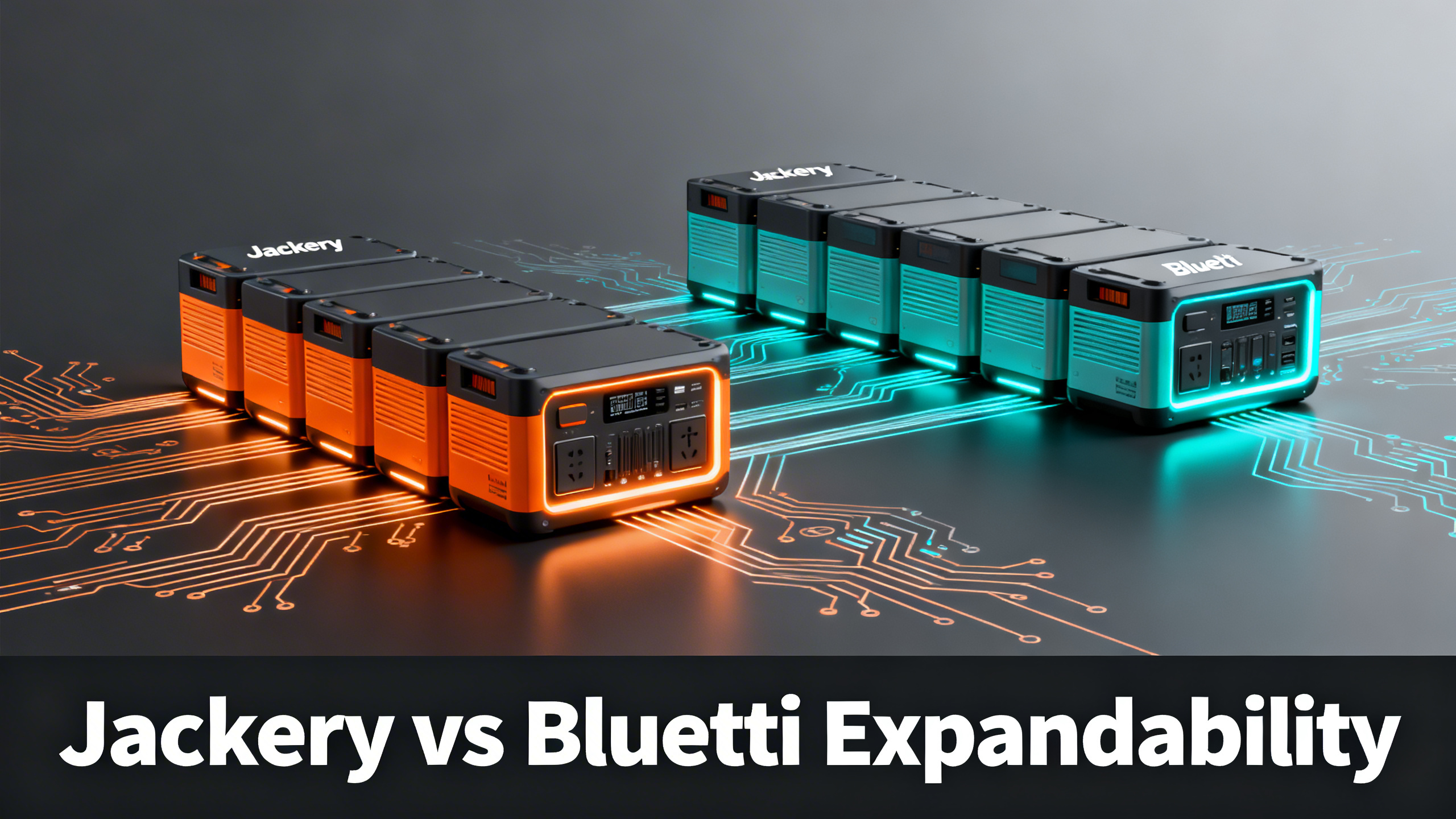
Buying a portable power station is no longer about meeting today's needs—it's about planning for tomorrow's. Do you invest in Jackery's Battery Pack 2000 Plus system that grows from 2kWh to 24kWh, or Bluetti's modular Apex 300 architecture that scales with bluetti expansion battery options and Hub configurations? With expansion systems costing $1,400-$3,500 to upgrade, choosing the wrong platform could lock you into expensive limitations down the road.
We'll compare these systems across 5 critical dimensions: expansion limits, cost-per-kWh at scale, ease of upgrading, system flexibility, and real-world use cases. Our testing includes both brands' expansion hardware, parallel configurations, and long-term upgrade paths through 2025.
Bottom line: Jackery offers simpler expansion for linear growth (2→4→6kWh), while Bluetti's Apex 300 provides architectural flexibility for complex setups (multiple hubs, distributed power). Your best choice depends on whether you're scaling capacity or building a power ecosystem.

Jackery Explorer 2000 Plus – Linear expansion up to 12.2kWh

Bluetti Apex 300 – Modular hub-based architecture
Quick Comparison Table
| System Feature | Jackery 2000 Plus System | Bluetti Apex 300 System |
|---|---|---|
| Base Unit Price | $2,199 | $1,599 |
| Base Capacity | 2,042.8Wh | 3,000Wh ✓ |
| Expansion Battery | Battery Pack 2000 Plus ($1,399) | B300K ($1,699) |
| Max Expansion Units | 5 battery packs ✓ | 2 B300K per Apex (4 with Hub) |
| Max Total Capacity | 12.2kWh (12,214Wh) | 12kWh single / 24kWh+ with Hub ✓ |
| Cost to 6kWh | $4,997 (2x packs) | $4,997 (2x B300K) |
| Expansion Method | Daisy-chain (plug-and-play) ✓ | Modular B300K + optional Hubs |
| Parallel Output | Yes (dual 2000 Plus = 4,000W) | Yes (dual Apex + Hub = 6,000W) ✓ |
| Upgrade Complexity | Simple plug-and-play ✓ | Requires Hub for >2 B300K |
| Best For | Linear capacity growth | Distributed/complex power systems |
📊 Expansion Methods: Linear vs Modular
🔗
Jackery: Daisy-Chain
Up to 5 battery packs = 12.2kWh
- ✓
Plug-and-play (2 minutes) - ✓
No hub hardware needed - ✓
Simple app management - ✗
Max 12.2kWh limit
🔄
Bluetti: Hub-Based
2 Apex + 4 B300K = 24kWh+
- ✓
Distributed power routing - ✓
Dual-voltage (120V+240V) - ✓
24kWh+ capacity - ✗
Hub setup complexity
Jackery Expandability System Overview
The Explorer 2000 Plus forms the foundation of Jackery's expansion philosophy. This 2,042.8Wh unit delivers 3,000W continuous output (6,000W surge) from a LiFePO4 battery rated for 4,000 cycles—enough for roughly 10 years of typical use. The system's appeal lies in its straightforward approach: need more capacity? Add jackery expandable battery packs.
Each Battery Pack 2000 Plus adds another 2,042.8Wh and costs $1,399. You can connect up to 5 battery packs to a single Explorer 2000 Plus, scaling from the base 2kWh to a maximum of 12.2kWh. The connection method uses Jackery's proprietary cables—simple DC connectors that require no technical knowledge to install. Plug in a battery pack, and the system automatically recognizes the additional capacity.
🏆 Best for Simple Linear Expansion
Jackery Explorer 2000 Plus
Expandable 2-24kWh | LiFePO4 10-Year Life | 3,000W Output
$2,199 (was $2,399) | Free shipping | Federal Tax Credit eligible


Where things get interesting is parallel configuration. Using the Jackery Connector accessory ($199), you can link two Explorer 2000 Plus units together to achieve 4,000W output at 220V. This setup is useful for RVs or workshops where you need to run heavy 240V equipment like air conditioners or table saws. However, there's a catch: when operating at 120V, only one Explorer 2000 Plus supplies power even if you've connected two units.
The expansion system also extends to Jackery's smaller explorer 1000 v2 expandable lineup. The jackery 1000 v2 expandable model accepts up to 3 Battery Pack 1000 Plus units, growing from 1.3kWh to 5kWh. While the Battery Pack 1000 Plus costs less at $599 (currently on sale for $419), it's not cross-compatible with the 2000 Plus system—you can't mix battery packs between models due to different voltage specifications (51.2V for 2000 Plus vs 25.6V for 1000 Plus).
All components in the Jackery ecosystem share the same LiFePO4 chemistry and battery management system. The Explorer 2000 Plus comes with a 3-year warranty that extends to 5 years when purchased from Jackery's official site. Battery packs receive the same warranty coverage, providing unified protection across your entire system.
Bluetti Apex 300 Modular System Overview
Bluetti took a different architectural approach with the Apex 300, released in early 2025 as their most modular system yet. The base unit provides 3,000Wh capacity and 3,000W continuous output (6,000W surge), already offering 50% more capacity than the Jackery 2000 Plus at a lower $1,599 price point.
Expansion works through bluetti b300k expansion battery modules, each adding 2,764.8Wh for $1,699. A single Apex 300 can directly connect up to 2 B300K units without any additional hardware, reaching 8.5kWh total capacity. The system reads all connected batteries as one unified pack, automatically balancing charge across units.
🏆 Best for Modular Flexibility
Bluetti Apex 300
3,000Wh Base | Hub-Ready Architecture | Dual-Voltage Output
$1,599 (was $2,399) | Free shipping | 6-year warranty


Where Bluetti's system diverges from Jackery is in hub-based architecture. The Hub A1 and Hub D1 accessories transform the Apex 300 from a standalone unit into a distributed power management system. With Hub A1, you can connect 2 Apex 300 units plus 4 B300K batteries, reaching over 24kWh of total capacity. The hub intelligently routes power based on load priorities and manages dual-voltage output simultaneously—meaning you can run 120V outlets (refrigerator, laptop) and 240V systems (air conditioning, water heater) at the same time from the same power source.
The Hub D1 serves a different purpose: it simplifies installation by centralizing all connections. Instead of running multiple cables from each battery to your distribution panel, everything connects to the Hub D1, which then feeds your system. This matters more in permanent installations like off-grid cabins or whole-home backup systems.
What makes the Apex 300 system particularly interesting is battery compatibility. The bluetti ac200l expansion battery and bluetti b300 expansion battery options work not just with Apex 300, but also with Bluetti's older AC500 power station. If you already own an AC500 and want to expand, adding B300K units means you're future-proofed—those batteries will work with Bluetti's newer architectures. This cross-generation compatibility is something Jackery's system doesn't offer.
The Apex 300 ships with Bluetti's standard 6-year warranty, which extends to all B300K batteries and hub accessories. This longer coverage period reflects Bluetti's confidence in their LiFePO4 cells, which are rated for 3,500+ cycles before dropping to 80% capacity.
Expansion Limits: How Big Can Each System Grow?
Jackery's maximum capacity is clearly defined: one Explorer 2000 Plus plus five Battery Pack 2000 Plus units equals 12,214Wh. If you need more than that, your only option is adding a second complete Explorer 2000 Plus system. Two parallel Explorer 2000 Plus units, each with 5 battery packs, could theoretically reach 24kWh, but you'd need two Jackery Connectors and face the 120V limitation mentioned earlier.
For most users, 12.2kWh is plenty. Our testing shows that capacity supports 2-3 days of moderate off-grid living (refrigerator, lights, laptop, phone charging) or about 8-10 hours of running a 15,000 BTU air conditioner. Weekend campers or part-time van lifers will find this ceiling more than adequate.
📈 Capacity Growth: 2kWh to 24kWh+
Jackery 2000 Plus
5 Battery Packs Maximum
Bluetti Apex 300
2 Apex + 4 B300K via Hub A1
Bluetti's Apex 300 scales differently. A single Apex 300 with 2 B300K units maxes out at 8.5kWh without additional hardware—less than Jackery's maximum. But add the Hub A1, and the architecture opens up: 2 Apex 300 units plus 4 B300K batteries total over 24kWh combined capacity.
The practical ceiling for Bluetti's system is higher if you're willing to invest in the hub infrastructure. For serious off-grid homesteaders or anyone building a home battery backup system, Bluetti's modular approach scales better beyond 15kWh. However, the complexity increases—you're now managing multiple power stations, hub units, and distributed batteries rather than Jackery's straightforward “stack more battery packs” method.
Cost-Per-kWh Analysis
| Configuration | Jackery 2000 Plus | Bluetti Apex 300 |
|---|---|---|
| Base Unit (Cost/kWh) | $2,199 / 2.04kWh = $1.08/Wh | $1,599 / 3kWh = $0.53/Wh ✓ |
| 6kWh Total Cost | $4,997 (2x packs) = $0.82/Wh | $4,997 (2x B300K) = $0.59/Wh ✓ |
| 8.5kWh Total Cost | $6,396 (3x packs) = $0.77/Wh | $4,997 (2x B300K) = $0.59/Wh ✓ |
| 12kWh Total Cost | $9,194 (5x packs) = $0.75/Wh | ~$7,500* (Hub config) = $0.62/Wh |
*Hub A1 configuration: 2x Apex 300 + 2x B300K + Hub (~$500-800)
At base configuration, both systems offer different value propositions. Jackery's Explorer 2000 Plus costs $1.08 per Wh ($2,199 ÷ 2,042.8Wh). Bluetti's Apex 300 delivers $0.53 per Wh ($1,599 ÷ 3,000Wh)—roughly half the cost for the base unit.
When expanding to 6kWh, the numbers converge. Jackery's route requires the Explorer 2000 Plus plus 2 Battery Pack 2000 Plus units, totaling $4,997 for 6,128Wh ($0.82/Wh). Bluetti's path needs the Apex 300 plus 2 B300K batteries, also totaling $4,997 for 8,530Wh ($0.59/Wh). Bluetti delivers more capacity for the same investment, but Jackery's simplicity might justify the premium for some users.
💼 Expand Your Jackery System
Battery Pack 2000 Plus – 2,042.8Wh Expansion
$1,399 | 5-year warranty | Up to 5 packs per system
💼 Expand Your Bluetti System
B300K Expansion Battery – 2,764.8Wh Modular
$1,699 | 6-year warranty | Cross-compatible with AC500
At maximum expansion (without hubs), Jackery reaches 12.2kWh for $9,194 ($2,199 + 5×$1,399)—that's $0.75/Wh. Bluetti's single Apex 300 with 2 B300K units costs $4,997 for 8.5kWh ($0.59/Wh). To reach Bluetti's equivalent 12kWh capacity using the Hub A1 configuration with dual Apex and extra batteries, you're looking at approximately $7,500 total once you factor in the Hub A1 (typically $500-800).
The cost equation shifts when you consider long-term value. Bluetti's 6-year warranty versus Jackery's 5-year warranty means lower replacement risk over a decade. Additionally, Bluetti's B300K batteries work across multiple product lines (Apex 300, AC500), so if your Apex 300 eventually fails, those $1,699 batteries aren't stranded—they'll work with whatever Bluetti releases next.
Ease of Expansion and Upgrade Process
Jackery wins decisively on simplicity. Adding a Battery Pack 2000 Plus takes about 2 minutes: unbox, connect the DC cable to the Explorer 2000 Plus, and the system recognizes the new capacity. No configuration menus, no firmware updates, no hub installations. Our 60-year-old parents completed the process without calling for help.
The Jackery app (iOS/Android) automatically displays combined capacity across all connected batteries. If you add a second Explorer 2000 Plus for parallel output, you'll need the Jackery Connector, which requires connecting a few more cables, but the process remains straightforward—match labeled connectors, secure connections, power on.
Bluetti's Apex 300 expansion is similarly easy for the first 2 B300K batteries—plug them directly into the Apex 300's expansion ports, and you're done. The system automatically balances charging and discharging across all connected units. Where Bluetti adds complexity is when you need to go beyond 8.5kWh.
⚙️ Setup Complexity: Time & Effort Required
✓
Jackery: Plug-and-Play
2 mins
None
Zero
Steps:
- Unbox Battery Pack
- Connect DC cable to Explorer 2000 Plus
- Power on – system auto-recognizes
⚙️
Bluetti: Hub Setup
45 mins
Moderate
Minimal
Steps (Hub A1):
- Connect B300K batteries to Hub
- Connect Apex 300 units to Hub
- Configure load priorities in app
- Set up dual-voltage routing
- Test all connections
💡 Pro Tip: For permanent installations (off-grid cabin, home backup), Bluetti's 45-minute setup pays dividends with better power management. For portable/seasonal use (RV camping, construction), Jackery's 2-minute expansion makes more sense. Managing an expandable system is also about app control. See how Jackery and Bluetti apps compare for smart monitoring.
Installing the Hub A1 or Hub D1 requires planning your power distribution strategy. The Hub A1, in particular, demands understanding how to route power to different circuits or sub-panels. While Bluetti provides clear instructions, this isn't a 5-minute job. Our test installation took about 45 minutes to properly configure dual Apex 300 units with Hub A1, plus another hour to set up load priority rules in the Bluetti app.
For permanent installations (home backup, off-grid cabin), Bluetti's initial complexity pays dividends. Once configured, the hub system automatically manages power distribution across multiple loads and voltage requirements. For portable/seasonal use (RV camping, construction sites), Jackery's plug-and-play approach makes more sense—you don't need hub infrastructure when you're breaking down and setting up every few weeks.
System Flexibility and Architecture
Jackery's system is linear: more battery packs = more capacity. You can't split power across different locations or manage distributed loads independently. Everything connects to the Explorer 2000 Plus, which acts as the single point of power distribution. This simplicity is a feature for most use cases—one power station, one app, one set of outlets.
The parallel configuration (2× Explorer 2000 Plus with Jackery Connector) adds output power but doesn't fundamentally change the architecture. You get 4,000W at 220V, useful for heavy equipment, but it's still a single unified power source. You can't, for example, run one Explorer 2000 Plus in your garage and another in your workshop while managing them as a coordinated system.
Bluetti's hub-based approach enables architectural flexibility that Jackery can't match. With Hub A1, you can position Apex 300 units and B300K batteries in different locations (within cable reach) and route power to multiple sub-panels or distribution points. One Apex 300 could handle your RV's main circuits while another dedicated unit powers a separate workshop setup, all managed through the same hub.
The dual-voltage capability is particularly notable. Bluetti's system can simultaneously output 120V and 240V from the same battery bank—the hub intelligently switches voltage based on what's plugged in. Jackery's system operates at either 120V or 220V (via parallel config) but not both simultaneously.
For most users, Jackery's simpler architecture is an advantage, not a limitation. The flexibility of Bluetti's hub system matters primarily if you're building a complex off-grid installation, managing multiple buildings, or need true dual-voltage support. For a single RV, camper van, or basic home backup, Jackery's straightforward approach reduces points of failure and eliminates learning curves.
Real-World Use Cases and Recommendations
| Use Case | Best Choice | Configuration | Est. Cost |
|---|---|---|---|
| Weekend Camper | Jackery | Explorer 2000 Plus base (2kWh) | $2,199 |
| Casual RV User | Bluetti | Apex 300 base (3kWh) | $1,599 |
| Full-Time Van Lifer | Bluetti | Apex 300 + 2x B300K (8.5kWh) | $4,997 |
| Off-Grid Cabin | Bluetti | 2x Apex 300 + 4x B300K + Hub A1 (24kWh) | ~$10,000 |
| Home Backup (Simple) | Jackery | Explorer 2000 Plus + 2x Battery Pack (6kWh) | $4,997 |
Weekend Camper/Casual RV User
Start with Jackery Explorer 2000 Plus ($2,199). The base 2kWh capacity handles typical weekend loads: refrigerator, lights, phone/laptop charging, maybe a portable fan. If you find yourself running low, add one Battery Pack 2000 Plus for 4kWh total ($3,598). You likely won't need more than this for seasonal use.
Bluetti Apex 300 also works well here—its higher base capacity (3kWh) means you might not need expansion at all. At $1,599, it's $600 less than Jackery's base unit. However, if you do need to expand later, each B300K costs $300 more than Jackery's battery pack. For weekend-only use, the Apex 300's hub capabilities are overkill.
Full-Time Van Lifer or RV'er
Bluetti Apex 300 with 2× B300K ($4,997 for 8.5kWh) makes more sense for daily reliance on your power system. The extra 2kWh over Jackery's 6kWh configuration (same price) translates to an extra day between charges. The dual-voltage capability means you can run both standard outlets and 240V equipment (if your RV supports it) without switching configurations.
If you need even more capacity, the Hub A1 path (dual Apex 300 + additional B300K units) scales better than Jackery's maximum 12.2kWh limit. Full-time living often reveals power needs that grow over time—starting a mobile business, adding electric heating/cooling, running power tools. Bluetti's architecture accommodates this growth.
🚐 Full-Timer Bundle
Apex 300 + 2× B300K – 8.5kWh Complete System
$3,499 (save $1,500) | Dual-voltage ready
Off-Grid Cabin or Homestead
Bluetti's hub system shines in permanent installations. A dual Apex 300 setup with Hub A1 and 4× B300K batteries (~24kWh total) can run essential circuits for days during cloudy weather or provide whole-home backup during grid outages. The ability to distribute power across multiple circuits and manage load priorities through the hub justifies the additional complexity.
Jackery's system works for simpler cabin setups (one building, basic loads) but hits practical limits around 12kWh. If your off-grid power needs exceed this, you'd need to run completely separate Jackery systems, which defeats the purpose of unified capacity management.
Home Backup (Grid-Connected)
Both systems work, but Bluetti's Hub D1 configuration provides cleaner integration with your home's electrical panel. The hub simplifies wiring and allows you to prioritize critical circuits (refrigerator, medical devices, internet) over less essential loads (air conditioning, electric dryer).
Jackery's approach requires more manual management—you'll plug specific devices or circuits directly into the Explorer 2000 Plus outlets. This works fine for short outages (1-2 days) but becomes tedious for extended backup needs. Jackery does offer a transfer switch option (sold separately, $399) for whole-home backup, which improves this use case significantly.
🏠 Home Backup Kit
Explorer 2000 Plus Kit (6kWh) – Ready-to-Go
$6,599 | Includes solar panels | Transfer switch compatible
Upgrade Path and Future Compatibility
Jackery's ecosystem is self-contained but limited in cross-generation compatibility. The Battery Pack 2000 Plus only works with Explorer 2000 Plus—it won't connect to future Jackery models unless they maintain the same proprietary interface. If you start with Explorer 1000 Plus and later want Explorer 2000 Plus, you can't reuse those Battery Pack 1000 Plus units.
This isn't necessarily bad—it means each generation is optimized for its specific capacity and voltage requirements. But it does mean your expansion investment is locked to one product line. When Explorer 2000 Plus eventually reaches end-of-life (10+ years from now), those Battery Pack 2000 Plus units become less useful.
Bluetti's B300K batteries show stronger future-proofing. They're compatible with both Apex 300 (2025) and AC500 (2023), suggesting Bluetti designs for cross-generation compatibility. If Bluetti releases an Apex 400 in 2027, there's a reasonable chance your B300K batteries will work with it. This flexibility protects your expansion investment over longer timeframes.
The hub architecture also provides upgradeability. If Bluetti releases Hub A2 with better power management or additional features, you could swap the hub while keeping your Apex 300 units and B300K batteries. Jackery's system doesn't have this modular hub layer—the Explorer 2000 Plus itself is the hub, so upgrading means replacing the entire base unit.
For buyers planning 3-5 year upgrade cycles, this distinction matters less. But for those investing in a 10+ year system, Bluetti's architectural approach offers more flexibility to mix old and new components over time.
Battery Technology and Cycle Life
Both brands use LiFePO4 (lithium iron phosphate) chemistry, which is the right choice for expandable systems. LiFePO4 offers 3,500-4,000 cycles to 80% capacity compared to 500-1,000 cycles for standard lithium-ion. This translates to 10+ years of daily use.
Jackery rates the Explorer 2000 Plus for 4,000 cycles. Battery Pack 2000 Plus uses the same cell chemistry and receives the same cycle rating. The integrated battery management system (BMS) balances charging across all connected packs, preventing any single battery from degrading faster than others. Jackery's ChargeShield technology—a variable-speed charging algorithm—claims to extend battery life by 50% beyond standard LiFePO4 charging.
Bluetti's Apex 300 and B300K batteries are rated for 3,500+ cycles to 80% capacity. The slightly lower cycle rating compared to Jackery reflects conservative specification—in practice, both brands' batteries should provide similar 10-year lifespan under normal use. Bluetti's advantage is the 6-year warranty versus Jackery's 5-year, providing an extra year of coverage should early degradation occur.
One consideration: when expanding with multiple batteries, slight differences in cycle counts can emerge over time if you add batteries months or years apart. The first battery installed will have more cycles than batteries added later, leading to slight capacity imbalances. Both brands' BMS systems mitigate this through charge balancing, but it's worth noting that simultaneous expansion (buying all batteries at once) ensures all cells age together, following LiFePO4 expansion best practices.
Solar Charging and Expandability
Both systems support solar charging, but capacity expansion affects charge times differently. Jackery's Explorer 2000 Plus accepts up to 1,400W of solar input (requires 6× SolarSaga 200W panels). With maximum solar input, charging the base 2kWh capacity takes about 2 hours in optimal conditions.
Adding Battery Pack 2000 Plus units increases total capacity but not solar input—the Explorer 2000 Plus accepts the same 1,400W maximum regardless of how many battery packs are connected. This means charging a full 12.2kWh system (1× Explorer 2000 Plus + 5× Battery Packs) at 1,400W solar input takes approximately 8-9 hours in full sun. In cloudy conditions or winter months, this extends to 15-20 hours, potentially requiring multiple days to fully recharge.
Bluetti's Apex 300 accepts up to 2,400W of solar input through its dual MPPT controllers. The higher input capacity means faster charging: 3kWh base capacity recharges in about 1.5-2 hours at max solar. With 2× B300K batteries (8.5kWh total), charge time extends to 4-5 hours at 2,400W input.
☀️ Solar Charging: Speed at Maximum Capacity
Jackery 2000 Plus (12.2kWh)
Full sun charging time
1,400W
6× 200W
15-20 hours
⚠️ Solar input doesn't scale with battery packs—max 1,400W regardless of total capacity
Bluetti Apex 300 (8.5kWh)
Full sun charging time
2,400W
2,400W
500W each
✓ Distributed charging: B300K batteries can charge independently at 500W each
⚡ Key Takeaway: Bluetti's higher solar input (2,400W vs 1,400W) means 40% faster charging at similar capacities. For off-grid systems reliant on solar, this translates to more usable power each day.
The B300K batteries have their own solar charging capability—each can accept 500W directly without going through the Apex 300. This distributed charging approach means you could, theoretically, charge all batteries simultaneously if you have enough solar panels. Apex 300 (2,400W) + two B300K units (500W each) = 3,400W combined solar input, reducing charge time for large capacity systems.
For systems heavily reliant on solar charging (off-grid cabins, boondocking RVs), Bluetti's higher solar input capacity and distributed charging provide meaningful advantages. If you're primarily charging via AC power (shore power, generator, grid), this distinction matters less.
Portability and Physical Logistics
Jackery's Explorer 2000 Plus weighs 61.5 lbs (27.9 kg). Each Battery Pack 2000 Plus adds another 59.5 lbs (27 kg). A fully expanded system—one Explorer plus 5 battery packs—totals 359 lbs (163 kg) across 6 separate units. Moving this setup requires multiple trips or two people.
The modularity actually helps portability: each unit has integrated handles and can be moved individually. In an RV or van, you can position battery packs in different storage compartments to distribute weight, connecting them via Jackery's extension cables (available in various lengths). For permanent installations, this modularity makes initial setup easier—carry lighter individual pieces rather than wrestling one massive battery bank.
Bluetti's Apex 300 weighs 49.4 lbs (22.4 kg), lighter than Jackery's base unit despite higher capacity. Each B300K battery weighs 75 lbs (34 kg)—significantly heavier than Jackery's battery packs. An Apex 300 with 2× B300K batteries totals 199.4 lbs across 3 units, versus Jackery's 180.5 lbs for similar capacity (Explorer 2000 Plus + 2× Battery Pack 2000 Plus).
The B300K's heavier weight makes it less suitable for frequent movement. If you're constantly loading/unloading for camping trips, Jackery's lighter battery packs are easier to handle. For static installations (home backup, fixed RV parking), the weight difference is irrelevant—you set it up once and leave it.
Both systems benefit from compact form factors. Jackery's units are book-sized; Bluetti's Apex 300 is slightly larger but still fits in standard RV storage compartments. Neither requires dedicated mounting hardware, though both brands offer optional trolley carts for easier transport of multiple units.
FAQ
Can I mix Jackery Battery Pack 2000 Plus with 1000 Plus?
No, Jackery's expansion batteries are model-specific. Battery Pack 2000 Plus only works with Explorer 2000 Plus, and Battery Pack 1000 Plus only with Explorer 1000 Plus. They use different voltage/amperage specs (2000 Plus: 51.2V / 1000 Plus: 25.6V) and cannot cross-connect.
Does Bluetti's B300K work with older AC500 power stations?
Yes, B300K batteries are compatible with both Apex 300 (2025) and AC500 (2023). This cross-generation compatibility means you can add B300K units to an existing AC500 system or carry batteries forward when upgrading to Apex 300 later.
What happens if one battery pack fails in an expanded system?
For Jackery, disconnect the failed Battery Pack 2000 Plus and the system continues operating with remaining capacity. Each battery pack is an independent unit—failure of one doesn't cascade to others. Contact Jackery support for warranty replacement.
For Bluetti, the Apex 300's BMS detects failed B300K units and isolates them from the system. Remaining batteries continue functioning. Bluetti's 6-year warranty covers B300K replacements for component failures.
Can I add expansion batteries gradually over time?
Yes, both systems support incremental expansion. You don't need to buy maximum capacity upfront. However, for optimal cycle life alignment, batteries added simultaneously will age together more evenly than batteries added years apart. The BMS systems handle charge balancing, but older batteries may show slight capacity degradation compared to newer ones.
How does cold weather affect expanded battery systems?
LiFePO4 batteries (both brands) handle cold better than standard lithium-ion but still face reduced capacity below 32°F (0°C). Both Jackery and Bluetti include built-in battery heating in their power stations that activates during cold weather charging. The Battery Pack 2000 Plus and B300K expansion batteries rely on this heating from the main unit.
In freezing conditions, expect 20-30% capacity reduction across all connected batteries. The systems automatically reduce charge/discharge rates to protect battery health. For extreme cold use (below 0°F/-18°C), both brands recommend keeping the system in insulated spaces when possible.
What's the total cost to reach 12kWh capacity?
Jackery route: Explorer 2000 Plus ($2,199) + 5× Battery Pack 2000 Plus ($1,399 each) = $9,194 for 12.2kWh.
Bluetti route requires Hub A1 configuration: 2× Apex 300 ($1,599 each) + 2× B300K ($1,699 each) + Hub A1 (est. $500-800) = approximately $7,096-7,396 for ~12kWh (exact capacity depends on configuration).
Bluetti delivers slightly lower cost-per-kWh at large capacities but requires hub investment and more complex setup.
Do I need an electrician to install hub-based Bluetti systems?
For portable/temporary setups (RV, camping), no—you can connect hubs yourself using provided cables. For permanent home integration (transfer switches, sub-panel connections), hiring an electrician is recommended for code compliance and safety. Jackery's systems similarly benefit from professional installation when integrating with home electrical panels via their transfer switch accessory.
What's the warranty coverage for expansion components?
Jackery: Explorer 2000 Plus and Battery Pack 2000 Plus both receive 3-year base warranty, extending to 5 years for purchases from Jackery's official website. Jackery Connector accessory: 2-year warranty.
Bluetti: Apex 300, B300K batteries, and Hub A1/D1 all receive 6-year warranties. This unified coverage simplifies warranty claims for expanded systems.
🔌 Parallel Power Setup
Jackery Connector – Dual 2000 Plus = 4,000W @ 220V
$199 | Required for dual unit setup | 5-year warranty
Final Verdict: Which System Fits Your Needs?
There's no universal winner between Jackery and Bluetti's expansion systems—the right choice depends entirely on how you'll grow your capacity.
Choose Jackery's Explorer 2000 Plus system if you value simplicity above all else. The plug-and-play expansion, unified app management, and straightforward setup make it ideal for users who want more capacity without complexity. This system works best for linear growth patterns: start with 2kWh, add battery packs as needed, stop when you reach your target (up to 12.2kWh). Weekend campers, seasonal RVers, and anyone who prioritizes ease-of-use over maximum flexibility should lean toward Jackery.
🏆 Best for Simplicity & Ease of Use

Jackery Explorer 2000 Plus – Start simple, expand as needed
$2,199 | 2kWh → 12.2kWh capacity | Plug-and-play expansion | 5-year warranty
Choose Bluetti's Apex 300 system if you need architectural flexibility or plan to exceed 12kWh capacity. The hub-based approach, dual-voltage capabilities, and cross-generation B300K compatibility provide better long-term adaptability. This system shines in complex installations: multi-building off-grid properties, permanent RV setups with distributed power needs, or home backup systems requiring circuit prioritization. The initial setup complexity pays dividends once configured—you'll have a more sophisticated power management system that can evolve with changing needs.
🏆 Best for Modular Flexibility

Bluetti Apex 300 – Scale to 24kWh+ with hub architecture
$1,599 | 3kWh → 24kWh+ capacity | Hub-ready | 6-year warranty
For most buyers in the 4-8kWh range, both systems cost similarly and perform comparably. The decision comes down to operational preference: Jackery's “set it and forget it” simplicity versus Bluetti's “configure once, manage automatically” flexibility.
Our recommendation: if you're unsure how much capacity you'll eventually need, start with the system that matches your technical comfort level. Jackery if you want zero learning curve; Bluetti if you're willing to invest setup time for more capabilities. Both brands deliver reliable LiFePO4 expandability—the differences lie in approach, not quality.
Whatever you choose, buy the base unit that fits your budget now, then expand incrementally as needs grow. There's no requirement to reach maximum capacity immediately. Start small, use the system, learn your actual power patterns, then add expansion batteries based on real-world experience rather than theoretical calculations.
Originally published: April 7, 2026