
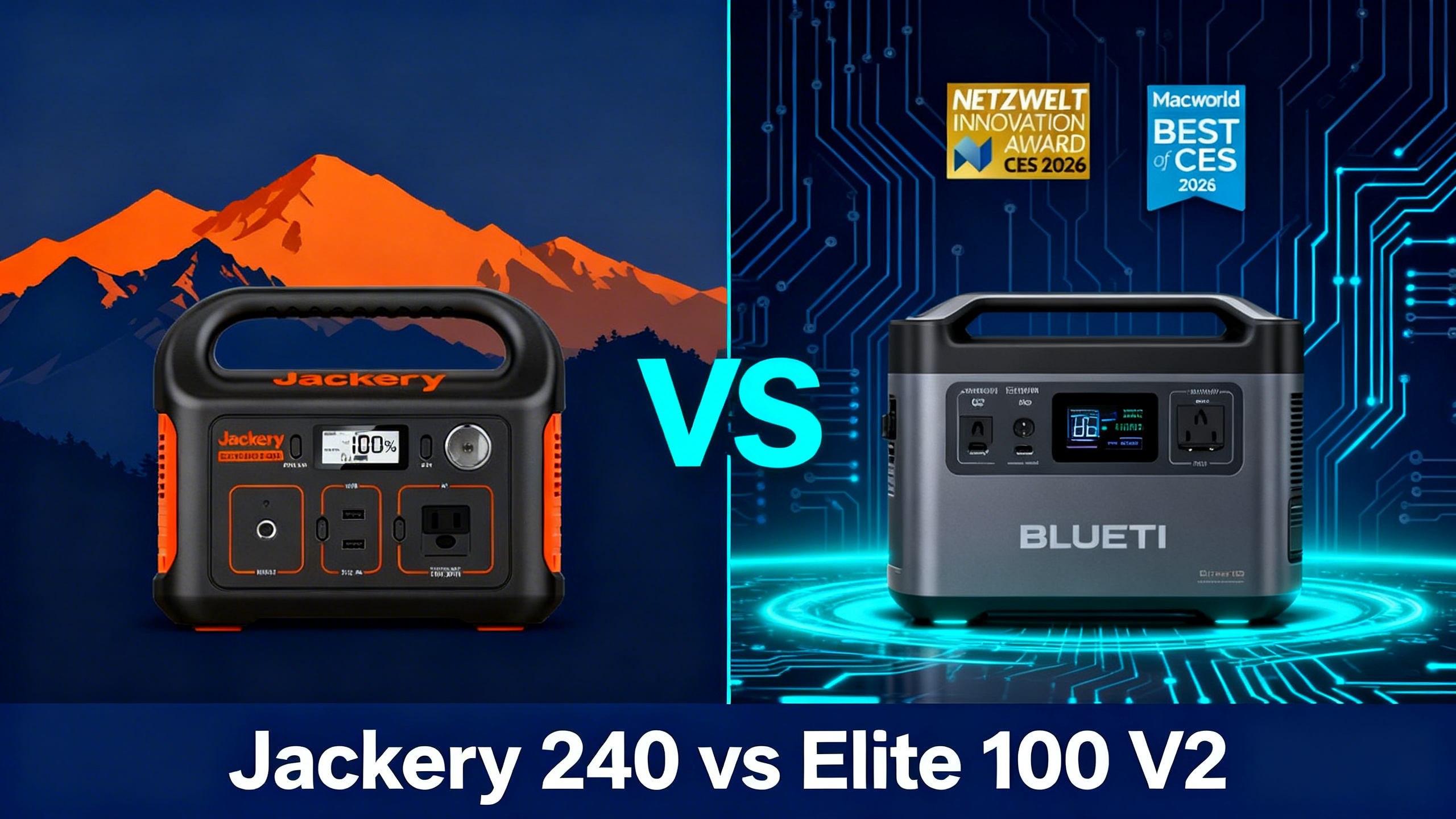


Bluetti Elite 100 V2 100Wh • 130W • $429
🏆 Best Value: Jackery Explorer 240
Why we recommend it: Maximum capacity per dollar ($0.91/Wh) with proven 5-year track record. Perfect for weekend camping and emergency backup.
$219 • Free shipping • Limited stock availability
⚡ Best Tech: Bluetti Elite 100 V2
Why we recommend it: LiFePO4 6,000-cycle battery, USB-C PD 100W, ultra-lightweight (5 lbs). 10+ year lifespan for daily users.
$429 • Free shipping • In stock now
Quick Comparison Table
At first glance, these stations reveal their different priorities. The Jackery doubles the capacity but also weighs nearly twice as much. The Bluetti costs double but includes technology that should outlast the Jackery by years. Here's how the specs stack up:| Specification | Jackery Explorer 240 | Bluetti Elite 100 V2 |
|---|---|---|
| Capacity | 240Wh | 100Wh |
| AC Output | 200W (400W Surge) | 130W |
| Weight | 8.6 lbs (3.9 kg) | ~5 lbs (2.3 kg) est. |
| Battery Type | Lithium-ion | LiFePO₄ (6,000+ cycles) |
| Recharge Time (AC) | 5.5 hours | ~1.5 hours (est.) |
| USB-C Output | ❌ No | ✅ Yes (PD 100W) |
| Price | $219 | $429 |
| $/Wh Value | $0.91/Wh | $4.29/Wh |
Capacity & Runtime: The Core Trade-Off
Here's the fundamental question: do you need 240Wh or can you work with 100Wh? That 140Wh difference isn't abstract. It's the gap between powering your laptop for an afternoon versus just a couple hours.

📊 Real-World Runtime Scenarios
🏕️ Overnight Camping
- 📱 Phone charging 2x: 20Wh
- 💡 LED lantern 4h: 8Wh
- 📷 Camera battery: 10Wh
- Total: ~38Wh
⛺ Weekend Camping
- 📱 Phone charging 4x: 40Wh
- 💡 LED lantern 8h: 16Wh
- 💻 Laptop work 3h: 90Wh
- 📷 Camera 2x: 20Wh
- Total: ~166Wh
🏠 Emergency Backup
- 🌐 Router + modem 4h: 40Wh
- 💡 LED lights 6h: 18Wh
- 📱 Phone charging 3x: 30Wh
- Total: ~88Wh
💡 Pro Tip: The Bluetti's 1.5-hour fast recharge lets you top up during lunch breaks, compensating for smaller capacity with more frequent charging cycles.
Output Power: Can They Run Your Gear?
Capacity means nothing if the station can't actually power your devices. This is where output wattage matters. The Jackery Explorer 240 provides 200W continuous AC output with 400W surge capability. That's enough for most camping electronics: laptops (50-100W), CPAP machines (40-60W), small fans (30-50W), and charging hubs. You can even run a 150W mini-blender briefly. The 400W surge handles startup spikes from devices like mini-fridges that draw extra power when compressors kick in. The Bluetti Elite 100 V2 tops out at 130W continuous AC output. No surge rating is specified, which typically means minimal surge tolerance. This limits you to lower-power devices: phones, tablets, small laptops (under 100W), cameras, LED lights, and smaller fans. That 100W+ gaming laptop? Borderline. A 150W mini-fridge? Probably won't start.🔌 Port Configuration Showdown
Jackery Explorer 240
Bluetti Elite 100 V2
🎯 Key Takeaway: The Bluetti's USB-C PD 100W port charges modern laptops, tablets, and phones at full speed directly from DC—no inverter losses. The Jackery's lack of USB-C in 2025 means wasting power through AC adapters or relying on slow USB-A charging.
💪 Need Higher Wattage?
The Jackery 240's 200W output and 400W surge handles mini-fridges, CPAP machines, and power-hungry laptops that the Bluetti can't manage.
⚡ Want USB-C Fast Charging?
The Bluetti's 100W USB-C PD charges MacBooks, iPads, and phones at maximum speed without needing bulky AC adapters.
Portability & Weight: Who Wins the Ultralight Battle?
Both stations claim “ultra-portable” status, but they define it differently. The Jackery Explorer 240 weighs 8.6 pounds and measures roughly 9 x 5 x 8 inches. It's got a solid handle and squared-off design that fits well in car trunks or storage compartments. At 8.6 pounds, it's manageable for short carries but starts feeling heavy on longer hikes or when packed with other gear. The build feels tank-like and ready for abuse. The Bluetti Elite 100 V2 reportedly weighs around 5 pounds based on the brief specs, though exact measurements aren't widely available yet as a newer model. That 3.6-pound difference between 8.6 and 5 pounds matters enormously for backpackers, cyclists, or anyone carrying gear long distances. It's the difference between “portable” and “actually ultralight.”⚖️ Weight Winner by Use Case
🥾 Backpacking/Hiking
Every ounce matters on the trail. 3.6 lbs saved = room for more food or gear.
🚗 Car Camping
Weight doesn't matter in vehicles. Extra 240Wh capacity becomes more valuable.
✈️ Air Travel
Jackery 240Wh exceeds 100Wh FAA limit. Bluetti at 100Wh is technically legal.
🏠 Emergency Kit
Weight doesn't matter for stationary storage. Extra capacity = better backup.
🎒 Daily Commute
At 5 lbs, actually portable for daily carry. 8.6 lbs destroys your shoulder.
🚐 Van Life/RV
Both tuck away easily. Weight minimal compared to larger power stations.
Charging Speed: Time is Money
Dead batteries are worthless. How fast can you get back to full power? The Jackery Explorer 240 recharges via AC wall outlet in 5.5 hours. That's a reasonable overnight charge but feels sluggish if you need power quickly. It also charges via 12V car adapter (slower, about 7-8 hours) or solar panels with the right connector. Solar charging depends on panel wattage, but expect 4-6 hours in ideal conditions with a 100W panel. The Bluetti Elite 100 V2 claims approximately 1.5-hour AC charging based on the brief. That's significantly faster—under two hours from empty to full. This quick-charge capability matters enormously for short recharge windows during travel or when time is limited. The 12V car charging option exists, though speeds aren't specified. Solar input is supported, likely hitting full charge in 2-3 hours with adequate panel wattage.⚡ Charging Speed Face-Off
Jackery Explorer 240
Bluetti Elite 100 V2
The Bluetti's rapid 1.5-hour recharge means you're less likely stuck without power. Top up during lunch breaks or between uses, effectively compensating for smaller capacity through more frequent charging cycles.
Build Quality & Durability: Long-Term Reliability
These stations need to survive drops, temperature swings, and years of use. How do they hold up? The Jackery Explorer 240 sports a straightforward plastic housing with rubberized corners for impact protection. It's been on the market since 2019, which means plenty of long-term user data exists. The build feels solid but basic. The cooling system relies on passive heat dissipation—no fans, which means silent operation but potential overheating in extreme conditions. The display is simple and functional: a basic LCD showing battery level and output status. The lithium-ion battery inside should deliver around 500 charge cycles before noticeable degradation. That translates to roughly 2-3 years of regular use (weekly camping trips) or 5+ years of occasional use. The Pure Sine Wave inverter is reliable and safe for sensitive electronics. The Bluetti Elite 100 V2 represents newer engineering. The exterior details aren't fully documented yet as a recent release, but Bluetti's track record suggests premium materials and thoughtful design. The LiFePO4 battery chemistry is the standout feature for longevity. Rated for 6,000+ cycles, this battery could last a decade or more with regular use.🔋 Battery Lifespan Showdown
Jackery Explorer 240
- Weekly use: ~10 years
- Daily use: ~1.5-2 years
- Monthly use: 40+ years
Bluetti Elite 100 V2
- Weekly use: 100+ years 🚀
- Daily use: 15-20 years 🎯
- Monthly use: 500+ years
LiFePO4 batteries handle temperature extremes better, are safer (less fire risk), and maintain capacity across wider temperature ranges. This matters for stations stored in vehicles or used in hot/cold environments.
Features & Technology: Modern vs. Proven
Strip away the battery specs and what features actually improve the user experience?

- Pure Sine Wave AC inverter (safe for sensitive electronics)
- LCD display with battery level indicator
- Built-in LED flashlight with SOS mode
- BMS (Battery Management System) with overload protection
- Pass-through charging (use while recharging)
- Multiple output ports: AC, DC, USB-A
- LiFePO4 battery technology (6,000+ cycle lifespan)
- USB-C PD 100W output (fast-charging for modern devices)
- Faster AC recharge (1.5 hours estimated)
- Advanced BMS with 12+ protection layers
- Likely includes smart app connectivity (standard on Bluetti v2 models)
- Compact, lightweight design optimized for portability
Price & Value: The $210 Question
Is the Bluetti worth double the Jackery's price? This is where the comparison gets philosophical. Jackery Explorer 240: $219- $0.91 per watt-hour
- 500-cycle lifespan
- Proven reliability (5 years on market)
- No USB-C
- $4.29 per watt-hour
- 6,000-cycle lifespan
- Newer technology (limited field data)
- Modern USB-C PD
💰 10-Year Total Cost of Ownership Analysis
Jackery Explorer 240
Bluetti Elite 100 V2
The Bluetti could cost 51% less over a decade ($447 saved) because you're not replacing it every few years. The LiFePO4 battery outlasts multiple lithium-ion replacements.
⚠️ Important Note: This assumes regular use where you actually hit 500+ cycles. For occasional users (monthly camping), the Jackery's battery outlasts your interest in camping. The TCO advantage only matters for weekly or daily users.
- Occasional use (monthly or less): Jackery wins. Lower upfront cost, and you'll never hit 500 cycles.
- Regular use (weekly): Bluetti wins. You'll blow through 500 cycles in 10 years and appreciate not replacing the unit.
- Heavy use (daily/near-daily): Bluetti wins decisively. The 6,000-cycle battery pays for itself through longevity.
Use Cases: Who Should Buy Which?
Let's get specific about real-world scenarios.🎯 Decision Tree: Which Station Wins Your Use Case?
🏕️ Weekend Camping (2-3 days)
Need 240Wh capacity for lights, phones, cameras, and mini-fridge for two nights. 100Wh runs out too quickly.
🥾 Ultralight Backpacking
5 lbs vs 8.6 lbs saves significant pack weight. For overnight trips charging phones/headlamps, 100Wh is plenty.
🚐 Van Life/Mobile Office
Bluetti's 1.5-hour fast recharge means topping up during lunch stops. USB-C PD powers laptops efficiently with solar panels.
🏠 Emergency Home Backup
Extra 140Wh means running router, modem, and LED lights significantly longer. Sits unused for months, so cycle longevity doesn't apply.
✈️ Air Travel/Flight-Friendly
Bluetti at 100Wh sits right at FAA limit, technically compliant for carry-on. Jackery at 240Wh exceeds limit and may get flagged.
🎒 Daily Use (office, commuting)
Lighter weight, USB-C PD, and fast recharge ideal for daily carry. 6,000-cycle battery justifies price with daily use.
💰 Budget-Conscious Buyers
Jackery costs half as much. If $210 is meaningful in your budget, Jackery delivers more energy storage per dollar.
🔬 Tech Enthusiasts
LiFePO4 battery tech, USB-C PD, faster charging, and likely app connectivity. Value cutting-edge features.
Important Considerations Before Buying
Before you click purchase, here are critical factors often overlooked in spec comparisons.⚠️ Jackery Explorer 240 Stock Availability
The brief notes the Jackery 240 currently shows “N” stock availability. This matters. If it's discontinued or out of stock frequently, consider the Jackery Explorer 240 v2 instead. The v2 adds USB-C and updates the design while maintaining similar capacity and price point around $279. That USB-C addition alone might be worth the $60 upgrade over hunting for original 240 stock.
🆕 Bluetti Elite 100 V2 is Brand New
As a recently launched model, user reviews are limited. You're betting on Bluetti's engineering and the inherent advantages of LiFePO4 chemistry rather than years of verified field performance. Early adopters always carry some risk of undiscovered issues or firmware bugs. The upside is you're getting the latest technology.
The Verdict: Different Winners for Different Users
There's no universal winner in this comparison because these stations target fundamentally different buyers. Choose the Jackery Explorer 240 if you:- Need maximum capacity for the lowest price ($0.91/Wh is excellent value)
- Plan occasional use (monthly or less) where 500 cycles is sufficient
- Want proven reliability with five years of user feedback
- Need to power higher-wattage devices (up to 200W continuous)
- Are okay with slower charging and no USB-C
- Don't mind the extra weight (8.6 lbs) for car camping or home backup
- Value modern features (USB-C PD 100W) and faster 1.5-hour charging
- Plan regular or daily use where 6,000 cycles justify the premium price
- Prioritize weight savings (5 lbs vs 8.6 lbs) for backpacking or air travel
- Want the longest possible battery lifespan (10+ years with LiFePO4)
- Can work within 100Wh capacity through disciplined power management
- Are willing to pay $210 more for cutting-edge technology
🏆 Best Capacity Per Dollar
Jackery Explorer 240: 240Wh capacity, 200W output, proven 5-year track record. Perfect for weekend camping and emergency backup at just $0.91/Wh.
$219 • 240Wh • Free shipping
⚡ Best Tech & Longevity
Bluetti Elite 100 V2: LiFePO4 6,000-cycle battery, USB-C PD 100W, 1.5-hour fast charge, ultra-lightweight at 5 lbs. 10+ year lifespan.
$429 • 100Wh • In stock now
Frequently Asked Questions
Can the Jackery 240 and Bluetti Elite 100 V2 charge at the same time they're powering devices?
Yes, both stations support pass-through charging. You can plug devices into the outputs while the station itself is recharging via AC, car, or solar. However, this typically slows down the recharge rate and may generate extra heat. For fastest recharge, power off outputs first.
How many times can I charge my phone with each station?
Most modern smartphones have 12-15Wh batteries. Factoring in 85% efficiency, the Jackery 240 can charge a phone roughly 14-16 times. The Bluetti Elite 100 V2 manages about 6-7 full phone charges. These are approximations—actual results vary by phone model and charging method.
Will either station power a CPAP machine overnight?
The Jackery 240 can run a typical CPAP (40-50W) for 4-5 hours, covering most sleep sessions. The Bluetti Elite 100 V2 at 100Wh provides only 2-3 hours of CPAP runtime, which isn't sufficient for a full night. For CPAP users, the Jackery is the better choice or consider larger capacity stations.
Can I take these on airplanes?
The Bluetti Elite 100 V2 at 100Wh sits right at the FAA limit for carry-on lithium batteries, making it technically compliant. The Jackery 240 at 240Wh exceeds the 100Wh limit and officially requires airline approval, though enforcement varies. For hassle-free air travel, the Bluetti is safer.
How long do the batteries actually last before needing replacement?
The Jackery's lithium-ion battery is rated for 500 cycles at 80% capacity retention. With weekly use, that's roughly 10 years. With daily use, about 1.5-2 years. The Bluetti's LiFePO4 battery lasts 6,000+ cycles, translating to 10+ years even with daily use. Neither battery is user-replaceable, so this determines the unit's total lifespan.
What's the difference between the Jackery 240 and 240 v2?
The 240 v2 (upgraded version) adds USB-C output, updates the design slightly, and may improve charging speeds. It costs around $279 versus $219 for the original. If the original 240 is out of stock or you value USB-C, the v2 is worth considering. The core capacity and output remain similar.
Do I need to buy brand-specific solar panels?
No, but compatibility matters. The Jackery uses 8mm barrel connectors—you can use their SolarSaga panels or third-party panels with appropriate adapters. The Bluetti likely uses standard MC4 connectors found on most solar panels. Check connector types and voltage/amperage compatibility before purchasing panels.
Can these stations power a mini-fridge?
The Jackery 240 with its 200W output and 400W surge can start and run most mini-fridges (50-80W running, 150-200W startup surge). Runtime depends on fridge efficiency but expect 3-5 hours. The Bluetti Elite 100 V2 at 130W may struggle with startup surges from compressor fridges and offers limited runtime even if it starts. For fridge use, the Jackery is more practical.
What happens when the battery dies after all the cycles are used up?
Neither station allows easy battery replacement. When the battery degrades below usable levels (typically after rated cycles), you're essentially buying a new unit. The Jackery's 500-cycle limit means replacement in 2-10 years depending on use frequency. The Bluetti's 6,000-cycle battery pushes that replacement timeline to 10+ years, even with heavy use.
Affiliate Disclosure: This article contains affiliate links. If you purchase through these links, we may earn a small commission at no additional cost to you. This helps support our in-depth testing and reviews. We only recommend products we've researched thoroughly and believe offer genuine value to our readers.
Originally published: April 7, 2026