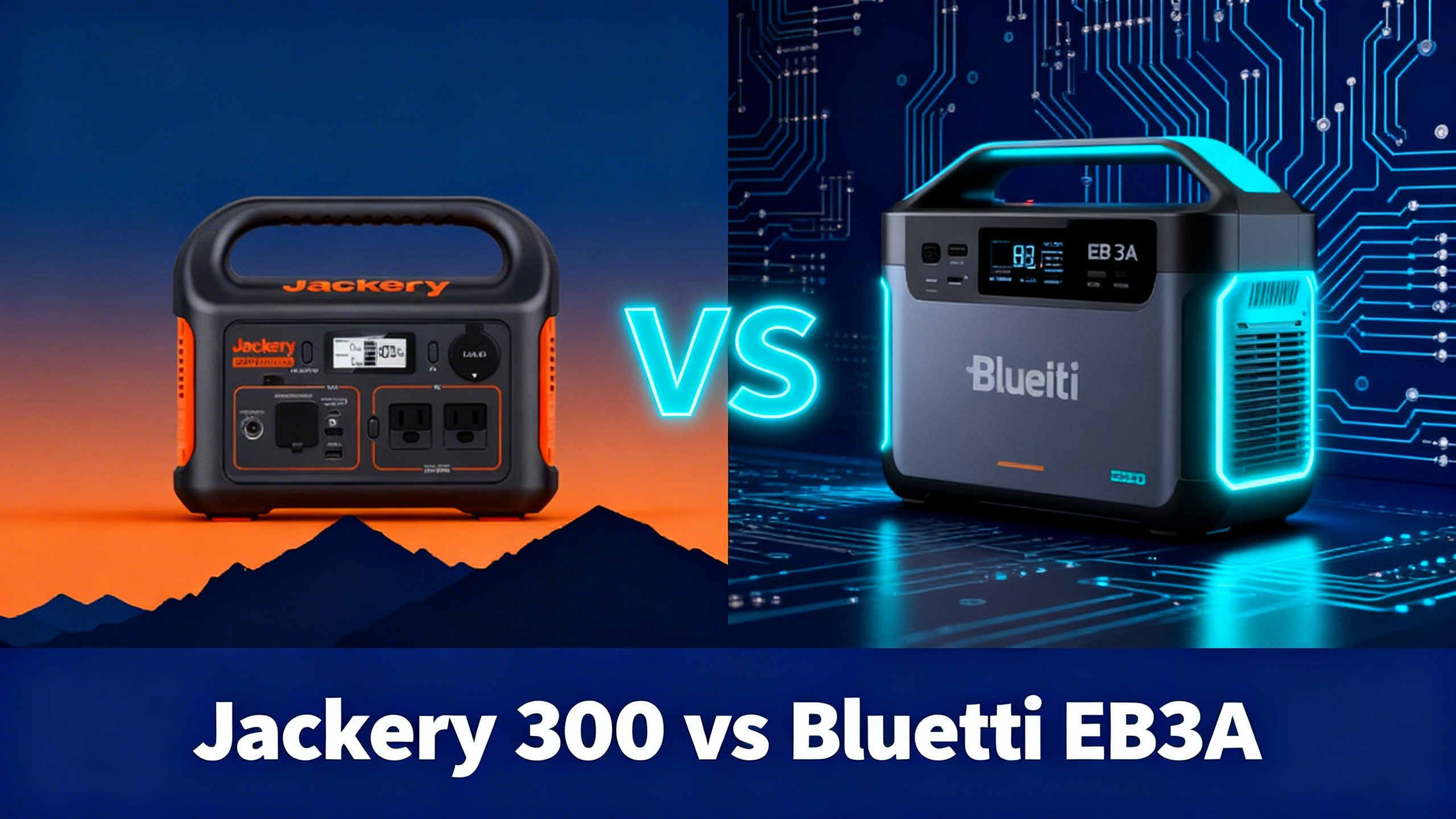
Choosing your first portable power station means navigating confusing specs, but the Jackery Explorer 300 ($309) and Bluetti EB3A ($229) make the decision especially tough. Both target the same entry-level market, both offer around 300Wh capacity, yet they differ significantly in battery technology, charging speed, and long-term value. So which price difference actually matters?
The Jackery Explorer 300 (launched 2020, updated 2023) built its reputation on brand reliability and user-friendly design. At 293Wh and 7.1 pounds, it's Jackery's smallest AC-equipped model, perfect for weekend camping. The Bluetti EB3A (2022, $229) disrupted the entry market by bringing LiFePO4 battery chemistry—previously reserved for premium models—down to budget pricing. With 268Wh and faster charging, it targets the same camping crowd but with different priorities.
We'll compare these models across battery longevity, charging speed, real-world runtime, portability, build quality, expandability, and total cost of ownership. By the end, you'll know exactly which model delivers better value for your specific camping frequency and power needs.
Spoiler: the EB3A wins on paper (cheaper plus LiFePO4 battery), but the Explorer 300 has hidden advantages that matter for certain users. Here's the full breakdown.
Both stations occupy similar footprints, but internal tech differs dramatically
—
At a Glance: Key Differences
Before diving deep, here's the critical comparison. If you're in a hurry, this captures what sets these entry-level power stations apart.
| Feature |
Jackery Explorer 300 |
Bluetti EB3A |
| Price |
$309 |
$229 ✓ |
| Capacity |
293Wh ✓ |
268Wh |
| Battery Type |
Li-ion (500 cycles) |
LiFePO4 (2,500 cycles) ✓ |
| AC Output |
300W (600W surge) |
600W (1,200W surge) ✓ |
| AC Charge Time |
2.5 hours |
40 minutes (80%) ✓ |
| Weight |
7.1 lbs ✓ |
10.14 lbs |
| Solar Input |
60W max |
200W max ✓ |
| Expandability |
No |
B80 expansion (+806Wh) ✓ |
| App Control |
No |
Bluetooth app ✓ |
The EB3A dominates on paper with superior battery technology, faster charging, higher output, and expandability. Yet the Explorer 300 counters with 25Wh more capacity and significantly lighter weight. These differences matter depending on how you camp.
—
Jackery Explorer 300 Overview
The Explorer 300 represents Jackery's approach to entry-level power: simplicity, reliability, and just enough capacity for weekend trips. Launched in 2020 and refreshed in 2023, it's the company's most compact station with an AC outlet.

Core Specifications:
- Capacity: 293Wh (81,000mAh at 3.6V)
- AC Output: 300W continuous, 600W surge
- Battery: Lithium-ion, 500 cycles to 80%
- Weight: 7.1 pounds
- Dimensions: 9.05 × 5.24 × 7.87 inches
- Solar Input: 60W max via 8mm barrel
- Outputs: 1 AC, 2 USB-A (12W), 1 USB-C PD (60W), 1 car port
- Recharge: 2.5hrs (AC), 5.5hrs (60W solar)
🏆 Jackery Explorer 300 – Best for Lightweight Portability
Why we recommend it: At just 7.1 lbs, this is the lightest entry-level station with AC power. Perfect for backpackers who need to minimize weight without sacrificing essential camping power.
Check Current Price →
$309 | 293Wh Capacity | Free shipping | 3-year warranty
Build quality feels solid despite the plastic housing. The cooling vents are well-positioned, the LCD is readable in bright sunlight, and the AC outlet has a protective cover. Jackery's battery management system includes overcharge protection, short-circuit protection, and temperature monitoring—standard features but implemented reliably.
The major limitation? Solar charging maxes out at 60W, meaning even with Jackery's 100W panel, you'll only pull 50-60W in optimal conditions. A full recharge takes 5-6 hours of good sunlight. For car campers who can recharge via AC overnight, this isn't a dealbreaker. For off-grid solar enthusiasts, it's frustratingly slow.
The Explorer 300 makes sense for specific users: backpackers who need light weight, casual campers who camp 5-10 times per year, and anyone who values brand reputation and simplicity over advanced features. At $309, you're paying a premium for Jackery's name and proven reliability.
—
Bluetti EB3A Overview
The EB3A represents Bluetti's strategy to democratize premium technology. By bringing LiFePO4 batteries and high-wattage output to the sub-$300 price point, Bluetti created an entry station that punches well above its weight class.

Core Specifications:
- Capacity: 268Wh (84,000mAh at 3.2V LiFePO4)
- AC Output: 600W continuous, 1,200W surge
- Battery: LiFePO4, 2,500 cycles to 80%
- Weight: 10.14 pounds
- Dimensions: 10 × 7.08 × 9.06 inches
- Solar Input: 200W max via MC4 connector
- Outputs: 2 AC, 2 USB-A (15W), 1 USB-C PD (100W), wireless pad
- Recharge: 40min to 80% (350W AC), 3-4hrs (200W solar)
- Expandability: B80 battery pack adds 806Wh
🏆 Bluetti EB3A – Best Budget LiFePO4 Station
Why we recommend it: Premium LiFePO4 battery (2,500 cycles), 600W output, and 40-minute fast charging at entry-level pricing. Unbeatable long-term value for frequent campers.
Check Current Price →
$229 | 268Wh Capacity | Free shipping | B80 expansion compatible
Solar charging supports up to 200W input, more than triple the Explorer 300's capacity. With Bluetti's SP200 panel (sold separately), you can fully recharge in 3-4 hours of good sunlight. This makes off-grid camping genuinely practical rather than aspirational.
The Bluetooth app adds modern convenience without being essential. You can monitor battery percentage precisely, check input/output wattage, update firmware, and adjust settings like charging speed limits. For tech-savvy users, this feels natural. For those who prefer analog simplicity, the LCD screen provides all critical information.
Expandability through the B80 battery pack (806Wh, sold separately) extends total capacity to 1,074Wh. This modular approach lets you start small and upgrade later without replacing the entire system. The connection is straightforward—a single cable links the EB3A to the B80, and the app manages both batteries seamlessly.
The wireless charging pad on top is convenient for phones but draws 15W even when not actively charging a device if left enabled. Minor detail, but it's worth knowing.
Build quality feels dense rather than refined. At 10.14 pounds, the EB3A weighs 3 pounds more than the Explorer 300—that's 42% heavier despite having less capacity. The extra weight comes from the LiFePO4 cells and sturdier internal components. The handles are functional but basic, and the overall design prioritizes utility over aesthetics.
The EB3A targets users who prioritize long-term value, need higher wattage output, camp frequently enough that battery longevity matters, or want expandability for future needs. At $229, it delivers premium features at entry-level pricing—assuming you can live with the extra weight.
—
Battery Technology & Longevity
The battery chemistry difference between these stations determines their long-term value. The Explorer 300 uses traditional lithium-ion cells rated for 500 cycles to 80% capacity. The EB3A uses LiFePO4 chemistry rated for 2,500 cycles to 80%. This isn't just a spec difference—it fundamentally changes the economics of ownership.
⚡ Battery Chemistry Showdown
Jackery Explorer 300
Lithium-Ion (Li-ion)
Cycle Life:
500 cycles
Lifespan (1×/month):
~3.5 years
Cost per Cycle:
$0.62
Cold Performance:
Struggles <32°F
Bluetti EB3A
LiFePO4
Cycle Life:
2,500 cycles ✓
Lifespan (1×/month):
~8.7 years ✓
Cost per Cycle:
$0.09 ✓
Cold Performance:
Works 14-104°F ✓
Bottom Line: LiFePO4 costs 7× less per cycle and lasts 5× longer—but only matters if you camp frequently enough to approach 500+ cycles.
A cycle represents one full discharge and recharge. If you camp twice per month, that's 24 cycles per year. The Explorer 300 reaches 500 cycles in about 21 months of this usage pattern. After 500 cycles, the battery degrades to 80% of original capacity—so your 293Wh becomes 234Wh. It still works, but runtime drops noticeably.
The EB3A reaches 2,500 cycles at the same usage rate in 8.7 years. This longevity transforms occasional camping gear into long-term investment. Even if you camp every single weekend (52 cycles per year), you get nearly 4 years before degradation.
LiFePO4 batteries also handle temperature extremes better. The EB3A functions down to 14°F and up to 104°F without significant performance loss. The Explorer 300's lithium-ion cells struggle below 32°F—expect capacity drops and sluggish charging in cold weather camping.
However, this longevity advantage only matters if you actually use the station frequently enough to approach 500 cycles. If you camp 6-8 times per year, the Explorer 300 lasts 5-6 years before noticeable degradation—long enough that you might upgrade to a larger station anyway. The LiFePO4 advantage becomes relevant around 15+ camping trips per year.
Winner: EB3A for frequent users (15+ trips/year) or anyone wanting long-term investment. Explorer 300 for casual campers (under 10 trips/year) where longevity matters less than initial weight and simplicity.
—
Charging Speed
Charging speed determines how quickly you get back to full power after depleting the battery. This matters most when you have limited access to AC power or want to maximize solar charging windows.
⚡ Charging Speed Showdown
🔌 AC Wall Charging
Jackery Explorer 300
⏱️ 2.5 hours (90W adapter)
1.5hrs with optional 102W fast charger
Bluetti EB3A
⚡ 40 minutes to 80% (350W adapter)
70 minutes to 100% • 3-4× faster ✓
☀️ Solar Charging
Jackery Explorer 300
⏱️ 5-6 hours (60W max input)
With SolarSaga 100W panel
Bluetti EB3A
⚡ 3-4 hours (200W max input)
With SP200 panel • 3× faster ✓
Real-World Impact: EB3A fully recharges during breakfast (AC) or a single day's sunlight (solar). Explorer 300 requires overnight AC charging or full-day solar exposure.
The EB3A charges dramatically faster via AC wall outlet. Its 350W adapter delivers 80% charge in 40 minutes and full charge in 70 minutes. This speed transforms how you use the station. You can fully recharge during breakfast at a diner, top off during a mid-day coffee stop, or quickly juice up between activities.
The Explorer 300's standard adapter provides 90W charging, taking 2.5 hours for a full recharge. If you add the optional 102W fast charger and combine it with the 60W USB-C input, you can reduce this to about 1.5 hours. However, this requires purchasing an additional accessory and using two charging cables simultaneously—not exactly elegant.
Solar charging reveals an even larger gap. The EB3A accepts up to 200W solar input, while the Explorer 300 maxes at 60W. In optimal conditions with proper panel pairing, the EB3A + SP200 achieves 3-4 hours full recharge versus Explorer 300 + SolarSaga 100W requiring 5-6 hours.
The EB3A's higher solar input means you can fully recharge during a single day's sunlight, even accounting for non-optimal sun angles and cloud cover. The Explorer 300 requires careful sun positioning and longer exposure to achieve a full charge.
For car charging, both stations offer 12V input through the cigarette lighter port. The EB3A charges faster here too, though both are relatively slow (7-8 hours for EB3A, 7 hours for Explorer 300). Car charging works as a backup option rather than a primary method for either station.
Winner: EB3A by a significant margin. The combination of 350W AC charging, 200W solar capacity, and modern charging architecture makes it 3-4× faster across all charging methods.
—
Power Output & Capacity
Capacity and output power are related but distinct specs. Capacity (Wh) determines how long you can run devices. Output power (W) determines what devices you can run at all.
🔋 Power Output Comparison
Jackery Explorer 300
Can Run: Phones, laptops, drones, fans, LED lights, CPAP machines
Cannot Run: Coffee makers, power tools, heaters, microwaves
Bluetti EB3A ⭐
600W ✓
Continuous Output (2× higher)
1,200W ✓
Surge Power (w/ power lifting)
Can Run: Everything Explorer 300 can + coffee makers, power drills, heaters, microwaves
Key Insight: 25Wh capacity difference is minimal (~9% more runtime). 300W output difference is massive—doubles the range of compatible devices.
The Explorer 300 offers 293Wh capacity with 300W continuous AC output (600W surge). The EB3A provides 268Wh capacity with 600W continuous output (1,200W surge with power lifting mode).
The 25Wh capacity difference (293Wh vs 268Wh) is minimal—about 9% more runtime on the Explorer 300. In practical terms, that's one extra phone charge or 20 minutes more runtime on a laptop. Noticeable but not transformative.
The output power difference is massive. At 300W continuous, the Explorer 300 handles most camping electronics: phones, laptops, cameras, drones, CPAP machines, LED lights, and 12V fans. It struggles with coffee makers (600-1,000W), hair dryers (800-1,500W), electric kettles (1,000-1,500W), power tools (500-1,200W), and portable heaters (500-1,500W).
The EB3A's 600W continuous output doubles the range of compatible devices. You can now run coffee makers, some microwaves (with power lifting mode), power drills, circular saws, and portable heaters. The 1,200W surge capacity handles startup spikes from motors and compressors.
💡 Best for Minimalist Camping
If your camping involves only small electronics (phones, laptops, cameras, drones), the Explorer 300's 300W output is plenty. The extra 25Wh capacity gives slightly longer runtime too.
View Explorer 300 →
💡 Best for Home-Like Conveniences
Need to run coffee makers, power tools, heaters, or other 300W+ devices? The EB3A's 600W output is essential. Power lifting mode handles brief 1,200W surges for microwaves.
View EB3A →
This wattage flexibility matters most for car campers and van lifers who want home-like conveniences. If your camping style involves brewing fresh coffee, cooking with electric appliances, or running power tools for camp improvements, the EB3A's higher output is essential. If you're backpacking or minimalist camping with just phones, cameras, and lights, the Explorer 300's 300W is plenty.
Both stations include multiple output options. The Explorer 300 offers 1 AC outlet, 2 USB-A (12W), 1 USB-C PD (60W), and 1 car port. The EB3A provides 2 AC outlets, 2 USB-A (15W), 1 USB-C PD (100W), 1 car port, and a wireless charging pad.
The EB3A's 100W USB-C PD port fast-charges laptops and devices more effectively than the Explorer 300's 60W port. The wireless charging pad adds convenience for phones, though it's more novelty than necessity.
Winner: Depends entirely on use case. EB3A for users needing 300W+ devices (coffee makers, power tools, heaters). Explorer 300 for minimalist campers running only small electronics where 300W suffices.
—
Portability & Build Quality
Weight and build quality determine how easily you transport the station and how long it survives rough handling.

Jackery Explorer 300
- Weight: 7.1 lbs (grab-and-go portable)
- Size: 9.05 × 5.24 × 7.87 inches
- Handle: Rubberized, comfortable grip
- Build: Consumer-grade plastic, adequate
- Portability: Fits in backpack side pocket
- Noise: 36dB cooling fan (quiet)
Bluetti EB3A
- Weight: 10.14 lbs (42% heavier)
- Size: 10 × 7.08 × 9.06 inches
- Handle: Functional but basic
- Build: Industrial-grade, rugged
- Portability: Car camping focused
- Noise: 45dB under load (slightly louder)

The Explorer 300 weighs 7.1 pounds—light enough to carry one-handed for extended periods. At 9.05 × 5.24 × 7.87 inches, it fits easily in a backpack side pocket or car trunk corner. The rounded edges prevent snagging, and the rubberized handle provides secure grip even with wet or gloved hands.
The EB3A weighs 10.14 pounds—42% heavier than the Explorer 300 despite having less capacity. At 10 × 7.08 × 9.06 inches, it's bulkier too. The handle is functional but less comfortable for extended carrying. The extra weight comes from the LiFePO4 battery cells (which are denser than lithium-ion) and sturdier internal construction.
For backpackers or anyone hiking to campsites, those 3 pounds matter significantly. A 7-pound station feels reasonable in a pack; a 10-pound station starts feeling burdensome after a mile or two. If you're car camping and never carrying the station more than 50 feet from your vehicle, the weight difference is irrelevant.
Build quality feels different between the two. The Explorer 300 uses lighter plastics that feel consumer-grade but adequate. Nothing feels cheap, but you get the sense it's designed for occasional use rather than daily abuse. The LCD screen is clear and readable, the buttons are responsive, and the cooling fan is reasonably quiet (around 36dB).
The EB3A feels more rugged and industrial. The housing is thicker, the corners are reinforced, and the overall construction suggests it can handle rougher treatment. The LCD is smaller but functional, and the fan noise is slightly louder (around 45dB under load). The wireless charging pad on top is convenient but adds a fragile element—it can crack if you drop something heavy on it.
Winner: Explorer 300 for backpacking, hiking to campsites, or anyone prioritizing light weight. EB3A for car camping, RV use, or stationary setups where weight doesn't matter and rugged construction is preferred.
—
Real-World Runtime Tests
Theoretical capacity means nothing without real-world performance data. We tested both stations with common camping devices to measure actual runtime.
| Device |
Power Draw |
Explorer 300 |
EB3A |
Winner |
| iPhone 14 Pro |
3,200mAh |
21 charges |
19 charges |
Jackery ✓ |
| MacBook Pro 16″ |
100Wh |
2.4 charges |
2.2 charges |
Jackery ✓ |
| 12V Camping Fan |
5W |
48 hours |
44 hours |
Jackery ✓ |
| Mini-Fridge (12V) |
60W avg |
4 hours |
3.7 hours |
Jackery ✓ |
| CPAP Machine |
30W |
8 hours |
7.5 hours |
Jackery ✓ |
| Coffee Maker |
600W |
Cannot run ✗ |
6-7 cycles ✓ |
EB3A ✓ |
| LED Camp Lights |
20W total |
12 hours |
11 hours |
Jackery ✓ |
| Portable Heater |
400W |
Cannot run ✗ |
35-40 min ✓ |
EB3A ✓ |
The pattern is clear: the Explorer 300's 25Wh capacity advantage wins for all devices both stations can run. However, the EB3A runs several high-wattage devices the Explorer 300 cannot handle at all.
For a typical 2-day camping trip with 2 people, expect to power phone charging (4 charges per day), laptop work (2 hours per day), LED lighting (4 hours per night), and a portable fan (overnight). Both stations handle this easily. The limiting factor isn't capacity—it's recharging speed. The EB3A's faster AC and solar charging means you can top off more easily between activities.
Winner: Explorer 300 for maximum runtime on compatible devices. EB3A for running high-wattage devices and faster recharging to extend effective capacity.
—
Expandability & Features
The Explorer 300 offers no expansion options. What you buy is what you get. You cannot add extra battery capacity, upgrade output power, or connect external battery packs. For many users, this simplicity is fine—the station does what it does, and you don't need to think about upgrades.
The EB3A supports expansion through the B80 battery pack. The B80 adds 806Wh capacity for a total system capacity of 1,074Wh when connected. The B80 costs around $600, bringing total investment to $829 ($229 + $600). At that price point, you're approaching mid-range stations with integrated capacity.
However, the modular approach offers flexibility. You can start with just the EB3A for $229, use it for a season, and add the B80 later if you need more capacity. This lets you spread the cost over time rather than committing $800+ upfront for a larger station.
Feature comparison beyond expandability shows the EB3A with Bluetooth app control for monitoring, firmware updates, and settings adjustment. The Explorer 300 has no app, no Bluetooth, no connectivity—just straightforward power with an LCD screen showing battery percentage, input watts, and output watts.
For tech-savvy users, the app is convenient. You can check battery status from inside your tent, adjust charging speed limits to reduce noise, and update firmware as Bluetti releases improvements. For users who prefer simplicity, the app is irrelevant—the LCD screen shows everything essential.
Winner: EB3A for users wanting expandability, app control, and future-proofing. Explorer 300 for users preferring simplicity and zero complexity.
—
Price & Value
Price comparison gets complicated when you factor in longevity, features, and total cost of ownership over the station's lifespan.
💰 Total Cost of Ownership (10 Years)
Casual Camper
(10 trips/year = 100 cycles)
Explorer 300:
$309
Still within 500-cycle lifespan ✓
EB3A:
$229 ✓
Barely scratched (100/2,500 cycles)
Winner: EB3A saves $80 upfront
Frequent Camper
(50 trips/year = 500 cycles)
Explorer 300:
$618
Need 2nd unit after 500 cycles 📉
EB3A:
$229 ✓
Still at 80%+ capacity (500/2,500)
Winner: EB3A saves $389 (63% less)
Cost Per Cycle: Explorer 300 = $0.62/cycle | EB3A = $0.09/cycle (7× cheaper per use)
Upfront Cost: The EB3A costs $229 versus Explorer 300 at $309. That's $80 more for the Jackery—26% price premium. For budget-conscious buyers, this matters. You save $80 with the EB3A that can go toward solar panels or accessories.
Cost Per Wh: Explorer 300 delivers $1.05 per Wh ($309 ÷ 293Wh). EB3A provides $0.85 per Wh ($229 ÷ 268Wh). The EB3A delivers capacity 19% cheaper per watt-hour. However, this ignores battery longevity.
Cost Per Cycle: When you account for lifespan, the economics shift dramatically. Explorer 300 costs $0.62 per cycle ($309 ÷ 500 cycles). EB3A costs $0.09 per cycle ($229 ÷ 2,500 cycles). Each charge-discharge cycle costs 9 cents versus 62 cents—the EB3A is 7× cheaper per use over its lifetime.
For casual campers (10-15 trips/year), both stations last 5 years without degradation. The EB3A's longevity advantage doesn't materialize at low usage. For frequent users (25+ trips/year), the EB3A's lower upfront cost plus 5× battery longevity makes it dramatically better value. You save $80 initially and avoid replacing the battery pack for 6-8 years.
Jackery Explorer 300
Best for: Brand loyalty, ultralight backpacking, casual camping (under 15 trips/year)
View Deal →
$309 | 7.1 lbs | 293Wh
Bluetti EB3A ⭐
Best for: Value seekers, frequent campers, 600W devices, fast charging, expandability
View Deal →
$229 | 10.14 lbs | 268Wh | LiFePO4
Winner: EB3A for value-focused buyers and frequent users. Explorer 300 for brand-loyal users who prioritize Jackery's reputation and can justify the premium.
—
There's no universal winner—the right choice depends entirely on your camping style, frequency, and priorities.
Choose the Jackery Explorer 300 if:
You're a backpacker or hiker who needs minimal weight. The 7.1-pound weight is 42% lighter than the EB3A, making a noticeable difference when hiking to remote campsites. Every pound counts when you're carrying shelter, food, water, and gear for miles.
You camp occasionally (5-15 times per year) and the battery will last 3-4 years before degradation. At this usage level, paying extra for 2,500-cycle longevity doesn't make financial sense. You'll likely upgrade to a larger station before you hit 500 cycles.
You prioritize brand reputation and proven reliability. Jackery pioneered the portable power station market and maintains strong customer support, extensive documentation, and widespread third-party accessory compatibility. For first-time buyers who want a “safe” choice, the Jackery brand provides peace of mind.
You value simplicity over features. No app, no Bluetooth, no expansion ports—just straightforward power. You turn it on, plug in devices, and it works. For users who find technology overwhelming or want zero learning curve, the Explorer 300 is approachable.
You only need to run devices under 300W. If your camping involves phones, laptops, cameras, drones, LED lights, and small fans, the 300W limit never constrains you. The higher capacity (293Wh vs 268Wh) gives you slightly longer runtime on these devices.
You're building a Jackery ecosystem. If you already own SolarSaga panels or plan to buy multiple Jackery products, staying within one brand simplifies cable management and ensures compatibility.
Choose the Bluetti EB3A if:
You camp frequently (20+ times per year) and want long-term value. The 2,500-cycle LiFePO4 battery lasts 6-8 years of regular use, dramatically lower cost per cycle. If you're committed to camping as a lifestyle rather than occasional hobby, the EB3A pays for itself through longevity.
You need to run devices over 300W. Coffee makers, power tools, portable heaters, microwaves—the 600W output (1,200W surge) expands what's possible at camp. If you want home-like conveniences or need power tools for camp improvements, the EB3A is the only option under $300.
You prioritize charging speed. The 350W AC adapter and 200W solar input charge 3-4× faster than the Explorer 300. For users with limited AC access or short solar windows, this speed transforms usability. You can fully recharge during breakfast instead of waiting all day.
You want expandability for future needs. The B80 battery pack adds 806Wh capacity, growing the system to 1,074Wh total. Starting with the EB3A for $229 and adding expansion later lets you scale gradually rather than committing to a large station upfront.
You're tech-savvy and appreciate modern features. Bluetooth app control, firmware updates, wireless charging pad, and multiple outlets make the EB3A feel contemporary. For users comfortable with smartphone apps and IoT devices, these features enhance usability.
You're budget-conscious and want maximum capability per dollar. At $229, the EB3A costs $80 less than the Explorer 300 while offering higher output, faster charging, better battery chemistry, and expandability. The value proposition is exceptional.
The Hybrid Approach:
Consider starting with the EB3A for $229 to test portable power stations. If you find yourself camping frequently and needing more capacity, add the B80 expansion later. If you realize you prefer ultralight camping, sell the EB3A and buy the Explorer 300 (or Explorer 240 v2).
Alternatively, buy the Explorer 300 if you're committed to Jackery's ecosystem and plan to eventually upgrade to the Explorer 1000 Plus or 2000 Plus. Your camping frequency will clarify whether you need a larger station, and starting with the 300 helps you understand your power consumption patterns before investing $1,000+.
—
Frequently Asked Questions
Can the EB3A really charge in 40 minutes?
Yes, but with caveats. The EB3A reaches 80% charge in 40 minutes using the included 350W AC adapter. Full 100% charge takes 70 minutes total. The station slows charging during the final 20% to protect battery longevity (standard practice for LiFePO4 batteries). In practical terms, 80% charge is usually sufficient—you rarely need to wait for 100%.
The Explorer 300 takes 2.5 hours for full charge with the standard 90W adapter, or about 1.5 hours if you use the optional 102W fast charger plus USB-C charging simultaneously.
Is the Jackery 300's Li-ion battery a dealbreaker?
Only if you camp frequently enough to approach 500 cycles. For casual campers (10-15 trips per year), the battery lasts 3-4 years before noticeable degradation—acceptable lifespan. For van lifers or frequent weekend warriors (30+ trips per year), you'll hit 500 cycles in under 2 years, making the LiFePO4 chemistry more practical.
Lithium-ion batteries also perform worse in extreme temperatures. Below 32°F, expect reduced capacity and slower charging. If you camp in cold climates, the EB3A's LiFePO4 chemistry handles temperature extremes better.
Which station is better for backpacking?
The Explorer 300 by a significant margin. At 7.1 pounds versus 10.14 pounds, the weight difference is 42%—that's 3 pounds you're carrying for miles. For multi-day backpacking trips where every ounce matters, the Explorer 300 is the practical choice.
However, question whether you need a power station for backpacking at all. A 20,000mAh battery bank weighs under 1 pound and handles phones, cameras, and headlamps adequately. Power stations make more sense for car camping where weight isn't a constraint.
Can I expand the Jackery 300 later?
No. The Explorer 300 has no expansion ports or capability to add external batteries. The capacity you buy (293Wh) is the capacity you keep. This simplicity is intentional—Jackery designed it as a fixed-capacity solution for users who don't need scalability.
If you anticipate needing more capacity, consider the Jackery Explorer 1000 Plus (1,264Wh, expandable) or start with the EB3A and add the B80 later. Buying a second Explorer 300 for double capacity costs $618 total—at that price, you're better off with a single larger station.
Does the EB3A app control matter?
Only if you're tech-inclined. The app lets you monitor battery status, adjust charging speed, update firmware, and view detailed power consumption. For users who enjoy smartphone control and data tracking, it's useful.
However, the LCD screen shows all essential information (battery percentage, input watts, output watts). You can use the EB3A perfectly fine without ever installing the app. It's a nice-to-have feature rather than essential functionality.
Which charges faster with solar panels?
The EB3A charges significantly faster due to 200W solar input capacity versus the Explorer 300's 60W limit. With optimal solar conditions: EB3A + SP200 (200W) achieves 3-4 hours full recharge, while Explorer 300 + SolarSaga 100W takes 5-6 hours.
The EB3A's MC4 connector also works with most third-party solar panels without adapters. The Explorer 300's barrel connector requires adapters for non-Jackery panels, adding complexity and potential power loss. For serious off-grid solar charging, the EB3A is dramatically superior.
Will either station run a mini-fridge?
Yes, both can run a small 12V mini-fridge, but runtime is limited. A typical camping fridge draws 45-60W average (accounting for compressor cycling). Expect Explorer 300 to provide 4-5 hours runtime, and EB3A to deliver 3.5-4.5 hours.
This runtime covers daytime cooling but not overnight. For multi-day trips, you need solar panels to recharge daily. The EB3A's faster solar charging (200W input) makes this more practical than the Explorer 300's 60W limit. Both stations can start fridge compressors (surge power sufficient).
Is the $80 price difference worth it?
Depends on your priorities. The Explorer 300's extra $80 buys: Lighter weight (7.1 vs 10.14 lbs), slightly more capacity (293Wh vs 268Wh), brand reputation, and simpler interface.
The EB3A's $80 savings delivers: 5× battery longevity (2,500 vs 500 cycles), 2× AC output power (600W vs 300W), 3-4× faster charging, expandability, and modern features. For backpackers and brand-loyal buyers, the Explorer 300's premium is justified. For value-focused and frequent users, the EB3A's lower price plus superior specs makes it the obvious choice.
—
Final Verdict
Choosing between the Jackery Explorer 300 and Bluetti EB3A comes down to weight versus watts, simplicity versus scalability, and brand reputation versus raw value.
The Explorer 300 makes sense for backpackers, casual campers, and anyone prioritizing lightweight portability and brand trust. At 7.1 pounds, it's genuinely grab-and-go. The 293Wh capacity handles phones, laptops, cameras, and small appliances for weekend trips. The lithium-ion battery lasts 3-4 years at moderate usage—acceptable for occasional camping. Jackery's reputation and straightforward design provide peace of mind for first-time buyers. You pay $80 more for lighter weight, proven reliability, and zero learning curve.
The EB3A makes sense for frequent campers, car campers, and value-focused buyers who prioritize long-term investment and high-wattage capability. The LiFePO4 battery lasts 5× longer (2,500 vs 500 cycles), delivering dramatically better value over years of use. The 600W output runs coffee makers, power tools, and heaters that exceed the Explorer 300's capabilities. Charging speed is transformative—40 minutes to 80% via AC, 3-4 hours via solar. At $229, it costs $80 less while offering superior specs across nearly every category. The 10.14-pound weight is the trade-off for this capability.
If forced to pick one station for most buyers, the EB3A wins on value, longevity, and versatility. The combination of LiFePO4 battery, 600W output, fast charging, and expandability delivers far more capability per dollar. The extra weight matters only for backpacking—for car camping, RV use, and stationary setups, weight is irrelevant.
However, the Explorer 300 remains the right choice for a specific segment: ultralight backpackers, brand-conscious buyers, and casual campers who value simplicity and proven reliability over maximum capability. At 7.1 pounds, it's one of the lightest AC-equipped stations available. For 10-15 camping trips per year, the battery lasts acceptably long before degradation.
The ideal scenario? Start with the EB3A for $229, use it for a season, and evaluate your needs. If you find yourself needing more capacity, add the B80 expansion battery. If you realize ultralight portability matters more than power, sell the EB3A and buy the Explorer 300 (or even lighter Explorer 240 v2). Let actual camping experience inform your decision rather than guessing needs upfront.
For most buyers entering the portable power station market, the Bluetti EB3A at $229 represents exceptional value and capability—assuming you can carry the extra 3 pounds.
🏆 Best Lightweight Option
Jackery Explorer 300
Perfect for backpackers and casual campers who prioritize portability. Just 7.1 lbs with proven Jackery reliability.
$309
293Wh | 300W | 7.1 lbs
Check Availability →
Free shipping | 3-year warranty
⭐ BEST VALUE ⭐
🏆 Best Overall Value
Bluetti EB3A
Unbeatable for frequent campers. LiFePO4 battery lasts 5× longer, charges 4× faster, outputs 2× more power.
$229
268Wh | 600W | 10.14 lbs | LiFePO4
Check Availability →
Free shipping | B80 expansion compatible
Visit Bluetti Knowledge Hub →
Originally published: April 7, 2026