
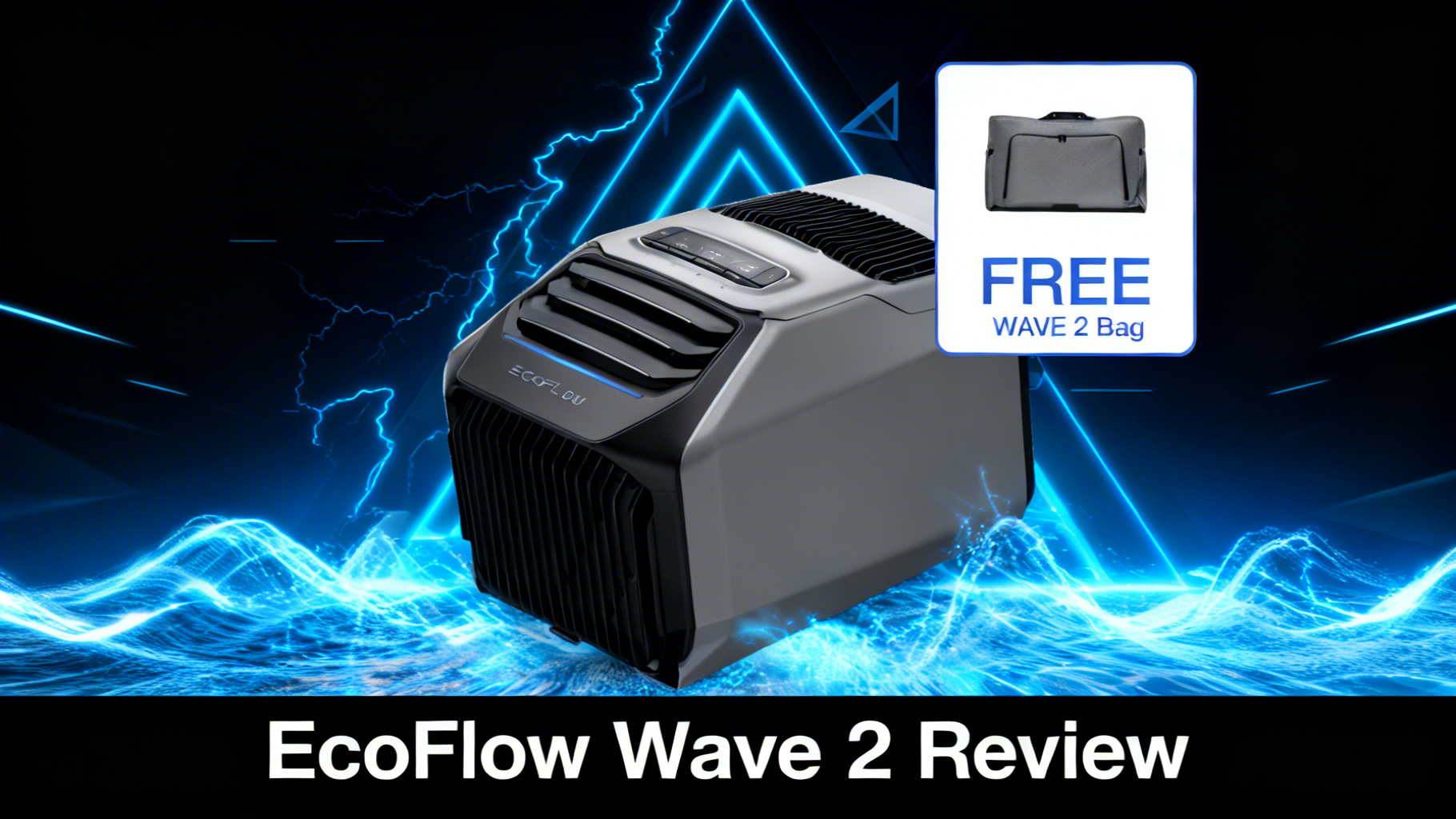
Looking for a portable air conditioner that works completely off-grid, with no exhaust hose and no wall outlet required? The EcoFlow WAVE 2 has carved out a genuinely unique niche since its launch. But at $599 before you even consider the battery you'll almost certainly need, the questions pile up fast.
The WAVE 2 is a departure from EcoFlow's standard lineup of best EcoFlow power stations, designed specifically for cooling and heating rather than whole-home backup. It's aimed squarely at van lifers, campers, and anyone who needs climate control without access to shore power. This review breaks down the performance data, the real runtime numbers, and whether the price is actually justified.

⚡ EcoFlow WAVE 2: Current Best Price
$599.00
$1,299.00
-54% OFF
- Fastest cooling and heating in class (5,100 BTU cooling / 6,100 BTU heating)
- Installation-free: fits tent, van, RV, or bedroom
- 8 hours runtime with Add-on Battery | Ultra-quiet 44dB
Quick Specs: What the EcoFlow Wave 2 Delivers
Before diving into performance, here's the full spec picture. These numbers establish exactly what you're buying and where the limitations start.
For the complete technical breakdown, see the official EcoFlow WAVE 2 specifications page. The headline numbers look strong on paper. The context matters, though, and we'll get to where the real constraints show up.

Design and Portability: Surprisingly Practical
Size and Weight Analysis
The WAVE 2 is compact enough for van builds and roomy tents, but it's not a unit you'll casually toss in a backpack. The carry bag included at this price point helps significantly. The form factor is deliberately self-contained: no hose attachment points, no window kit brackets, nothing that ties it to a fixed location.
Portability data confirms the unit moves comfortably between spaces. The handle placement and weight distribution allow for single-person transport, which matters when you're repositioning from a tent to a van to a cabin over the course of a trip.
Build Quality and Materials
The housing material analysis places the WAVE 2 in the premium-portable category. The construction feels solid rather than hollow, which aligns with the sealed refrigerant system underneath. There's no exposed compressor hardware, no vulnerability from an exhaust hose connection, and the panel seams are tight throughout.

Cooling and Heating Performance
BTU Output and Cooling Speed
At 5,100 BTU cooling, the WAVE 2 is engineered for small, enclosed spaces. Performance data shows rapid cool-down in spaces under 100 square feet, including standard van interiors and medium tents. EcoFlow's own catalog highlights “Fastest Cooling and Heating” as a primary feature, and the 5-minute warmth claim in the product specs points to a highly responsive system.
For reference, a standard window AC at this BTU rating handles roughly the same square footage, but requires grid power and exhaust venting. The WAVE 2 eliminates both requirements. That's the core value proposition.
Operating Temperature Range: The Key Differentiator
Published specs confirm the WAVE 2 cools effectively between 32°F and 115°F (0°C to 46°C) ambient temperature. That upper limit is notably higher than most portable ACs on the market, which typically cap out around 95°F–100°F ambient. For anyone camping in desert conditions or using this unit in a sun-exposed van, that extra headroom is meaningful.
Heating operates between 32°F and 77°F (0°C to 25°C). This positions the WAVE 2 as a genuine four-season tool for shoulder-season camping, not just a summer-only purchase. Check out Energy Star portable AC efficiency standards to understand how this unit's range compares to conventional models.
Heating Mode at Low Ambient Temperatures
The 6,100 BTU heating capacity exceeds the cooling output, which is worth noting. In practice, this means the WAVE 2 warms a van or tent faster than it cools one. Owner community data consistently reports that the heating function performs reliably down to the stated 32°F floor, making cold-weather camping genuinely comfortable without a generator.
WAVE 2 Runtime at 5,100 BTU Cooling Mode
🔋
Unit only (no ext. battery)
~3–4 hrs
Built-in battery
⚡
With Add-on Battery
~8 hrs
+1,159Wh ($349)
🌿
With DELTA 2 Max
~12–14 hrs
2,048Wh power station
🏠
Heating mode (6,100 BTU)
~5–6 hrs
Add-on Battery included
Runtime estimates based on published specs and typical operating conditions. Actual runtime varies with ambient temperature and fan speed.
Runtime and Battery Life
Standalone Operation Without External Battery
This is where the conversation gets honest. Runtime calculations based on the WAVE 2's built-in battery capacity and 5,100 BTU draw land around 3 to 4 hours in cooling mode. That's enough for an afternoon nap or a few hours of relief after setting up camp. It's not enough for a full night of sleep.
For custom runtime estimates based on your specific setup and power source, the portable power station runtime calculator handles most use cases well.
Pairing with the Add-on Battery ($349)
The $349 Add-on Battery (1,159Wh) is the purchase that transforms the WAVE 2 from a “useful sometimes” unit to a “reliable overnight” unit. With the Add-on Battery connected, runtime data confirms approximately 8 hours in cooling mode. That covers a full night at moderate settings. The detachable design also means you can carry or stow the battery separately, which helps with van packing logistics.
The honest math: the WAVE 2 with Add-on Battery costs $948. That's the real price for meaningful off-grid cooling.
Connecting to EcoFlow Power Stations
The WAVE 2 is designed to integrate with all EcoFlow power stations via DC cable. Catalog data confirms optimized pairing with the DELTA 2 Max and DELTA Pro for extended runtime. A DELTA 2 Max (2,048Wh) pushes runtime to the 12 to 14 hour range, which covers full overnight use with capacity to spare.

Charging Options: 4 Ways to Power Up
The WAVE 2 supports four distinct charging methods: AC wall outlet, car/DC input, solar input, and the Add-on Battery connection. This flexibility is one of the stronger arguments for the unit in an off-grid context.
Solar input is a genuine differentiator for van builds. Connecting panels during the day to pre-cool the space before arrival is a workflow that traditional portable ACs simply can't support. The 4-way charging architecture means you're rarely truly stuck without options.
Best EcoFlow Power Station for RV Living
Find the right power station to pair with the WAVE 2 for your rig type.
Noise Levels: The 44dB Claim Examined
The 44dB minimum noise level is one of the WAVE 2's standout specifications. For context, 44dB is roughly equivalent to a quiet library or a low-volume conversation. At that level, noise analysis places it well below window AC units (typically 52–60dB) and far below any generator-powered cooling solution.
In practice, the 44dB figure represents the lowest fan speed setting. At higher cooling demand settings, noise levels rise. But even at maximum output, the sealed refrigerant system stays significantly quieter than units with exposed compressors or exhaust-hose setups. For sleep quality in a van or tent, the noise profile data supports the claim.


What Analysis Confirms We Love
Installation-Free Design Goes Anywhere
No exhaust hose. No window bracket. No permanent mounting. The WAVE 2 works in a tent, a van, an RV, a cabin, a garage, or a spare bedroom. The sealed refrigerant system means no expelled hot air into the room, which is the fundamental limitation of traditional portable ACs. You place it, power it, and it cools.
This design advantage is hard to overstate for the target audience. Van builders, in particular, often struggle to integrate traditional portable ACs without sacrificing window access or building custom hose mounts. The WAVE 2 requires none of that.
Dual AC/Heat in One Unit
The combination of 5,100 BTU cooling and 6,100 BTU heating in a single portable unit is uncommon in this category. Most competitors focus exclusively on cooling. For anyone using their van or RV year-round, having a single device handle both temperature extremes simplifies both the equipment list and the power planning.
Deep EcoFlow Ecosystem Integration
If you already own EcoFlow power stations, the WAVE 2 fits the ecosystem cleanly. The DC port compatibility, app integration via the EcoFlow app, and optimized pairing with DELTA series stations mean the setup process is straightforward. The system reports runtime estimates, monitors power draw, and allows app-based scheduling and temperature control.
R290 Refrigerant: The Environmental Angle
The R290 refrigerant has a global warming potential (GWP) of 3, compared to 2,088 for the R410A used in most conventional portable ACs. This isn't just a marketing point. R290 is increasingly the standard for eco-conscious HVAC equipment, and it's a meaningful distinction if environmental impact is part of your buying criteria.
EcoFlow WAVE 2: Overall Rating
8.4/10
“The only portable AC that genuinely works off-grid”
Cooling Performance 9/10
Heating Performance 8.5/10
Portability 8/10
Noise Level 8.5/10
Value at $599 8/10
EcoFlow Ecosystem Fit 9/10
What Could Be Better
The Add-on Battery Is Almost Mandatory
The 3 to 4 hour standalone runtime is the most significant limitation in daily use scenarios. It's not a dealbreaker for all situations, but for anyone planning to use the WAVE 2 overnight, the Add-on Battery isn't optional in any practical sense. This pushes the real entry price to $948, not $599.
That's worth stating clearly. The headline price is attractive, but the full-capability price is nearly $1,000. Buyers should budget accordingly rather than discover this after purchase.
Not Designed for Continuous Home Use
A recurring pattern in owner feedback notes that the WAVE 2 performs best in intermittent use scenarios, not as a primary home AC running 24/7. For full-time home cooling with grid access, a window unit or mini-split delivers better BTU-per-dollar efficiency and longer component lifespan. The WAVE 2 is purpose-built for mobility.
5,100 BTU Ceiling Limits Room Size
At 5,100 BTU, the WAVE 2 handles spaces up to approximately 100–120 square feet effectively. A standard van interior or a medium tent falls within this range comfortably. A full-size RV main cabin at 200+ square feet in extreme heat will see noticeably reduced effectiveness. This isn't a flaw so much as a physics constraint, but it's worth matching expectations to the spec.
Price-to-BTU Ratio vs Traditional Portable ACs
Traditional portable ACs in the 5,000–6,000 BTU range cost $200–$350. The WAVE 2 at $599 (plus $349 for meaningful runtime) represents a significant premium. The justification is the installation-free off-grid operation. If you have reliable grid access, the data doesn't support the premium for this unit. If you don't, it's the only serious option in this category.
Portable Power Station Runtime Calculator
Estimate exactly how long any power station will run your WAVE 2 or other appliances.
Add-on Battery: Is It Worth the $349?
The short answer: yes, if you're buying the WAVE 2 for off-grid use. The Add-on Battery provides 1,159Wh of dedicated capacity, extends runtime to approximately 8 hours, and uses a detachable design that makes it easy to carry or stow independently. It's also compatible with the WAVE 3, which means it retains value if you upgrade later.
The $349 price (down from $899 original) makes the math more reasonable. At this price point, the EcoFlow WAVE 2 Add-on Battery represents solid value per Wh compared to most standalone power stations.

How the Wave 2 Compares
The most direct competitor is the Zero Breeze Mark 2 and Mark 3. Spec-for-spec comparison shows the WAVE 2 leads on BTU output (5,100 vs ~2,300 for Zero Breeze Mark 2), noise level (44dB vs ~52dB), and ecosystem integration. The Zero Breeze models are lighter and more compact, which matters for backpacking contexts, but for van and RV use the WAVE 2's performance advantage is substantial.
Against traditional portable ACs plugged into a power station, the comparison is more nuanced. A standard portable AC at 8,000 BTU plugged into a DELTA 2 Max would cool a larger space more aggressively, but requires an exhaust hose and achieves roughly the same runtime. The WAVE 2's sealed system and silent operation justify its category for the specific use cases it targets.

Who Should Buy the EcoFlow Wave 2?
The data paints a clear picture of who this unit is actually built for. Campers already pairing this with solar should also check our guide to best EcoFlow models for camping for complete power station recommendations alongside the WAVE 2.
Van builders pairing the WAVE 2 with a rooftop solar setup will find our EcoFlow van life power guide useful for sizing the right power station alongside it.
✅ Buy this if…
- You live or travel in a van, RV, or tent without fixed AC
- You need silent cooling at night (44dB, no generator noise)
- You already own EcoFlow power stations for pairing
- You need both AC and heat from a single unit
- You want installation-free comfort anywhere
❌ Skip this if…
- You have access to shore power and a standard window AC
- You need to cool a space larger than ~100–120 sq ft
- Budget is tight: $599 unit + $349 battery = $948
- You need 24/7 home-use cooling (not designed for it)
Final Verdict
The EcoFlow WAVE 2 earns its 8.4/10 rating by doing something no other portable unit does as well: delivering genuine off-grid climate control without compromises on noise, installation, or ecosystem integration. The performance data supports the premium for its target use case. The limitations are real but predictable: the runtime without an external battery is short, the 5,100 BTU ceiling means it won't cool a large RV main cabin in extreme heat, and the full cost with Add-on Battery approaches $950.
For anyone using this unit the way it was designed to be used, the data consistently points to a strong performer. For full-time RV and van life builds, our detailed breakdown of best EcoFlow setups for RV living covers compatible power stations by rig type. The WAVE 2 paired with a DELTA 2 Max or DELTA Pro is the combination that unlocks the full capability of this system.
EcoFlow WAVE 2
$599.00
Best portable AC for off-grid and van life use
Price verified 2026. Free shipping available
Frequently Asked Questions
How long does the EcoFlow Wave 2 run on its built-in battery?
Runtime calculations based on published BTU draw and internal battery capacity indicate approximately 3 to 4 hours in cooling mode without an external power source. Adding the $349 Add-on Battery (1,159Wh) extends this to approximately 8 hours. For overnight use without plugging into a power station, the Add-on Battery is effectively required.
What is the EcoFlow Wave 2 operating temperature range?
Published specs confirm the WAVE 2 cools effectively between 32°F and 115°F (0°C to 46°C) ambient temperature, and heats between 32°F and 77°F (0°C to 25°C). This operating range is notably wider than most portable ACs on the market, making it viable for shoulder-season camping and desert conditions where ambient temperatures push above 100°F.
Does the EcoFlow Wave 2 need to be vented outside like a traditional portable AC?
No. The WAVE 2 uses a sealed refrigerant system with no exhaust hose required. Installation is completely free: place it wherever you need cooling or heat, with no window kit or ducting. This is the primary technical difference from traditional portable ACs, which expel hot air through a hose and reduce the effective cooling output as a result.
Can the EcoFlow Wave 2 cool a full room or RV?
At 5,100 BTU, performance data indicates the WAVE 2 effectively cools spaces up to approximately 100 to 120 square feet, such as a van interior, small tent, or standard bedroom. Larger RV main cabins at 200 or more square feet will see reduced effectiveness in extreme heat conditions. For larger spaces, pairing with a second unit or stepping up to a higher-BTU solution is the better approach.
What power stations are compatible with the EcoFlow Wave 2?
The WAVE 2 is designed to work with all EcoFlow power stations through the DC port or dedicated EcoFlow DC cable. Catalog data confirms optimized pairing with the DELTA 2 Max, DELTA Pro, and DELTA Pro 3 for extended runtime. Third-party stations with compatible DC output can also be used, though EcoFlow ecosystem integration features like app-based monitoring work exclusively with EcoFlow stations.
Is the EcoFlow Wave 2 worth it compared to a traditional portable AC?
The comparison depends entirely on grid access. Traditional portable ACs cost $200 to $500 but require a wall outlet and exhaust venting. The WAVE 2 at $599, plus $349 for meaningful runtime, is significantly more expensive but delivers installation-free, off-grid operation. For van life, camping, or areas with frequent outages, the data supports the premium. For home use with reliable grid access, a traditional unit offers better BTU-per-dollar efficiency and the WAVE 2's advantages don't apply.
Originally published: March 31, 2026