
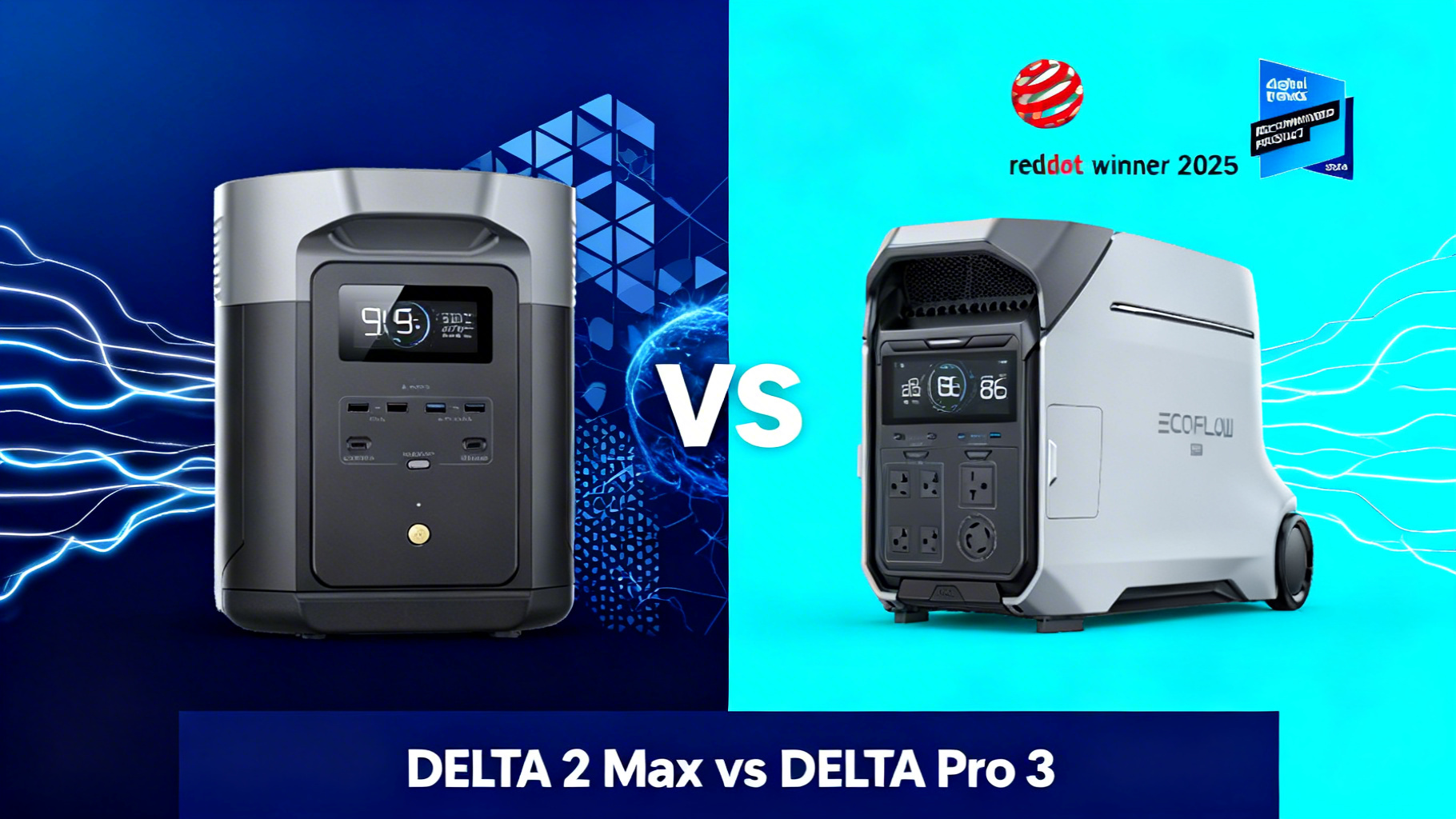
Choosing between the EcoFlow DELTA 3 Max and DELTA 2 Max comes down to a question that's rarely this clear-cut: do you pay more for the older model, or less for the newer one? Both units share the same 2,048Wh capacity and LFP battery chemistry. But the generation gap shows up in output power, charging speed, weight, and UPS performance, and the data points strongly in one direction.
This comparison breaks down every meaningful difference between the two units. If you're still deciding between multiple DELTA models, the EcoFlow DELTA series buying guide covers the full lineup. For this matchup, here's what the specs and real-world data reveal.

At a Glance: Key Differences Between Generations
Both units share identical capacity (2,048Wh) and the same LFP chemistry with 3,000+ cycles. The differences show up in AC output, charging speed, weight, UPS transfer time, and price. The table below puts them side by side.


DELTA 3 Max Overview
The DELTA 3 Max represents EcoFlow's current flagship in the 2kWh portable power category, priced at $749 (down from $1,499). Per the official DELTA 3 Max specifications, the unit delivers 2400W continuous AC output with a 4800W surge ceiling, powered by automotive-grade full-tab LFP cells.
The 10ms UPS transfer time is the spec that stands out for home backup use. At that speed, sensitive electronics like NAS drives and desktop computers won't register the switchover during a power outage.
What's New in the DELTA 3 Generation
The generation jump brought four meaningful upgrades over the previous 2kWh platform: a 400W increase in continuous AC output, a charge time cut from roughly 2 hours down to 68 minutes (0-80%), a 4.3 lb weight reduction, and a UPS transfer improvement from 30ms to 10ms. The OASIS 3.0 app adds Storm Guard Mode, which monitors weather forecasts and automatically pre-charges the unit before extreme weather events.
Battery construction also upgraded to full-tab automotive-grade cells, which EcoFlow says reduces internal resistance and heat generation compared to standard LFP cell configurations.
DELTA 2 Max Overview

The DELTA 2 Max launched as EcoFlow's premium 2kWh unit and earned a strong reputation for reliability. Current pricing sits at $849 (from $1,899). Per the official DELTA 2 Max specifications, it delivers 2000W AC continuous output with X-Boost enabling up to 3400W for compatible high-draw appliances.
Its standout advantage is expandability: the DELTA 2 Max supports up to two Smart Extra Batteries for a total system capacity of 6,144Wh. It also carries a 5-year warranty, compared to the DELTA 3 Max's 3-year base (extendable to 5 via app registration).
What Still Makes It Competitive
The DELTA 2 Max is not an outdated unit by any measure. The 3,000+ LFP cycle count, 1000W solar input capability, and X-Boost support for 99% of home appliances remain competitive specs. For buyers who already own DELTA 2 Max accessories or extra batteries, staying in that ecosystem makes practical sense. The issue is purely one of value: at its current $849 price, it asks for a $100 premium over a unit that outperforms it on most measurable dimensions.
⚠️ Important: The DELTA 2 Max Smart Extra Battery is not cross-compatible with the DELTA 3 Max. If you own DELTA 2 Max expansion batteries, they will not work with the newer unit.
New Generation
EcoFlow DELTA 3 Max
$749.00 $1,499.00
2,048Wh · 2400W · 44.7 lbs

Previous Generation
EcoFlow DELTA 2 Max
$849.00 $1,899.00
2,048Wh · 2000W · ~49 lbs
Head-to-Head: Charging Speed & Input Options
Charging speed is where the generation gap is most measurable. The DELTA 3 Max reaches 0-80% in 68 minutes via wall charging, which is roughly 30% faster than the DELTA 2 Max's approximate 90 minutes to the same threshold. For anyone using their unit as primary home backup and cycling it regularly, that difference adds up over time.

Both units support multiple charge input sources: wall outlet, solar panels, and generator. The DELTA 2 Max published 1000W solar input capacity with 99% MPPT efficiency. The DELTA 3 Max supports 4 input modes with the same rapid-charge architecture. For solar-heavy setups, both units handle meaningful panel arrays.

The practical takeaway: if fast turnaround between uses matters (think frequent power outages, daily cycling, or van life where you charge from solar during the day and discharge at night), the DELTA 3 Max's charging architecture has a clear edge.
Head-to-Head: AC Output & X-Boost Performance
AC output capacity separates the generations more than any other single spec. The DELTA 3 Max delivers 2400W continuous with a 4800W surge ceiling. The DELTA 2 Max tops out at 2000W continuous with a 4600W surge. That 400W gap matters for high-draw appliances: portable air conditioners, power tools with compressors, induction cooktops, and some workshop equipment approach or exceed 2000W under load.
Both units share the same X-Boost ceiling at 3400W, which handles 99% of residential appliances including washers, coffee makers, and circular saws by intelligently managing draw. X-Boost is the equalizer for typical household use. Where you feel the DELTA 3 Max's advantage is in sustained, simultaneous load scenarios: running a window AC unit alongside a refrigerator, for instance, where the aggregate draw pushes past 2000W.
💡 Pro Tip: If you're running a window AC unit (typically 1200-1500W) alongside a refrigerator (100-200W) and other loads, the DELTA 3 Max's 2400W output gives you meaningful headroom. The DELTA 2 Max may require load management in that scenario.
Head-to-Head: Portability & Build Quality
At 44.7 lbs, the DELTA 3 Max is 13% lighter than EcoFlow's previous 2kWh generation. The DELTA 2 Max comes in at approximately 49 lbs. That 4.3 lb difference may sound modest, but for a unit you're lifting into a vehicle, carrying to a campsite, or repositioning during a storm event, it's noticeable.
Build quality on both units reflects EcoFlow's standard construction: robust plastic housing, recessed carry handles, and a clean port layout. The DELTA 3 Max's automotive-grade full-tab LFP cells add a durability argument beyond cycle count: the construction standard reduces internal stress during charge/discharge cycles, which translates to more consistent performance across the full 10-year lifespan.
DELTA 3 Max: Key Portability Specs
- 44.7 lbs (20.3 kg)
- 13% lighter than previous 2kWh gen
- Automotive-grade full-tab LFP cells
- EV-grade CTC structure
DELTA 2 Max: Key Portability Specs
- ~49 lbs (~22.5 kg)
- Standard LFP construction
- Dual carry handles
- Proven field reliability record
What Can They Power? Real-World Runtime
Both units carry identical 2,048Wh capacity, so runtime calculations are the same across both models. The differentiator at this stage is output power: the DELTA 3 Max can sustain more simultaneous devices at higher draw levels before hitting its output ceiling.
Runtime calculations based on 2,048Wh capacity at 80% efficiency show the following estimates for common use cases:
What Can They Power? (2,048Wh: Both Models Same Capacity)
❄️
Mini Fridge
~34 hrs
60W avg
💡
LED Lights (5x)
~170 hrs
12W total
🖥️
Laptop
~30 charges
65W avg
🔌
CPAP Machine
~51 hrs
40W avg
📺
65″ TV + devices
~17 hrs
120W avg
Runtime calculations based on 2,048Wh capacity at 80% efficiency. Actual results vary by appliance draw.
Run your own numbers with the portable power station runtime calculator to match capacity against your specific devices.
Portable Power Station Runtime Calculator
Enter your devices to get personalized runtime estimates for any capacity.
Expandability & Battery Ecosystem
The DELTA 2 Max has a clear advantage in expansion ceiling: it supports up to two Smart Extra Batteries, reaching a total system capacity of 6,144Wh. That's enough to power a home for a full day during an outage, or to sustain an off-grid setup through multiple cloudy days.
The DELTA 3 Max also supports expansion via its own Smart Extra Battery, but the two ecosystems are not compatible. For a complete breakdown of which batteries pair with which models, the EcoFlow extra battery compatibility guide covers every current SKU.
If you're planning to build out a high-capacity system from scratch, both units can scale. If you already own DELTA 2 Max expansion batteries, that's a concrete reason to stay in that ecosystem, as those batteries represent a significant investment that won't transfer.
EcoFlow Extra Battery Compatibility Guide
Which batteries pair with which DELTA models: a complete breakdown by SKU.
Noise, UPS & Smart App Features
The DELTA 3 Max operates at 25dB or less at 600W output. That's near-silent in a bedroom or living space context: quieter than a library (30dB) and comparable to a whisper. EcoFlow does not publish an equivalent dB rating for the DELTA 2 Max under comparable load conditions, which makes direct comparison difficult. Owner accounts generally describe the DELTA 2 Max fan as audible but not disruptive under moderate loads.
The UPS transfer time gap is significant for specific use cases. A 10ms transfer (DELTA 3 Max) is below the threshold at which most desktop computers, NAS devices, and medical equipment will register a power interruption. The DELTA 2 Max's 30ms transfer is adequate for many devices but may cause brief resets on sensitive electronics. For CPAP machines, home server setups, or any device without its own internal battery, that 20ms difference matters.
Both units connect to EcoFlow's OASIS app for remote monitoring and control. The DELTA 3 Max's OASIS 3.0 adds Storm Guard Mode, which cross-references weather forecasts and automatically pre-charges the unit before incoming weather events without requiring manual action.
Value Analysis: Price Per Watt-Hour Over Time
At current pricing, the DELTA 3 Max comes in at $749 and the DELTA 2 Max at $849. Both deliver 2,048Wh. That's roughly $0.37/Wh for the DELTA 3 Max versus $0.41/Wh for the DELTA 2 Max. The newer unit is less expensive per unit of capacity, and offers more output power on top of that.
Warranty math adds nuance. The DELTA 2 Max carries a 5-year warranty outright. The DELTA 3 Max offers 3 years standard, with a 2-year extension available through app registration, effectively matching 5 years for users who register. If you skip the registration step, you're left with 3 years of coverage.
The home backup capacity guide for EcoFlow breaks down appliance-by-appliance coverage for users evaluating 2kWh units for home backup scenarios.
Winner by Use Case

✅ Buy the DELTA 3 Max if…
- You want the latest generation at a lower price ($749 vs $849)
- Faster AC charging matters (68 min vs ~2 hrs to 80%)
- You run sensitive equipment and need 10ms UPS response
- Portability is a priority (13% lighter than previous 2kWh gen)
- Whisper-quiet operation is important (25dB at 600W)
✅ Buy the DELTA 2 Max if…
- You find it on sale below $700 (deep discount scenarios)
- A 5-year warranty is non-negotiable for your use case
- You need to expand to 6144Wh with two extra batteries now
- You already own accessories designed for the D2M ecosystem
Best for Home Backup
The DELTA 3 Max wins on home backup. The 10ms UPS transfer time protects sensitive electronics during outages. The faster charging means you can top up during a brief grid restoration and be ready for the next interruption. The 2400W output handles more simultaneous loads. For most households, this is the stronger backup platform.
Best for Camping & Outdoor Use
The DELTA 3 Max's lighter weight (44.7 lbs vs ~49 lbs) and quieter operation make it the better camping companion. The 25dB noise floor means it won't disturb a campsite at typical overnight loads. Both units handle solar input for recharging off-grid.
Best for RV and Van Life
For RV and van life use, the DELTA 3 Max's combination of faster charging, higher output, and lighter weight makes it the practical choice for most setups. RV users will find a full breakdown of the best EcoFlow models for RV living across rig types. Weight savings matter in a vehicle where every pound affects fuel efficiency and payload capacity.
Best for Budget Buyers
Counterintuitively, the DELTA 3 Max is also the better value at current pricing: it's $100 cheaper and offers stronger performance across most specs. The DELTA 2 Max only becomes the budget pick if it drops significantly below $700 through a sale or refurbished channel.
Final Recommendation

The verdict here is clearer than most generation comparisons. The DELTA 3 Max is newer, lighter, faster charging, more powerful in AC output, quieter, and $100 cheaper. For most buyers comparing these two units today, the EcoFlow DELTA 3 Max is the straightforward recommendation.
The DELTA 2 Max earns the nod only in specific scenarios: if you find it significantly discounted (below $700), if you already own DELTA 2 Max extra batteries you want to keep using, or if the 5-year out-of-box warranty is a firm requirement and you're unwilling to register for the DELTA 3 Max's extension.
Spoiler: there's no scenario where paying more for the older generation makes sense at current street pricing unless one of those specific conditions applies to you.
EcoFlow DELTA 3 Max
$749.00
Best next-gen upgrade for most buyers
Price verified March 2026 · Free shipping available
Frequently Asked Questions
Is the EcoFlow DELTA 3 Max better than the DELTA 2 Max?
For most buyers, spec analysis points to the DELTA 3 Max as the stronger choice. It offers higher AC output (2400W vs 2000W), faster charging (68 min to 80% vs approximately 2 hours), lighter weight, and a 10ms UPS transfer rate versus 30ms. It also costs $100 less at current pricing. The DELTA 2 Max maintains an edge on warranty length: 5 years versus 3 years standard (extendable to 5 via app registration for the DELTA 3 Max).
Do the DELTA 3 Max and DELTA 2 Max have the same battery capacity?
Yes. Both units pack 2,048Wh of usable capacity with LFP chemistry rated for 3,000 or more charge cycles. The generation upgrade did not change capacity. It focused on output power, charging speed, weight reduction, and smart features. Runtime will be identical for the same load on either unit.
Can I use the DELTA 2 Max Smart Extra Battery with the DELTA 3 Max?
No. The extra batteries are not cross-compatible between generations. The DELTA 3 Max requires its own dedicated Smart Extra Battery. If you own DELTA 2 Max expansion batteries, they will only work with the DELTA 2 Max. Check the EcoFlow extra battery compatibility guide for a full breakdown by model before purchasing expansion capacity.
Which is quieter, the DELTA 3 Max or the DELTA 2 Max?
Published specifications confirm the DELTA 3 Max operates at 25dB or less at 600W output, which is near-silent in a home environment. EcoFlow does not publish equivalent dB figures for the DELTA 2 Max under comparable load conditions. Based on available data, the DELTA 3 Max is the measurably quieter option.
Is the DELTA 2 Max still worth buying in 2026?
At its current $849 price, the DELTA 2 Max sits $100 above the DELTA 3 Max with fewer output specs to justify the premium. It remains a reasonable choice if purchased at a significant discount (below $700), if the 5-year out-of-box warranty is a firm requirement, or if you already have a DELTA 2 Max ecosystem built out with accessories and extra batteries that represent a sunk investment.
Related Reads
Originally published: March 31, 2026