
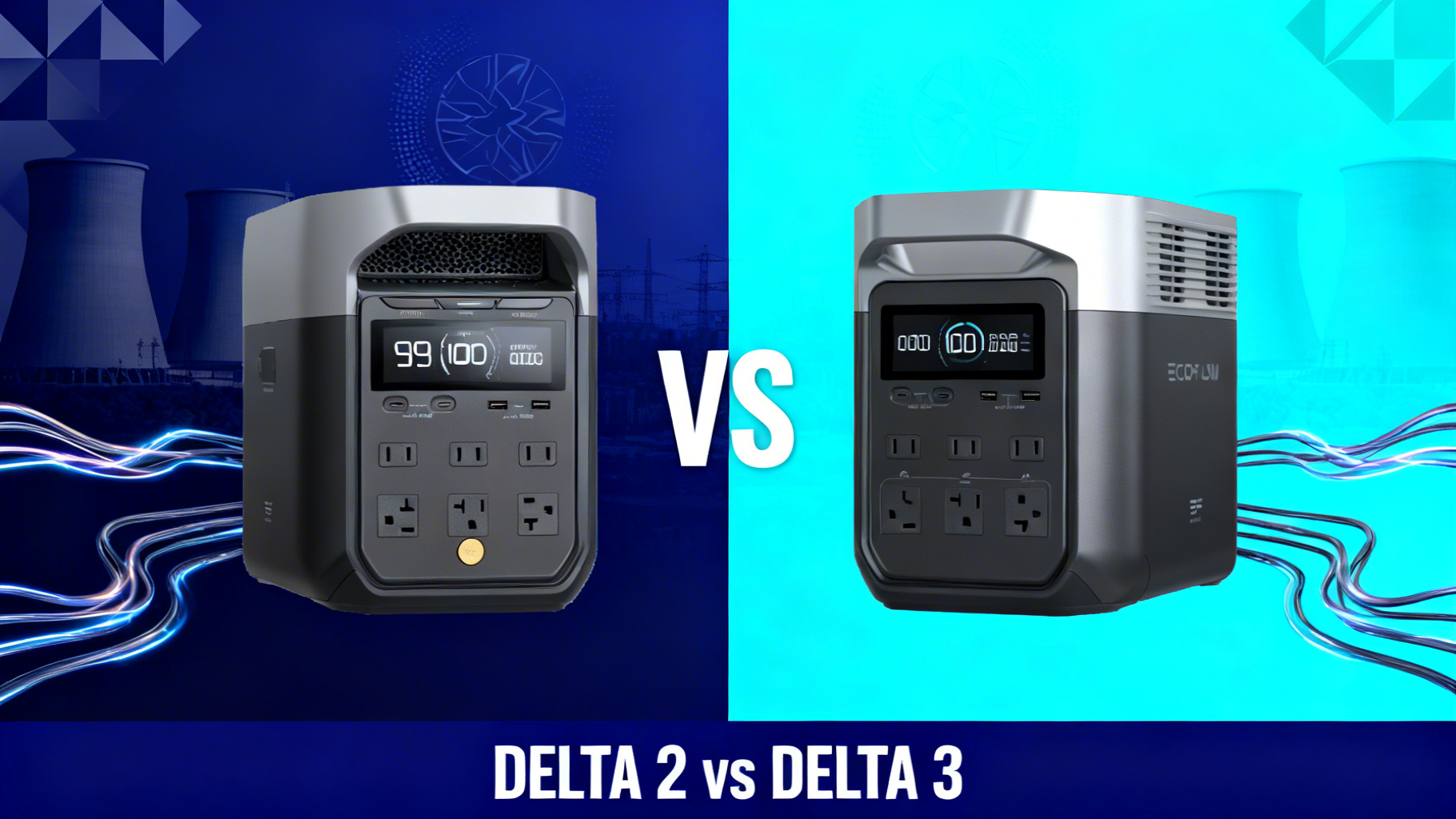
Choosing between the EcoFlow DELTA 2 and DELTA 2 Max is genuinely confusing: same LFP battery chemistry, same app, same EcoFlow ecosystem, yet the Max costs $450 more and weighs nearly 20 lbs heavier. Both use lithium iron phosphate (LiFePO4) cells rated for 3,000 cycles, so longevity isn't the deciding factor. The real question is whether doubling the capacity, boosting the solar input, and expanding output is worth that gap for your specific situation.
The DELTA 2 comes in at $399 with 1,024Wh of capacity and 1,800W AC output, weighing 28.7 lbs. The DELTA 2 Max steps up to $849, 2,048Wh, and 2,400W output at 48.5 lbs. This guide breaks down both models across six key dimensions: capacity, power output, solar charging, expandability, portability, and price value. Spoiler: the DELTA 2 Max wins on raw power and flexibility, but the DELTA 2 wins on value and portability.

At a Glance: Key Differences
Before diving into category-by-category analysis, here's the full spec-for-spec picture. Both models share the same LFP battery chemistry and EcoFlow app integration; the differences are almost entirely about scale.


Three takeaways jump out immediately: the Max doubles capacity at near-identical cost per watt-hour, the weight difference is significant (nearly 20 lbs), and solar input doubles from 500W to 1,000W. Everything else follows from those three gaps.
EcoFlow DELTA 2 Overview
The DELTA 2 launched as EcoFlow's answer to the mid-range market: a compact LFP station with fast AC charging and enough output for most camping and light home backup scenarios. At $399, it sits at a fraction of its original MSRP of $1,049, making the value proposition substantially stronger than at launch.
The core specs: 1,024Wh capacity, 1,800W continuous AC output with X-Boost technology pushing that ceiling to 2,200W for high-draw appliances. Solar input maxes at 500W. The LFP battery is rated for 3,000 cycles to 80% capacity, which translates to roughly 10 years of daily use. Capacity is expandable to 3,072Wh with one DELTA 2 Smart Extra Battery. Weight is 28.7 lbs with a built-in carry handle. The official DELTA 2 specifications are available directly on EcoFlow's site. For a complete analysis of the base model alone, our EcoFlow DELTA 2 review covers runtime results and long-term owner feedback in full detail.
EcoFlow DELTA 2 Max Overview
The DELTA 2 Max targets a different buyer profile: RV users, frequent home backup scenarios, and anyone who anticipates growing power needs. At $849 (down from $1,899), it delivers 2,048Wh of capacity with 2,400W continuous AC output and X-Boost extending that to 3,400W for 99% of household appliances. That output ceiling matters for running standard microwave ovens, power tools, and CPAP machines simultaneously.
Solar input doubles to 1,000W, which is the specification that defines true off-grid viability. With four 220W panels, a full charge via solar alone becomes a realistic same-day proposition. The expandability story scales further: the Max supports two DELTA 2 Max Smart Extra Batteries, reaching a combined 6,144Wh, enough for multi-day home backup without a generator. The tradeoff is weight: 48.5 lbs puts this unit firmly in the semi-stationary category for most users. The official DELTA 2 Max specifications are available directly from EcoFlow.

Head-to-Head: Capacity and Runtime
Capacity is the most straightforward comparison. The DELTA 2 holds 1,024Wh; the Max holds exactly double at 2,048Wh. Runtime calculations based on the respective capacities show roughly proportional differences across common appliances.
For home backup scenarios, the DELTA 2 can sustain a mini-fridge at 80W draw for approximately 13 hours, cover a CPAP machine through a full night, and keep phones and laptops charged for a full day. That covers short outages of 10 to 14 hours reasonably well. The DELTA 2 Max extends those runtimes to 24 to 26 hours for the same fridge scenario, making multi-day backup viable without any extra battery purchase. Run your specific appliances through our runtime calculator to get personalized estimates for both models.
DELTA 2 (1,024Wh): Estimated Runtimes
❄️
Mini Fridge
~13 hrs
80W avg
💻
Laptop
~17 hrs
60W
🌬️
Box Fan
~51 hrs
20W
📱
Smartphone
~85 charges
12Wh/charge
DELTA 2 Max (2,048Wh): Estimated Runtimes
❄️
Mini Fridge
~26 hrs
80W avg
💻
Laptop
~34 hrs
60W
🌬️
Box Fan
~102 hrs
20W
📱
Smartphone
~170 charges
12Wh/charge
Runtime estimates based on published capacity at 85% efficiency. Real-world results vary by appliance and temperature.
Verdict: The DELTA 2 Max wins for multi-day home backup and full-time RV use. The DELTA 2 covers weekend camping and short outages with capacity to spare.
Head-to-Head: Power Output
Output ratings determine which appliances you can actually run. The DELTA 2 delivers 1,800W continuous with X-Boost technology pushing surge capacity to 2,200W. That covers refrigerators, window AC units below 1,500W, power drills, and most CPAP machines without issue.
The DELTA 2 Max operates at 2,400W continuous, with X-Boost extending to 3,400W. That higher ceiling handles a standard 1,200W countertop microwave, hair dryers, and higher-draw power tools without the X-Boost workaround. The Max also supports 15 devices simultaneously across 6 AC outlets, USB-C high-wattage ports, and DC outputs.
Verdict: For camping and most home backup scenarios, the DELTA 2's 1,800W continuous covers 95% of appliances. The DELTA 2 Max is the better choice when running a microwave, hair dryer, or multiple high-draw devices at the same time.
Head-to-Head: Charging Speed and Solar Input
Both models charge quickly via AC. The DELTA 2 reaches 0 to 80% in approximately 1.5 hours from a standard wall outlet. The DELTA 2 Max, despite carrying double the capacity, achieves a full charge in about 2.3 hours using X-Stream dual AC+Solar input. That's a meaningful advantage in preparing for a predicted outage.
Solar input is where the gap becomes most consequential for off-grid users. The DELTA 2 accepts up to 500W of solar. With two 220W panels, a full charge from empty takes roughly 5 to 6 hours in ideal sunlight conditions. The DELTA 2 Max accepts up to 1,000W of solar with 99% MPPT efficiency. Four 220W panels can deliver a full charge in approximately 2 to 3 hours under direct sunlight, making it genuinely viable as a daily solar-charging setup.

Verdict: If solar charging is part of your plan, the DELTA 2 Max is the clear choice. The 1,000W input ceiling enables off-grid daily use that the DELTA 2's 500W cap cannot match. For grid-dependent users, both models charge fast enough to not be a limiting factor.
Head-to-Head: Expandability
Both models support EcoFlow's Smart Extra Battery system, but the expansion ceiling differs significantly. The DELTA 2 accepts one DELTA 2 Smart Extra Battery, bringing total capacity to 3,072Wh. That's a solid upgrade path for users whose power needs grow over time, stopping at a reasonable ceiling for most home backup situations.
The DELTA 2 Max supports two DELTA 2 Max Smart Extra Batteries, scaling to a maximum of 6,144Wh. That level of storage sits in the territory of small whole-home backup systems, enough for one to two days of essential appliances during extended outages. For full-time RV users planning a solar array, this expandability path has real operational significance.
Portable Power Station Runtime Calculator
Calculate exactly how long each model will power your specific appliances.
Verdict: If you're confident 3,072Wh is your maximum need, the DELTA 2 expansion path is sufficient and cheaper overall. If you anticipate wanting 4,000Wh or more at any point, the DELTA 2 Max is the only viable starting point in this lineup.
Head-to-Head: Portability
Weight defines portability in this category. The DELTA 2 at 28.7 lbs with an integrated carry handle is genuinely portable for most adults: one person can move it in and out of a car, carry it to a campsite, or relocate it within a home during an outage. That's a practical consideration most spec comparisons underweight.
The DELTA 2 Max at 48.5 lbs is heavier than a large bag of dog food. Two people can manage it, but it's not a one-hand carry at any distance. In practice, it functions as a semi-stationary unit: set it up in the garage, RV, or backup station location and leave it there. For RV users where it lives permanently in the vehicle, weight is a non-issue. For campers who need to carry it from the parking lot, it's a real limitation.


Verdict: The DELTA 2 is the only genuine one-person portable option here. The DELTA 2 Max is a station you position and keep stationary.
Price and Value Analysis
The price gap is $450, and on a cost-per-watt-hour basis, both models are nearly identical: the DELTA 2 works out to roughly $0.39/Wh, while the Max comes to approximately $0.41/Wh. You're not paying a meaningful premium for the extra capacity itself; you're paying for the higher output ceiling, the doubled solar input, and the expanded expansion path.
One scenario where the Max becomes the better value: if you plan to add an expansion battery. A DELTA 2 at $399 plus one expansion battery may cost more overall than a DELTA 2 Max at $849 with superior specs built in. Check the DELTA 2 Max's current pricing before making that calculation, as promotional pricing affects the math significantly.
Verdict: The DELTA 2 wins on entry price and is the better value for users who don't need more than 3kWh. The DELTA 2 Max becomes more competitive in value terms when expansion is part of the plan.
Winner by Use Case
Best for Camping and Outdoor Use
The DELTA 2 wins this category without much debate. At 28.7 lbs, it fits in most trunk setups and doesn't require a hand truck to move around a campsite. The 1,024Wh capacity covers a weekend of lighting, phone charging, a small fan, and a portable cooler with room to spare. For a complete breakdown of models suited to different outdoor setups, our guide to the best EcoFlow for RV living breaks down which model matches each rig type and power profile.
Best for Home Backup (1 to 2 Day Outages)
For outages lasting under 15 hours, the DELTA 2 is viable: it can run a fridge, keep devices charged, and power essential lights through a typical overnight event. For outages extending to 18 hours or longer, or for homes with a full-size refrigerator drawing 150W or more, the DELTA 2 Max is the more reliable option. For a full breakdown of which appliances each model can sustain during outages, see our analysis of DELTA 2 home backup capacity.
Best for RV and Van Life
The DELTA 2 Max is the stronger RV choice on almost every axis: the 1,000W solar input enables daily recharging from rooftop panels, the 2,400W output handles a residential microwave and air conditioner without issue, and the expandability to 6,144Wh provides serious safety margin for multi-day cloudy periods. Our guide to the best EcoFlow for RV living maps out which models work best by rig type.
✅ Choose the DELTA 2 if…
- Budget is a priority ($399 vs $849)
- Camping trips and weekend use
- You need portability (28.7 lbs vs 48.5 lbs)
- 1,024Wh covers your typical load
- You may expand with one extra battery only
✅ Choose the DELTA 2 Max if…
- Home backup for extended outages (24+ hrs)
- RV or van life with consistent power demand
- You want to expand up to 6,144Wh later
- 1,000W solar input enables true off-grid use
- Running high-draw appliances (2,400W+ output)
Best for Budget-Conscious Buyers
The DELTA 2 wins this outright. At $399 with LFP battery chemistry, it delivers 3,000 cycles and 10-year longevity at a price point that was inconceivable two years ago. The same battery technology that costs $849 in the Max costs $399 in the DELTA 2, just at half the capacity. For buyers where $450 is a meaningful number, the DELTA 2 is the clear choice.
Frequently Asked Questions
Is the EcoFlow DELTA 2 Max worth the extra $450?
For RV users, frequent home backup needs, and off-grid solar setups, the DELTA 2 Max justifies its premium through double the capacity, 1,000W solar input, and expansion to 6,144Wh. For occasional camping and budget-focused buyers, the DELTA 2 at $399 delivers excellent long-term value with the same LFP battery chemistry and comparable build quality.
Do both the DELTA 2 and DELTA 2 Max use LFP batteries?
Yes. Both models use LiFePO4 (LFP) chemistry rated for 3,000 cycles to 80% capacity, which equates to roughly 10 years of daily use. Battery longevity is not a differentiating factor between the two models. The chemistry choice is one of the strongest aspects of both units in this price range.
Can the DELTA 2 Max charge faster via solar than the DELTA 2?
Yes. The DELTA 2 Max accepts up to 1,000W of solar input versus 500W for the DELTA 2. With four 220W panels under ideal conditions, the Max can complete a full charge in approximately 2 to 3 hours. The DELTA 2 with the same panel array would be capped at 500W input and take roughly twice as long to reach full capacity.
Can I expand the DELTA 2 later if I need more capacity?
Yes, the DELTA 2 supports one DELTA 2 Smart Extra Battery, bringing total capacity to 3,072Wh. For expansion beyond that ceiling, the DELTA 2 Max is the only option in this lineup: it accepts two DELTA 2 Max Smart Extra Batteries for a maximum of 6,144Wh. If you anticipate needing more than 3kWh at any point, starting with the Max is the more efficient path.
Which model is better for powering a refrigerator during a power outage?
Both models can power a standard mini-fridge, but runtimes differ significantly. The DELTA 2 provides approximately 13 hours at an 80W average draw, while the DELTA 2 Max extends that to roughly 26 hours. For outages exceeding 18 hours or homes with full-size refrigerators drawing 150W or more, the DELTA 2 Max is the more reliable option.
Final Recommendation
The ecoflow delta 2 vs delta 2 max decision comes down to use case clarity. Both units share the same LFP battery chemistry, the same EcoFlow app, the same 3,000-cycle longevity rating, and the same 5-year warranty. The Max delivers double the capacity, 33% more continuous output, double the solar input, and a higher expansion ceiling. The tradeoff is $450 more and nearly 20 lbs heavier.
Choose the DELTA 2 if you're camping, need genuine portability, or are working with a budget where $399 versus $849 is a real consideration. It covers the majority of outdoor and short-term backup scenarios with room to spare. Choose the DELTA 2 Max if home backup reliability, RV living, or solar off-grid is your primary use case. The doubled solar input alone is often worth the premium for anyone planning a panel setup.
If you're still deciding between other DELTA models, the EcoFlow DELTA series buyer's guide maps out the full lineup from DELTA 2 through DELTA Pro 3.

Ready to Choose?
Prices verified March 2026. Free shipping available on ecoflow.com
Related Reads
Related Reads
Originally published: March 31, 2026