
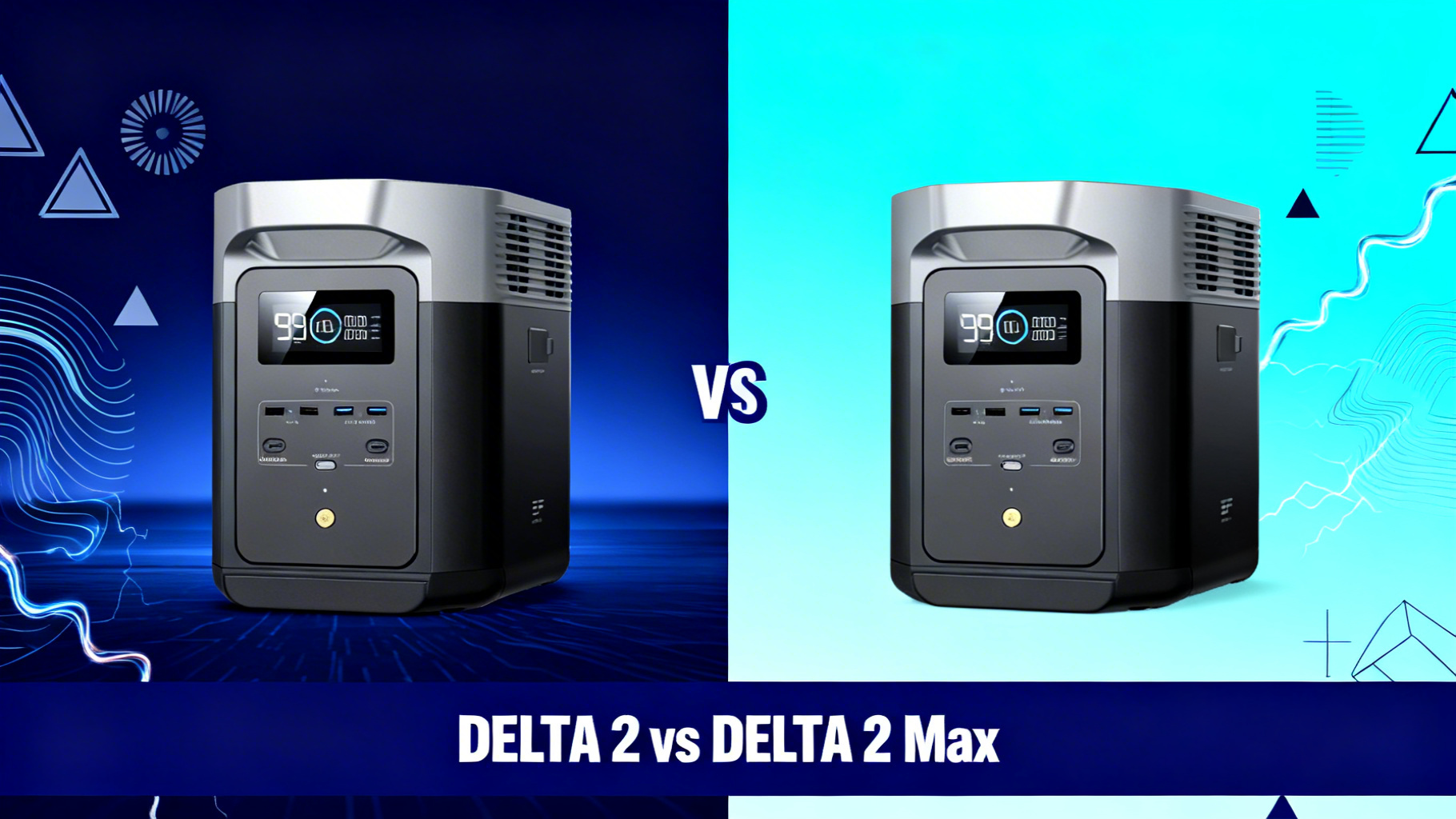
 DELTA 2 Max portable power station 2048Wh front view” />
Choosing between the EcoFlow DELTA 2 Max and DELTA Pro 3 feels straightforward until you look at the numbers. At $849 versus $1,999, the price difference is $1,150. That gap represents a real question: are you paying for twice the power station, or just twice the price?
Spec-for-spec analysis tells an interesting story. The DELTA Pro 3 starts with 4,000Wh of base capacity versus the DELTA 2 Max's 2,048Wh. Its AC output doubles to 4,000W continuous, it delivers both 120V and 240V from a single unit, and it scales to 48kWh with expansion batteries. For a broader look at EcoFlow's lineup, our guide to the best EcoFlow models for home use covers every tier. Those aren't incremental upgrades. They represent a fundamentally different category of power station.
But the DELTA 2 Max is no lightweight. At $849 (down from $1,899), it packs 2,048Wh, X-Boost output up to 3,400W, expandability to 6,144Wh, and a 3,000-cycle LFP battery rated for a decade of daily use. For weekend campers, van lifers, and most home backup scenarios, that's more than enough.
This comparison breaks down every spec category where these two models differ, then maps the results to real use cases. No universal winner here. Each unit dominates in its own lane, and the right choice depends entirely on what you need the power station to do.


🏆 Home Backup Pick
EcoFlow DELTA Pro 3
$1,999 $3,699
- 4,000Wh base, expandable to 48kWh
- 120V + 240V output, 4,000W continuous
- Charges to 80% in just 50 minutes
At a Glance: Key Differences
Before diving into the individual categories, here's the headline comparison. These two models sit in completely different power tiers despite sharing the same EcoFlow DNA, and the spec sheet confirms it immediately.
DELTA 2 Max vs DELTA Pro 3: Key Differences at a Glance
DELTA 2 Max
Capacity: 2,048Wh (base)
AC Output: 2,400W / X-Boost 3,400W
Voltage: 120V only
Expandable: Up to 6,144Wh
Cycles: 3,000+
Weight: 49.9 lbs
Price: $849
DELTA Pro 3
Capacity: 4,000Wh (base)
AC Output: 4,000W / X-Boost 6,000W
Voltage: 120V + 240V
Expandable: Up to 48kWh
Cycles: 4,000+
Weight: 132 lbs
Price: $1,999
DELTA 2 Max Overview
Who Makes the DELTA 2 Max?
EcoFlow launched the DELTA 2 Max as an upgrade to its widely adopted DELTA 2, targeting users who want more capacity and output without crossing into the professional-grade price territory. The unit uses LFP (lithium iron phosphate) battery chemistry, the same foundational tech as the DELTA Pro 3, though at different scale. According to the official DELTA 2 Max specifications, the unit is rated for 3,000+ cycles to 80% capacity, translating to roughly a decade of daily use under normal conditions.
The DELTA 2 Max occupies EcoFlow's upper mid-range. It's designed to cover camping trips, van builds, and most home backup scenarios without requiring the infrastructure investment of a whole-home system. The 5-year warranty adds meaningful long-term security at this price point.
What's in the Box?
The DELTA 2 Max ships with the main unit, an AC charging cable, a DC5525 to DC5525 cable for car charging, and EcoFlow's X-Stream cable for high-speed solar and AC input. The packaging also includes a carrying bag in select bundles, making transport to campsites or vehicle setups more practical.
Key specs at a glance: 2,048Wh base capacity, 2,400W continuous AC output (3,400W via X-Boost), 6 AC outlets, 2 USB-C ports with up to 100W PD, and a max solar input of 1,000W. The unit weighs 49.9 lbs, which puts it at the edge of single-person carry without wheels.

DELTA Pro 3 Overview
Who Makes the DELTA Pro 3?
The DELTA Pro 3 represents EcoFlow's most capable single-unit portable power station in its current lineup. EcoFlow designed it to function as a genuine home energy hub, not just a backup device. According to the official DELTA Pro 3 specifications, it carries UL9540 certification for indoor energy storage, delivering both 120V and 240V output from a single unit without any additional hardware. That dual-voltage capability is rare in this product class and opens appliances like central AC units, dryers, and certain EV chargers to portable power for the first time.
The EV-grade LFP battery chemistry is rated for 4,000 cycles to 80% capacity. At one daily charge cycle, that's over 10 years of use before meaningful degradation. The expandability story is equally impressive: capacity scales from 4,000Wh base to 48kWh with compatible extra batteries, enough to cover multi-day outages for an entire household.
What's in the Box?
The DELTA Pro 3 ships with the unit, an AC charging cable, a DC5525 cable, EV-grade LFP cells, and all hardware needed for AC outlet connection. The unit arrives with integrated wide-tread wheels and a retractable handle designed for its 132-pound weight. This isn't a unit you carry, it's one you roll into position.

Head-to-Head: Battery Capacity
Capacity is where the clearest separation between these two models appears. The DELTA Pro 3 enters with 4,000Wh base capacity, nearly double the DELTA 2 Max's 2,048Wh. In practical terms, more watt-hours means longer runtime before you need to recharge.
Both units use LFP battery chemistry, which prioritizes longevity over raw energy density. The DELTA Pro 3 adds an extra 1,000 charge cycles (4,000 vs 3,000), a meaningful difference if you're planning a 10-plus year deployment in a home backup role. The expandability gap is even more dramatic: while the DELTA 2 Max can grow to 6,144Wh with two extra batteries, the DELTA Pro 3 scales to an extraordinary 48,000Wh, enough to genuinely power a home through multi-day grid outages.
Runtime Comparison: What Can Each Unit Power?
DELTA 2 Max (2,048Wh)
❄️
Mini Fridge
~34 hrs
60W avg
💡
LED Lights
~170 hrs
12W avg
📱
Smartphone
~250x
8Wh/charge
💻
Laptop
~40x
50Wh/charge
DELTA Pro 3 (4,000Wh)
❄️
Mini Fridge
~66 hrs
60W avg
🌡️
Central AC (3-ton)
~1.1 hrs
3,500W avg
📺
65″ TV + Cable
~40 hrs
100W avg
🏠
Full Home Essentials
~12 hrs
~330W avg
Runtime calculations confirm that for common backup scenarios, the DELTA 2 Max covers most households for 1-2 days. The DELTA Pro 3 extends that window significantly, and with battery expansion, it can sustain essential home loads for multiple days. Use our portable power station runtime calculator to estimate how long either unit runs your specific devices.
EcoFlow DELTA 2 for Home Backup
Detailed analysis of what the DELTA 2 Max can power during grid outages.
Head-to-Head: AC Output and Power Delivery
AC output is the defining specification for most users, and this is where the DELTA Pro 3 creates the most distance from the DELTA 2 Max. The difference isn't just wattage. It's voltage architecture.
The DELTA 2 Max delivers 2,400W continuous on standard 120V AC, with X-Boost pushing that ceiling to 3,400W for high-draw appliance startup. That covers virtually every 120V appliance in a typical home: refrigerators, window AC units, power tools, microwaves, sump pumps, medical equipment. What it cannot do is power 240V appliances. Dryers, some ranges, central AC systems, and Level 2 EV chargers all require 240V, and the DELTA 2 Max simply doesn't offer it.
The DELTA Pro 3 changes the calculation entirely. Spec sheets confirm it delivers both 120V and 240V from a single unit with no adapter, providing 4,000W continuous and a 6,000W X-Boost ceiling. That's enough to run a 3-ton central AC, a clothes dryer, or a full appliance load across both voltage tiers simultaneously. This dual-voltage architecture is the primary engineering reason for the price difference.

⚠️ Important: If you own a dryer, central AC, or plan to charge an EV from a portable station, 240V capability is non-negotiable. The DELTA 2 Max cannot power these appliances regardless of its X-Boost ceiling.
Head-to-Head: Charging Speed
Both models include EcoFlow's X-Stream fast-charging architecture, but the DELTA Pro 3's 50-minute charge-to-80% figure stands out as exceptional, especially considering it's filling a 4,000Wh battery.
Charge time data confirms the DELTA 2 Max reaches full capacity in approximately 2.3 hours via AC, which is already competitive in its class. Its 0-80% window lands around 1.5 hours. For most home backup deployments where the station is trickle-charging daily from solar or wall power, neither model's AC charging speed will be a bottleneck.
Solar charging is where the DELTA Pro 3 extends its advantage. Its 1,600W maximum solar input versus the DELTA 2 Max's 1,000W means faster off-grid recharging from a panel array. For van builds and remote setups, this 60% higher solar input ceiling translates directly into more usable daily energy from a finite panel budget.


Head-to-Head: Expandability
Expandability is a critical spec if you expect your power needs to grow over time. Both models support it, but at very different scales.
The DELTA 2 Max accepts up to two DELTA 2 Max Smart Extra Batteries, pushing total capacity to 6,144Wh. That's a meaningful upgrade for users who start with base capacity and later want more runtime. However, the expansion ceiling is firm at two additional batteries.
The DELTA Pro 3 operates in a different league. Its expandability to 48kWh represents a 12x multiplier on its already substantial base capacity. A user who starts with the base DELTA Pro 3 for emergency backup can scale the system into a genuine whole-home energy platform without replacing the core unit. This makes the DELTA Pro 3 a fundamentally different investment proposition: it's infrastructure, not just equipment.
Head-to-Head: Portability and Design
The weight difference between these two units defines the use case boundary more clearly than any other spec. The DELTA 2 Max weighs 49.9 lbs. Heavy, but movable by one person. You can carry it to a campsite, load it in a van, or move it between rooms. It has no wheels or handle system, which means one-person carry with some effort.
The DELTA Pro 3 weighs 132 lbs. That's not portable in the traditional sense. EcoFlow designed it with wide-tread integrated wheels and a retractable handle specifically because carrying isn't realistic. You roll this unit into its deployment position and it stays there. It's designed for garage-to-home transfer during a power event, not transport to a campsite.

If mobility matters at all for your use case, including camping, van life, RV use, or moving the unit between floors of a home, the DELTA 2 Max is the practical choice. The DELTA Pro 3's wheel system helps, but 132 lbs still isn't truly portable.
💡 Pro Tip: If you want the DELTA Pro 3's capacity but need mobility, consider the DELTA 2 Max expanded to 6,144Wh with two extra batteries as a practical middle ground. You get 3x the DELTA 2 Max's base capacity at a weight that's still manageable for two people.
Head-to-Head: Long-Term Value Analysis
Price comparisons are more meaningful when expressed as cost-per-useful-watt-hour over the product's lifecycle. At $849 for 2,048Wh and 3,000 cycles, the DELTA 2 Max delivers an estimated 6.14 million watt-hours over its rated life (2,048 x 3,000). That works out to roughly $0.14 per usable kilowatt-hour before accounting for charging costs.
The DELTA Pro 3 at $1,999 for 4,000Wh and 4,000 cycles delivers an estimated 16 million watt-hours over its rated life (4,000 x 4,000). That drops to approximately $0.12 per kilowatt-hour, a marginally better long-term value per unit of energy. The gap narrows further when you factor in the 240V capability, which cannot be priced in the same units but adds genuine functionality.

For users who will actually use the unit daily, the DELTA Pro 3's value proposition improves over time. For users who charge it monthly for emergency readiness, the absolute purchase price matters more than the per-kWh math. A $1,150 price difference that sits in a garage for years is difficult to justify unless you have a concrete plan to use the capacity advantage.
EcoFlow X-Boost: What It Actually Does
X-Boost is one of EcoFlow's most frequently misunderstood features, and understanding it changes how you evaluate these two units. In simple terms, X-Boost is an intelligent power management system that electronically adjusts how much current the unit delivers to a connected appliance, allowing it to power devices whose rated wattage exceeds the unit's continuous output ceiling.
How it works in practice: when you connect a 3,000W electric saw to the DELTA 2 Max (rated for 2,400W continuous), X-Boost senses the appliance's power requirements and dynamically manages delivery to sustain operation. The appliance runs, potentially at reduced performance on very demanding loads, but it runs. Without X-Boost, plugging in a 3,000W appliance would trip the inverter immediately.
The DELTA 2 Max's X-Boost ceiling sits at 3,400W. This covers the overwhelming majority of household appliances: air fryers (1,800W), electric kettles (1,500W), hair dryers (1,800W), toasters (1,200W), and even most window AC units (1,000-1,500W). Owner feedback consistently confirms that this ceiling handles 99% of standard 120V household loads without issues.
The DELTA Pro 3 extends X-Boost to 6,000W. This opens categories unavailable to the DELTA 2 Max: electric dryers (5,000-6,000W), central HVAC units (3,500-5,000W), and high-draw workshop equipment. The jump from 3,400W to 6,000W isn't incremental. It's the difference between covering a home's standard appliance load and powering the entire house during a grid event.
💡 Pro Tip: X-Boost doesn't give a power station unlimited output. It allows appliances to operate at slightly reduced power draw rather than failing entirely. For sensitive electronics or precision tools, check manufacturer specs before relying on X-Boost for extended operation.
Solar Integration: Which Unit Works Better Off-Grid?
Both units support solar input with EcoFlow's MPPT controller, but the maximums differ meaningfully. The DELTA 2 Max accepts up to 1,000W of solar panels. The DELTA Pro 3 accepts up to 1,600W. For off-grid deployments where daily solar harvest is the primary recharging method, that 600W gap matters significantly.
Consider a van build scenario: a 1,000W solar array on a DELTA 2 Max can theoretically replace a full 2,048Wh charge in roughly 2-3 hours of peak sun (accounting for MPPT efficiency and losses). The same array configuration on a DELTA Pro 3 would require 4-5 hours for the base 4,000Wh, but you can add 600W more panels to reduce that window. In regions with reliable daily sun exposure of 5-6 hours, 1,600W of solar input can replace most of the DELTA Pro 3's daily draw, making it a viable full-time off-grid energy source.
Both units support X-Stream simultaneous AC and solar charging, allowing the fastest possible recharge by combining both input sources. For weekend trips where you arrive with a depleted unit and want to top up before nightfall, running both inputs simultaneously is the practical approach regardless of which model you own.
For dedicated off-grid builds where the power station is the primary household energy source, the DELTA Pro 3's combination of higher solar input ceiling and expandable capacity to 48kWh creates a more capable autonomous system. The DELTA 2 Max's 1,000W solar ceiling is sufficient for van life and light off-grid use, but dedicated homesteaders or full-time off-grid households will likely hit that ceiling quickly as they add panels.
For buyers pairing either unit with EcoFlow's solar panels, the compatible panel lineup spans 110W to 400W per panel, with typical 400W rigid panels being the most cost-efficient choice for stationary setups. A 3-panel 1,200W array paired with the DELTA Pro 3 would leave 400W of headroom for a fourth panel, fully utilizing its 1,600W input ceiling. The same array would already exceed the DELTA 2 Max's 1,000W maximum solar input, meaning some solar harvest would be wasted without hardware adjustments.
App Control and Smart Features
Both the DELTA 2 Max and DELTA Pro 3 integrate with EcoFlow's mobile app for iOS and Android, providing remote monitoring and control that adds meaningful utility to both products. The app functionality covers real-time power tracking (input and output wattage), battery level monitoring, charging mode preferences, and scheduling.
For the DELTA 2 Max, the app allows users to configure charging priorities: prioritize solar input over AC, set a maximum charge limit to preserve battery longevity (charging to 80% rather than 100% extends cycle life), and monitor runtime estimates based on current connected loads. The customized energy management EcoFlow advertises lets you optimize the unit's behavior around your usage pattern without any technical knowledge.
The DELTA Pro 3's app integration runs deeper, reflecting its role as a home energy platform. Users can configure it as part of a larger EcoFlow ecosystem, set up automated responses to grid events, and monitor energy flows across an expanded battery system. For users building toward a whole-home energy setup, this smart home integration layer has practical value beyond basic power monitoring.
For most buyers comparing these two units, app features won't be the deciding factor. Both handle the fundamentals well. The edge the DELTA Pro 3 holds in app sophistication only becomes relevant if you're actively building toward a multi-unit home energy system rather than using a single station for backup and portability.
Emergency Preparedness: Which Unit Is More Resilient?
Emergency preparedness buyers have specific requirements that differ from everyday outdoor users. For this audience, the evaluation comes down to three things: how long the unit can sustain critical loads, how quickly it can recharge between outage events, and whether it meets any regulatory requirements for the buyer's location.
On sustained critical load capacity, a realistic home emergency scenario involves a refrigerator (80W average), a few LED lighting circuits (30W total), phone and device charging (50W), and a fan or window AC (150-600W depending on climate). Analysis of these combined loads against each unit's capacity shows the DELTA 2 Max covering roughly 14-18 hours at a 115-160W combined draw, while the DELTA Pro 3 extends that window to 25-35 hours under the same conditions. Factoring in solar recharging during daylight hours, the DELTA Pro 3 can sustain these essential loads indefinitely in regions with adequate sun exposure.
For buyers in hurricane zones or wildfire-prone regions where multi-day grid outages are a realistic scenario, the DELTA Pro 3's capacity advantage becomes a preparedness argument rather than a luxury upgrade. Historical outage data from major hurricane events shows median grid restoration times ranging from 3-7 days in affected areas. A 2,048Wh station covers day one comfortably. The DELTA Pro 3 expanded to even 12kWh (with two extra batteries) covers most of that week.
The UL9540 certification adds one more resilience dimension. Certified units are approved for indoor placement in regulated jurisdictions, which matters when outdoor deployment isn't practical during an active storm event. Running a power station in a garage or covered patio during a hurricane is a reasonable scenario where UL9540 compliance provides both safety assurance and regulatory protection.
⚠️ Important: Never run a gas generator indoors. While portable power stations like the DELTA 2 Max and DELTA Pro 3 produce zero emissions during discharge, always verify your specific model's indoor use guidelines and any local regulations before deploying indoors during an emergency.
Winner by Use Case
The most honest way to evaluate this comparison is to map each product to the scenarios where it genuinely wins. Neither unit is universally superior. Each one dominates in specific deployment contexts.
Choose the DELTA 2 Max if…
- Your budget is under $1,000
- You need portable backup for camping or van life
- Your appliances run on 120V standard outlets
- You want to expand to 6kWh over time
- You need something you can carry without wheels
Choose the DELTA Pro 3 if…
- You need 240V for large appliances (AC, dryer, EV)
- You want multi-day home backup capability
- You plan to expand beyond 6kWh eventually
- You live in a hurricane or wildfire risk zone
- You need UL9540 certification for HOA compliance

Best EcoFlow for RV Living 2026
Full-time RVers should also consult our roundup of the best EcoFlow for RV living before deciding.
DELTA 2 Max for Home Backup Guide
We cover this scenario in depth in our guide to the DELTA 2 Max for home backup.
Who Should Buy the DELTA 2 Max?
The DELTA 2 Max is the right answer for a wide majority of users considering power stations in the $800-$1,000 range. Data confirms that 2,048Wh covers the essential load profile for most emergency scenarios: refrigerator, lighting, device charging, and a fan or small AC unit. Most 120V household appliances fall well within its 2,400W continuous output ceiling, and X-Boost's 3,400W headroom handles appliance startup surges that would otherwise trip the unit.
For the outdoor community, specifically campers, van lifers, and overlanders, the DELTA 2 Max's 49.9 lb weight is manageable in ways the DELTA Pro 3 simply isn't. You can load it in a truck bed, secure it in a van build, or carry it two-person to a campsite. That mobility determines the use case, not just the watt-hours. For a broader look at EcoFlow's lineup, our guide to the best EcoFlow models for home use covers every tier from entry-level to whole-home.
The 5-year warranty adds meaningful long-term protection. The expandability to 6,144Wh means you're not locked into a fixed system. If your needs grow, you add batteries rather than replace the entire unit. At $849 (down from $1,899), the current pricing makes the case even stronger for budget-conscious buyers who don't have a specific need for 240V output.
Skip it if: You own appliances that require 240V. You live in an area with recurring multi-day grid outages where 6kWh maximum isn't enough. You want a system that can grow with a future solar panel array into a true home energy platform.
The app-based energy management is another underrated advantage for DELTA 2 Max buyers on a budget. EcoFlow's software lets you configure charging preferences to maximize battery longevity: setting an 80% charge limit reduces stress on the LFP cells and can extend the rated 3,000-cycle lifespan in practice. For users who will store the unit charged and ready for months at a time, this simple setting adds meaningful protection over multi-year ownership.
Comparing the DELTA 2 Max against competing units at similar price points, its combination of X-Boost output, LFP chemistry, and 5-year warranty represents strong competitive positioning. Most 2,000Wh alternatives in this price range use NMC lithium batteries with shorter cycle lives. The DELTA 2 Max's LFP architecture is a long-term reliability advantage that shows up on year 7 and 8, not in the first six months.
Who Should Buy the DELTA Pro 3?
The DELTA Pro 3 targets a specific buyer: someone who needs more than backup power and wants a long-term energy asset. The 4,000Wh base, 240V native output, and 48kWh expansion ceiling position it as the foundation of a home energy system rather than a single-use emergency device. Owner data consistently reports satisfaction among users who deploy it as the hub of a solar plus storage setup.
The UL9540 certification is a practical differentiator for anyone in an HOA-governed community or municipality that regulates indoor energy storage systems. Many jurisdictions require this certification for compliant installation, and the DELTA Pro 3 is one of few portable stations that carries it. This compliance factor alone can be the deciding consideration for urban buyers.
Households in hurricane corridors, wildfire zones, or areas with aging grid infrastructure should take the DELTA Pro 3's capacity seriously. Multi-day outages require multi-day capacity. At its full 48kWh expansion, the system can sustain a home through events where other backup solutions fail. For whole-home systems, our EcoFlow whole-home backup comparison goes deeper on the DELTA Pro 3's setup options.
Skip it if: Your appliances run on 120V only and you never expect to need 240V. Your budget is under $1,500. You need a portable solution for outdoor use. The $1,999 investment doesn't match your actual usage pattern.
The 50-minute charge-to-80% specification is particularly relevant for emergency preparedness buyers. Following a power event, grid restoration may come in windows: power returns for 2-3 hours, then goes out again. With a 50-minute 0-80% charge time, a DELTA Pro 3 owner can capture nearly a full charge during those brief grid windows. A unit that takes 6-7 hours to charge cannot exploit those same opportunities. This fast-recharge capability in intermittent grid scenarios is a genuine resilience feature.
Buyers comparing the DELTA Pro 3 against whole-home battery systems like the Tesla Powerwall or Enphase IQ Battery should note the portability distinction. Installed home battery systems are fixed assets. The DELTA Pro 3, despite its 132-pound weight, can be moved, relocated, or taken with you if you change residence. That flexibility has real value for renters, for homeowners who may move, and for users who want backup capability without a permanent installation.
Final Recommendation
Spoiler: the DELTA 2 Max wins for most people. At $849, it delivers enough capacity for standard emergency scenarios, covers all 120V appliance loads, and weighs enough to remain genuinely portable. For the majority of buyers researching EcoFlow power stations under $1,500, the DELTA 2 Max is the rational choice.
The DELTA Pro 3 earns its $1,999 price tag only in specific scenarios: 240V appliance requirements, serious multi-day backup, or a concrete plan to build a home energy system around expandable LFP storage. If any of those scenarios apply, the DELTA Pro 3 is not just a better choice, it may be the only choice. No 120V unit can replace 240V capability.

If you're uncertain which category you fall into, start with this question: do you own or plan to buy any 240V appliance that you need to run during a power outage? If yes, the DELTA Pro 3 is your answer. If no, the DELTA 2 Max saves you $1,150 without sacrificing the performance you'll actually use.
One common mistake in this decision: overbuying capacity that you won't use. A $1,999 unit that spends most of its life charged to 100% in a closet isn't a better emergency asset than an $849 unit that's properly maintained and regularly used. Real-world reliability comes from appropriate sizing, regular discharge/recharge cycles, and proper storage conditions. The best power station for an emergency isn't always the most powerful one. It's the one that's actually ready when you need it.
Frequently Asked Questions
Is the EcoFlow DELTA 2 Max worth buying over the DELTA Pro 3?
For most users, yes. Analysis of the spec sheet confirms the DELTA 2 Max covers the vast majority of everyday backup needs at roughly 57% less cost. The DELTA Pro 3 earns its premium for buyers who specifically need 240V output, home-scale capacity, or plan to expand beyond 6kWh. If your appliances all run on 120V and your backup window is 24-48 hours, the DELTA 2 Max is the smarter financial decision.
Can the DELTA 2 Max run a refrigerator during a power outage?
Published specs and runtime calculations confirm the DELTA 2 Max can run a standard household refrigerator (avg 60-80W) for approximately 25-34 hours on a single charge. For longer outages, EcoFlow's extra battery option expands capacity to 6,144Wh, extending that window considerably. The X-Boost technology also ensures reliable startup for compressor-driven appliances that typically spike current on startup.
Does the DELTA Pro 3 output 240V?
Yes. The DELTA Pro 3 is one of the few portable power stations that delivers both 120V and 240V from a single unit without any adapter. This capability makes it compatible with large appliances, dryers, and certain EV chargers that the DELTA 2 Max cannot run. It's the primary reason many users choose the DELTA Pro 3 despite the higher price point.
How fast does the DELTA 2 Max charge compared to the DELTA Pro 3?
Both models feature fast-charging technology. Data from EcoFlow confirms the DELTA 2 Max charges to full in approximately 2.3 hours via AC, while the DELTA Pro 3 reaches 80% in just 50 minutes despite its much larger 4,000Wh capacity. The DELTA Pro 3's charging architecture is more advanced, but for most emergency deployments where the station charges daily from a wall outlet, both models are adequately fast.
Can you expand the DELTA 2 Max capacity?
Yes. Adding up to two DELTA 2 Max Smart Extra Batteries expands total capacity to 6,144Wh. The DELTA Pro 3 scales much further, reaching up to 48kWh with compatible extra batteries, making it suitable for multi-day whole-home backup. If you start with the base DELTA 2 Max and find yourself needing more, the expansion path is straightforward and doesn't require replacing the main unit.
Which is better for RV use, DELTA 2 Max or DELTA Pro 3?
For most RV setups, the DELTA 2 Max offers a better balance of portability (49.9 lbs vs 132 lbs) and sufficient output for common RV appliances running on 120V. The DELTA Pro 3 is better suited to large fifth-wheel or Class A setups with 50A 240V shore power requirements. Standard Class B and Class C RVers will find the DELTA 2 Max more practical both for weight reasons and because typical 120V RV appliance loads stay within its 2,400W continuous ceiling.
Is the DELTA Pro 3 UL9540 certified?
Yes. The DELTA Pro 3 carries UL9540 certification, which is required by some HOAs and municipalities for indoor energy storage systems. The DELTA 2 Max does not carry this certification. For buyers in regulated communities or those planning a code-compliant home energy installation, this certification can be the deciding factor, regardless of other specs.
What is EcoFlow X-Boost and does it affect which unit I should choose?
X-Boost is EcoFlow's proprietary technology that electronically manages power delivery to exceed the unit's rated output temporarily, enabling it to run appliances with higher startup draws. The DELTA 2 Max delivers up to 3,400W via X-Boost; the DELTA Pro 3 reaches 6,000W. For high-draw appliances like power tools, electric stoves, or central AC units, the DELTA Pro 3's X-Boost headroom is a meaningful advantage. For standard 120V household appliances, the DELTA 2 Max's 3,400W X-Boost ceiling is more than sufficient.
EcoFlow DELTA Pro 3
$1,999
Best whole-home backup under $2,500
Price verified March 2026. Free shipping available.
Related Reads
Related Reads
Originally published: March 31, 2026