
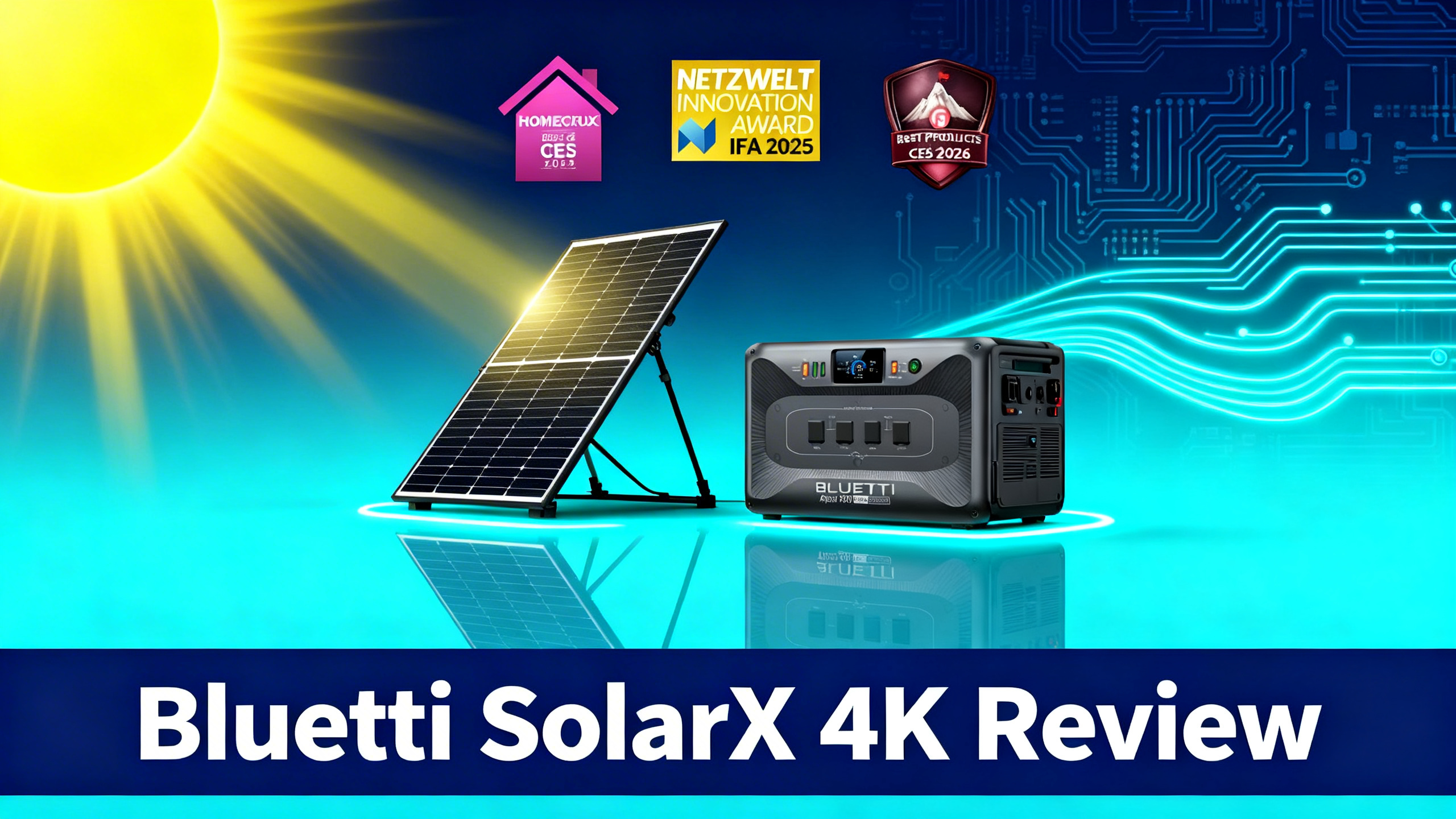
The Bluetti SolarX 4K isn't a solar panel you stumble across while browsing a product catalog. It's a purpose-built system component: four 300W panels linked in series, designed exclusively for one station and one station only. If you own the Apex 300, or you're planning to buy it, this panel array is the fastest path to a full recharge from the sun.
At $2,448 for the base bundle (Apex 300 + SolarX 4K, down from $3,048), the question isn't whether the panel is technically impressive. It is. The question is whether 1,200W of solar input is what your setup actually needs, and whether the bundle pricing makes sense for your situation. This review covers exactly that.
One thing to know upfront: the SolarX 4K is not sold as a standalone accessory. It ships only as part of bundle packages with the Apex 300. This is an important distinction that shapes every buying decision covered below. For a comparison across the full panel lineup, including the 350W and 200W options, that guide covers all wattages side by side.

Bluetti Apex 300 + SolarX 4K Bundle
$2,448 $3,048
- 1,200W combined solar input via SolarX 4K
- Apex 300 delivers 3,000W AC output / 3,072Wh
- Save $600 vs buying separately
What Is the Bluetti SolarX 4K?
The SolarX 4K is a four-panel solar array rated at 1,200W total. Each of the four panels delivers 300W, and they connect in series through Bluetti's proprietary P090D high-current connector. The “4K” designation refers to the system's theoretical daily energy production under ideal conditions, not a storage figure.

The panel is engineered exclusively for the Apex 300 the SolarX 4K pairs with, which delivers 3,072Wh and 3,000W continuous AC output. Bluetti built the SolarX 4K to maximize that station's solar input ceiling, which sits at 1,200W. No other Bluetti station currently accepts the P090D connector or handles this input level, so the pairing is locked.
Why did Bluetti create a panel exclusive to one model? The Apex 300 targets home backup and semi-permanent off-grid installations where recharge speed matters as much as capacity. A 1,200W solar input means you can theoretically recover the full 3,072Wh in under three hours on a clear day. That's a meaningful operational advantage if you're running the station as primary power for a cabin, workshop, or emergency home setup.
Bluetti Solar Panels: Full Lineup Compared
See how the SolarX 4K stacks up against the 350W and 200W options across price, wattage, and portability.
SolarX 4K Specs and Panel Design
The specs for the SolarX 4K are straightforward once you understand the system architecture. Four panels at 300W each, wired in series, feeding into the Apex 300 via the P090D connector. The rated peak input of 1,200W matches the Apex 300's maximum solar acceptance exactly. No wattage is left on the table.

Source: official SolarX 4K product page
The P090D connector deserves attention because it's a genuine limitation. Standard Bluetti panels use XT60 or aviation-style connectors that work across multiple stations. The P090D is specific to the Apex 300 ecosystem. If you ever upgrade to a different power station down the road, the SolarX 4K doesn't come with you.
How does it compare to Bluetti's other panels on a per-watt basis? The 350W panel sells for approximately $299 standalone, putting it at roughly $0.85 per watt. The SolarX 4K, priced within the bundle at implied cost, comes in considerably cheaper per watt once you're targeting 1,000W or more of solar capacity for the Apex 300. Buying three or four individual 350W panels to reach the same wattage would cost more and require multiple connection points.
Bluetti Apex 300 Review: Full Specs and Analysis
Everything you need to know about the station the SolarX 4K is built for.
Real-World Solar Performance
Charge time calculations based on rated capacity and 1,200W peak input show the Apex 300's 3,072Wh can be recovered in approximately 2.6 hours under ideal conditions. That's a strong number. But ideal conditions require direct sun, optimal panel angle, and ambient temperatures that don't push the cells into thermal throttling.
Performance data for the SolarX 4K under real-world conditions tells a more nuanced story. On partly cloudy days, effective input typically drops to 500-600W, pushing charge time to 5-6 hours. Latitude and season matter significantly: a panel delivering 1,200W in Arizona in July may produce 600-700W in the Pacific Northwest in October. According to U.S. Department of Energy solar efficiency data, real-world panel output routinely runs 10-25% below STC ratings due to heat, angle, and atmospheric conditions.
Apex 300 (3,072Wh) Estimated Charge Times with SolarX 4K (1,200W)
☀️
Peak Sunshine
~2.6 hrs
1,200W input / 3,072Wh
⛅
Partly Cloudy
~5–6 hrs
~500–600W effective
🔋
+ B300K (6,144Wh)
~5.1 hrs
Peak sun, full system
⚡
AC Combo Charge
~1.5 hrs
Solar + AC wall combined
Charge time calculations based on rated capacity and peak solar input. Real-world results depend on sun angle, ambient temperature, and panel orientation.
One performance factor worth highlighting is the series wiring configuration. Because all four panels operate in series, shading on a single panel reduces output for the entire array. Analysis of series-wired solar configurations consistently shows that even partial shade covering 20% of one panel can drop total array output by 30-50%. If your installation site has trees, roof overhangs, or any obstacle that casts shadows during peak hours, this is a critical placement consideration.


The AC combination charging option is worth factoring into your planning. Combining the SolarX 4K solar input with AC wall charging, the Apex 300 can reach full charge in approximately 1.5 hours. For installations where grid power is available as a backup, this hybrid approach eliminates dependence on weather conditions for fast recharge.
How to Connect the SolarX 4K to the Apex 300
Connecting the SolarX 4K is mechanically straightforward. The four-panel array arrives pre-wired and terminates in a single P090D connector. You plug that connector into the designated solar input port on the Apex 300, then open the Bluetti app to activate solar charging mode. The station's MPPT (Maximum Power Point Tracking) controller takes over from there, optimizing the incoming current to maximize charge efficiency.
⚠️ Important: The SolarX 4K uses a P090D connector that is incompatible with any other Bluetti power station. Do not attempt to modify or adapt the connector for use with the AC200L, Elite 200 V2, or any other model. Doing so voids the warranty and risks damaging both the panel and the station.
For optimal output, position the panels at an angle between 30 and 45 degrees facing south (in the Northern Hemisphere). Adjusting angle every 2-3 hours as the sun moves can increase daily harvest by 20-30% compared to a fixed flat position. Avoid positioning the array where shadows from trees, chimneys, or rooftop equipment can fall across any panel, even partially, during peak sun hours.
For a full wiring walkthrough including cable routing and app configuration, see the Apex 300 full solar setup guide.
Which Bundle Should You Choose?

Three bundle configurations are available. The entry point is the Apex 300 + SolarX 4K at $2,448, down from $3,048. The mid-tier adds a B300K expansion battery for $3,597 (originally $4,697). A third tier with dual B300K batteries reaches $4,848. Here's how to decide.
The base bundle suits users who want maximum solar recharge speed for day-to-day use and don't need multi-day outage coverage. The 3,072Wh capacity handles most 24-hour outage scenarios comfortably, running a refrigerator, lighting, phone charging, and a CPAP machine through a full night without stress.
The Apex 300 + B300K + SolarX 4K bundle at $3,597 makes sense if you're planning for extended outages or running higher-draw appliances. The B300K adds another 3,072Wh, bringing total system capacity to 6,144Wh. Spec analysis confirms this doubles your runtime without requiring any additional solar panels. The SolarX 4K still charges the full 6,144Wh system, just in approximately 5.1 hours at peak sun rather than 2.6. A broader look at all panel options for Apex 300 includes the 350W rigid panel and 200W foldable, which suit tighter budgets or rooftop installs.
SolarX 4K vs Other Panel Options
For Apex 300 owners evaluating solar input options, the comparison comes down to three Bluetti panels: the 200W foldable, the 350W rigid, and the SolarX 4K. The economics shift depending on how much wattage you're targeting.
At 200W for approximately $209 and 350W for approximately $299 standalone, those panels work across multiple Bluetti stations and offer genuine portability. They're the right choice if you're building a flexible setup that might change stations, or if you only need 200-700W of solar input. At that scale, the individual panels are more cost-effective and easier to reposition.
The SolarX 4K's cost advantage appears when you're targeting 1,000W or more specifically for the Apex 300. Reaching 1,200W using individual 350W panels would require four units at roughly $1,200 total, plus four separate connection adapters, versus the integrated SolarX 4K system included in the bundle. The math favors the SolarX 4K for high-wattage builds, but only if the Apex 300 is your station. The P090D exclusivity is a hard constraint that doesn't bend.
Who Is the SolarX 4K For?

✅ Buy this bundle if…
- You want the fastest possible solar recharge for the Apex 300
- You're planning off-grid home backup where grid access is unreliable
- You need 3+ kWh recharged in a single sunny afternoon
- You're building a permanent solar setup (cabin, garage, workshop)
❌ Skip this if…
- You don't own (or plan to buy) the Apex 300 (it's exclusive to that station)
- Portability is a priority: 4 linked panels limit mobility
- Your budget tops out at $1,500 (look at 200W or 350W single panels instead)
- You only need occasional top-ups, not full daily recharges
The SolarX 4K targets a specific buyer: someone committed to the Apex 300 ecosystem who needs serious solar throughput. Cabin owners running essential loads off-grid, homeowners in areas with frequent multi-day outages, and workshop users who rely on the Apex 300 as primary power are all strong fits. The 2.6-hour full-recharge window under good sun means you can cycle through a full charge and discharge within a single day.
Where it doesn't fit: anyone prioritizing flexibility. The P090D connector, the fixed four-panel format, and the bundle-only availability all reduce modularity. If you're camping occasionally or want panels that work across different stations, individual 200W or 350W panels are a better long-term investment.
SolarX 4K Verdict

The bluetti solarx 4k earns its place as the definitive solar companion for the Apex 300, but it's genuinely niche. Analysis of the specs, pricing, and use-case fit points to a strong product for the right buyer and a poor fit for everyone else.
Strengths: 1,200W is the fastest solar input the Apex 300 supports, and the SolarX 4K delivers it efficiently. The IP65 rating handles outdoor installation without concern. Bundle pricing offers real savings on a per-watt basis at this capacity level. The P090D connector provides a clean, high-current single-cable connection.
Limitations: Exclusive to the Apex 300. Not sold separately. Series wiring makes the array sensitive to partial shading. Four panels linked together are less portable than individual units. If Bluetti's ecosystem roadmap changes, there's no guarantee of future compatibility.
Overall score: 8.5/10. For Apex 300 owners who need maximum solar throughput, it's the right tool. For everyone else, it's the wrong product entirely. For a complete look at the full Bluetti lineup, the full Bluetti brand review covers every model and ecosystem.
Apex 300 + SolarX 4K
$2,448
Best entry point for 1,200W solar charging
Price verified April 2026. Free shipping available
Frequently Asked Questions
Can you buy the Bluetti SolarX 4K separately, without the Apex 300?
Based on current Bluetti catalog data, the SolarX 4K is not available as a standalone purchase. It ships exclusively as part of bundle packages with the Apex 300 power station. This makes the SolarX 4K a system component rather than an independent accessory. If you already own an Apex 300 and want to add the SolarX 4K later, you would need to purchase one of the available bundles and add the station to an existing setup.
Is the SolarX 4K compatible with other Bluetti power stations like the AC200L or Elite 200 V2?
No. The SolarX 4K uses a proprietary high-current P090D connector designed specifically for the Apex 300. It is not compatible with other Bluetti models, which use standard XT60 or aviation-style solar connectors. Spec analysis confirms the voltage and current ratings also match exclusively with the Apex 300's solar input parameters. Attempting to adapt the P090D connector for use with other stations risks damaging both the panel and the station and voids the warranty.
How long does it take the SolarX 4K to fully charge the Apex 300?
Runtime calculations based on the 3,072Wh capacity and 1,200W rated input show an estimated charge time of approximately 2.5 to 3 hours under peak solar conditions (direct sun, optimal panel angle). On partly cloudy days with effective input dropping to 500-600W, charge time extends to 5-6 hours. Adding a B300K expansion battery brings total capacity to 6,144Wh, which charges in approximately 5.1 hours at peak sun. Combining solar with AC wall charging reduces total time to approximately 1.5 hours regardless of weather.
What happens if one of the four panels in the SolarX 4K array is shaded?
Because the four panels operate in series, partial shading on a single panel reduces output for the entire array. Performance data from series-wired configurations consistently shows that even 20% shading on one panel can reduce total system output by 30 to 50 percent. This is the key placement consideration for the SolarX 4K. Choose an installation site with unobstructed sun exposure throughout peak hours, and avoid locations where trees, roof edges, or structures cast shadows across any portion of the array.
Is the Apex 300 + B300K + SolarX 4K bundle worth the extra cost vs the base bundle?
The upgrade from the $2,448 base bundle to the $3,597 B300K bundle adds 3,072Wh of expansion capacity, effectively doubling the system to 6,144Wh. For home backup scenarios where multi-day outage coverage is the priority, spec analysis confirms the B300K bundle delivers significantly better value per watt-hour stored. The $1,149 difference buys a meaningful jump in resilience. For users whose primary goal is day-to-day fast recharge rather than extended storage, the base bundle is sufficient.
Originally published: April 7, 2026