
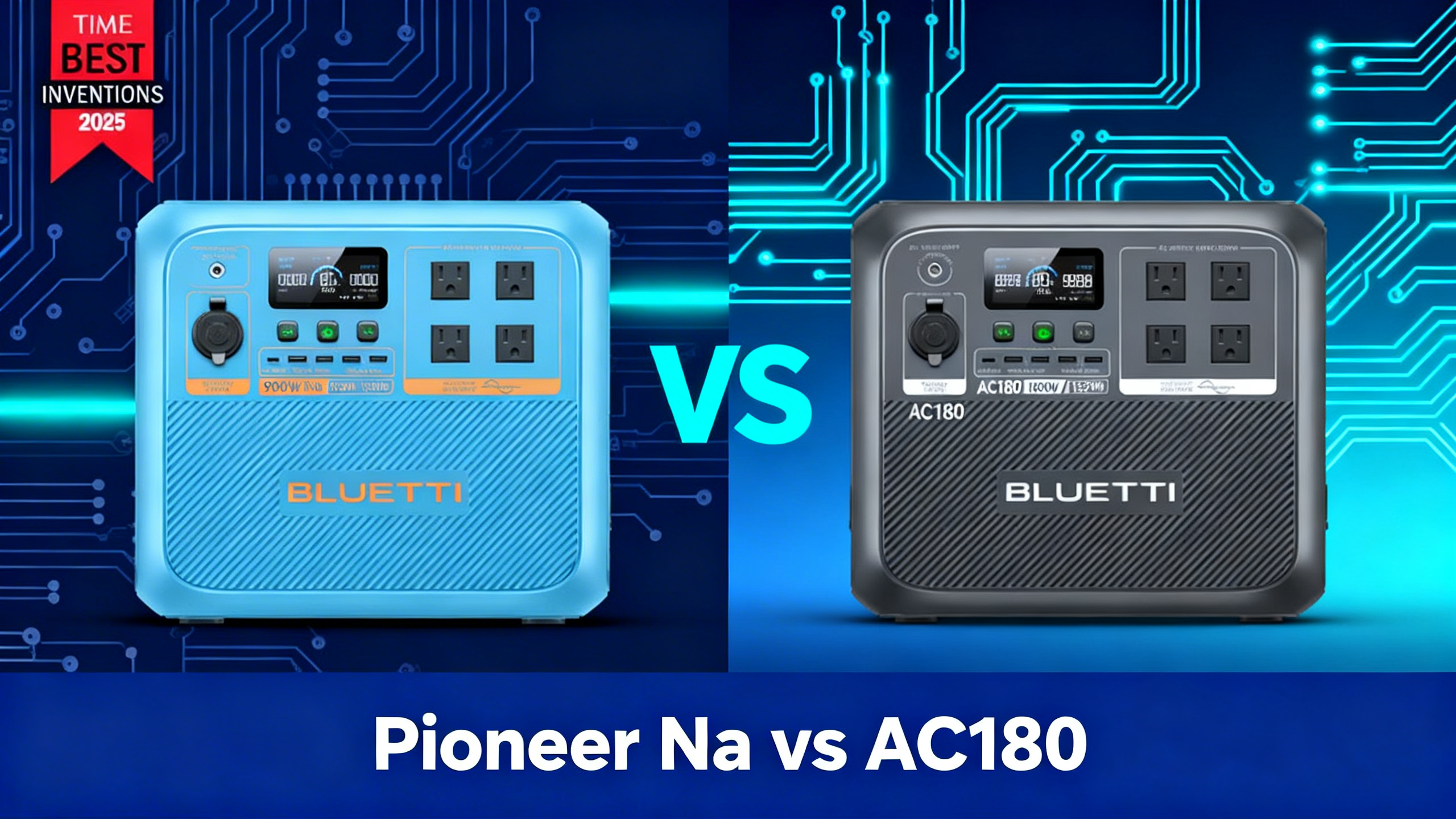
The Pioneer Na is the first consumer sodium-ion power station on the market. The AC180 is one of Bluetti's most reliable mid-range units. At $300 apart, picking between them isn't obvious.
On paper, the gap looks straightforward: the AC180 offers more raw capacity (1,152Wh vs 900Wh) at a lower price ($499 vs $799). But the Pioneer Na brings a genuinely new battery chemistry to the table, one that published data confirms handles cold temperatures and charge cycles differently than any lithium unit on the market. Whether that matters depends entirely on how and where you use your power station.
This comparison covers the six factors that actually determine which unit fits your needs: battery chemistry, capacity, AC output, charging speed, cold weather performance, and long-term cost of ownership. The Bluetti Pioneer Na is currently discounted to $799 from $1,299. For a broader look at the full lineup, our Bluetti brand review covers every model in depth.

Best for Cold Weather
Bluetti Pioneer Na
900Wh sodium-ion | 1,500W | -25°C
$799 $1,299

Best Value Pick
Bluetti AC180
1,152Wh LiFePO4 | 1,800W | 45min fast charge
$499 $699
Quick Verdict
Battery Technology: Sodium-Ion vs LiFePO4 Explained
The core difference between these two units isn't a spec on a sheet. It's the underlying chemistry that determines how the battery performs across temperature, charge rate, and long-term degradation.
The AC180 uses LiFePO4 (lithium iron phosphate), a mature and well-tested chemistry that has dominated the portable power station market for the past several years. Published data on LiFePO4 confirms good thermal stability, a cycle rating of 3,000+ charges before significant capacity loss, and proven reliability across mainstream use cases. It's the chemistry in most premium power stations, and the AC180 is a strong implementation of it.

The Pioneer Na uses sodium-ion (Na-ion) chemistry. Published research on Na-ion cells confirms several structural advantages over lithium at extreme temperatures: the sodium ion moves more freely through the electrolyte at sub-zero temperatures, which means less performance degradation in the cold. Manufacturer specifications rate the Pioneer Na for discharge operation down to -25°C (-13°F), five degrees lower than the AC180's cold-weather ceiling. Na-ion also supports faster charge rates at a structural level, which explains the Pioneer Na's 1,900W fast-charge input versus 1,440W on the AC180. The trade-off is energy density: Na-ion cells store slightly less energy per unit of volume than LiFePO4, which is why the Pioneer Na's 900Wh capacity comes in a chassis similar in size to the AC180's 1,152Wh unit.
Specs Comparison: Pioneer Na vs AC180
The headline numbers tell part of the story. The AC180 leads on raw capacity and AC output wattage. The Pioneer Na counters with faster charging, better cold weather tolerance, and a longer rated cycle life. Neither model dominates across every spec, which is what makes the choice interesting.


One spec worth noting beyond the table: AC surge capacity. The Pioneer Na actually leads here at 3,000W versus the AC180's 2,700W, despite having lower continuous output. For appliances with high startup draws (compressors, power tools), that surge headroom matters more than the continuous wattage difference.
Charging Speed and Recharge Options
The Pioneer Na's 1,900W AC input is one of its strongest arguments. Spec data confirms a 0-to-80% charge in approximately 30 minutes, with a full charge completed well under an hour. For users who regularly need to top up quickly between uses, or who can only access grid power for a short window, that advantage is real and meaningful.

The AC180 charges at 1,440W AC input, reaching 80% in roughly 45 minutes. That's still fast relative to most power stations in the segment, and Bluetti's 1,152Wh capacity means you're moving more electrons through the same time window. Solar input for the AC180 accepts up to 500W via MPPT. The Pioneer Na accepts solar input up to 200W, connected via its Pioneer Na official product page compatible MC4 connectors. For solar-heavy setups, the AC180's higher solar input ceiling is a concrete advantage.
Bluetti Pioneer Na
World's first Na-ion power station, 4,000+ cycle lifespan
$799 $1,299
Runtime: What Can Each Unit Power?
Runtime calculations based on published capacity figures show the AC180 with a natural edge for most appliance scenarios. Its 1,152Wh capacity provides approximately 14 hours of runtime for an 80W mini-fridge versus roughly 11 hours from the Pioneer Na's 900Wh bank. For a 10W LED lighting setup, that gap widens: around 115 hours for the AC180 versus 90 hours for the Pioneer Na. Use our power station runtime calculator to model your exact appliance mix against either unit's capacity.
Runtime Comparison: What Can Each Unit Power?
Pioneer Na, 900Wh
🔌
Mini Fridge
~11 hrs
80W avg
💡
LED Lights
~90 hrs
10W avg
📱
Phone
~70 chg
13Wh/chg
AC180, 1,152Wh
🔌
Mini Fridge
~14 hrs
80W avg
💡
LED Lights
~115 hrs
10W avg
📱
Phone
~89 chg
13Wh/chg
For most camping and backup scenarios, the capacity gap is manageable. But if you're running a CPAP machine (30-60W), a portable induction cooktop (1,200-1,800W in bursts), or a chest freezer overnight, the AC180's extra 252Wh adds meaningful buffer. The Pioneer Na's runtime figures are solid for weekend use. Full-time off-grid users may feel the 900Wh ceiling more consistently.
Cold Weather Performance
This is where the sodium-ion chemistry creates a meaningful separation. The Pioneer Na is rated for discharge operation down to -25°C (-13°F). Published data on Na-ion cell behavior at low temperatures confirms the chemistry maintains ion mobility significantly better than lithium-based cells, which experience increased internal resistance as temperatures drop. For users in Alaska, northern Canada, Scandinavia, or anyone doing serious winter camping, that five-degree buffer versus the AC180's -20°C rating is not just a marketing number.

The AC180 handles cold conditions better than many non-LiFePO4 competitors, but owner feedback patterns suggest noticeable capacity reduction when temperatures dip below -15°C. That's expected behavior for lithium chemistry. For users operating consistently in mild winters (above freezing), neither unit presents a significant cold-weather concern. For sustained sub-zero conditions, the Pioneer Na is structurally better suited.
💡 Pro Tip: If you store either unit outdoors in winter, bring it inside to warm up before heavy use. Even the Pioneer Na benefits from operating closer to ambient room temperature for maximum output efficiency.
Price and Value Analysis
At face value, the AC180 wins on price-per-Wh by a wide margin: $0.43/Wh versus $0.89/Wh for the Pioneer Na. That gap is hard to ignore, especially for buyers who primarily care about how much backup power they're getting for their dollar today.
The longer view is more nuanced. Data on total cost of ownership over a 10-year horizon narrows the gap significantly. The Pioneer Na's 4,000+ rated cycle life versus the AC180's 3,000+ cycles means the sodium-ion unit sustains usable capacity through more charge-discharge events before degradation. For daily or near-daily users, that difference translates to extended service life without replacement. The Pioneer Na's $799 price divided across 4,000 cycles comes to roughly $0.20 per cycle. The AC180 at $499 across 3,000 cycles is approximately $0.17 per cycle. The cost-per-cycle difference is smaller than the upfront price gap suggests. The AC180 official specs page confirms the LiFePO4 cycle rating independently.
Who Should Buy the Pioneer Na?
The Pioneer Na targets a specific type of buyer. If you recognize yourself in the list below, the $300 premium over the AC180 is justified by specs and technology, not marketing.
- You live in or regularly operate in cold-weather regions where temperatures drop below -20°C
- You want the longest rated battery lifespan available in a mid-size unit (4,000+ cycles, 10-year rating)
- Fast recharge time is critical and 30 minutes to 80% is a meaningful operational advantage
- You're an early adopter drawn to new battery chemistry and willing to pay the technology premium
- Long-term durability and lower replacement frequency are the priority over raw Wh-per-dollar
For the full deep-dive on specs and real-world performance data for this unit alone, see our full Pioneer Na review.
Choose Pioneer Na if…
- You live in a cold-weather region (below -20°C)
- You want the longest battery lifespan (4,000+ cycles)
- Fast recharge time is critical (30 min to 80%)
- You're an early adopter drawn to new battery tech
- Budget is $799 and long-term durability is the priority
Choose AC180 if…
- You need more capacity (1,152Wh vs 900Wh) on a tighter budget
- Higher AC output is required (1,800W vs 1,500W)
- You prefer a well-tested, proven lithium platform
- Budget is $499 and raw Wh-per-dollar matters most
- Solar charging compatibility with existing panels is needed
Who Should Buy the AC180?

The AC180 is the right choice for buyers who want proven performance, more raw capacity, and a lower entry price. It's a mature, well-documented platform with a track record across thousands of owners. The Bluetti AC180 is currently available at $499 (from $699). Our full AC180 review breaks down every spec and real-world runtime in detail.
- You need higher continuous AC output (1,800W handles more demanding appliances)
- Capacity matters more than chemistry: 1,152Wh covers a wider range of overnight use cases
- Solar input flexibility is important, with the AC180's 500W solar max covering larger panel arrays
- The $499 price point fits your budget and you want a unit with a proven ownership record
See how all Bluetti models stack up
Not sure where these two fit in the broader lineup?
Final Verdict: Pioneer Na vs AC180, the Bottom Line
If you're still undecided between multiple Bluetti options, our guide to all Bluetti models ranked puts every unit in context.
For most buyers, the AC180 delivers the better value proposition. At $499, it provides more raw capacity (1,152Wh), higher continuous output (1,800W), and a proven LiFePO4 platform at $0.43/Wh. Spec analysis consistently points to the AC180 as the pragmatic choice for camping, road trips, and home backup scenarios that don't involve extreme cold.
The Pioneer Na earns its premium for a specific audience. If you operate below -20°C, charge daily and want the best rated longevity available, or are drawn to being an early adopter of sodium-ion technology, the $799 price is supported by the chemistry's published advantages. It's not a better power station in every category. It's a better power station for a narrower set of use cases, and for those use cases, it's clearly the right call.
Bluetti Pioneer Na
$799
Best for all-weather reliability and long-term ownership
Price verified April 2026, free shipping available
Frequently Asked Questions
Is the Bluetti Pioneer Na worth the $300 premium over the AC180?
For most users, spec analysis indicates the AC180 delivers better raw value at $0.43/Wh versus $0.89/Wh for the Pioneer Na. However, if cold weather operation below -20°C or an extended 10-year lifespan is the priority, the Pioneer Na premium is justified by published cycle data and sodium-ion thermal performance specifications.
What is sodium-ion battery technology and why does it matter?
Sodium-ion (Na-ion) chemistry uses sodium instead of lithium as the charge carrier. Published research and manufacturer data confirm Na-ion cells maintain stable performance at temperatures as low as -25°C, charge faster at high rates, and complete more charge cycles before degradation. The Pioneer Na is one of the first consumer portable power stations to deploy this chemistry at scale.
Does the Pioneer Na work with standard Bluetti solar panels?
Based on published specs, the Pioneer Na accepts solar input up to 200W and is compatible with Bluetti's solar panel lineup. Spec data indicates standard MC4 connector compatibility, matching most third-party panels as well.
Which unit is better for camping in winter?
Performance data and cold-weather specifications clearly favor the Pioneer Na for winter camping. Its -25°C discharge rating versus the AC180's standard lithium cold-weather limitations makes it the stronger choice for sub-zero conditions. For mild-winter camping above freezing, either unit performs well.
Can I expand either unit with a battery module?
Neither the Pioneer Na nor the AC180 supports external expansion battery modules. For expandable capacity, Bluetti's Apex 300 with B300K compatibility is the recommended alternative. See our guide to Bluetti expansion systems for full compatibility data.
Originally published: April 7, 2026