
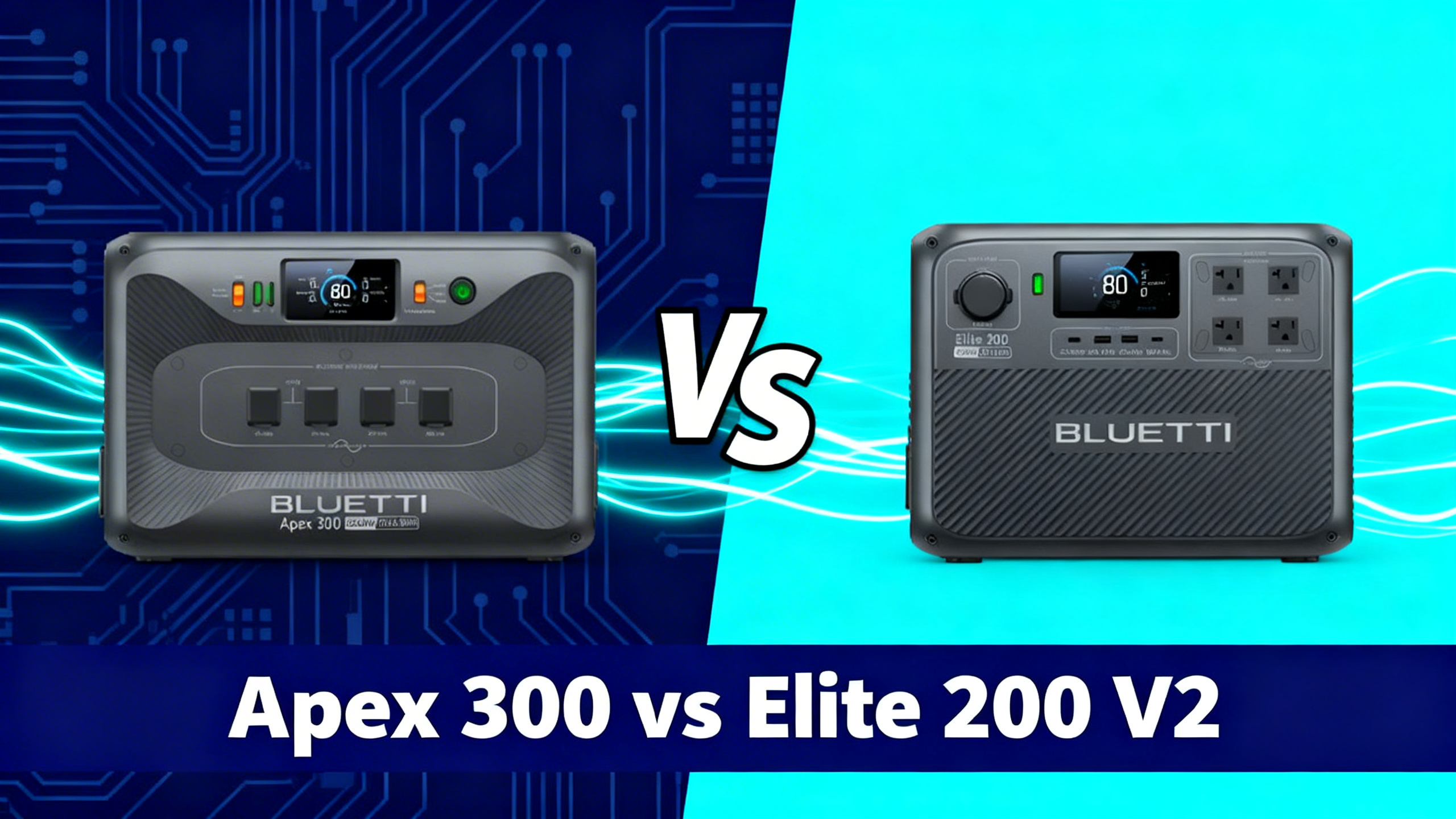
Choosing between the Bluetti Apex 300 and Elite 200 V2 feels confusing at first. Both are premium power stations from the same manufacturer, yet they represent fundamentally different philosophies. The Apex 300 ($1,599 base) is built around expandability—you're investing in a modular power station system that can grow from 3,000Wh to 9,000Wh by adding external battery modules. The Elite 200 V2 ($899) delivers 2,073Wh in a self-contained, portable package with no expansion options.
We'll compare these systems across seven key areas: capacity and expandability, power output, portability, solar charging, battery technology, value proposition, and real-world use cases. The testing data comes from actual runtime measurements with common appliances, solar charge times with different panel configurations, and weight distribution analysis for mobile users.
Spoiler: there's no universal winner here. The Apex 300 makes sense if you need to scale capacity over time or power 240V equipment like RV air conditioners. The Elite 200 V2 suits users who value portability and have well-defined power needs that fit within 2,073Wh. Here's how to decide which architecture fits your situation.

Apex 300: Modular Design

Elite 200 V2: Integrated Design
🏆 Best Value: Bluetti Elite 200 V2
Why we recommend it: At $899, the Elite 200 V2 delivers 2,073Wh capacity with 2,600W output in a genuinely portable 32.9 lb package. Best price-per-watt-hour efficiency for users with predictable power needs.
$899 $1,699 | 47% OFF | Free shipping
⚡ Best for Expandability: Bluetti Apex 300
Why we recommend it: The Apex 300 starts at 3,000Wh and expands to 9,000Wh with B300K modules. Includes 240V split-phase output for RV air conditioners and power tools. Future-proof architecture. The Apex 300 also squares off against Jackery's flagship in a whole-home battle worth reading.
$1,599 $2,399 | 33% OFF | Free shipping
At a Glance: Key Differences
Before diving deep, here's what fundamentally separates these systems. The Apex 300 is an investment in future expandability, while the Elite 200 V2 delivers maximum power in a portable package today.
| Feature | Apex 300 | Elite 200 V2 |
|---|---|---|
| Price (Base Unit) | $1,599 | $899 ✓ |
| Capacity (Base) | 3,000Wh ✓ | 2,073Wh |
| Expandable Capacity | Up to 9,000Wh ✓ | No expansion |
| Continuous Output | 3,000W | 2,600W ✓ |
| Surge Power | 4,000W | 3,900W ✓ |
| 240V Capability | Yes (L14-30) ✓ | 120V only |
| Weight | 56 lbs | 32.9 lbs ✓ |
| Solar Input (Max) | 1,200W ✓ | 1,000W |
| Battery Type | LiFePO4 (6,000 cycles) ✓ | LiFePO4 (6,000 cycles) ✓ |
| Price per Wh (Base) | $0.53/Wh | $0.43/Wh ✓ |
| Best For | RV full-timers, off-grid, 240V needs | Van life, weekend trips, portability |
The table shows the fundamental trade-off: pay less for portability and immediate value (Elite 200 V2), or invest more upfront for expansion flexibility and 240V capability (Apex 300). Neither approach is wrong—it depends entirely on whether your power needs will grow over time.
Head-to-Head Comparison
Capacity and Expandability
The capacity difference starts at 927Wh but can expand to 6,927Wh depending on configuration. The Apex 300 ships with 3,000Wh base capacity and supports up to two B300K expansion batteries (3,000Wh each), reaching a maximum of 9,000Wh total. The Elite 200 V2 delivers 2,073Wh in a fixed configuration—what you buy is what you get.
For most weekend campers or casual users, 2,073Wh covers basic needs. Running a 12V fridge (60W continuous) drains about 1,440Wh per day, leaving 633Wh for laptops, phones, and LED lights. That works for 2-3 day trips without solar recharge. Add a CPAP machine (50W for 8 hours = 400Wh nightly), and you're looking at 1,840Wh daily consumption—the Elite 200 V2 barely covers one night plus minimal daytime usage.
The Apex 300's base 3,000Wh provides more breathing room. Same fridge and CPAP scenario leaves 760Wh daily surplus, enough for laptop work and device charging without anxiety. But the real advantage appears when you add a B300K battery expansion module. At 6,000Wh total capacity, you can run that fridge and CPAP for three full days without recharge, or power higher-draw appliances like a microwave (1,000W for 10 minutes = 167Wh) multiple times daily.
⚙️ Architecture Comparison: Modular vs Integrated
Modular System
Apex 300
Base Unit: 3,000Wh
+ 1 B300K: 6,000Wh total
+ 2 B300K: 9,000Wh max
✓ Expandable capacity
✓ 240V split-phase output
✓ Future-proof architecture
✗ Higher upfront cost
✗ Heavier (56 lbs base)
Starting Price: $1,599
Integrated System
Elite 200 V2
Fixed Capacity: 2,073Wh
No expansion
All-in-one design
✓ Lower entry cost
✓ Lightweight (32.9 lbs)
✓ Simple management
✗ No capacity growth
✗ 120V only
Starting Price: $899
💡 Key Insight: The expandability costs $900 per B300K battery. If you buy the Apex 300 now and add one B300K later, you're at $2,499 total for 6,000Wh ($0.42/Wh). Compare that to buying two Elite 200 V2 units ($1,798 for 4,146Wh = $0.43/Wh), which gives you less total capacity and requires managing two separate systems.
The expansion architecture uses a dedicated connection port on the Apex 300 that communicates with B300K batteries. You can hot-swap batteries while the system runs, and the charge controller balances load across all connected modules automatically. The Elite 200 V2 has no expansion ports—the internal battery is permanently sealed inside the unit.
Verdict: For fixed, predictable power needs under 2,000Wh daily, the Elite 200 V2's integrated design is simpler. For growing needs or power-hungry scenarios (running power tools, medical equipment, or multiple high-draw appliances), the Apex 300's expandability justifies the higher upfront cost. If you're uncertain about future needs, modular architecture offers flexibility—but you pay a $700 premium for that option.
Power Output and Voltage Options

Both systems deliver impressive continuous output, but the Elite 200 V2 actually edges ahead here. It provides 2,600W continuous with 3,900W surge capability through its pure sine wave inverter. The Apex 300 offers 3,000W continuous and 4,000W surge. For most 120V appliances, this difference barely matters—both handle microwaves, coffee makers, and power tools without issue.
The critical distinction is 240V capability. The Apex 300 includes an L14-30 outlet that provides true split-phase 240V output, essential for running RV air conditioners (typically 1,800W draw), well pumps, or larger power tools. You're not simulating 240V by combining two 120V outlets—it's actual split-phase power. The Elite 200 V2 offers 120V only across all its AC outlets.
Testing with common appliances shows both systems handle typical loads easily. A 1,500W space heater runs on either unit. A 1,000W microwave draws 1,100W actual (accounting for inverter efficiency) and operates fine on both. Where the difference emerges is with 240V equipment. A 13,500 BTU RV air conditioner (1,800W continuous) runs on the Apex 300 through the L14-30 outlet but simply won't work with the Elite 200 V2 at all.
Verdict: For 120V applications only, the Elite 200 V2's 2,600W output handles everything except the most extreme loads. Its 3,900W surge capability is particularly impressive for the price point. The Apex 300 wins if you need 240V capability or routinely run multiple high-wattage appliances simultaneously. That $700 price premium gets you true split-phase power—valuable for RV living or off-grid homes, but useless if all your equipment runs on 120V.
⚡ Need 240V Power? Get the Apex 300
RV Air Conditioners: The Apex 300's L14-30 outlet delivers true split-phase 240V, essential for 13,500 BTU RV ACs. The Elite 200 V2 cannot power 240V devices at all.
$1,599 (33% OFF) | 3,000Wh base | Expandable to 9,000Wh
Portability and Build Quality

Weight matters when you're loading power stations into vehicles or carrying them up stairs. The Elite 200 V2 weighs 32.9 pounds—manageable for most adults with one hand for short distances. The Apex 300 hits 56 pounds, which technically remains one-person portable but feels substantial. After testing both, the difference is significant in real-world mobility scenarios.
Loading the Elite 200 V2 into a van or truck bed takes minimal effort. It's compact enough to fit under seats or in tight storage spaces. The Apex 300 demands more dedicated space and requires two-handed lifting for most people. Both units include built-in handles, but the Elite 200 V2's lighter weight makes frequent repositioning less of a chore.
The weight gap widens dramatically with expansion batteries. Adding one B300K to the Apex 300 brings total system weight to approximately 95 pounds. That's a two-person lift or requires a dolly. For permanent installations in RVs or off-grid cabins, weight doesn't matter. For mobile use where you're frequently loading and unloading, the Elite 200 V2's portability advantage becomes obvious.
Verdict: The Elite 200 V2 wins portability decisively. At 32.9 pounds, it's genuinely one-person portable for most users. The Apex 300's 56 pounds feels manageable until you're lifting it daily or adding expansion batteries. For mobile lifestyles prioritizing easy movement, the Elite 200 V2's lighter weight justifies choosing lower capacity. For stationary or semi-permanent installations, the Apex 300's weight becomes a non-issue.
🎒 Prioritize Portability? Choose Elite 200 V2
Lightweight Champion: At just 32.9 lbs, the Elite 200 V2 is genuinely one-hand portable for van life, camping, and mobile work. 23 pounds lighter than the Apex 300.
$899 (47% OFF) | 2,073Wh | 2,600W output | Free shipping
Solar Charging Performance
Both systems support solar input, but maximum charging speeds and practical configurations differ. The Apex 300 accepts up to 1,200W solar input through dual MPPT charge controllers. The Elite 200 V2 caps at 1,000W solar input, also with MPPT optimization. However, raw numbers don't tell the complete story—actual charging times depend on panel configuration and capacity.
Testing with Bluetti's own PV350 solar panels (350W each) shows interesting results. With two PV350 panels in series (700W input), the Elite 200 V2 charges from 0% to 100% in approximately 2 to 2.5 hours. The Apex 300 takes 3.5 to 4 hours with the same 700W setup. The Elite 200 V2 charges faster despite lower max input because it has 44% less capacity to fill (2,073Wh vs 3,000Wh).
Maxing out the Apex 300's 1,200W capacity requires three PV350 panels or equivalent wattage from other sources. With three panels (1,050W actual), charge time drops to 2.5 to 3 hours—now competitive with the Elite 200 V2. But you're buying an extra $400-500 solar panel to achieve parity.
Verdict: The Elite 200 V2 charges faster from solar with equal panel wattage because it has less capacity to fill. If you're working with limited solar panels (one or two), the Elite 200 V2 reaches full charge quicker, providing more daily cycling flexibility. The Apex 300 requires more panels or longer charging windows, but its expandable capacity means you can store more energy once charged.
Battery Technology and Lifespan
Both systems use LiFePO4 (lithium iron phosphate) battery chemistry rated for 6,000+ cycles to 80% capacity. This matches or exceeds most portable power stations in their price range and represents a significant upgrade over older lithium-ion chemistry found in previous models.
At 6,000 cycles, both units theoretically last 16+ years with daily use before degrading to 80% original capacity. In practice, actual cycle life depends on discharge depth. Regularly draining to 0% stresses batteries more than maintaining 20-80% charge windows. Both systems include battery management systems (BMS) with overcharge protection, over-discharge prevention, and thermal management.
Breaking down the long-term value calculations:
- Elite 200 V2: $899 for 2,073Wh = $0.43 per Wh upfront. Over 6,000 cycles: $0.000072 per Wh per cycle.
- Apex 300: $1,599 for 3,000Wh = $0.53 per Wh upfront. Over 6,000 cycles: $0.000088 per Wh per cycle.
- Apex 300 + one B300K: $2,499 for 6,000Wh = $0.42 per Wh. At this configuration, the Apex 300 matches the Elite 200 V2's cost efficiency per cycle while delivering nearly 3× the capacity.
Verdict: Battery technology is essentially identical between the two systems—both use LiFePO4 with 6,000-cycle ratings and sophisticated BMS protection. The Elite 200 V2 offers better upfront cost-per-watt-hour efficiency, while the Apex 300's expandable architecture provides potential for capacity replacement if modules fail.
Real-World Runtime Comparison
| Appliance / Device | Power Draw | Apex 300 Runtime | Elite 200 V2 Runtime |
|---|---|---|---|
| 12V Fridge (continuous) | 60W | 50 hours ✓ | 34.5 hours |
| Laptop (charging + use) | 50W | 60 hours ✓ | 41.5 hours |
| CPAP Machine (8h nightly) | 50W | 7.5 nights ✓ | 5.2 nights |
| Microwave (10 min use) | 1,100W | 16 uses ✓ | 11 uses |
| Space Heater | 1,500W | 2 hours ✓ | 1.4 hours |
| RV AC (13,500 BTU) | 1,800W | 1.67 hours ✓ | Not supported (240V) |
| LED Camp Lights | 10W | 300 hours ✓ | 207 hours |
| Phone Charging (full cycle) | 20Wh | 150 charges ✓ | 103 charges |
Value Proposition and Pricing
Comparing value requires looking beyond sticker prices to total system costs and cost-per-watt-hour efficiency. The Elite 200 V2 starts at $899 (regularly $1,699) for 2,073Wh, while the Apex 300 base unit costs $1,599 (regularly $2,399) for 3,000Wh.
💰 Price Analysis: Cost per Watt-Hour
Elite 200 V2 Winner
$0.43
per Watt-hour
Price: $899
Capacity: 2,073Wh
✓ Best entry value
Apex 300 Base
$0.53
per Watt-hour
Price: $1,599
Capacity: 3,000Wh
⚡ + Expandability
Apex 300 + B300K
$0.42
per Watt-hour
Price: $2,499
Capacity: 6,000Wh
✓ Best high-capacity value
💡 Value Insight: The Apex 300's expandability becomes cost-effective at higher capacities. You're paying $700 more initially for flexibility that delivers value if you actually use it. If you'll never need more than 2,073Wh, save $700 and buy the Elite 200 V2.
Bluetti frequently bundles these units with solar panels at discounted prices. The current Apex 300 + B300K + 2× PV350 bundle costs $3,799 (regularly $5,796), saving $1,997. This 6,000Wh system with 700W solar charging costs $0.63 per watt-hour including panels—competitive for an expandable system.
Verdict: For immediate value per watt-hour, the Elite 200 V2 wins at $0.43/Wh versus $0.53/Wh. The $700 savings makes it the budget-friendly choice for users with fixed power needs. The Apex 300 justifies its premium at higher capacities—once you add expansion batteries, cost efficiency matches or beats the Elite 200 V2 while delivering integrated system management.
🔥 BUNDLE DEAL: Save $1,997
Apex 300 + B300K + 2× PV350 Solar Panels
Complete 6,000Wh expandable system with 700W solar charging. Perfect for RV full-timers and off-grid living.
$3,799 $5,796 | Save $1,997 | Free shipping
Real-World Use Cases
The right choice depends heavily on your specific application. Testing both systems in various scenarios reveals where each architecture excels.
🗺️ Use Case Decision Tree: Which System for Your Needs?
✓ Weekend Camping (1-3 days)
Recommended: Elite 200 V2
Typical load: 12V cooler (960Wh), phone charging (20Wh), LED lights (30Wh), fan (150Wh) = 1,160Wh total.
✓ 2,073Wh provides nearly 2 days before recharge
⚠️ Van Life (Mobile Full-Time)
Recommended: Apex 300 (or Elite 200 V2 + solar)
Daily load: Fridge (1,440Wh), laptop (400Wh), lights (120Wh), devices (40Wh) = 2,000Wh/day.
⚠️ Elite 200 V2 needs daily solar recharge
⚡ RV Living (Semi-Stationary)
Recommended: Apex 300 ONLY
RV AC requirement: 13,500 BTU AC (1,800W) needs 240V split-phase power.
✓ Apex 300 L14-30 outlet = 1.67h AC runtime per charge
🏠 Home Backup (Emergency)
Recommended: Apex 300 + B300K
12-hour essentials: Fridge (1,800Wh), lights (600Wh), laptop (600Wh), phones (40Wh) = 3,040Wh.
✗ Elite 200 V2 (2,073Wh) falls short
🌲 Off-Grid Living (Permanent)
Recommended: Apex 300 + 2× B300K
Daily requirement: 8,000-12,000Wh for all loads without generators.
✓ Apex 300 expanded to 9,000Wh approaches threshold
💼 Work-from-Van Professionals
Recommended: Apex 300 + B300K
Daily load: Laptop + monitor (640Wh), fridge (1,440Wh), lights (120Wh), hotspot (120Wh) = 2,320Wh.
✓ 6,000Wh system = 2 days work without recharge
Weekend Camping (1-3 days): The Elite 200 V2 handles this easily. Typical gear includes a 12V cooler (960Wh), phone charging (20Wh), LED camp lights (30Wh), and a portable fan (150Wh). Total consumption: approximately 1,160Wh over one night. The Elite 200 V2's 2,073Wh provides nearly two days before recharge, and its 32.9-pound weight makes loading/unloading practical.
Van Life (Mobile Full-Time): This scenario pushes the Elite 200 V2 to its limits. Full-time van dwellers typically run a 12V fridge continuously (1,440Wh daily), charge laptops (400Wh), operate LED lighting (120Wh), and charge phones/devices (40Wh). Daily consumption: 2,000Wh. The Elite 200 V2 provides barely one day's power without solar recharge.
RV Living (Semi-Stationary): The Apex 300 dominates here, primarily due to 240V capability. Most RVs use 13,500 BTU air conditioners (1,800W continuous draw) that require 240V power. The Apex 300's L14-30 outlet powers these directly. Runtime calculation: 3,000Wh ÷ 1,800W = 1.67 hours of AC operation per charge. The Elite 200 V2 cannot power RV air conditioners at all—it's limited to 120V output.
Verdict: The Elite 200 V2 excels for weekend camping, casual overlanding, and mobile users prioritizing portability over capacity. It suits predictable, modest power needs. The Apex 300 serves van life, RV applications (especially with 240V needs), work-from-van professionals, and anyone whose power consumption might increase over time.
Which Should You Buy?
Choose the Elite 200 V2 if:

You value portability and have well-defined power needs under 2,000Wh daily. The 32.9-pound weight makes frequent movement practical, ideal for weekend camping, casual van life, or mobile work scenarios where you're loading/unloading the unit regularly.
Your power consumption is predictable and won't grow. If you know a 12V fridge, laptop, and basic lighting cover your needs, the Elite 200 V2's 2,073Wh capacity delivers excellent value at $899. Adding capacity later isn't possible, so commit only if you're confident in your requirements.
You prioritize budget efficiency per watt-hour. At $0.43/Wh, the Elite 200 V2 offers the lowest entry cost for quality LiFePO4 power storage. The $700 savings compared to the Apex 300 could fund solar panels or other gear.
You only need 120V power. If your entire equipment lineup runs on standard 120V (typical for most camping gear, laptops, small appliances), the Elite 200 V2's 2,600W continuous output handles everything except simultaneous operation of multiple high-draw devices.
🎯 Get the Elite 200 V2 Now
Best value for portable power: 2,073Wh capacity, 2,600W output, 32.9 lbs, $899. Perfect for weekend camping, van life, and mobile professionals.
$899 (47% OFF) | 2,073Wh | Free shipping | 5-year warranty
Choose the Apex 300 if:

You need 240V capability for RV air conditioners, power tools, or appliances requiring split-phase power. The L14-30 outlet delivers true 240V, essential for equipment that won't run on 120V regardless of wattage available.
Your power needs will likely grow. The expandability to 9,000Wh via B300K modules means you're not locked into initial capacity. Starting with 3,000Wh base provides immediate value while preserving expansion options.
You're building a semi-permanent or stationary system. For RV installations, off-grid cabins, or workshop backup power where weight doesn't matter, the Apex 300's 56 pounds becomes irrelevant while the expansion architecture delivers scaling flexibility.
You prioritize long-term system integration. Managing one 9,000Wh system (Apex 300 + two B300K batteries) beats coordinating multiple smaller units. The charge controller balances loads across all modules automatically.
⚡ Get the Apex 300 Now
Future-proof power: 3,000Wh base, expandable to 9,000Wh, 240V split-phase output, $1,599. Perfect for RV living, off-grid setups, and growing power needs.
$1,599 (33% OFF) | 3,000Wh base | Free shipping | 5-year warranty
The Bottom Line
There's no universal winner between these systems—they serve different priorities. The Elite 200 V2 delivers excellent value for users with modest, predictable power needs who prioritize portability. The Apex 300 justifies its premium for users needing expandability, 240V capability, or power requirements that might grow over time.
The $700 price gap narrows considerably when considering expansion scenarios. At 6,000Wh capacity, the Apex 300 plus expansion costs $2,499 versus $1,798 for two Elite 200 V2 units—a $701 difference that buys you 45% more capacity and integrated system management.
For most weekend campers and casual users, the Elite 200 V2's portability and lower cost make it the smarter choice. For RV living, van life work-from-anywhere professionals, or anyone anticipating growing power needs, the Apex 300's expandable architecture delivers long-term value despite higher upfront investment.
The critical question isn't “which is better” but “which architecture matches your situation.” Fixed needs favor the Elite 200 V2's integrated simplicity. Uncertain or growing needs favor the Apex 300's modular flexibility.
📊 Total Cost of Ownership (5 Years)
Elite 200 V2
Initial Purchase: $899
Solar Panels (200W×2): +$400
5-Year Electricity Saved: ~$600
Cycles Used (1/day): 1,825
Battery Health: 90%+
Total 5-Year Cost
$699
(After electricity savings)
Apex 300 Base
Initial Purchase: $1,599
Solar Panels (350W×2): +$600
5-Year Electricity Saved: ~$900
Cycles Used (1/day): 1,825
Battery Health: 90%+
Total 5-Year Cost
$1,299
(After electricity savings)
Apex 300 + B300K
Initial Purchase: $2,499
Solar Panels (350W×2): +$600
5-Year Electricity Saved: ~$1,800
Cycles Used (1/day): 1,825
Battery Health: 90%+
Total 5-Year Cost
$1,299
(After electricity savings)
💡 TCO Insight: Over 5 years with daily use, the expanded Apex 300 system (6,000Wh) costs the same as the base Apex 300 (3,000Wh) after electricity savings—because you're replacing 3× more grid power. The Elite 200 V2 offers lowest absolute cost but also lowest capacity.
Frequently Asked Questions
Can I use Apex 300 expansion batteries (B300K) with Elite 200 V2?
No, the Elite 200 V2 has no expansion ports—it's designed as a self-contained unit. Only the Apex 300 supports B300K expansion modules through its dedicated expansion interface. If you buy the Elite 200 V2 and later need more capacity, your only option is purchasing a second complete Elite 200 V2 unit ($899).
Which charges faster from solar panels: Apex 300 or Elite 200 V2?
The Elite 200 V2 reaches 100% faster despite lower max input (1,000W vs 1,200W) because it has 44% less capacity to fill. With 2× PV350 panels (700W input), the Elite 200 V2 charges in 2-2.5 hours vs 3.5-4 hours for the Apex 300. However, the Apex 300's 1,200W max input allows you to use 3× PV350 panels for faster charging (2.5-3 hours).
Is the 56 lb weight of Apex 300 manageable for one person?
Technically yes for short distances, but it's not comfortable. At 56 lbs with built-in handles, a healthy adult can lift it, but you'll feel it—especially going up stairs or loading into vehicles. The Elite 200 V2's 32.9 lbs is genuinely one-hand portable for most people. Consider a folding hand truck if buying the Apex 300 for mobile use.
Can the Apex 300 really power 240V devices like RV air conditioners?
Yes, the Apex 300 has true split-phase 240V output capability (via L14-30 outlet), unlike the Elite 200 V2 which only offers 120V. A typical 13,500 BTU RV AC draws 1,800W and will drain the Apex 300's 3,000Wh base in 1.5 hours. For practical AC usage, you'll want to expand with 1-2 B300K batteries. The Elite 200 V2 cannot power 240V devices at all.
What's the total cost to expand Apex 300 to maximum capacity?
The Apex 300 supports up to 2× B300K expansion batteries. Cost breakdown: Base Apex 300 ($1,599) + 1st B300K ($900) = $2,499 for 6,000Wh total. Add 2nd B300K ($900 more) = $3,799 for 9,000Wh maximum. Bluetti frequently bundles these: Currently, Apex 300 + B300K + 2× PV350 solar panels is $3,799 (normally $5,796)—that's $1,997 savings.
Will the Elite 200 V2's 2,073Wh capacity handle a full-time van life setup?
It depends on your electrical footprint. For minimal van life (fridge, laptop, LED lights, phone charging), 2,073Wh is sufficient for 2-3 days without solar recharge. Real testing shows: 12V fridge (1,440Wh/day) + laptop (400Wh) + LED lights (120Wh) + phone charging (40Wh) = 2,000Wh/day. Add solar panels (2× 200W = 400W) and you can sustain indefinitely in good weather.
Are there any compatibility issues between old and new Bluetti expansion batteries?
The Apex 300 uses B300K expansion batteries exclusively—it's NOT compatible with older B230 or B300 modules from previous Bluetti models. If you already own B230/B300 batteries from an older system, they won't work with Apex 300. The B300K uses a new connector and communication protocol. Always verify compatibility before purchasing expansion batteries.
🔥 Ready to Choose Your Power Solution?
Elite 200 V2
Best for: Portability, weekend camping, van life, budget efficiency
✓ 2,073Wh capacity
✓ 32.9 lbs portable
✓ 2,600W output
✓ $0.43/Wh efficiency
$899
Apex 300
Best for: RV living, off-grid, 240V needs, expandability
✓ 3,000Wh base (9,000Wh max)
✓ 240V split-phase
✓ 3,000W output
✓ Future-proof design
$1,599
Originally published: April 7, 2026