
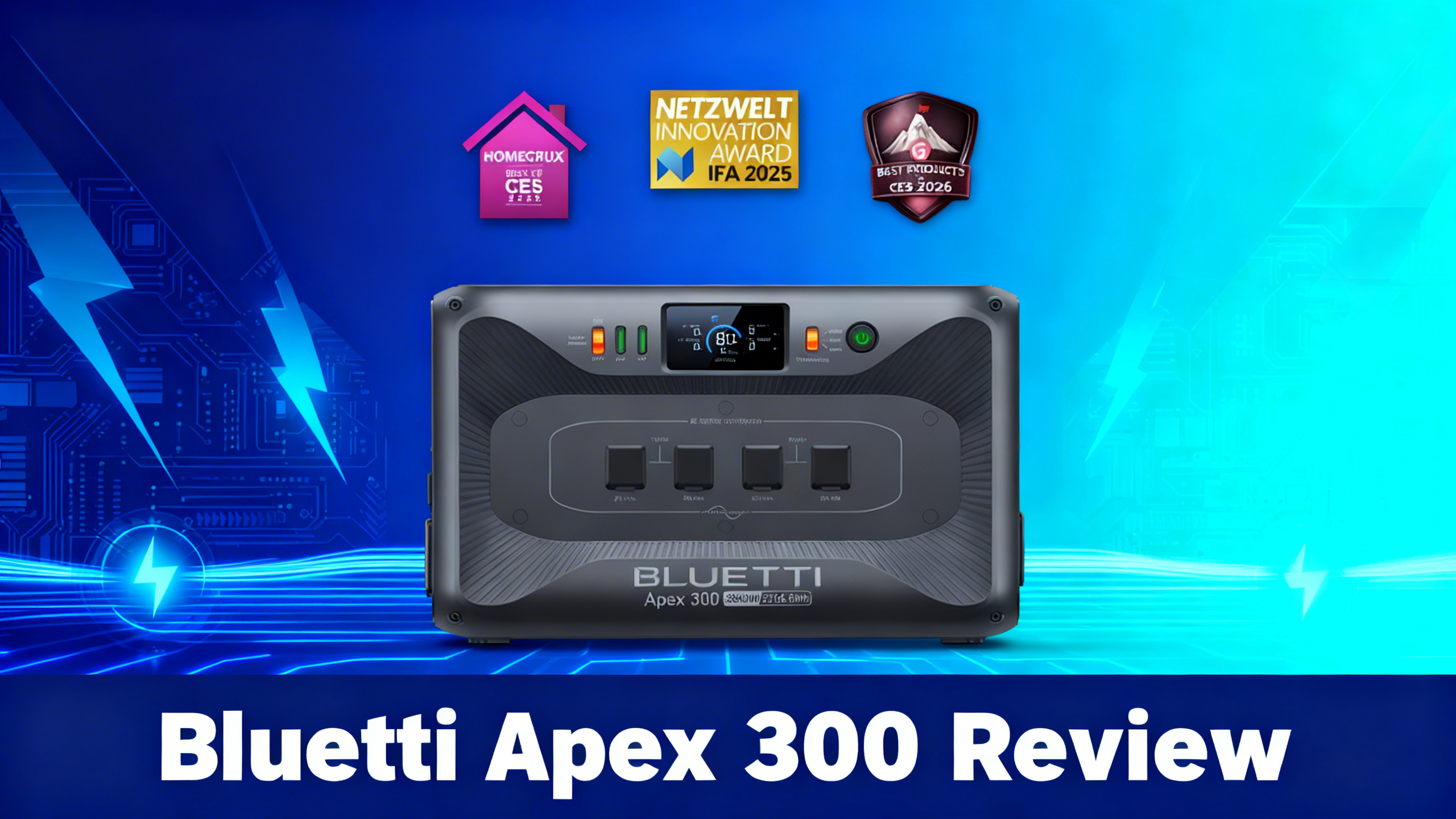
Most 3,000Wh power stations fall into one of two traps: they're either too heavy to move or too limited to handle real residential loads. The Bluetti Apex 300 aims to solve both problems at once, combining a high-capacity LFP battery with a modular ecosystem designed to scale with your needs. At $1,599 (currently 33% off the $2,399 list price), it's a serious proposition for homeowners who've outgrown entry-level backup units.
The Apex 300 is Bluetti's 2026 flagship, positioned just above the Elite 200 V2 in the lineup. It targets homeowners planning for multi-day outages, high-draw appliances, and long-term expandability rather than campers or occasional users. The 3,000Wh base capacity, dual-voltage compatibility, and B300K expansion support make this a fundamentally different product category than a portable camping battery. For a broader look at the full Bluetti lineup, our Bluetti brand overview covers every model from entry-level to flagship.
This review covers the specs in detail, the charging performance data, expandability options, and the specific buyer profiles where the Apex 300 makes sense and where it doesn't.

Bluetti Apex 300: Overall Rating
8.8/10
“The most expandable Bluetti flagship to date, worth the premium for long-term power planning.”
Capacity & Power 9.0/10
Charging Speed 8.5/10
Expandability 9.5/10
Value for Price 8.0/10
Portability 7.5/10
App & Smart Features 8.8/10
Bluetti Apex 300
$1,599 $2,399 -33% OFF
- Dual-voltage output (120V + 240V split-phase ready)
- Expandable capacity with B300K battery module
- Smart accessory compatibility: Hub A1/D1 support
Bluetti Apex 300 Quick Verdict
The Apex 300 earns its flagship status. At $1,599 with a 33% discount applied, it delivers a spec sheet that would have cost $2,500+ just two years ago: 3,000Wh of LFP capacity, 3,000W continuous AC output, 2,400W solar input, and a genuine expansion path to 9,000Wh-plus via B300K modules. The charging speed data is particularly strong for this capacity class.
Where it falls short is portability. At roughly 70.5 lbs, this isn't a unit you'll carry to a campsite. The 240V split-phase output, while valuable, also requires a Hub accessory rather than being native. These are real tradeoffs, not disqualifying factors, but they define who the right buyer actually is. The Apex 300 is a long-term home backup investment, not a versatile portable.
Technical Specifications
The 3,000Wh LFP (lithium ferro-phosphate) battery is the foundation of this unit. LFP chemistry matters here: where standard lithium-ion batteries typically last 500-800 cycles before significant degradation, LFP holds to 3,500+ cycles. For a home backup unit that may see regular charge cycles during solar self-consumption or frequent outages, that translates to a decade-plus of useful life. See the Bluetti Apex 300 official specs page for the full certified specification list.
The AC output figure deserves attention. At 3,000W continuous with a 6,000W surge rating, the Apex 300 handles high-inrush appliances (well pumps, refrigerator compressors, window A/C units) that trip up lower-rated units. Most portable power stations in this price range top out at 2,000W continuous, making the Apex 300's output one of the category's strongest points.
The 2,400W solar input via MPPT is equally notable. MPPT (Maximum Power Point Tracking) controllers optimize energy harvest from connected panels, particularly in variable light conditions. At 2,400W, you can theoretically recharge the base 3,000Wh in just over an hour of peak sun, a figure that holds up that holds up on a clear day with appropriately sized panels.
What Can the Apex 300 Power?
What Can the Apex 300 Power? (3,000 Wh)
🖥️
Home Office Setup
15 hrs
~200W draw
❄️
Refrigerator
20-25 hrs
~120-150W avg
🌡️
Window A/C (1 ton)
2-3 hrs
~900-1,200W
📱
Smartphone
200+ charges
~15Wh/charge
💻
Laptop (65W)
40+ hrs
~65W draw
Runtime calculations based on 3,000Wh capacity at 90% efficiency. Actual results depend on load and temperature conditions.
Runtime calculations based on the 3,000Wh capacity and typical appliance draws show where this unit genuinely excels for home use. A refrigerator running at an average 120-150W draw runs for 20-25 hours uninterrupted. A full home office setup (monitor, desktop, router, lighting) at roughly 200W combined gets 15 hours of coverage. These numbers position the Apex 300 as a capable single-day and multi-day essential appliance backup.
High-wattage appliances tell a different story. A 1-ton window A/C unit at 900-1,200W draws down the battery in 2-3 hours. Central HVAC is even more demanding. For sustained cooling coverage during summer outages, or for powering multiple high-draw appliances simultaneously, the base 3,000Wh runs out faster than most homeowners expect. The expansion path via B300K modules directly addresses this limit, per home energy backup planning guidelines that recommend sizing to 1.5-2x your essential daily consumption.
Planning a solar-backed home system?
See how to size and configure your Apex 300 with solar panels for maximum outage coverage.
Charging Performance
Charge time data for the Apex 300 is one of its strongest competitive arguments. AC charging at 3,000W pushes the unit from 0 to 80% in approximately one hour, with a full charge completing in around 1.5 hours. For a 3,000Wh battery, this is genuinely fast: comparable units from EcoFlow and Jackery in this capacity class typically take 2-3 hours for a full AC charge. The practical implication is that a nightly charge from the grid, or a quick top-up after a partial discharge, rarely requires planning around.
Solar input peaks at 2,400W MPPT. On a clear day with appropriately sized panels, this allows a full recharge in 1.5-2 hours of peak sun, or a meaningful partial recharge on overcast days. Pairing this unit optimally requires the right panels: the rundown of best solar panels for Apex 300 covers compatibility and wattage targets. A complete walkthrough of panel configuration is available in the Apex 300 solar setup guide.

12V DC car charging is available but, predictably, slow for a 3,000Wh unit. It's useful as a supplemental trickle source during travel, not as a primary charge method. For the Apex 300's intended use case (home backup), car charging is a fallback rather than a feature to plan around.
Design & Build Quality
The Apex 300's physical profile is shaped by its battery capacity. At 70.5 lbs (32 kg), it's not portable in any conventional sense. You won't carry it to a campsite or load it into a car trunk for a weekend trip. It moves around the home on a flat surface reasonably well with its integrated wheels and handle, but this is a station that stays put once positioned. Anyone expecting the portability of a 20-30 lb camping unit will be disappointed.


The build quality reflects a premium positioning. The chassis is solid, the panel layout organized, and the display readable without strain. Bluetti's industrial design has improved noticeably across recent flagship generations, and the Apex 300 continues that trend.
The LiFePO4 (LFP) battery chemistry is the right choice for a residential backup unit. LFP cells are thermally stable (far less prone to thermal runaway than NMC lithium), which matters when a battery is stored in a garage or utility room for extended periods. The 3,500+ cycle lifespan means you can charge and discharge this unit daily for a decade before reaching 80% of original capacity, a figure that puts it in a different durability category than standard lithium-ion alternatives.
Ports & Connectivity
The port layout covers standard home use without gaps. AC outlets (4-6 standard sockets) handle major appliances, the dual USB-C ports with 100W Power Delivery handle fast-charging for laptops and tablets, and the two USB-A ports cover legacy devices. The 12V DC output and Anderson connector round out the options for vehicle and accessory integration.

The Bluetti App (iOS and Android) connects via both Wi-Fi and Bluetooth, giving you real-time monitoring of charge level, power draw, input rates, and system status. Scheduling features allow automated charge windows (useful for time-of-use electricity rate optimization), and firmware updates push over-the-air. The app experience is functional and improving, though it remains somewhat less polished than the EcoFlow ecosystem software. For straightforward monitoring and control, it does the job reliably.
Expandability & Ecosystem
The expansion story is where the Apex 300 separates itself from most competitors. Read the dedicated B300K review, the full Bluetti expansion systems guide, and our walkthrough for expanding your Bluetti system before adding modules. Pair it with the SolarX 4K for the full solar ecosystem. The B300K battery module connects directly, scaling capacity from the base 3,000Wh to 6,000Wh, 9,000Wh, or beyond with up to three units attached. Each B300K adds 3,072Wh. The B300K expansion battery guide covers compatibility, add-on pricing, and real-world capacity gains in detail.


The Hub accessory ecosystem adds another dimension. The Hub A1 and Hub D1 enable 240V split-phase output, opening compatibility with well pumps, dryers, central HVAC systems, and other 240V appliances that standard 120V portable power stations simply can't support. Choosing the right hub accessory matters for whole-home integration: Hub A1 vs Hub D1 for Apex 300 clarifies which configuration fits which use case.
The combination of B300K expansion modules and Hub accessories makes the Apex 300 genuinely competitive with low-end whole-home battery systems like the Tesla Powerwall at a fraction of the installed cost. It's a different product category (portable, not hardwired), but for renters or homeowners who can't or won't run a full installation, this ecosystem provides comparable coverage. For a direct head-to-head with two strong alternatives, see the Apex 300 three-way premium comparison.
Who Is the Apex 300 For?
✅ Buy the Apex 300 if…
- You need expandable storage for multi-day outages
- Your home has high-wattage appliances (HVAC, well pump)
- You plan to add solar panels in phases
- 240V split-phase compatibility is a priority
- Long-term investment in a 10-year system appeals to you
❌ Skip the Apex 300 if…
- You need something under 30 lbs for frequent travel
- Your budget tops out at $1,000 (consider Elite 200 V2)
- You only need occasional camping or tailgate power
- Whole-home integration is not a goal
The Apex 300's ideal buyer is a homeowner planning a multi-year power backup strategy, not someone shopping for a camping companion. The profile fits: households in areas with frequent outages lasting 12-48 hours, properties with well pumps or medical equipment requiring continuous power, and anyone already considering a permanent battery installation who wants a portable alternative with similar capabilities.
For users whose needs sit below this threshold, alternatives make more sense. Comparing options at different price points? The guide to top Bluetti models ranked breaks down the full range from entry-level to flagship, with segmented recommendations by use case and budget.
Bluetti Apex 300 vs The Competition
The most direct comparison is between the Apex 300 and the Elite 200 V2, the next model down in Bluetti's lineup. The AC200L and AC240 are also worth weighing at different price points. The Elite 200 V2 offers 2,000Wh capacity and 2,000W AC output at roughly $900-1,000 currently. For users whose essential appliances draw under 2,000W and whose outage planning targets 12-18 hours, the Elite 200 V2 covers the need at a $600 discount. The Apex 300 upgrade justifies itself when you need the additional capacity, the higher output ceiling for large appliances, or the 240V Hub compatibility.
Against the AC200L, the Apex 300 competes at similar capacity levels but with better expansion headroom and faster charging. The AC200L has its own strengths (lighter, simpler setup), making the choice between them primarily a question of whether the modular expansion path matters to your planning horizon.
Versus EcoFlow's DELTA Pro Ultra or Jackery's Explorer 3000 Pro, the Apex 300 holds its ground on price-per-watt-hour and solar input ceiling. The ecosystem and accessory compatibility differ enough that these comparisons depend heavily on brand preference and which accessories you already own.
Final Verdict
The data points to a straightforward conclusion: the Apex 300 is a well-executed flagship that delivers on its core promises. Shoppers comparing the full Bluetti catalog should also read our best Bluetti power stations 2026 ranking and our Bluetti home backup 2026 and off-grid living guides. The 3,000W output, sub-1.5-hour full charge, and 2,400W solar ceiling are category-leading specs, not marketing claims. The LFP chemistry adds durability that makes the $1,599 price more defensible over a 10-year ownership horizon. The expansion ecosystem via B300K and Hub accessories is genuinely differentiated.
The limitations are real but category-appropriate. At 70.5 lbs, you're not taking this camping. The 240V output requires a Hub accessory, adding cost if that's a priority from day one. And at $1,599 even discounted, this isn't an impulse purchase: it's a considered infrastructure investment. Anyone buying this unit as a casual outage hedge will likely feel over-served by the capacity and under-served by the portability. Additional buying context is available in our Pilier #02 Apex 300 analysis, which focuses specifically on best-use scenarios.
For homeowners who've decided that serious home backup is worth investing in, the Bluetti Apex 300 is the most capable expandable portable system under $2,000 right now. The current 33% discount makes the timing reasonable.
Bluetti Apex 300
$1,599
Best expandable home backup under $2,000
Price verified April 2026. Free shipping available
Frequently Asked Questions
What is the capacity of the Bluetti Apex 300?
The Apex 300 features a 3,000Wh LFP battery as the base unit. Capacity is expandable to 9,000Wh or more with B300K battery modules. Up to three B300K units are supported, making it one of the most scalable portable power systems in its price range.
Can the Bluetti Apex 300 power a whole home during an outage?
For essential appliance coverage, the Apex 300 delivers 20-25 hours of refrigerator runtime and 15+ hours for a home office at base 3,000Wh capacity. Whole-home coverage for HVAC and major appliances simultaneously requires B300K expansion modules and solar recharging.
How long does it take to charge the Apex 300?
AC charge time data confirms 0-to-80% in approximately one hour via the 3,000W AC input. Full charge from empty takes roughly 1.5 hours under ideal grid conditions, which is unusually fast for a 3,000Wh-class unit.
Is the Bluetti Apex 300 expandable?
Yes. Up to three B300K battery modules can be added, scaling capacity well beyond the base 3,000Wh. This modular design positions the Apex 300 as a long-term investment rather than a fixed-capacity unit.
What is the difference between the Apex 300 and the Elite 200 V2?
Key differences include capacity (3,000Wh vs 2,000Wh), AC output (3,000W vs 2,000W), and 240V split-phase capability on the Apex 300 via Hub accessories. The price gap is approximately $600-700 at current pricing, making the Elite 200 V2 the better fit for users who don't need the additional output or expansion headroom.
Does the Bluetti Apex 300 support 240V output?
Standard 120V AC output is built-in. The 240V split-phase output requires a Bluetti Hub accessory (Hub A1 or Hub D1), enabling high-voltage appliances such as well pumps, dryers, and HVAC systems. This configuration is a significant advantage over most portable power stations at this price point.
Originally published: April 7, 2026