
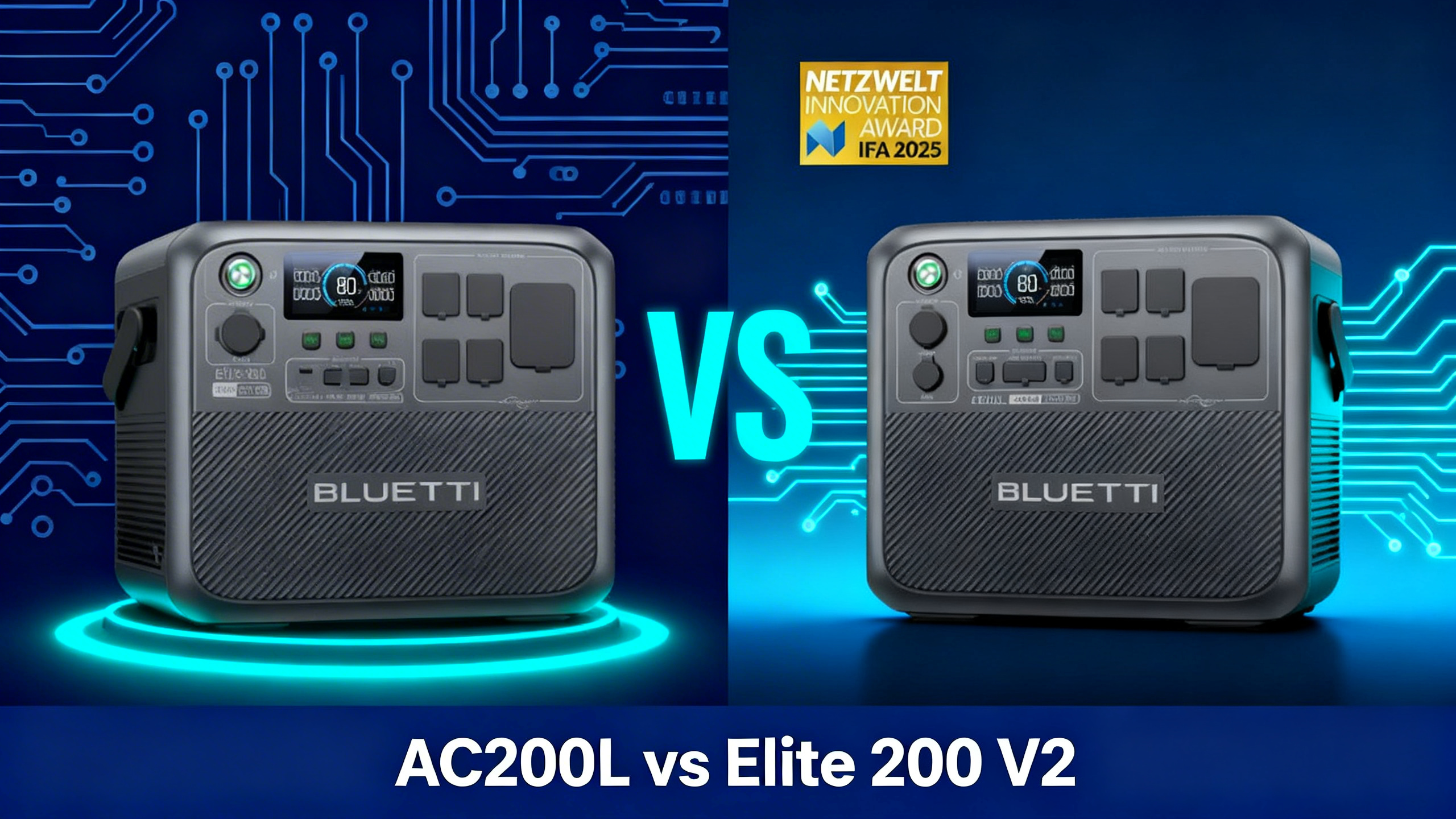
Choosing between the AC200L and Elite 200 V2 feels straightforward on paper: both Bluetti units sit in the same $800-$900 price band, share near-identical charging speeds, and run on the same LiFePO4 battery chemistry. Yet the differences between them are real and specific enough to matter. Expandability, sustained output, and port count separate these two in ways that directly affect your buying decision.
Spec-for-spec analysis confirms that neither model is universally better. Each wins in distinct scenarios. This comparison maps those differences to actual use cases so you can match the right unit to your setup. For a complete overview of the brand, the Bluetti brand review covers all current models in context.


At a Glance: AC200L vs Elite 200 V2
Before diving into the details, here's the full spec comparison. Both units match on several key metrics, which makes the divergences stand out more clearly.
The key takeaways: charging speed and solar input are identical. Capacity and runtime are nearly tied. The real split comes down to three variables: the AC200L's expandability up to 7kWh, the Elite 200 V2's higher 2,600W sustained output, and its larger total port count at 9 devices. Those three differences drive every use-case verdict below.
Bluetti AC200L: Full Review
Deep dive into performance data, real-world runtime, and owner feedback patterns.
BLUETTI AC200L: Full Overview
The AC200L positions itself as Bluetti's value-focused platform in the 2kWh range, priced at $799 (down from $1,599). The emphasis on “platform” is intentional: the AC200L is designed from the ground up for expandability, and that shapes the entire product.

For a deeper standalone analysis, the full AC200L review covers every spec and use case in detail.
Capacity and Battery Technology
The AC200L delivers 2,048Wh of usable capacity via a LiFePO4 (lithium ferro-phosphate) battery. LiFePO4 is the chemistry of choice for longevity: published cycle data indicates this chemistry sustains capacity over thousands of charge cycles, far beyond what older lithium-ion units manage. At roughly 60.6 lbs, the unit is substantial but within the manageable range for most home and RV use cases.
The AC200L supports 6 recharge methods, including AC, solar, car, and combined inputs. Turbo charge data confirms the 0-80% AC fill completes in approximately 45 minutes, making downtime between uses minimal. The official AC200L specifications confirm the full recharge input ceiling at 2,400W from AC.
AC Output and Surge Capability
Continuous AC output sits at 2,400W, which covers the majority of household appliances including refrigerators, power tools, air compressors, and most small air conditioning units. The surge capacity of 4,800W is where the AC200L genuinely stands out in this comparison. Surge wattage matters for motor-start loads: pumps, compressors, and induction motors draw 2-3 times their running wattage for a fraction of a second on startup. At 4,800W surge, the AC200L handles these starts comfortably where the Elite 200 V2's 3,900W ceiling introduces more risk with borderline appliances.

Expandability: The Key Advantage
This is the AC200L's defining feature. Published specs confirm compatibility with Bluetti expansion battery modules, allowing total system capacity to scale from 2,048Wh up to 7kWh. No other feature in this comparison has the same long-term impact. If your power needs grow, or if you want multi-day home backup coverage, the AC200L grows with you. You buy the base unit now at $799 and add capacity later as budget allows.
The Elite 200 V2 cannot do this. It's a standalone unit, full stop. That distinction alone makes the AC200L the stronger long-term platform for users who anticipate evolving needs.
BLUETTI Elite 200 V2: Full Overview
The Elite 200 V2 enters the comparison as Bluetti's higher-output alternative in this tier, priced at $899 (down from $1,699). The extra $100 over the AC200L buys a specific set of upgrades: more continuous wattage, slightly more capacity, and a denser port configuration. Whether those upgrades justify the cost depends entirely on your actual usage pattern.

The full Elite 200 V2 review goes deeper on real-world performance data and owner feedback patterns.
Capacity and Battery Chemistry
Published specs place the Elite 200 V2 at 2,073.6Wh, a 25.6Wh edge over the AC200L's 2,048Wh. LiFePO4 chemistry is standard here as well, with the same longevity and thermal stability profile. The weight comes in at approximately 61 lbs, essentially equivalent to the AC200L for transport and placement purposes.
The Elite 200 V2 supports the same fast AC charging: 0-80% in approximately 45 minutes under turbo charge conditions. The official Elite 200 V2 specifications confirm a 1,200W maximum solar input, identical to the AC200L.
Higher Sustained Output (2,600W)
The Elite 200 V2's headline advantage is its 2,600W continuous AC output. That's 200W more than the AC200L's ceiling. In most everyday scenarios, this distinction is invisible: laptops, refrigerators, fans, and entertainment systems draw well below 2,000W. But the difference becomes relevant for specific appliances. Larger portable air conditioners, induction cooktops running at full draw, and some electric grills consistently push into the 2,400-2,600W range. The Elite 200 V2 handles these without throttling; the AC200L may hit its ceiling.
Keep in mind the surge trade-off: the Elite 200 V2's surge ceiling of 3,900W sits below the AC200L's 4,800W. For sustained high-wattage loads, the Elite 200 V2 wins. For momentary motor-start surges, the AC200L's higher ceiling offers more headroom.

Port Count and Device Connectivity
The Elite 200 V2 supports up to 9 devices simultaneously across its full port configuration: 4 AC outlets, 2 USB-A, 2 USB-C, 2 DC outputs, and a car port. That total device count is the broadest in this tier. For households running multiple devices during an outage, or campers who want to charge everything at once, the denser port layout removes friction. The AC200L matches on AC outlets and USB specs but sits slightly behind on total simultaneous device support.
Head-to-Head: Key Differences Compared
With the individual overviews done, here's how the two models stack up across the metrics that matter most for a buying decision.
Price and Value per Wh
The AC200L at $799 works out to roughly $0.39 per Wh of rated capacity. The Elite 200 V2 at $899 comes in around $0.43 per Wh. The AC200L offers better raw storage value per dollar. However, value-per-Wh is only part of the picture: if you need the Elite 200 V2's sustained 2,600W output and the AC200L can't sustain your specific appliance load, the $100 premium on the Elite 200 V2 is justified by function, not marketing.
Battery Capacity (2,048Wh vs 2,073.6Wh)
The 25.6Wh difference between these two units is essentially a rounding error in real-world use. Both deliver runtime figures that are functionally identical across common appliance scenarios. Capacity alone should not be a deciding factor in this comparison: the gap is too small to register in practice. Focus instead on output, expandability, and port count.
AC Output and Surge Watts
This is where the spec sheets diverge meaningfully. The Elite 200 V2 wins on continuous output at 2,600W vs 2,400W. The AC200L wins on surge capacity at 4,800W vs 3,900W. Published performance data indicates that the continuous output advantage matters for sustained appliance loads, while surge headroom matters for motor-start applications. If you run heavy appliances constantly, the Elite 200 V2's continuous ceiling is the relevant number. If your concern is starting large motors or compressors, the AC200L's surge advantage is what protects against tripped overloads.
⚠️ Important: Continuous wattage and surge wattage are different specs. An appliance listed at “1,500W” may surge to 3,000W+ at startup. Always check both the running draw and the startup draw of motor-driven appliances before assuming either unit can handle them.
Expandability: One Has It, One Doesn't
This is the most consequential difference in this comparison. The AC200L supports expansion batteries, scaling to 7kWh total. The Elite 200 V2 is fixed at 2,073.6Wh with no expansion path. If there's any chance your power needs will grow, the AC200L's modular architecture is a meaningful long-term advantage. The Elite 200 V2 asks you to commit to a fixed capacity at purchase. That's fine if 2,073.6Wh is enough for your use case permanently, but limiting if your needs evolve.
Charging Speed Comparison
Both units match exactly on AC charging performance: approximately 45 minutes to 80% under turbo charge conditions. This is one of the fastest AC charge rates available in the 2kWh power station category, and both models deliver it equally. Solar charging is also identical at 1,200W maximum input, meaning neither unit holds an advantage here. Charging speed is a non-factor in this decision.
Solar Input and Recharge Options
Published specs confirm identical 1,200W maximum solar input across both units. The AC200L supports 6 recharge methods including combined AC and solar simultaneous input. Both models are compatible with the BLUETTI app for remote monitoring and management. Solar setup and recharge flexibility are effectively equivalent between these two models.

What Can They Power? Real-World Runtime
Capacity calculations based on rated Wh figures and typical appliance draws show that both units perform near-identically for standard loads. The 25.6Wh capacity gap between them produces runtime differences measured in minutes, not hours. Here's what the numbers reveal across common scenarios, applying an 85% efficiency factor to account for inverter losses.
What Can They Power? Estimated Runtimes
AC200L: 2,048Wh
❄️
Mini Fridge
~27 hrs
75W
💡
LED Lights x5
~136 hrs
15W
🖥️
Laptop
~40 hrs
50W
🌀
Box Fan
~68 hrs
30W
Elite 200 V2: 2,073.6Wh
❄️
Mini Fridge
~27.6 hrs
75W
💡
LED Lights x5
~138 hrs
15W
🖥️
Laptop
~41 hrs
50W
🌀
Box Fan
~69 hrs
30W
Runtime calculations based on rated capacity with ~85% efficiency factor. Actual results depend on load and temperature.
The practical conclusion from the data: for the vast majority of appliances, you won't notice a runtime difference between these two units. The Elite 200 V2's slight edge in Wh is real but operationally negligible. Both deliver approximately two full days of refrigerator power, multiple laptop charges per cycle, and sustained lighting for extended outages.

Winner by Use Case
Both models earn clear wins in distinct scenarios. Here's where the data points for each primary buyer profile.
Home Backup and Emergency Power
The AC200L holds the advantage for home backup. Its expandability to 7kWh is the decisive factor: a single-day outage is manageable at 2,048Wh, but multi-day outages require more capacity than either standalone unit provides. With the AC200L, you can expand incrementally as budget allows, building toward meaningful multi-day coverage. For extended home backup planning, the Bluetti home backup guide maps each model to real outage scenarios.
The Elite 200 V2's 2,600W sustained output does help when running multiple appliances simultaneously during an outage, but its fixed capacity limits multi-day scenarios. For short outages where higher simultaneous wattage matters, the Elite 200 V2 competes well. For anything longer than 24 hours at meaningful load, the AC200L's expandability wins.
Best Bluetti for Home Backup: Full Guide
How to match each Bluetti model to real outage duration scenarios, including expansion battery planning.
Off-Grid Living and Long-Term Use
For full-time off-grid living, the AC200L's expandable architecture is again the stronger choice. Off-grid setups almost always require more capacity than a single 2kWh unit provides, and the ability to scale to 7kWh with expansion modules provides meaningful headroom. The AC200L's 4,800W surge also helps when running power-hungry equipment occasionally.
Off-grid users who have fixed, modest power needs and want a simpler standalone solution may find the Elite 200 V2's higher sustained output more practically useful. But most committed off-grid setups will outgrow a fixed 2kWh unit quickly.
RV and Van Life
For RV and van life, the analysis points in both directions depending on setup. If you run a 12V refrigerator, laptop, phone, and lighting, both units handle the load with identical runtime. The Elite 200 V2's broader port count handles charging more devices simultaneously, which matters in a compact living space where multiple people share power. The AC200L wins if you anticipate adding a second battery module to the system for longer dry camping stretches.
Workshop and Power Tools
This is the Elite 200 V2's strongest case. Workshop tools, especially those with large induction motors like table saws, miter saws, and air compressors, frequently run sustained draws in the 1,800-2,400W range. The Elite 200 V2's 2,600W continuous ceiling provides meaningful buffer above where the AC200L tops out. Running a circular saw, drill, and worksite lighting simultaneously is more reliably managed by the Elite 200 V2. The AC200L's higher surge helps with tool startups, but the Elite 200 V2's sustained ceiling is the relevant metric for continuous workshop use.
Budget-Conscious Buyer
At $799 versus $899, the AC200L saves $100 upfront. For a buyer who doesn't consistently push appliances above 2,400W and has no immediate expansion plans, that $100 stays in your pocket with zero meaningful performance trade-off for typical use cases. The AC200L is the straightforward value choice for buyers who want proven 2kWh performance without paying for output headroom they won't use.
Which One Is Right for You?
Final Recommendation
Spec-for-spec analysis shows no universal winner here, which is the honest conclusion. Both units are solid performers in the 2kWh tier at prices well below their original retail.
The AC200L at $799 is the right pick for anyone who values long-term flexibility. Its expandability to 7kWh, lower price, and higher surge ceiling (4,800W) make it the stronger platform for home backup, off-grid growth, and buyers who want room to scale. The AC200L's expandable design is genuinely differentiated in this price range.
The Elite 200 V2 at $899 is the right pick for users who consistently push appliances toward the 2,400W ceiling, want the broadest simultaneous device support, and are comfortable with a fixed-capacity standalone setup. Workshop users and households running multiple high-draw appliances during outages will appreciate the 200W headroom.
If budget allows, you may also want to add Apex 300 to the comparison to see whether the flagship justifies the step up.
💡 Pro Tip: Both units are deeply discounted from original retail pricing ($1,599 and $1,699 respectively). Bluetti's promotional pricing makes this tier significantly more accessible than it was at launch. Verify current pricing before purchase, as these figures shift with seasonal promotions.
Frequently Asked Questions
Is the Bluetti AC200L or Elite 200 V2 better for home backup?
For home backup, the AC200L holds a meaningful edge: its expandability allows adding extra battery modules to push total capacity up to 7kWh, covering multi-day outages. The Elite 200 V2, while fixed at 2,073.6Wh, offers slightly more sustained AC output at 2,600W, which matters for running larger appliances simultaneously. Budget-focused home backup users generally find more long-term value with the AC200L.
What is the actual price difference between the AC200L and Elite 200 V2?
At current prices, the AC200L lists at $799 versus the Elite 200 V2 at $899, a $100 gap. Both are discounted significantly from their original retail prices ($1,599 and $1,699 respectively). The price gap is relatively narrow given the feature differences, so the buying decision comes down to which specific advantage matters more.
Can the Bluetti AC200L be expanded with extra batteries?
Yes. The AC200L supports expansion battery modules, allowing total system capacity to scale up to 7kWh. The Elite 200 V2 does not support this feature and functions as a standalone unit only. This distinction makes the AC200L the stronger long-term platform for users who anticipate growing power needs.
Are the charging speeds the same on both models?
Both units offer fast AC charging with a 0-80% charge time of approximately 45 minutes under turbo charge conditions. Max solar input is also identical at 1,200W for both models. The charging infrastructure is effectively equivalent between the two, making this a non-factor in the comparison.
Which Bluetti model handles higher-wattage appliances better?
The Elite 200 V2 handles sustained high-wattage loads more comfortably with its 2,600W continuous output, compared to the AC200L's 2,400W. However, the AC200L actually surges higher at 4,800W versus 3,900W for the Elite 200 V2. For appliances that draw consistently above 2,400W (such as some air conditioners or induction cooktops), the Elite 200 V2 is the safer choice.
Conclusion
The bluetti ac200l vs elite 200 v2 decision comes down to one fundamental question: do you prioritize expandability or sustained output? The AC200L's modular design and $799 price make it the stronger long-term value for most buyers. The Elite 200 V2's 2,600W continuous ceiling and broader port count earn it the win for heavy-load scenarios and dense multi-device setups.
Both are capable units at prices far below their original retail. Either choice delivers reliable LiFePO4 performance, fast AC charging, and substantial 2kWh capacity for the scenarios that matter most.
Originally published: April 7, 2026