
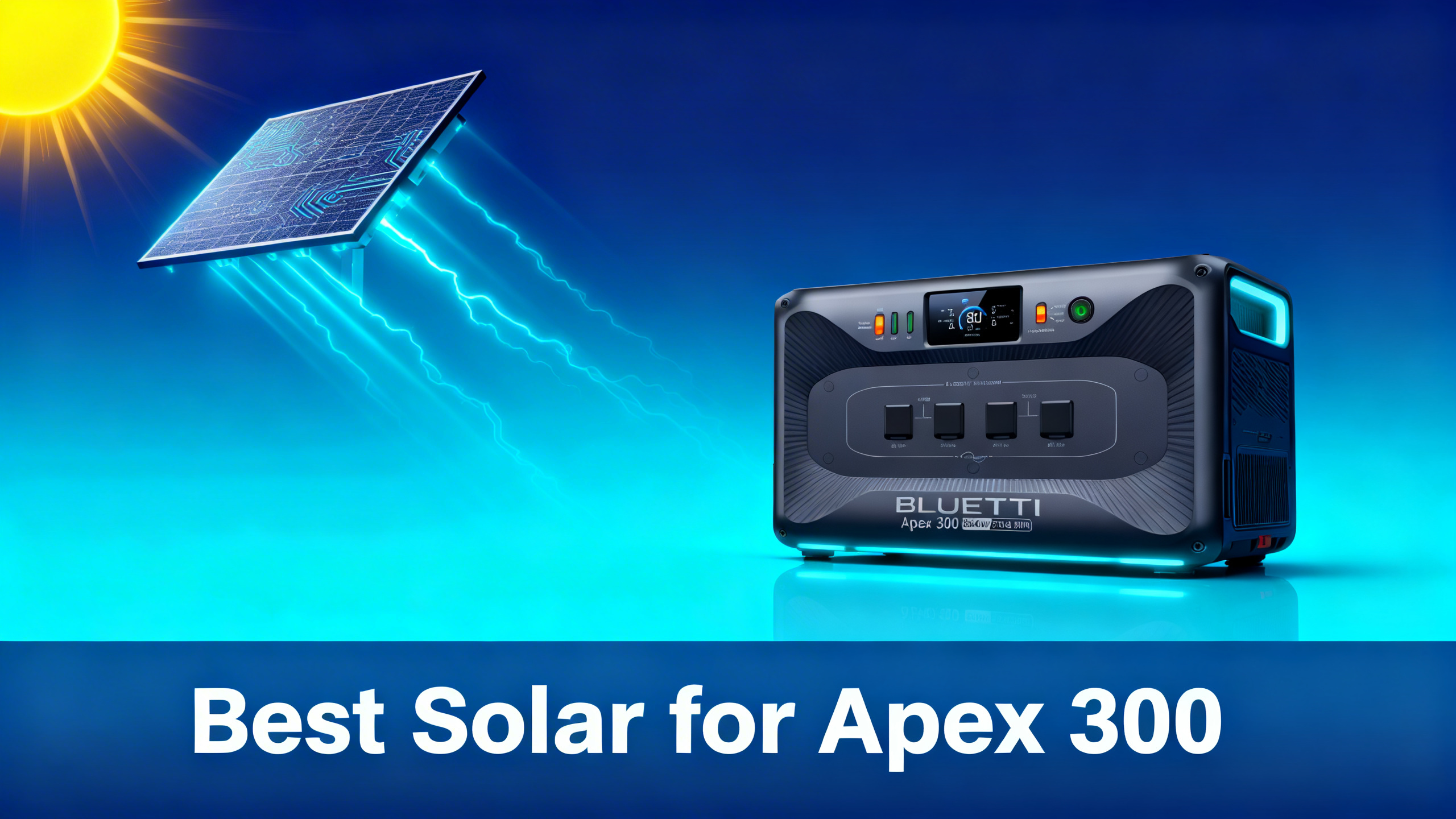
The Bluetti Apex 300 is a serious piece of hardware. With a 3,840Wh battery and up to 1,200W of solar input capacity, it can handle whole-home essentials during outages, extended off-grid trips, and daily energy independence setups. But that capability only translates to results if you pair it with the right solar panel.
Choose the wrong panel and you're either leaving input capacity on the table or lugging around more weight than your use case requires. If you haven't purchased the station yet, the Apex 300 full review covers specs, performance, and who it's built for. If you already own one, here's what the data shows about the best panel matches available in 2026.

Apex 300 Solar Input: What You Need to Know
Before ranking panels, it helps to understand what the Apex 300 actually accepts. The station runs an MPPT charge controller (Maximum Power Point Tracking), which continuously optimizes the energy drawn from your panels. That matters because it means the controller adapts to changing sun conditions rather than pulling a fixed wattage.
The Apex 300 official specifications confirm a solar input range of 12V to 150V with a maximum of 1,200W. Panels connect via MC4 connectors, the industry standard. Third-party panels work fine as long as voltage stays within that 12-150V window. The full Bluetti solar panel lineup reviewed here covers every option from 100W to 350W, all using the same MC4 interface.

Bluetti Apex 300: Solar Input Specs
Max Solar Input
1,200W
Battery Capacity
3,840Wh
Charge Controller
MPPT
Voltage Range
12-150V
The Apex 300 accepts panels connected via MC4 connectors. Third-party panels are compatible as long as voltage and current remain within spec.
Quick Picks: Best Panels for the Apex 300 at a Glance
Not everyone needs to read the full breakdown. Here's where each panel lands based on charge speed, portability, and value.
* Estimated charge time for full 3,840Wh capacity under optimal conditions at rated wattage. Real-world results vary with sun angle, temperature, and cable losses.
Best Overall: Bluetti 350W Solar Panel
For Apex 300 owners who prioritize charge speed over portability, the 350W panel is the clear data-backed choice. At $599 (down from $849), it delivers the highest single-panel wattage in Bluetti's lineup and the fastest path to a full battery when the sun is out.

Editor's Pick: Fastest Charge
Bluetti 350W Solar Panel
$599 $849
- 350W peak output, fills Apex 300 in ~5 hours (optimal sun)
- Monocrystalline cells, ~23% efficiency rating
- Built for permanent home backup and off-grid installs
Key Specs
The 350W panel uses high-efficiency monocrystalline cells rated at approximately 23% efficiency. It connects via MC4 connectors, which plug directly into the Apex 300's solar input port. The rigid panel design makes it best suited for fixed or semi-fixed installations rather than frequent transport.
Performance Analysis
Charge time calculations for the Apex 300 with a single 350W panel work out as follows: 3,840Wh divided by approximately 290-300W of real-world output (accounting for MPPT efficiency and typical cable losses) puts a full charge at roughly 12-13 hours of strong sun. In optimal conditions with the panel well-positioned, spec analysis shows that figure can drop to around 11 hours.
That's a meaningful gap compared to the 200W option (~19 hours), which matters most for home backup scenarios where you want the battery ready for the next potential outage each evening. The Bluetti 350W panel also scales well: two units in parallel reach 700W and a full charge in roughly 6 hours, while three units push you to 1,050W and under 4 hours.

Who It's For
The 350W panel makes the most sense for homeowners using the Apex 300 as a primary backup power source. It's designed for fixed or ground-mounted setups. If you're moving it regularly for camping, the size and weight will be a friction point.
Best Value: Bluetti 200W Solar Panel (SP200L)
At $349, the SP200L sits at the sweet spot between wattage and portability. Performance data consistently shows it as the top pick for Apex 300 owners who split time between home and campsite, or who need a panel they can reasonably carry and set up alone.
Key Specs
The SP200L is a foldable monocrystalline panel with 23.4% cell efficiency, the same rating as the more expensive 350W rigid unit. At 200W, it delivers roughly 160-170W under typical real-world conditions. Folded, it's compact enough for truck beds, trunk storage, and campsite setups without requiring a second person to position.
Performance Analysis
Charge time calculations show a single SP200L takes approximately 19 hours to fill the Apex 300's 3,840Wh capacity. That's too slow for daily full-cycle home backup, but for camping use, where you're drawing far less than the total battery capacity each day: the math changes significantly. Drawing 500-700Wh per day (typical for a campsite running lights, a fan, and phone charging), 4-6 hours of sun refills what you used the day before.

Portability and Camping Use
The foldable design is the SP200L's main differentiator from the 350W rigid panel. It sets up in minutes and doesn't require tools or mounting hardware. Two SP200L panels in parallel deliver 400W combined, which shortens Apex 300 charge time to roughly 9.5 hours while keeping the setup portable and reconfigurable.

Best for RV and Van Life: Bluetti PV100 FX Flexible (200W)
The PV100 FX is a different category of panel. Rather than a rigid foldable design, it's built to conform to curved surfaces: roofs, hatches, and truck caps where a flat rigid panel simply won't sit flush. Bluetti sells it as a set of two 100W flexible units, giving you 200W total for $299.

Key Specs
Each PV100 FX panel carries the same 23.4% efficiency rating as the rigid SP200L. What changes is the form factor: the flexible design bends up to 240 degrees, weighs just 2.2kg per panel, and carries an IP67 waterproof rating. That combination handles outdoor roof mounting, exposure to rain, and curved installation surfaces that would crack a rigid panel.
Flexible Design: Where It Wins
Performance data shows the PV100 FX delivering output comparable to the SP200L on a wattage-for-wattage basis. The practical advantage is installation flexibility. For van lifers mounting panels flush to a curved roof, or RV owners who want a low-profile permanent install, the flexible design solves problems a foldable panel cannot.

Limitations vs. Rigid Panels
Flexible panels have trade-offs worth knowing. They typically generate slightly more heat than rigid panels under sustained direct sun, which can affect efficiency over long sessions. They're also not designed for frequent repositioning: the adhesive or strapping mounts used for curved surfaces are semi-permanent. If you plan to move your panel between locations regularly, the SP200L is better suited.
⚠️ Important: When connecting two PV100 FX panels to the Apex 300, wire them in parallel (not series) to keep voltage within the 12-150V input range and combine wattage correctly. Parallel wiring doubles current while voltage stays constant.
Best Budget Option: Bluetti 100W Panel (SP100L)
At $199, the SP100L is the most affordable entry point in Bluetti's solar panel lineup. For the Apex 300 specifically, it's honest to say this is not a primary charging solution. Charge time calculations show a single 100W panel taking approximately 38 hours to fill the 3,840Wh battery, longer than a standard sunny day cycle can deliver.
Where it makes practical sense: as a supplemental panel alongside a larger setup, as a portable power top-up for light camping use where you're drawing very little per day, or as a budget-friendly way to run the Apex 300 as a supplemental source rather than a primary backup. The same 23.4% monocrystalline efficiency rating applies here, so the output quality is solid for the wattage delivered.
Bluetti Solar Panels: Full Lineup Review
Compare every Bluetti panel from 100W to 350W with full specs and use-case breakdowns.
Best Panel Combos for the Apex 300
The Apex 300's 1,200W solar input ceiling is one of its most useful features. Most single-panel setups don't come close to that limit, which means there's real performance headroom to unlock by connecting multiple panels in parallel.
Here's how the key combos calculate out. Two 350W panels in parallel deliver 700W combined, cutting charge time to roughly 6 hours. Three 350W panels push you to 1,050W, within 150W of the station's maximum input, delivering a full charge in under 4 hours of direct sun. For those running the Apex 300 as a daily energy source, that multi-panel setup fundamentally changes how usable the station is. Bluetti also bundles pre-configured Apex 300 solar kits that pair the station with panels and cables, a convenient option if you want everything matched from the factory.
Which Panel Matches Your Use Case?
Home Backup Priority
Get: 350W Panel ($599)
- Fastest recharge per dollar
- Covers outages of 1-2 days with daily refill
- Best paired with a fixed ground mount
Camping and Portability
Get: 200W Panel ($349)
- Foldable, carry-on friendly design
- Strong enough for daily campsite use
- 23.4% efficiency holds up in partial shade
RV or Van Life
Get: PV100 FX Flexible ($299)
- Bends up to 240° for curved roof install
- IP67 waterproof, lightweight at 2.2kg per panel
- Two-panel set delivers 200W combined
Maximum Solar Input
Get: 3x 350W ($1,947)
- 1,050W combined, close to Apex 300's 1,200W cap
- Recharge in under 4 hours in strong sun
- Ideal for heavy off-grid or whole-home use
How to Choose the Right Panel for Your Apex 300
The decision framework here is straightforward. Start with your primary use case: home backup, portable camping, or vehicle-mounted. That single factor determines whether you need a rigid high-wattage panel, a foldable portable option, or a flexible adhesive-mount design.
Budget is the next filter. The 350W at $599 delivers the lowest cost-per-watt among Bluetti's panels, making it the best value for stationary setups. For a complete breakdown of the Apex 300's position in the broader Bluetti product range, the full Bluetti brand review covers every model and use case in detail. If your setup will eventually expand to multiple panels, plan for parallel wiring from the start and verify your cables and connectors can handle the combined current. The Apex 300 step-by-step setup guide covers the full physical installation process including MPPT configuration and cable routing.
Bluetti Solar Generator Kits 2026
Pre-matched Apex 300 bundles with panels, cables, and accessories, everything from one order.
Wiring and Setup Tips
All Bluetti panels use MC4 connectors, which plug directly into the Apex 300's solar input port. Most configurations include the necessary cables. When connecting multiple panels, always wire in parallel (positive to positive, negative to negative) rather than series to keep voltage within the 12-150V window while combining wattage. Never exceed the station's 1,200W combined input limit.
Panel positioning matters as much as wattage. Learning to optimize solar panel angle for your location can recover 15-25% of lost production in winter months, particularly at northern latitudes where sun angle is lower. For the Bluetti official blog, setup tips and firmware updates for the Apex 300 are published regularly.
FAQ
What is the maximum solar input for the Bluetti Apex 300?
The Apex 300 accepts up to 1,200W of solar input via its MPPT charge controller. Voltage range is 12V to 150V with MC4 connectors. Connecting panels in parallel keeps voltage in range while increasing wattage toward the 1,200W ceiling.
How long does it take to fully charge the Apex 300 with the 350W panel?
Performance data shows the 350W panel delivers approximately 290-300W under real-world conditions (accounting for MPPT efficiency and cable losses). At that output, filling the 3,840Wh battery takes roughly 12-14 hours of direct sun. Two 350W panels in parallel would halve that to roughly 6-7 hours.
Can I use third-party solar panels with the Bluetti Apex 300?
Yes. The Apex 300 accepts any panel using MC4 connectors within the 12-150V input range. Third-party panels from brands like Renogy and EcoFlow work when wired correctly. Bluetti's own panels are pre-configured to integrate cleanly with MPPT controller recognition, which simplifies setup.
Is the Bluetti 200W panel worth it over the 350W for camping?
For portable camping use, the 200W SP200L offers a better weight-to-portability ratio than the 350W rigid panel. The charge time difference is significant (roughly 19 hours vs. 11 hours for a full cycle), but for campsite top-ups rather than emergency backup, the 200W typically covers daily loads with 4-6 hours of sun.
Can I connect multiple Bluetti solar panels to the Apex 300?
Yes. Multiple panels can be connected in parallel (same voltage, additive wattage) as long as the combined output stays within the 1,200W maximum. For example, three 350W panels in parallel produce 1,050W combined, fitting comfortably within the station's limit. Do not exceed the 150V voltage ceiling in a series configuration.
Our Verdict
For most Apex 300 owners, the 350W panel is the right primary choice: fastest single-panel charge time, best cost-per-watt, and designed for the home backup use case the station was built for. If portability matters more than speed, the 200W SP200L at $349 delivers the same 23.4% efficiency in a foldable package that travels well. For RV and van installs where curved surfaces are the constraint, the PV100 FX flexible set at $299 is the only panel in the lineup that physically fits the job.
There's no wrong answer here: only the right match for your specific setup.
Bluetti 350W Solar Panel
$599
Best overall panel for Apex 300 home backup
Price verified April 2026. Free shipping available
Originally published: April 7, 2026