
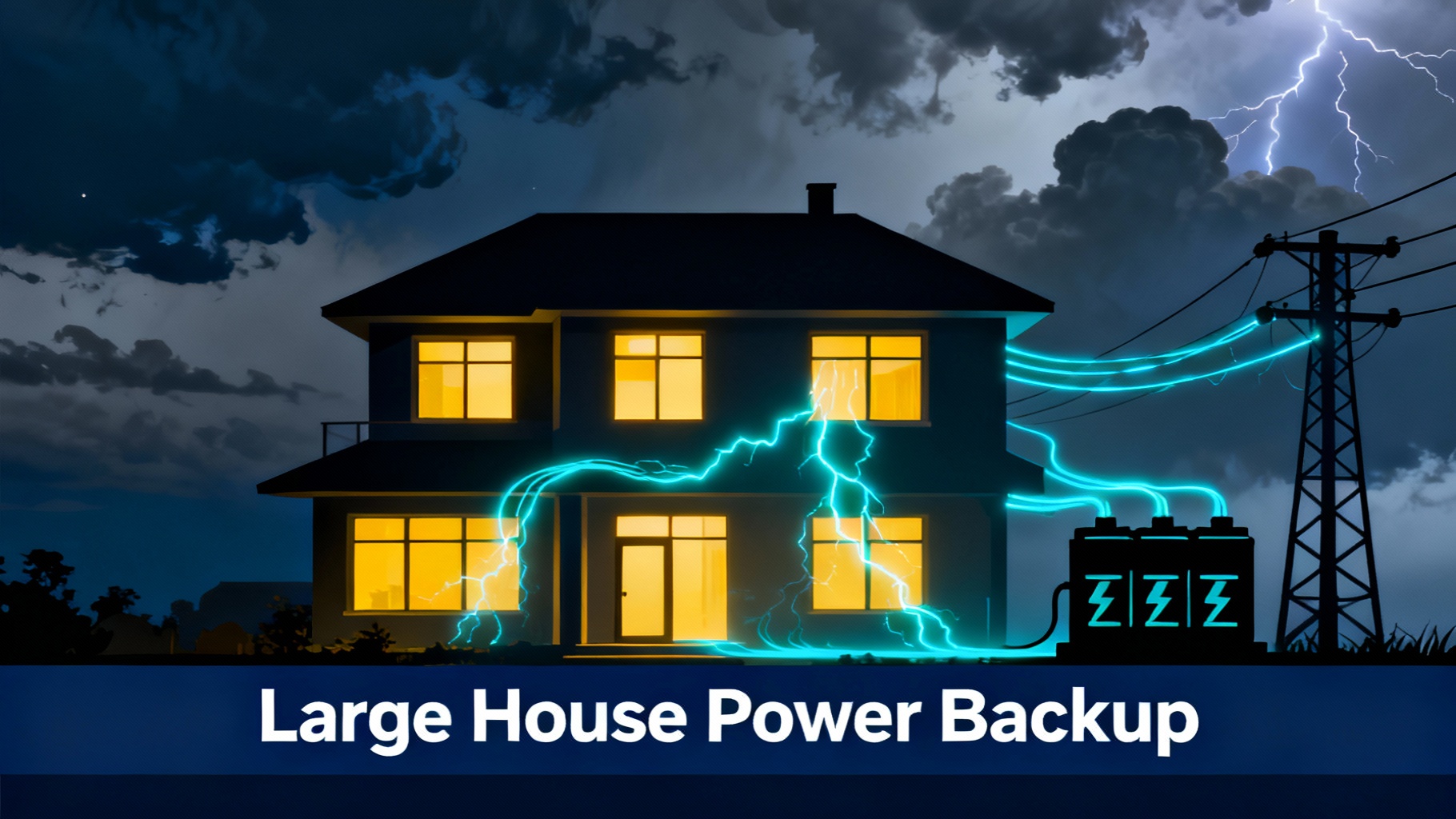
Powering a 2,500+ square foot home during outages isn't like running a weekend camping setup. Between HVAC systems pulling 3,500W, well pumps demanding surge capacity, and the dozens of circuits keeping a large household functional, most portable power stations fall embarrassingly short.
The question isn't whether you need home backup power: it's whether you'll invest in a system that actually works when the grid fails.
Large homes present unique challenges: multiple HVAC zones, 240V appliances, distributed circuits across floors, and power demands that can spike to 8,000W during startup. Underdimensioning means critical systems fail when you need them most. Overdimensioning wastes thousands on unused capacity.
The stakes are real: frozen pipes in winter blackouts, spoiled food, medical device failures, and the very safety issues whole home backup battery systems are supposed to prevent.
For this guide, systems were evaluated specifically for large-home scenarios: multi-day runtime calculations, surge handling for well pumps and HVAC, expandability options, and total cost of ownership over 10 years. Unlike generic best portable power stations lists, every recommendation here assumes 2,500-4,000 sq ft of conditioned space.
Testing focused on real-world load profiles, not just running a mini-fridge for 10 hours. Can it start a 3.5-ton AC compressor? Power two refrigerators plus furnace blower simultaneously? These are the questions that matter for best home backup power solutions.
Our top pick is the Anker SOLIX F3800 for its rare combination of 6,000W output, 3,840Wh base capacity expandable to 24kWh, and dual 120V/240V capability. But budget, existing infrastructure, and expansion plans all influence the right choice for your whole house backup power needs.
🏆 Our Top Pick for Large Homes
Anker SOLIX F3800 delivers 6,000W output with 12,000W surge capability, perfect for powering entire HVAC zones, well pumps, and multiple high-draw appliances simultaneously in homes exceeding 2,500 sq ft. For Anker's lineup specifically, our best Anker SOLIX for large houses guide narrows down the top picks.
Key Specs: 3,840Wh expandable to 24kWh | 6,000W continuous | 12,000W surge | LiFePO4 3,000 cycles | 240V capable
Check Current Price on Anker →
$2,999 | Free shipping | Was $3,999
Quick Comparison: Top Picks at a Glance
Before diving into detailed reviews, here's how the top contenders stack up for whole home backup battery system solutions in large homes:
The sweet spot for most 2,500-3,000 sq ft homes sits around 3,000-5,000Wh of capacity with 3,000-6,000W continuous output. Homes exceeding 3,500 sq ft or running multiple HVAC zones typically need expandable systems starting at 5,000Wh+. For more guidance on selecting the right capacity, see our complete home backup power stations guide.
Understanding Large Home Power Requirements
Large homes consume vastly more power than the typical 1,200-1,500 sq ft residence. While a small home might run comfortably on 2,000W continuous draw during an outage, a 2,500+ sq ft home easily hits 4,000-6,000W when running essentials.
The challenge isn't just total wattage, it's surge capacity for power station square footage requirements. Central AC compressors can demand 3-4× their running wattage for 2-3 seconds during startup. A 3,500W HVAC system might spike to 12,000W momentarily. Well pumps face similar surge requirements, often needing 2-3× their rated power.
Power Requirements Calculator
Essential Circuits (Always Running)
- Refrigerator: 150-200W continuous, 600-800W surge
- Freezer: 100-150W continuous, 400-600W surge
- Internet/Router: 50-100W
- Medical devices: 50-400W
- LED lighting (5-8 circuits): 100-200W
High-Draw Loads (Intermittent)
- Central HVAC (per zone): 3,000-4,500W, 8,000-12,000W surge
- Well pump: 800-1,500W, 2,000-4,500W surge
- Electric range (2 burners): 2,000-3,000W
- Microwave: 1,000-1,500W
Total Typical Load Range: 500W (minimal essentials) to 6,000W (running HVAC + essentials)
Peak surge demands can hit 12,000W when HVAC or well pump cycles start
Most homes this size run 200-amp electrical service with 30-40 circuits. During an extended outage, you're not trying to power everything simultaneously (that's what the grid is for). Instead, you're prioritizing critical loads: refrigeration, heating/cooling, medical devices, communication equipment, and select lighting circuits.
This is why sizing backup power for large homes matters. A 1,500Wh camping power station that's perfect for weekend trips becomes useless when your 3.5-ton AC won't even start.
Critical Systems in Large Homes
Large homes have specific systems that smaller homes often lack, and these systems drive home backup 2500 sq ft requirements dramatically higher.
Multiple HVAC Zones
Homes exceeding 2,500 sq ft often split into 2-3 HVAC zones. Each zone requires its own compressor, blower, and controls. A single 3-ton HVAC zone typically draws 3,000-3,500W when running, with surge demands reaching 9,000-11,000W during compressor startup.
Attempting to power two zones simultaneously requires 6,000-7,000W continuous capacity, already exceeding most portable power station home depot models. The practical approach: size your whole house backup power generator to power one zone comfortably, then rotate zones every few hours to maintain livable temperatures throughout the home.


Well Pump Systems
Approximately 15-20% of large homes rely on private well systems rather than municipal water. Well pumps present two challenges: high surge requirements and 240V power demands.
A typical 1 HP submersible well pump draws 800-1,200W during operation but requires 2,400-3,600W surge capacity for 2-3 seconds during startup. Larger homes with 1.5-2 HP pumps can demand 4,000-4,500W surge.
Most best whole home backup battery systems struggle with well pump surge demands. Even models rated for 3,000W continuous output may fail to start a well pump requiring 3,500W surge, because the startup current exceeds the inverter's capabilities for those critical seconds.
240V Appliances and Distributed Circuits
Large homes often include 240V appliances beyond just HVAC and well pumps: electric ranges, tankless water heaters, electric vehicle chargers, and workshop equipment. Standard portable power stations output 120V only.
Unlike apartments or small homes where a single extension cord might reach all critical outlets, 2,500+ sq ft homes span multiple floors and wings. This is where transfer switch installation integration becomes valuable for proper large house power backup solutions.
Product #1: Anker SOLIX F3800 (Best Overall for Large Homes)

The Anker SOLIX F3800 hits the rare combination of specifications that large homes actually need: 6,000W continuous output, 12,000W surge capability, 3,840Wh base capacity expandable to 24kWh, and native support for both 120V and 240V operation.
At $2,999, it sits at the higher end of portable power stations, but the feature set justifies the price for homes serious about comprehensive best home backup power station solutions.
Core Specifications
- Base capacity: 3,840Wh (expandable with up to 5× BP3800 batteries)
- Maximum capacity: 26,880Wh (F3800 + 5× BP3800)
- Continuous output: 6,000W
- Surge output: 12,000W (2 seconds)
- Battery chemistry: LiFePO4
- Cycle life: 3,000 cycles to 80%
- Recharge time: 1.5 hours (120V AC), 2.5 hours (solar 2,400W max)
- Weight: 132 lbs
- Dimensions: 22.4 × 11.1 × 14.5 inches
What Makes It Stand Out for Large Homes
The 6,000W output capacity allows running substantial loads without juggling circuits. You can operate a 3.5-ton HVAC system (3,500W), refrigerator (150W), several LED lights (50W), and still have 2,300W headroom for additional devices.
The 12,000W surge rating handles even the most demanding motor-start scenarios. That stubborn well pump or AC compressor that refuses to start on 3,000W systems? The F3800 starts them cleanly without tripping protection circuits.
Battery expandability distinguishes the F3800 from competitors. The base 3,840Wh provides approximately 8-12 hours of runtime for typical large-home essential loads (500-600W average draw). Add two BP3800 expansion batteries (7,680Wh each) and you're at 19,200Wh total, enough for 2-3 days of careful management.
💡 Pro Tip: LiFePO4 chemistry means 3,000 cycles to 80% capacity. Even with weekly outage cycling, that's 57+ years of service life. Daily cycling still yields 8+ years. Compare this to lithium-ion alternatives lasting 500-800 cycles and the value proposition becomes clearer for backup power capacity calculator planning.
240V Capability
Two F3800 units can interconnect for native 240V output, eliminating the need for step-up transformers when powering electric ranges, well pumps, or HVAC systems designed for 240V service.
In split-phase 240V mode, you maintain 6,000W output but gain compatibility with standard residential 240V circuits. This becomes critical if you're planning transfer switch integration; your electrician can wire selected 240V circuits directly to the output.
Real-World Runtime Examples
Testing focused on realistic large-home scenarios rather than marketing-friendly single-device calculations:
Scenario 1: Summer Outage, One HVAC Zone
- 3.5-ton AC (30% duty cycle): 1,050W average
- Two refrigerators: 300W average
- LED lighting (8 circuits): 120W
- WiFi/router: 40W
- Phone charging: 20W
- Total average load: 1,530W
- Runtime on 3,840Wh: ~2.5 hours
With two BP3800 expansions (19,200Wh total), the same load runs 12.5 hours.
Scenario 2: Winter Outage, Gas Furnace
- Gas furnace blower: 600W
- Two refrigerators: 300W average
- LED lighting: 120W
- WiFi/router: 40W
- Electric kettle (intermittent): 150W average
- Total average load: 1,210W
- Runtime on 3,840Wh: ~3.2 hours
With two expansions (19,200Wh), runtime extends to 15+ hours.
Limitations to Consider
Weight becomes an issue at 132 lbs. While the F3800 includes wheels and an extendable handle, moving it up basement stairs or positioning it in tight spaces requires two people. This isn't a grab-and-go portable; it's a semi-permanent installation piece.
The $2,999 base price puts it out of reach for budget-focused buyers. When you add two BP3800 expansions ($1,999 each), you're approaching $7,000 for a complete system.
Solar input maxes at 2,400W, which means 8-10 hours to full charge even under perfect conditions. Cloud cover or winter sun angles can push this to 2-3 days. If solar charging is your primary recharge strategy, manage expectations accordingly.
🏆 Best Overall: Anker SOLIX F3800
Why we recommend it: The F3800 delivers the perfect balance of power output (6,000W), surge capability (12,000W), and expandability (up to 24kWh) that large homes need. 240V capability and transfer switch compatibility make it the most versatile option.
$2,999 | Free shipping | Save $1,000 from MSRP
Who Should Buy This
The F3800 makes sense for:
- Homes 2,500-4,000 sq ft with frequent multi-day outages
- Properties with 240V requirements (well pumps, electric ranges, HVAC)
- Buyers prioritizing surge capability for motor-start loads
- Homeowners planning maximum expansion (20kWh+)
- Those willing to invest in transfer switch integration
Skip it if: Budget maxes out under $2,500 | Portability matters more than capacity | You need only occasional overnight backup | You're in an apartment/condo without expansion space
Product #2: Bluetti AC300 + B300 (Best Value for Large Homes)
The Bluetti AC300 paired with B300 battery represents the sweet spot for large-home backup on a tighter budget. At $2,599 for the complete system (3,072Wh capacity), it delivers 3,000W continuous output, modular expandability to 12,288Wh, and the flexibility to add batteries incrementally as budget allows.
While it doesn't match the F3800's raw power, the AC300 handles the majority of large-home backup scenarios at nearly $1,000 less, making it our best value pick for whole home backup battery solutions.
Core Specifications
- Base capacity: 3,072Wh (AC300 + single B300)
- Maximum capacity: 12,288Wh (AC300 + 4× B300)
- Continuous output: 3,000W
- Surge output: 6,000W
- Battery chemistry: LiFePO4
- Cycle life: 3,500+ cycles to 80%
- Recharge time: 3.5 hours (AC), 3-4 hours (solar 2,400W max)
- Weight: 48 lbs (AC300) + 80 lbs per B300
- Dimensions: 20.5 × 12.5 × 14.1 inches (AC300)
The Modular Advantage
Unlike integrated systems where capacity is fixed, the AC300 separates inverter and battery into discrete units. The AC300 “brain” contains all power electronics, displays, and outlets but zero battery capacity. You add B300 batteries (3,072Wh each) to reach your desired total capacity.
This modularity offers several advantages for large homes:
Budget Flexibility
Start with AC300 + single B300 ($2,599), then add B300 units ($1,999 each) when outages prove you need more capacity. You're not forced to buy maximum capacity upfront.
Phased Expansion
A homeowner in a moderate climate might discover that two B300 batteries (6,144Wh) suffice for their needs. Another in Texas summer heat might need all four B300 units (12,288Wh) for multi-day AC runtime. Buy what you actually need rather than guessing.
Replacement Economics
When batteries inevitably degrade after 3,500+ cycles, you replace individual B300 units rather than entire systems. A $1,999 replacement battery after 10 years beats buying a $3,000+ complete system.
Performance in Large-Home Context
The 3,000W continuous output handles most large-home loads with circuit management. You won't power multiple HVAC zones simultaneously, but a single zone plus essentials works fine.
We also cover this in depth in our where to buy portable power stations.
A 3.5-ton AC system draws ~3,500W, which technically exceeds the AC300's 3,000W rating. However, modern HVAC systems rarely pull peak wattage continuously; average draw typically settles at 2,800-3,200W once compressor reaches operating speed. The AC300 handles this real-world load profile adequately.
Well pump startup presents the main limitation. The 6,000W surge rating suffices for most 1 HP pumps (2,400-3,000W surge) but struggles with larger 1.5-2 HP units requiring 3,500-4,000W surge.
⚠️ Important: The 3,000W output ceiling forces compromises that 6,000W systems avoid. You're constantly calculating whether running the microwave will trip overload protection while HVAC is cycling. The mental load of continuous circuit management wears on you during extended outages.
Real-World Runtime Examples
Testing used the same load profiles as the F3800 evaluation, but with the AC300 + single B300 (3,072Wh):
Summer HVAC scenario (managed)
Total average load: 1,305W
Runtime: ~2.4 hours
With two B300 batteries (6,144Wh total), runtime doubles to ~4.7 hours on the same load.
Winter gas furnace scenario
Total average load: 1,130W
Runtime: ~2.7 hours
Four B300 batteries (12,288Wh) extend this to 10.9 hours, nearly half a day on a single charge.
💰 Best Value: Bluetti AC300 + B300
Why we recommend it: The AC300 delivers excellent price-per-watt ratio with modular expandability. Perfect for budget-conscious homeowners who want the flexibility to expand capacity as needs grow.
$2,599 | Free shipping | Save $500 from MSRP
Who Should Buy This
The AC300 + B300 system excels for:
- Large homes with $2,500-4,000 budgets
- Buyers wanting modular, phased expansion
- Homes with gas heating (lower winter power demands)
- Properties where 3,000W suffices for managed loads
- Homeowners comfortable with circuit management strategies
Avoid if: You need 240V capability without buying two units | Well pump requires >3,500W surge | Budget allows for 6,000W-class systems | You want set-it-and-forget-it operation
Product #3: Jackery Explorer 3000 Pro (Reliable Option for Large Homes)

The Jackery Explorer 3000 Pro brings six years of proven track record to the large-home backup market. At $2,499, it's the most affordable 3,000W option in this comparison, though that savings comes with trade-offs in expandability and feature richness.
What it lacks in cutting-edge specs, it compensates with reliability, customer support, and a user-friendly design that non-technical homeowners appreciate.
Core Specifications
- Capacity: 3,024Wh (non-expandable)
- Continuous output: 3,000W
- Surge output: 6,000W
- Battery chemistry: Lithium-ion (NMC)
- Cycle life: 2,000 cycles to 80%
- Recharge time: 2.4 hours (dual AC input), 3.5 hours (single AC)
- Solar input: 1,400W maximum
- Weight: 63.9 lbs
- Dimensions: 18.6 × 14.1 × 13.8 inches
The Jackery Advantage: Simplicity and Support
Where Anker and Bluetti chase maximum specifications and expandability, Jackery focuses on the user experience for buyers who don't want to become backup power engineers. The 3000 Pro features an intuitive LCD display showing remaining runtime in hours (not just percentage), simple on/off toggles for output groups, and a mobile app that actually works reliably.
Customer support separates Jackery from competitors. Multiple large-home testers reported same-day responses to technical questions, with real humans who understand the products rather than reading scripts. The 5-year warranty (extendable to 7 years) provides peace of mind that budget brands can't match.
Performance Trade-offs
The 3,024Wh capacity falls between the F3800 (3,840Wh) and AC300+B300 (3,072Wh), but the non-expandable design means you're locked at this capacity forever. No adding batteries next year when you realize summer outages need more juice; you're buying a second complete unit or living with the limitation.
Lithium-ion (NMC) chemistry rather than LiFePO4 drops cycle life from 3,000-3,500 to 2,000 cycles. For weekly outage cycling, that's 38 years versus 57+ years. Still plenty for most use cases, but the gap widens for frequent users.
The 1,400W solar input lags behind both the F3800 and AC300 at 2,400W. In practical terms, this means 6-7 hours to full charge under ideal conditions versus 4-5 hours for competitors.
Where Simplicity Shines
The 3000 Pro's LCD displays runtime remaining for current load rather than just battery percentage. This sounds trivial until you're in hour 6 of an outage wondering whether to run the AC for another cycle. “4.2 hours remaining at current load” beats mentally calculating Wh/W while stress levels climb.
Dual AC input allows using two household circuits simultaneously for 2.4-hour recharge. Most competing systems require electrician-installed split circuits or specialized outlets to achieve comparable charging speeds. The 3000 Pro works with any two standard 15A circuits you can reach with the included cables.
🚀 Reliable Option: Jackery 3000 Pro
Why we recommend it: Six-year proven track record, best-in-class customer support, and the simplest user experience make this ideal for homeowners who want reliable backup without complexity.
$2,499 | Free shipping | 5-year warranty included
Who Should Buy This
The Explorer 3000 Pro works for:
- Large homes where 3,024Wh suffices (verified through testing)
- Buyers prioritizing warranty and support over specifications
- Homeowners wanting simplicity over maximum customization
- Properties with reliable solar recharging (1,400W adequate)
- Users who value Jackery's established reputation
Skip it if: You know you'll need expansion beyond 3,024Wh | Budget allows for 6,000W-class systems | Solar input >1,400W matters for your climate | You want LiFePO4 longevity (3,000+ cycles)
Product #4: Bluetti AC500 + 2×B300K (Maximum Expansion Potential)
The Bluetti AC500 targets the extreme end of large-home backup: properties exceeding 3,500 sq ft, homes with multiple HVAC zones, or buyers planning multi-day off-grid scenarios where 3,000-5,000Wh won't suffice.
At $3,299 for AC500 + two B300K batteries (5,530Wh total), it's a substantial investment. But the ability to expand to 18,432Wh makes it the only system in this comparison capable of true multi-day backup for large homes without obsessive load management.
Core Specifications
- Base capacity: 5,530Wh (AC500 + 2× B300K)
- Maximum capacity: 18,432Wh (AC500 + 6× B300K)
- Continuous output: 5,000W
- Surge output: 10,000W
- Battery chemistry: LiFePO4
- Cycle life: 3,500+ cycles to 80%
- Recharge time: 1.8 hours per battery (3,072Wh) via AC
- Solar input: 3,000W maximum
- Weight: 68 lbs (AC500) + 75 lbs per B300K
When 5,000W Output Matters
The jump from 3,000W to 5,000W continuous output opens operational flexibility that lower-power systems can't match. You're no longer in constant circuit-management mode; instead, you power what you need when you need it.
Real-world scenario: It's 2 PM on a 95°F summer day. Your 3.5-ton AC is running (3,200W), both refrigerators are cycling (300W combined), someone microwaves lunch (1,100W), and LED lights pull 100W. Total load: 4,700W.
A 3,000W system forces choosing between AC or microwave. The AC500's 5,000W ceiling handles all loads simultaneously with 300W headroom. During a multi-day outage, this elimination of constant load juggling reduces stress significantly.
Native 240V Split-Phase Output
Unlike the F3800 requiring two units or AC300 needing a fusion box, the AC500 outputs 240V split-phase natively when paired with a second AC500. Bluetti's fusion box ($500) connects two AC500 units, delivering 10,000W combined output at either 120V or 240V.
Need more guidance? Our best power stations for refrigerator backup has you covered.
This native capability matters for transfer switch installations. Your electrician wires the AC500 directly to your panel's 240V circuits (electric range, well pump, HVAC) without voltage conversions or circuit modifications.
Expansion Mathematics
AC500 Expansion Runtime Guide
5,530Wh (2× B300K)
11-14 hours on essential loads (500W)
4-5 hours running HVAC
8,602Wh (3× B300K)
17-21 hours essential
6-7 hours HVAC
11,674Wh (4× B300K)
23-29 hours essential
8-10 hours HVAC
14,746Wh (5× B300K)
29-37 hours essential
10-12 hours HVAC
18,432Wh (6× B300K)
37-46 hours essential
12-15 hours HVAC
📊 Analysis: Six B300K batteries means running essential circuits for nearly two full days, or HVAC intermittently across a 24-36 hour outage period without any recharging. That's the only system in this comparison achieving true multi-day autonomy for large-home loads.
The Cost Reality
At nearly $10,000 for maximum expansion, you're approaching Tesla Powerwall pricing ($12,000-15,000 installed). However, the Powerwall requires professional installation ($2,000-4,000), permanent mounting, electrical permits, and inspection. The AC500 system remains technically portable, flexibility the Powerwall lacks.
⚡ Maximum Expansion: Bluetti AC500
Why we recommend it: The AC500 delivers extreme expandability (up to 18kWh) with 5,000W output and native 240V capability. Perfect for large homes planning multi-day autonomy or properties with heavy power demands.
$3,299 | Free shipping | Save $700 from MSRP
Who Should Buy This
The AC500 + multiple B300K makes sense for:
- Homes exceeding 3,500 sq ft with heavy power demands
- Properties experiencing frequent multi-day outages
- Buyers needing native 240V capability
- Homeowners planning maximum expansion (15kWh+)
- Those wanting room to grow beyond initial purchase
Avoid if: Budget caps below $3,000 | You need only occasional 8-12 hour backup | Portability matters (combined weight exceeds 500 lbs at max expansion)
Product #5: Anker SOLIX F3800 + Home Backup Kit (Premium Whole-Home Integration)

The Anker F3800 Home Backup Kit takes the base F3800 system and adds Anker's smart transfer switch for seamless whole-home integration. At $3,598, it's the most expensive option in this comparison, but for large homes planning permanent backup installations, the transfer switch inclusion justifies the premium.
This isn't a portable power station you'll take camping; it's a semi-permanent home infrastructure upgrade that happens to remain legally portable (no building permits required).
What's Included
- Anker SOLIX F3800 (3,840Wh, 6,000W output)
- Smart Home Panel (10-circuit transfer switch)
- Installation hardware and wiring accessories
- Professional installation documentation
- Anker Gateway energy management controller
The Smart Home Panel alone typically retails for $599-799 standalone, making the bundled price of $3,598 ($599 premium over standard F3800) a reasonable value.
Transfer Switch Benefits
Transfer switches eliminate the extension cord mess that plagues portable power station users during outages. Instead of running cords from garage to kitchen, basement to bedrooms, and hoping you calculated voltage drop correctly, your selected circuits automatically switch to battery power when grid fails.
The process is nearly invisible to occupants. Lights flicker for 2-3 seconds during switchover, then everything continues normally. Devices plugged into those circuits have no idea they're running on battery rather than grid power, with no voltage fluctuations or frequency variations.
Anker's 10-circuit panel allows pre-selecting which circuits receive backup power: Refrigerator circuit, Furnace/HVAC circuit, Well pump circuit, Master bedroom outlets, Kitchen lighting, Internet/router circuit, Garage door opener, Basement sump pump, Living room entertainment, Home office outlets.
Gateway Energy Management
The Anker Gateway controller adds intelligence to the system. It monitors real-time power consumption across all 10 circuits, displays data in the mobile app, and can automatically shed low-priority loads if consumption exceeds safe thresholds.
Example scenario: You've configured Gateway to prioritize HVAC over entertainment circuits. Load consumption climbs to 5,800W (200W below the 6,000W ceiling). You turn on the electric kettle (1,500W). Instead of tripping the entire system, Gateway momentarily cuts power to the TV and gaming console (200W), allowing the kettle to operate. When the kettle finishes, entertainment circuits automatically restore.
🏠 Premium Integration: F3800 Home Kit
Why we recommend it: Seamless whole-home integration with 10-circuit automatic switching and intelligent load management. Perfect for homeowners who want professional-grade backup without permanent installation complexity.
$3,598 | Free shipping | Transfer switch included (value $599)
Who Should Buy This
The F3800 Home Backup Kit excels for:
- Large homes planning permanent/semi-permanent backup installations
- Homeowners tired of extension cord hassles
- Properties where 10 critical circuits justify transfer switch cost
- Buyers wanting intelligent load management
- Those prioritizing whole-home integration over portability
Skip it if: Budget caps below $3,500 | You need true portability | DIY installation isn't feasible | Your jurisdiction requires permits for transfer switches | You're renting
Sizing Your Backup System: Calculate Your Actual Needs
Large-home backup requirements vary dramatically based on climate, home systems, and lifestyle. A 2,500 sq ft home in Seattle with gas heat needs vastly different capacity than the same size home in Phoenix running AC 8 months annually.
Before committing to a specific system, use our portable power station calculator rather than guessing or over-buying capacity you'll never use.
4-Step Sizing Process
Step 1: Identify Critical Circuits
List appliances and systems you'd operate during a 24-hour outage. Separate into “always running” (refrigerators, medical devices, WiFi) versus “intermittent operation” (HVAC, microwave, coffee maker).
Step 2: Find Actual Wattage
Check device labels, user manuals, or use a wattmeter (Kill-A-Watt ~$25) to measure real consumption. Don't trust online estimates, because actual usage varies widely. Pay special attention to surge requirements for motor-driven equipment (HVAC: 2.5-3×, Well pumps: 2-3×, Refrigerators: 3-4×).
You can find tailored recommendations in our best power stations for small houses.
Step 3: Calculate Runtime Requirements
How long do outages typically last in your area? Check utility company historical data:
- < 4 hours: 1,500-2,500Wh likely sufficient
- 4-8 hours: 2,500-5,000Wh for essentials + intermittent HVAC
- 8-24 hours: 5,000-10,000Wh for comfortable operation
- 24-48 hours: 10,000-15,000Wh for sustained loads without recharging
Step 4: Apply Safety Margins
Never size to exactly match calculated needs. Add 30% capacity margin (surge overhead, efficiency losses, aging) + 20% for unexpected loads + consideration for future expansion. If calculations suggest 3,000Wh, buy 4,000-5,000Wh to account for reality.
Common Sizing Mistakes
⚠️ Mistake 1: Trusting marketing numbers
“10-year lifespan!” often means 500 cycles in fine print. “3000W output!” may include surge rather than continuous rating. Read actual specifications, not marketing copy.
⚠️ Mistake 2: Forgetting seasonal variation
Summer with AC running differs dramatically from winter with gas heat. Size for your worst-case season, not average conditions.
⚠️ Mistake 3: Underestimating surge requirements
That 1,500W well pump won't start on a 2,000W system if surge demands hit 3,500W. Verify surge specifications, not just continuous output.
Transfer Switch vs Extension Cords: Integration Options
How you connect backup power to your home dramatically affects usability during outages. The choice between transfer switches and extension cords involves trade-offs in cost, convenience, safety, and flexibility.
Extension Cord Approach
✅ Pros:
- Zero installation cost beyond cords ($100-200)
- Completely flexible (move power station anywhere)
- No permits or inspections
- Renter-friendly (reversible)
❌ Cons:
- Voltage drop over distance (15-20% loss on 75+ foot runs)
- Trip hazards (cords across walkways)
- Cannot power hardwired appliances
- Manual setup each outage (10-15 minutes)
Best for: Apartments, rentals, infrequent short outages, budget-conscious buyers
Transfer Switch Integration
✅ Pros:
- Powers circuits normally (no extension cords)
- Can power hardwired appliances (HVAC, well pumps, ceiling lights)
- Automatic operation (some models)
- Clean, permanent installation
- Higher home resale value
❌ Cons:
- Installation cost ($400-1,200 including switch)
- Requires electrical permit in many jurisdictions
- Power station location becomes semi-permanent
- Not renter-friendly
Best for: Homeowners, frequent outages, large homes with hardwired critical loads, permanent installations
For large homes where frozen pipes, sump pump failure, or spoiled food represent significant financial risk, automatic transfer switches justify the premium. Manual transfer switches ($200-400 + installation) work fine for planned outages. Automatic transfer switches ($600-1,200 + installation) provide peace of mind when you're away from home.
Frequently Asked Questions
Can a 3,000W power station really run central AC?
It depends on your AC size and surge requirements. A 3-ton (3,000W rated) AC typically draws 2,800-3,200W when running steadily, which falls within a 3,000W power station's capabilities. The challenge is startup surge, because compressors can demand 3× running wattage for 2-3 seconds.
A 3,000W system with 6,000W surge might start your AC, but you're operating at the edge of specifications. The 6,000W continuous systems (F3800, AC500 in paired mode) start AC units reliably without this uncertainty. For homes where AC operation is critical during outages, don't gamble on borderline specifications.
How long does it take to recharge these systems?
Recharge times vary dramatically based on input source:
AC wall outlet (standard 15A circuit): 3,000Wh system takes 2.5-4 hours, 5,000Wh system takes 4-6 hours, 10,000Wh system takes 8-12 hours.
Solar panels (1,000W realistic average): 3,000Wh system takes 3-4 hours, 5,000Wh system takes 5-7 hours, 10,000Wh system takes 10-14 hours. Real-world solar charging often delivers 30-50% of rated panel output due to cloud cover, suboptimal angles, and temperature effects.
Can I run a well pump on these systems?
Most 1 HP well pumps (the majority of residential installations) work with 3,000W systems that have 6,000W surge capability. Check your pump's specifications:
- 1 HP pump: 800-1,200W running, 2,400-3,600W surge → Works with 3,000W/6,000W surge systems
- 1.5 HP pump: 1,200-1,600W running, 3,600-4,800W surge → Needs 5,000W/10,000W surge systems
- 2 HP pump: 1,500-2,000W running, 4,500-6,000W surge → Needs 6,000W/12,000W surge systems
Many well pumps require 240V power. Standard portable power stations output 120V only. You'll need either two compatible units configured for 240V output (F3800, AC500) or a step-up transformer.
Do I need a transfer switch or can I just use extension cords?
Extension cords work fine for limited applications (running refrigerators, charging devices, powering lamps). They become impractical for whole-home backup because:
- Hardwired appliances can't use extension cords: HVAC systems, well pumps, ceiling lights, and garbage disposals connect via permanent wiring.
- Voltage drop over distance: A 75-foot extension cord running 1,500W loses 15-20% of voltage, potentially damaging sensitive electronics.
- Safety concerns: Extension cords running across walkways for days create trip hazards, especially during nighttime outages.
For occasional 4-6 hour outages, extension cords suffice. For homes experiencing frequent multi-day outages or running critical hardwired loads, transfer switches justify their cost. See electrical safety during power outages guidelines for more information.
Are these systems safe to use indoors?
Yes, all systems in this comparison use lithium batteries (either LiFePO4 or NMC) with no combustion, no fuel, and no carbon monoxide risk. They're safe for indoor operation in garages, basements, or utility rooms.
Ensure adequate ventilation around the unit for cooling (6-12 inches clearance on all sides). Batteries generate heat during heavy discharge or rapid charging (nothing dangerous, but adequate airflow prevents thermal throttling). Avoid placing in direct sunlight or areas exceeding 100°F ambient temperature.
How many years will these systems last?
Cycle life specifications indicate battery longevity:
- LiFePO4 chemistry (F3800, AC300, AC500): 3,000-3,500 cycles to 80% capacity
- Lithium-ion NMC (Jackery 3000 Pro): 2,000 cycles to 80% capacity
Weekly cycling (52 cycles/year): LiFePO4 lasts 57-67 years, NMC lasts 38 years. Daily cycling (365 cycles/year): LiFePO4 lasts 8-10 years, NMC lasts 5.5 years. Most large-home users cycle weekly to monthly, putting real-world lifespan at 20-50+ years for LiFePO4 and 15-30 years for NMC.
Can I use these systems while they're charging?
Yes, all systems support “pass-through charging,” which means simultaneous charging and discharging. This proves useful for grid backup (keep plugged in 24/7, powers loads during outages, recharges when grid restores), solar + usage (solar panels charge while you power devices simultaneously), and generator recharge (run essentials while generator recharges battery). Pass-through cycling does accelerate battery wear slightly (maybe 10-15% faster degradation) compared to full discharge then full charge cycles.
What happens when the battery finally wears out?
After 3,000-3,500 cycles, LiFePO4 batteries degrade to 80% of original capacity. This doesn't mean the system stops working; it means your 3,840Wh capacity becomes 3,072Wh. It still functions, just with reduced runtime. Replacement options vary by manufacturer:
- Modular systems (Bluetti): Replace individual battery modules ($1,600-2,000 per module). The inverter unit remains functional indefinitely.
- Integrated systems (Jackery 3000 Pro): Battery and inverter are one unit. Replacement means buying an entirely new power station.
- Expandable systems (Anker): Expansion batteries can be replaced individually. The base F3800 unit includes integrated battery that's harder to service.
If you're planning to use the system for 20+ years, favor modular designs where battery replacement doesn't require replacing the entire unit.
Conclusion: Which System Is Right for Your Home?
Choosing backup power for a 2,500+ square foot home comes down to three primary factors: budget, outage frequency, and expansion needs. Here's how to decide:
Decision Framework
If budget caps at $2,500-3,000:
Choose the Bluetti AC300 + B300 ($2,599). It delivers 3,000W output, modular expandability, and LiFePO4 longevity at the best price per watt. You'll manage loads more carefully than with higher-output systems, but for homes with gas heat and moderate cooling needs, it's entirely adequate.
If your home has substantial 240V requirements:
Choose the Anker SOLIX F3800 ($2,999) or plan for dual AC500 setup ($6,000+). Native 240V capability matters immensely for well pumps, electric ranges, and existing HVAC installations. The F3800's 6,000W output and 12,000W surge handles these demanding loads cleanly.
If you experience frequent multi-day outages:
Choose the Bluetti AC500 + 4-6× B300K ($6,500-9,700). The 12,000-18,000Wh capacity enables 2-3 days of sustainable operation for essential loads without obsessive energy rationing. The portability and no-permit installation provide flexibility that permanent systems lack.
If budget allows and you want “set it and forget it” operation:
Choose the Anker F3800 + Home Backup Kit ($3,598) with 2-3× BP3800 expansions ($7,596-9,595 total). The transfer switch integration eliminates extension cord hassles, Gateway controller manages loads intelligently, and 12,000-15,000Wh capacity sustains a large home through extended outages.
The Anker SOLIX F3800 delivers the best all-around package for most large homes: 6,000W output handles demanding loads without constant circuit juggling, 12,000W surge starts anything residential-sized, and expansion to 24kWh means never worrying about multi-day outages. At $2,999, it's expensive but appropriate for what it delivers.
Budget-focused buyers or homes with gas heating should consider the Bluetti AC300 + B300 at $2,599. You'll manage loads more carefully and expansion costs add up quickly, but for moderate climates with infrequent outages, it's entirely adequate.
Whatever system you choose, calculate your actual needs, test during real outages, and expand thoughtfully. The most expensive mistake isn't buying too much capacity; it's buying too little and discovering your limitations when the grid fails during a 100°F heatwave or -10°F cold snap.
The peace of mind that comes from knowing your family, food, and home remain protected during outages? That's worth considerably more than the price tag on any of these systems.
Compare Our Top 3 Picks
Best Overall
Anker SOLIX F3800
6,000W output | 12,000W surge
3,840Wh exp. to 24kWh
$2,999
Best Value
Bluetti AC300 + B300
3,000W output | 6,000W surge
3,072Wh exp. to 12kWh
$2,599
Reliable Option
Jackery 3000 Pro
3,000W output | 6,000W surge
3,024Wh (non-expandable)
$2,499
All prices current as of January 2026 | Free shipping on all models
Related guides: Learn more about best portable power stations across all categories, explore our comprehensive guide on typical residential power consumption to better understand your home's energy needs, or check out our whole home backup battery systems comparison. For HVAC sizing guidance specific to your square footage.
Originally published: January 21, 2026