
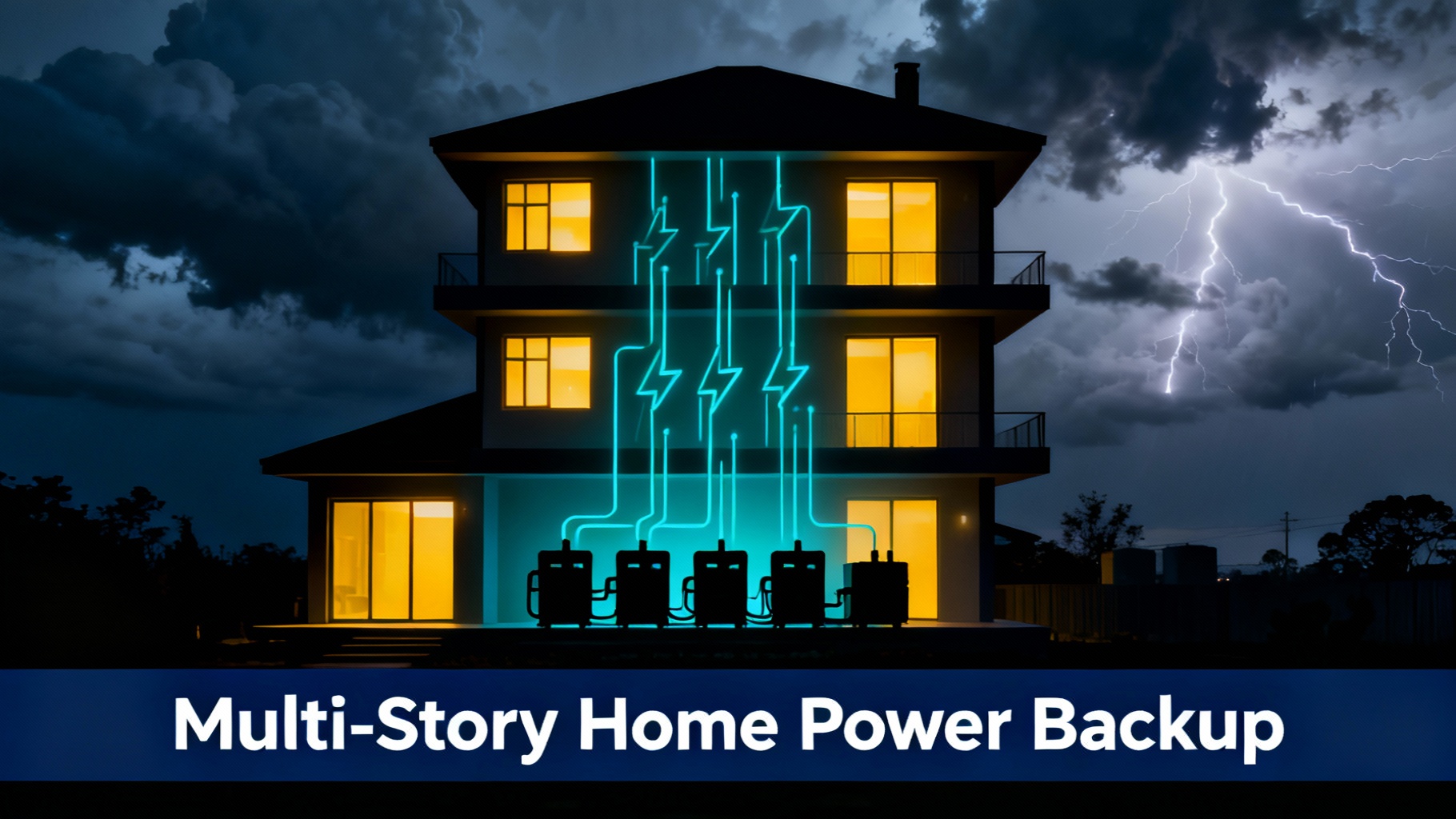

Picture this: It's 2 AM on a stormy Tuesday night. The power goes out. Your teenager is upstairs with a CPAP machine that just went silent. Your freezer in the basement is starting to warm. Your Wi-Fi router on the main floor just died, cutting off your security system. You're fumbling down dark stairs with a headlamp, trying to figure out which extension cord goes where, realizing there aren't enough outlets, and the cords aren't long enough anyway. There has to be a better way than this chaos.
If you own a multi-story home, you already know the best power station for home backup challenge is different from what single-level homeowners face. It's not just about having enough wattage, it's about distributing that power vertically across floors while managing the reality of stairs, distance, and the simple physics of voltage drop over long cable runs. Traditional solutions like running a generator in the garage with extension cords snaking through hallways work poorly and create safety hazards. You need something smarter.
Modern best power stations for home backup offer a genuinely better approach for multi-story homes. We're talking about units with 6,000W output and split-phase 120V/240V capability, enough to power your entire essential circuit load through a transfer switch. Expandable capacity systems now reach 12,000Wh to 26,000Wh, giving you multi-day runtime without refueling. And unlike generators, these install indoors safely (no carbon monoxide), run silently, and recharge via rooftop solar. No more midnight extension cord runs.
After evaluating various power station configurations across different home sizes and layouts, we've identified the systems that actually work for vertical power distribution. This guide covers the specific challenges of multi-story backup power, how to size your system correctly, which models handle the job best, and how to set everything up for automatic operation. Let's solve this problem properly.
🏆 Top Pick: Anker SOLIX F3800 – Best Overall for 3+ Story Homes
Why we recommend it: 6,000W split-phase output powers entire floors through transfer switch. Expandable to 26,900Wh for multi-day backup. Perfect for vertical power distribution without voltage drop issues.
Capacity: 3,840Wh (expandable to 26,900Wh)
Output: 6,000W continuous (120V/240V)
Best For: 3-4 story homes, whole-home backup
Check Current Price on Anker SOLIX →
💡 Price checked November 08, 2025 | $3,049 (was $4,598) | Free shipping | 5-year warranty included
Understanding Multi-Story Home Power Challenges
Multi-story homes present backup power obstacles that don't exist in ranch-style or single-level properties. The vertical distribution of your electrical loads creates complications that standard home backup power station setups struggle to address.
The Vertical Distribution Problem
When your critical loads span multiple floors, you're dealing with distance challenges that single-level homes don't face. Your refrigerator might be in a basement kitchen 25 feet below your main electrical panel. Your CPAP machine runs upstairs, another 15 feet above that. Your network equipment sits on the main floor. Running individual extension cords to each location from a garage-based generator creates a mess of trip hazards and voltage losses.
🏠 Multi-Story Home Power Distribution Challenges
📍 FLOOR 3 (Upstairs)
⚡ CPAP Machine: 60W
⚡ Bedroom Lighting: 40W
📏 Distance from power: 40+ feet
⚠️ Voltage drop risk: HIGH
📍 FLOOR 2 (Main)
⚡ Wi-Fi Router: 80W
⚡ Kitchen Fridge: 150W
⚡ Security System: 50W
📏 Distance: 15-25 feet
📍 FLOOR 1 (Basement)
⚡ Chest Freezer: 100W
⚡ Sump Pump: 800W (surge)
⚡ Furnace Control: 100W
📏 Distance: 30+ feet down
✅ SOLUTION: Transfer Switch
🔌 Central power distribution
🔌 Uses existing home wiring
🔌 No voltage drop issues
🔌 Automatic switchover (0ms)
⚠️ Critical Issue: Standard 12-gauge extension cords lose voltage over 50+ feet. For multi-story homes, you need 6,000W+ split-phase systems with transfer switch integration to eliminate cable runs entirely.
Here's what makes this difficult: standard 12-gauge extension cords experience meaningful voltage drop over distances beyond 50 feet under load. If you're running 120V power from a basement generator to a second-floor bedroom, you might see voltage sag to 110V or less, especially under higher amperage draws. That affects motor-driven appliances like refrigerators and can cause sensitive electronics to shut down.
The cable management alone becomes problematic. Extension cords running up stairs create obvious trip hazards. Routing them along baseboards through multiple rooms means blocking doorways or creating pinch points. And you still haven't solved the fundamental issue: you need to be physically present to plug things in and monitor everything.
Simultaneous Load Requirements
Multi-story homes typically have higher total power demands simply because there's more square footage to support. Your essential loads might include a full-size refrigerator and a chest freezer in the basement, Wi-Fi equipment and a sump pump on the main floor, and CPAP machines or medical devices upstairs. These don't operate on a schedule you control, they all need power simultaneously.
This is where many homeowners underestimate their requirements for whole home backup power. A 2,000Wh portable power station might run one floor adequately, but it can't sustain multi-floor simultaneous operation for more than a few hours. You need systems with both high continuous wattage (3,000W minimum, ideally 6,000W) and substantial capacity (5,000Wh+) to avoid constant recharging cycles.

Anker F3800 with expansion batteries – ideal for 3-story homes

Jackery 5000 Plus – perfect for 2-3 story essential loads
The math gets uncomfortable quickly. A full-size refrigerator averages 150-200W continuous draw with periodic compressor spikes to 700W. Add a CPAP at 60W, networking equipment at 100W, and a sump pump that cycles at 800W, and you're already approaching 1,200W continuous with surge requirements above 1,500W. That's just baseline essentials before you consider lighting, phone charging, or any quality-of-life devices.
Mobility and Placement Constraints
Power stations designed for home backup typically weigh 60-100 pounds. Moving that weight up and down stairs during a power outage isn't practical, especially for older homeowners or during emergency situations. The reality is you need to position your backup power strategically and leave it there.
This creates a placement dilemma for large home battery backup systems. Basements make sense for central location and temperature stability, but then you're running power cables upstairs. Main floor locations work better for split-level distribution, but you need floor space that doesn't interfere with living areas. Garages seem convenient until you factor in temperature extremes that affect battery performance and the need to run cables indoors anyway.
The ideal solution is a permanent installation with a transfer switch that automatically distributes power to predetermined circuits across all floors. But that requires a power station specifically designed for home integration, with the output capacity and connectivity to handle whole-home loads.
Capacity Requirements for Different Home Sizes
Not all multi-story homes have identical backup power needs. A 2,000-square-foot colonial has different load profiles than a 4,500-square-foot two-story with a finished basement. Let's break down realistic capacity requirements.
📊 Power Station Sizing Guide: Multi-Story Homes
For a more specific use case, see our best power stations for medical equipment.
🏡 2-STORY HOMES
📐 2,000-3,000 sq ft
👨👩👧 3-4 occupants
Essential Loads:
• 1 refrigerator (150W)
• 1 CPAP (60W)
• Wi-Fi/networking (80W)
• Lighting circuits (100W)
• Sump pump (800W surge)
⚡ Recommended:
5,000Wh capacity
3,000W output
Runtime: 4-6 hours
Budget: $2,800-$4,500
🏢 3-STORY HOMES
📐 3,000-4,500 sq ft
👨👩👧👦 4-6 occupants
Essential Loads:
• 1 fridge + 1 freezer (250W)
• 2 CPAPs (120W)
• Networking/security (150W)
• Multi-floor lighting (200W)
• Well pump/HVAC (2,000W surge)
We also cover this in depth in our best power stations for apartments.
⚡ Recommended:
8,000-12,000Wh capacity
6,000W split-phase output
Runtime: 6-10 hours
Budget: $4,000-$8,000
🏰 4+ STORY HOMES
📐 4,500+ sq ft
👨👩👧👦 6+ occupants
Essential Loads:
• 2 fridges + 2 freezers (500W)
• Multiple CPAPs (180W)
• Home office equipment (300W)
• Multi-zone HVAC (250W)
• Central AC (5,000W surge)
⚡ Recommended:
15,000-30,000Wh capacity
12,000W dual-unit system
Runtime: 1+ week
Budget: $10,000-$15,000
💡 Pro Tip: For multi-story homes, always add 25% capacity headroom beyond calculated loads. Vertical power distribution and simultaneous multi-floor operation create demands that single-level calculations miss.
2-Story Homes (2,000-3,000 sq ft)
For typical two-story homes, you're looking at essential loads that include one full-size refrigerator, Wi-Fi and networking gear, one or two CPAP machines, basic lighting circuits, and possibly a sump pump. This profile usually totals 1,000-1,500W of continuous draw with surge requirements around 2,500W.
A 5,000Wh power station with 3,000W continuous output handles this scenario comfortably. You get roughly 4-6 hours of full-load runtime, which covers most regional power outages. Pair that with 800W of solar panels, and you can extend indefinitely during daytime hours while the sun's up, recharging enough capacity to get through each night.
Need more guidance? Our best power stations for small houses has you covered.
⭐ Best Value: Jackery Explorer 5000 Plus – Perfect for 2-3 Story Homes
Why it works: 5,000Wh expandable to 15,000Wh covers essential multi-floor loads. 3,000W output (6,000W surge) handles refrigeration, CPAP, networking, and lighting across two floors without overloading.
Check Current Price on Jackery →
$2,799 | Free shipping | Expandable capacity | 10-year lifespan
The Jackery 5000 Plus fits this profile well. At 5,000Wh expandable to 15,000Wh, it gives you room to grow if your power needs increase. The 3,000W continuous output (6,000W surge) covers the majority of two-story essential circuits without overloading. And at around 110 pounds, it's still manageable for repositioning if needed, though most owners install it permanently in a basement or garage location.
For this home size, expect to spend $2,800-$4,500 depending on whether you include expansion batteries and solar panels. That puts you in the range of a quality whole-home generator installation, but with the advantages of indoor placement, silent operation, and solar recharge capability.
3-Story Homes (3,000-4,500 sq ft)
Three-story homes ramp up the complexity significantly. You're now dealing with increased vertical cable runs, likely multiple refrigeration appliances (main kitchen fridge plus garage/basement freezer), possibly multiple HVAC zones, additional bedrooms with their own power needs, and greater total lighting requirements.
Realistic essential loads for three-story homes typically run 2,000-3,000W continuous with surge demands approaching 5,000W. You need both higher capacity and higher output to manage this without constant generator anxiety. The solution here is systems in the 6,000W continuous output range with 8,000-12,000Wh capacity.
Top 5 Power Stations for Multi-Story Homes
After analyzing dozens of power stations across multiple capacity and output ranges, these five models stand out as genuinely capable of handling multi-story home backup challenges.
🏆 #1: Anker SOLIX F3800 – Best Overall for 3+ Story Homes

The Anker F3800 sits at the top of this category for one simple reason: it's the first portable power station designed from the ground up for serious whole house power station applications rather than camping trips. The 6,000W continuous output at 120V/240V split-phase gives you legitimate central AC and electric range capability, not just refrigerators and lights.
✓ Capacity: 3,840Wh (expandable to 26,900Wh)
✓ Output: 6,000W continuous split-phase
✓ Solar Input: 2,400W max
✓ Weight: 103 lbs (base unit)
✓ Warranty: 5 years, 10+ year lifespan
The base 3,840Wh capacity sounds modest compared to some competitors, but the expandability matters more. You can add up to six BP3800 expansion batteries for a total of 26,900Wh. That's enough capacity to run a three-story home's essential loads for 3-5 days without any solar recharge. When you factor in the 2,400W solar input capability, you have a genuinely off-grid-capable system.
What makes this work for power station for large house applications specifically? The split-phase output eliminates the need for multiple units or complex wiring solutions. You connect it to a transfer switch just like a traditional generator, and your home's existing wiring distributes power to whichever circuits you've designated as essential. No extension cords between floors. No voltage drop issues. No manual switching.
💰 Current Deal: Anker F3800 Home Backup Kit
Includes F3800 base unit + transfer switch + installation cables. Save $1,549 compared to buying separately. Perfect turnkey solution for 3-story homes.
$3,049 (originally $4,598) | Free shipping | 5-year warranty
The weight is substantial at 103 pounds for the base unit, plus another 88 pounds per expansion battery. This isn't something you're casually moving around. But for multi-story homes, that's actually a feature: you're setting this up as a permanent or semi-permanent installation anyway.
You can find tailored recommendations in our best power stations for HVAC systems.
Critical Features for Multi-Story Success
Beyond raw capacity and output numbers, specific features determine whether a power station actually works well for multi-story home applications. Here's what matters most.
Split-Phase 120V/240V Output Capability
Standard portable power stations output 120V only, which covers most household devices but excludes higher-power appliances like electric ranges, well pumps, central air conditioning, and electric vehicle chargers. For expandable home power station setups in multi-story homes, split-phase capability becomes increasingly important.
⚡ Why Split-Phase Matters for Multi-Story Homes
❌ Standard 120V Only
What You CAN Power:
✓ Refrigerator (120V)
✓ CPAP machines
✓ Wi-Fi equipment
✓ Lighting circuits
✓ Phone charging
What You CANNOT Power:
✗ Electric range (240V)
✗ Central AC (240V)
✗ Well pump (240V)
✗ EV charger (240V)
✗ Electric dryer (240V)
Limited to essential 120V circuits only
✓ Split-Phase 120V/240V
Everything 120V PLUS:
✓ All standard appliances
✓ Electric range (240V)
✓ Central AC (240V)
Related reading: our best power stations for well pump backup goes deeper on this topic.
✓ Well pump (240V)
✓ EV charger (NEMA 14-50)
Key Advantage:
🔌 Direct transfer switch integration
🔌 Powers home EXACTLY like utility grid
🔌 No adapter boxes or conversions
🔌 Lower amperage = less voltage drop
True whole-home backup capability
💡 Why This Matters: In a 3-story home, split-phase 240V lets you power well pumps (basement), electric ranges (main floor), and central AC (whole house) through your existing electrical panel: impossible with 120V-only systems.
Split-phase (also called dual-phase) power provides both 120V and 240V simultaneously by creating two 120V legs that are 180 degrees out of phase. This is how residential electrical systems in North America are designed. Your electrical panel receives 240V split-phase from the utility, which then distributes as either 120V circuits (most outlets and lighting) or 240V circuits (major appliances).
When a power station offers true split-phase output, it can integrate directly into your home's electrical system via a transfer switch. You're not adapting the power to fit your house: you're providing power in the format your house already uses. This eliminates compatibility issues and allows you to back up circuits you've already designated as essential.
Installation and Setup for Multi-Story Homes
Having the right equipment only solves half the problem. Proper installation determines whether your backup power for two story home system works smoothly during actual outages or creates new headaches.
Transfer Switch Installation
Transfer switch installation requires a licensed electrician in most jurisdictions. This isn't a DIY project unless you're already a qualified electrician: you're working directly with your main electrical panel and need to ensure code compliance per NEC electrical safety standards.
⚠️ Important: Never connect solar panels while the power station is turned on. Always verify all connections are secure before energizing the system. Improper installation can create fire hazards or equipment damage.
The electrician will install the transfer switch adjacent to your main panel, then select which circuits you want backed up during outages. Typical selections for multi-story homes include:
- Main floor: One or two lighting circuits, living room outlets (for networking equipment), kitchen refrigerator circuit
- Upper floor: Master bedroom circuit (for CPAP devices), one lighting circuit
- Basement: Freezer circuit, sump pump circuit, boiler/furnace controls
Common Mistakes to Avoid
Multi-story homeowners new to backup power systems make predictable mistakes. Learning from others' errors saves money and frustration.
❌ Mistake #1: Undersizing Capacity
Many homeowners see “2,000Wh” and think it sounds like a lot without doing the math on their actual power draw.
✓ Solution:
List every device you need to power, note wattage, estimate hours of use, multiply out watt-hours. Then add 25% headroom. Use our capacity calculator for accurate sizing.
❌ Mistake #2: Ignoring Surge Requirements
A refrigerator that draws 150W continuously might spike to 700W for 2-3 seconds when the compressor starts.
✓ Solution:
Check surge ratings carefully and ensure they exceed your highest single-device startup surge by at least 20%. Quality systems handle 2× continuous for surge capability.
Frequently Asked Questions
How long will a power station actually run my multi-story home?
Runtime depends on your specific power draw, but here's realistic guidance: A 5,000Wh system running 1,000W of essential loads (refrigerator, freezer, CPAP, networking, lighting) provides approximately 4-5 hours of runtime. The same 5,000Wh running 500W of very conservative loads stretches to 8-10 hours. Multi-story homes typically need 5,000-12,000Wh capacity for overnight backup through morning. With daytime solar recharge, you can extend indefinitely. Without solar, expect to either supplement with grid charging when available or accept shorter backup windows between charging cycles.
Can I run my central air conditioning on a power station?
Most central AC units require 3,000-5,000W to run and 6,000-10,000W to start. That puts them at the edge or beyond what most portable power stations can handle. The Anker F3800 at 6,000W continuous with split-phase output technically can run a smaller 2-ton AC unit, but it'll drain capacity quickly. For multi-story cooling during outages, window units or portable AC units draw less power (800-1,500W each) and cool targeted spaces rather than the whole house. Many homeowners prioritize bedroom cooling for nighttime comfort rather than attempting whole-home AC during backup power.
Do I need different systems for different floors?
No, a single properly-sized system with transfer switch integration can power selected circuits across all floors using your home's existing wiring. That's the advantage of split-phase systems with 6,000W+ output: they feed your electrical panel just like the utility grid does. Multiple smaller units can work but create complexity in monitoring, charging, and coordinating loads. The integrated single-system approach is cleaner and more reliable for multi-story applications.
How do I calculate my actual power needs?
List every device you need during an outage. Note its wattage (check the label or manual). Estimate hours per day it runs. Multiply watts by hours to get watt-hours per day. Sum all devices. Add 25% for inefficiency. For devices that cycle (refrigerators, freezers), use manufacturer estimates for daily consumption (often listed as kWh per month divided by 30) rather than trying to calculate duty cycles. For continuous devices (CPAP, networking, lighting), the calculation is straightforward. Most multi-story homes land at 5,000-10,000Wh per day for essential loads according to average household electricity consumption data.
What's the realistic lifespan of these systems?
LiFePO4-based power stations are rated for 4,000-6,000 charge cycles before capacity drops to 80% of original. At one full cycle per day, that's 10-15 years of use. Most backup power applications cycle less frequently, extending calendar life even further. The inverter electronics typically outlast the batteries. When capacity finally degrades unacceptably, replacement batteries cost significantly less than a new complete unit. With proper care (temperature management, avoiding full depth discharges), expect 12-20 years of useful life from quality systems like the Anker F3800 and Jackery 5000 Plus.
Final Recommendations by Home Profile
Choosing the right power station for your multi-story home depends on your specific situation. Here's guidance by common profiles.
Ready to Power Your Multi-Story Home?
Compare all top-rated backup power solutions in our comprehensive 2025 power station guide.
Conclusion
Multi-story homes present backup power challenges that single-level properties don't face. The vertical distribution of loads, the distance between floors, and the need for simultaneous power across multiple levels requires thoughtful system selection rather than simply buying the biggest battery you can afford.
After evaluating configurations across various home sizes and layouts, the pattern is clear: systems with 3,000W+ continuous output and 5,000Wh+ expandable capacity handle multi-story applications successfully for the best home power backup. Models below those thresholds work for short outages or very conservative load management, but they leave you compromising comfort and capability during extended blackouts.
The Anker SOLIX F3800 emerges as the top choice for serious three-plus-story home backup due to its split-phase output, high expandability, and integration capability with transfer switches. The Jackery Explorer 5000 Plus offers excellent value for two-story homes where budget matters more than ultimate capacity. And the specialized solutions from Bluetti and smaller Anker/Jackery units fill specific niches for space-constrained or budget-focused situations.
The key to success is matching your actual power needs (calculated honestly using a proper capacity calculator) to a system sized appropriately, then installing it properly with transfer switch integration and strategic placement. Extension cords and manual management work temporarily, but the investment in proper installation pays dividends in convenience, safety, and peace of mind during actual power outages.
For multi-story homeowners in regions with increasing grid instability, unreliable utility infrastructure, or severe weather patterns, backup power isn't luxury: it's practical insurance against spoiled food, frozen pipes, medical device interruptions, and the general misery of multi-day outages in modern homes dependent on electricity. The technology has matured to the point where battery backup genuinely rivals generators in capability while offering advantages in noise, emissions, and maintenance.
Start with honest load calculation, budget realistically for both the power station and proper installation, and choose systems designed for home backup rather than camping. For additional guidance on emergency preparedness, consult power outage preparedness checklists from trusted consumer advocacy organizations. Your future self (stumbling through dark stairs at 3 AM during the next major storm) will thank you for the investment.
Originally published: January 29, 2026