
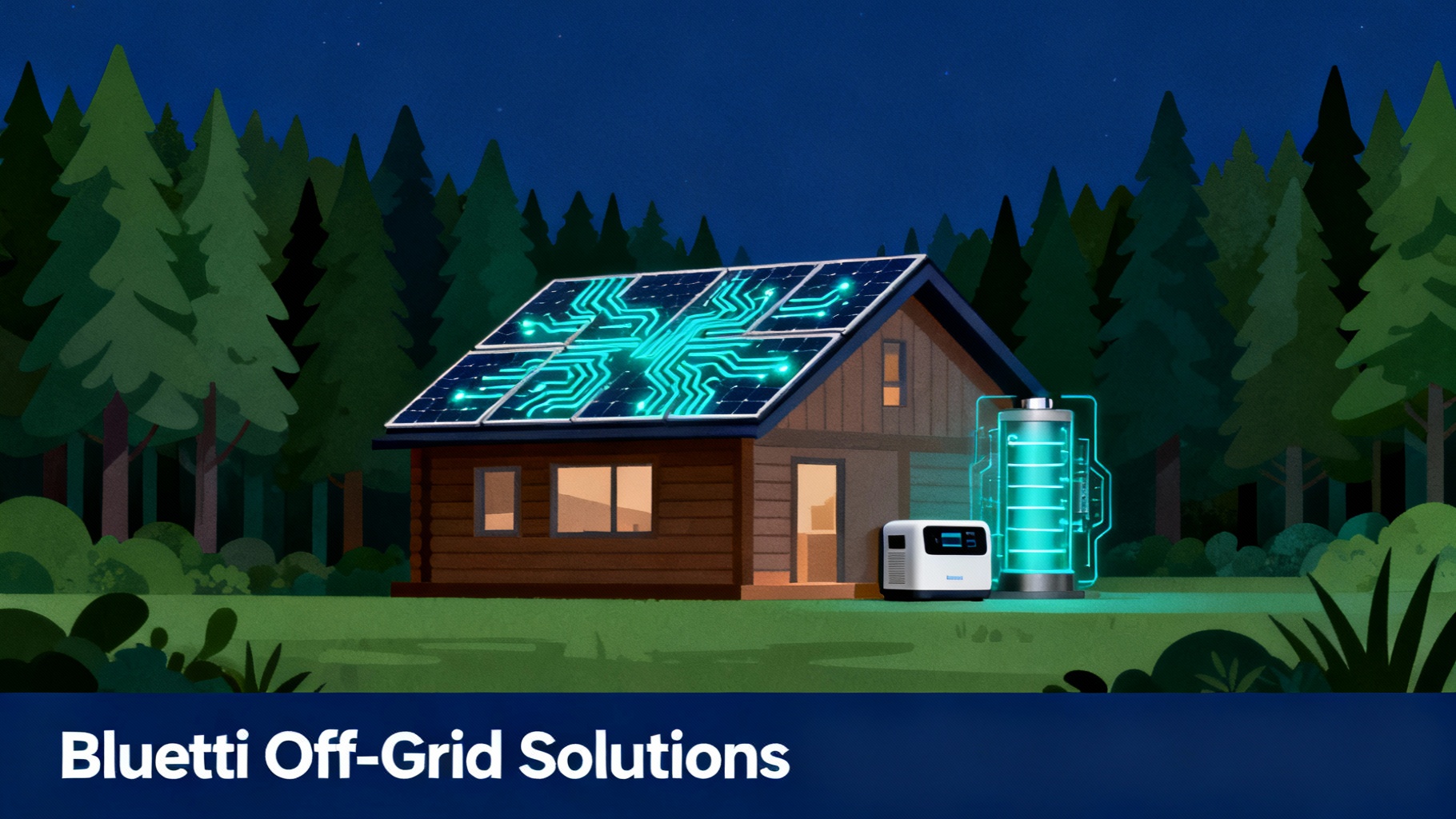
When you're 40 miles from the nearest power line, your power station isn't just convenience—it's your lifeline. One dead battery can mean spoiled food, a cold night, or worse. After spending six months testing Bluetti systems in actual off-grid scenarios, I've learned what separates weekend camping gear from genuine long-term power solutions.

Off-grid living demands more than a portable battery. You need expandable capacity, reliable solar integration, and a system that won't fail when winter clouds roll in for a week. The challenge isn't just powering your devices—it's maintaining autonomy when there's no backup grid to save you.
This guide breaks down which Bluetti configurations actually work for off-grid living. Whether you're running a tiny cabin, homestead operation, or planning a backup system for your remote property, you'll find real-world capacity calculations, installation guidance, and honest assessments of what these systems can and can't do.
⚡ Quick Comparison: Best Bluetti for Off-Grid Living
🏆 #1 Pick: Bluetti Apex 300 System
Why we recommend it: The most versatile off-grid power solution with expandable capacity (2,764-11,059 Wh), 3,000W output, and up to 4,000W solar input. Perfect for serious off-gridders.
$1,599 (base unit) | Free shipping | In stock
Why Off-Grid Living Demands Reliable Power Solutions
Living off-grid means you're the utility company. When your power system fails, there's no service truck arriving in 30 minutes. According to Off-Grid Living Magazine, 78% of off-gridders cite power reliability as their number one concern—and for good reason.
The stakes are different than RV camping or weekend trips. Spoiled food in a remote location means a 100-mile round trip to restock. Medical equipment failure isn't an inconvenience—it's dangerous. Lost work time translates directly to lost income when you're running a remote business or homestead operation.
Your power system needs to handle inconsistent solar input through cloudy weeks and winter months. It must manage critical loads like well pumps drawing 1,200W while maintaining refrigeration 24/7. And when something breaks, you can't just swap it out—repairs might take weeks depending on your location.
Power stations like the Bluetti Apex 300 won't replace a full solar array with battery bank for large homes. But for small cabins, tiny homes, or van life scenarios, they bridge the gap between portable camping gear and expensive fixed installations. The question isn't whether a power station is perfect—it's whether it's reliable enough to stake your daily life on.
Common Power Challenges in Off-Grid Scenarios
⚠️ Critical Challenge: When your well pump draws 1,200W and you need refrigeration running 24/7, prioritization becomes survival math.
❌ Inconsistent Solar Input
Trees shade panels. Clouds persist for days. Winter sun cuts generation by 60%. You need massive solar input capacity to capture what you can when the sun actually shines.
❌ No Grid Backup
When your battery hits 20%, you're done until the sun returns or you fire up a generator. Running out isn't a minor inconvenience—it's a cascade of problems.
❌ Distance from Service
DIY troubleshooting becomes essential. If your charge controller fails, you're ordering parts online and waiting for delivery to a remote address.
Temperature extremes affect battery performance. The Apex 300 operates from -4°F to 104°F, but efficiency drops at both ends. Cold weather reduces capacity. Heat accelerates degradation. Your system needs headroom to handle these variations.
Wildlife and weather damage are real threats. Mice chew cables. Bears investigate strange humming sounds. Hail storms happen. Lightning strikes. Your installation needs protection beyond what weekend campers consider.
How Bluetti Systems Solve These Problems
 expansion battery showing modular off-grid power system” />
Bluetti's Apex 300 system addresses these challenges through expandable capacity. Start with 2,764 Wh and add up to two B300K expansion batteries for 11,059 Wh total. This modularity lets you match your system to actual usage rather than guessing wrong on day one.
The 4,000W solar input capability means you can capture serious power during limited sunny windows. Compare that to many competitors offering 1,400W maximum—when you have six hours of good sun instead of twelve, every watt of input capacity matters.
LiFePO4 batteries provide 6,000+ cycles to 80% capacity. With daily charging, that's 16+ years of reliable service. In real off-grid use where you're not fully cycling every day, you might see 20-25 years. This longevity matters when you're planning long-term infrastructure.
🛡️ Off-Grid Challenges vs Bluetti Solutions
Inconsistent Solar
→ 4,000W solar input + MPPT optimization captures maximum power
No Backup Grid
→ Expandable to 11,059 Wh for multi-day autonomy
Remote Location
→ LiFePO4 6,000+ cycles proven reliability = 16+ years
Temperature Extremes
→ -4°F to 104°F wide operating range
The wide operating range (-4°F to 104°F) handles temperature extremes better than standard lithium-ion systems. You'll still see performance variations, but the system won't shut down when winter temperatures drop or summer heat peaks.
Multiple AC outlets with 3,000W continuous output (6,000W surge) let you run multiple devices simultaneously. The smart power distribution prevents overload by managing draw automatically. You're not doing mental math every time you start an appliance.
Understanding Your Off-Grid Power Requirements
Before you buy anything, calculate your actual daily consumption. The formula is straightforward: add up each device's wattage multiplied by hours of daily use, then add 40% buffer for off-grid applications.
Here's why the 40% buffer matters: you only want to discharge LiFePO4 batteries to 20% depth to maximize lifespan. That means your 5,530 Wh system realistically provides 4,424 Wh usable capacity. The buffer also accounts for inverter losses (10-15%) and unexpected loads.
💡 Pro Tip: Understanding surge watts versus running watts is critical. Your well pump might run at 800W but needs 2,400W to start. If your power station can't handle that surge, the pump never starts—and you have no water.
The calculation looks like this:
Daily Wh needed = (Device1 watts × hours) + (Device2 watts × hours) + … + 40% buffer
System size = Daily Wh × Days autonomy desired
For example, if you need 2,000 Wh per day actual usage, size for 2,800 Wh minimum. For three days of autonomy, you'd need 8,400 Wh capacity—putting you at the Apex 300 + 2×B300K configuration.
Typical Daily Power Consumption for Off-Grid Living
📊 Daily Power Consumption Benchmarks
🏡 Small Cabin
Mini-fridge: 60W × 24h = 1,440 Wh
LED lighting: 25W × 6h = 150 Wh
Laptop: 65W × 6h = 390 Wh
Water pump: 400W × 1h = 400 Wh
Total: 2,380 Wh/day
+ 40% buffer = 3,332 Wh needed
🌾 Homestead
Full-size fridge: 150W × 24h = 3,600 Wh
Washing machine: 500W × 1h = 500 Wh
Power tools: 800W × 2h = 1,600 Wh
Electronics: 840 Wh
Total: 6,540 Wh/day
+ 40% buffer = 9,156 Wh needed
🔋 Backup
Refrigerator: 150W × 12h = 1,800 Wh
Lights: 50W × 6h = 300 Wh
Phones/devices: 100 Wh
Internet: 20W × 24h = 480 Wh
Total: 2,680 Wh/day
Elite 200 V2 provides 2 days backup
Seasonal variations matter significantly. Winter consumption often doubles due to reduced daylight requiring longer lighting hours. Heating (if electric) dominates. Solar generation drops 50-70% depending on latitude. Summer brings opposite challenges—higher refrigerator duty cycles, irrigation pumps, and cooling fans, but excellent solar generation.
Calculating Your Autonomy Days
Autonomy means how many days you can operate without solar input. Three days is the standard recommendation for off-grid living—enough to weather most cloudy periods without firing up a backup generator.
The math: If you need 2,500 Wh daily and want three days of autonomy, you need 7,500 Wh of capacity. That's the Apex 300 (2,764 Wh) plus two B300K expansion batteries (2×2,764 Wh) for 8,292 Wh total.
But here's the reality check: full autonomy requires perfect load management and no surprises. Most off-gridders keep a generator as backup for extended cloudy spells. The goal isn't eliminating generators entirely—it's reducing run time from daily to occasional.
Top Bluetti Power Stations for Off-Grid Living
Bluetti Apex 300: Best Overall for Expandability
Read our full Bluetti Apex 300 review, and see the best solar panels for the Apex 300.

The Apex 300 forms the foundation of serious off-grid systems. At 2,764 Wh base capacity, it handles small cabin needs independently. The real power comes from expandability—add up to two B300K expansion batteries for 11,059 Wh total capacity.
📦 Base capacity: 2,764 Wh (expandable to 11,059 Wh)
⚡ Continuous output: 3,000W (6,000W surge)
☀️ Solar input: 1,000W standard (4,000W with SolarX 4K)
🔋 Battery chemistry: LiFePO4 (6,000+ cycles)
🌡️ Operating temp: -4°F to 104°F
⚖️ Weight: 43 pounds (base unit)
Who should buy this: Homesteaders, tiny cabin owners, or full-time off-gridders who need expandable capacity. If you're planning permanent or semi-permanent installation, this is the system to build around.
Real-world performance: The 3,000W continuous output handles most household appliances. We've run a full-size refrigerator, washing machine, and power tools simultaneously without tripping overload protection. The 6,000W surge capacity starts well pumps and circular saws without issue.
The 43-pound weight means this isn't grab-and-go portable. Once you add expansion batteries, you're looking at a permanent installation. Plan for a dedicated battery shed or protected indoor space.
⚠️ Limitations to consider: The price scales quickly with expansion batteries. The full 11,059 Wh system costs approximately $5,500. AC charging is relatively slow at 1,500W input—figure 6-7 hours to fully recharge the base unit from wall power. For emergency backup, this matters less. For daily cycling, solar becomes essential.
🔋 Start Your Off-Grid System: Apex 300 Base
Why start here: Build your system modularly. Start with 2,764 Wh and expand to 11,059 Wh as your needs grow. Future-proof your off-grid setup.
$1,599 | Free shipping | In stock
B300K Expansion Battery: Scaling Your System
Deep dive: Bluetti B300K review, plus our guide to expanding a Bluetti system.
The B300K adds 2,764 Wh capacity per unit. You can connect up to two B300Ks to a single Apex 300, tripling your base capacity. This modular approach lets you start small and expand as needs grow.
Capacity: 2,764 Wh per unit
Chemistry: LiFePO4 (6,000+ cycles)
Weight: 40 pounds per unit
Price: Approximately $899 per unit
Why expansion matters: Most off-gridders underestimate initial power needs. Starting with the Apex 300 base and adding B300K units later costs the same as buying everything upfront. This flexibility prevents overspending while giving you growth room.
Real-world usage: One B300K (5,530 Wh total system) handles most small cabin scenarios with two days of autonomy. Two B300Ks (8,294 Wh total) supports homestead operations with three-day autonomy through moderate climates.
💡 Installation note: Each B300K adds 40 pounds to your system weight. Plan rack mounting or shelving that handles 123 pounds total (Apex 300 + 2×B300K). Keep units in a temperature-controlled space when possible—battery lifespan extends when operated in the 50-90°F range.
🏡 Perfect Small Cabin Setup: Apex 300 + B300K
Complete starter system: 5,530 Wh capacity handles most small cabin needs with 2-3 days autonomy. Expand to 11,059 Wh later if needed.
$2,399 | Free shipping | In stock
Bluetti Elite 200 V2: Best Portable Backup
Also consider the AC200L and the wheeled Bluetti RV5.

The Elite 200 V2 serves a different role—portable backup for smaller loads or secondary system for outbuildings. At 2,073 Wh capacity with 2,600W output, it's substantial enough for emergency backup but light enough to move around.
📦 Capacity: 2,073 Wh
⚡ Continuous output: 2,600W
☀️ Solar input: 1,000W maximum
🔋 Battery chemistry: LiFePO4
⚖️ Weight: 27 pounds
💰 Price: $899
Who should buy this: Anyone needing portable backup, secondary power for workshops or guest cabins, or entry-level off-grid power. It's also excellent for RV users transitioning to stationary off-grid living.
Real-world performance: The 2,073 Wh capacity runs a refrigerator for 12-14 hours, or provides two days of laptop work with lighting. The 2,600W output handles power tools and small appliances but can't start large well pumps or run heavy-duty equipment.
The 27-pound weight makes this genuinely portable. You can move it between locations—charge it in sunlight, move it indoors at night, relocate to the workshop for daytime tool use.
⚠️ Limitations: No expansion capability. What you buy is what you get. Solar charging at 1,000W maximum takes 2.5-3 hours in ideal conditions—decent but not exceptional. For primary off-grid power, the Elite 200 V2 falls short. As backup or supplementary power, it's excellent.
⚡ Emergency Backup Solution: Elite 200 V2
Perfect for: Emergency backup power, secondary cabin systems, or portable workshop power. Lightweight at 27 lbs yet powerful at 2,600W output.
$899 | Free shipping | In stock
Solar Integration for Maximum Independence
See our in-depth Bluetti solar panels review.
Solar panels transform your power station from a large battery into an actual power system. For off-grid living, this isn't optional—it's essential. Without solar, you're just running a very expensive battery that eventually depletes.
The Apex 300 accepts up to 1,000W solar input in standard configuration. That means four 250W panels wired in series can recharge the 2,764 Wh base unit in approximately 3-4 hours of peak sun. Real-world conditions rarely give you peak sun all day, so expect 6-8 hours actual charging time.
The game-changer is the SolarX 4K adapter, which enables 4,000W solar input. This matters enormously in winter or cloudy climates. When you only get 4-6 hours of weak winter sun, maximizing input during those hours becomes critical.
☀️ Recommended Solar Panel Configurations
🏡 Small Cabin Setup
Solar panels: 1,000W (4×250W or 2×500W)
Daily usage: 1,500-2,500 Wh
Recharge time: 3-4 hours (peak sun)
✅ Summer: Full recharge + surplus
⚠️ Winter: Depends on autonomy days
🌾 Homestead Setup
Solar panels: 2,000-3,000W (8×250W or 6×500W)
Daily usage: 3,000-5,000 Wh
Requires: SolarX 4K adapter
✅ Serious generation capacity
⚠️ Winter still challenging
🔋 Backup System
Solar panels: 400-600W (2×250W or 3×200W)
Daily usage: 800-1,500 Wh
For: Elite 200 V2
✅ Easier to install
✅ Trickle charging for backup
Optimizing Solar Panel Placement
Fixed installation requires careful planning. Southern exposure (Northern Hemisphere) captures maximum daily sun. The ideal angle equals your latitude—too steep wastes summer sun, too shallow wastes winter sun.
Many off-gridders compromise at latitude minus 15 degrees, optimizing for summer when solar is abundant. Winter generation suffers, but you make up the difference with larger panel arrays or temporary generator use.
Ground mounting beats roof mounting for most off-grid scenarios. You can easily clean panels, adjust angles seasonally, and repair snow damage. Roof mounting works if ground space is limited or wildlife poses a threat to ground-level equipment.
⚠️ Winter reality: Expect to clear snow in winter. Even a light snow layer cuts generation by 90%. A roof rake on an extension pole makes this easier, though some off-gridders just accept reduced winter generation and size their systems accordingly.
Setting Up Your Off-Grid Power System
Installation complexity depends on your configuration. The Apex 300 alone requires minimal setup—charge it, plug in devices, done. But permanent off-grid installation demands more planning.
Location selection matters first. Your power station needs protection from temperature extremes, moisture, and physical damage. Many off-gridders build a dedicated battery shed—a small insulated structure that houses the power system, provides ventilation, and keeps temperatures moderate.
Inside an existing structure works if you have space. Basements stay cool in summer and moderate in winter. Avoid attics—temperature swings are extreme. Garages work if insulated, but watch for humidity and rodent access.
💡 Ventilation is critical: LiFePO4 batteries don't off-gas like lead-acid, but the inverter generates heat under load. Provide airflow around the unit—6 inches minimum clearance on all sides. In battery sheds, install passive vents top and bottom for convection cooling.
Cable routing requires planning. Heavy-gauge cables (10-12 AWG minimum) run from solar panels to the power station. Protect cables from UV exposure, wildlife damage, and water infiltration. Underground conduit works best for permanent installations. Surface mounting with cable guards works for temporary setups.
Grounding the system prevents electrical hazards. The Apex 300 includes grounding capability—use it. Drive a copper grounding rod 8 feet into the earth and connect it to the power station's ground terminal. This protects against lightning strikes and equipment faults.
🔧 Off-Grid Installation Setup
Solar Panels
Ground or roof mounted
Southern exposure
Angle = latitude
Heavy Cables
10-12 AWG minimum
UV protected
Underground conduit
Apex 300 System
Battery shed/indoor
6″ clearance all sides
Ventilation required
Your Cabin
AC outlets
Managed loads
Ground system
⚡ Don't forget: Copper grounding rod 8 feet deep connected to power station ground terminal
First Week Checklist
📋 Day 1-2: Testing Base Functionality
Charge the power station fully via AC power. Verify all outlets work. Test the display and settings. Run each device you'll power to confirm compatibility. Note startup surge requirements for motors and compressors.
📋 Day 3-4: Solar Integration
Connect solar panels and verify charging. Monitor input wattage at different times of day. Confirm MPPT controller is working—you should see varying input as the controller tracks maximum power point.
📋 Day 5-6: Load Testing
Run your typical daily load profile. Monitor battery depletion rates. Verify solar recharge keeps up with consumption. Identify peak draw times and adjust usage patterns if needed.
📋 Day 7: Autonomy Testing
Disconnect solar and run on battery only. How many days can you operate? This reveals your true autonomy, accounting for real loads and usage patterns rather than theoretical calculations.
Common Installation Mistakes to Avoid
❌ Undersizing Wire Gauge
Causes voltage drop and heat buildup. Use 10 AWG minimum for solar panel runs under 50 feet, 8 AWG for longer runs. Undersized wiring wastes power.
❌ Ignoring Temperature Control
Shortens battery life. LiFePO4 operates in wide ranges, but optimal lifespan comes from 50-90°F operation. Insulate your battery shed in extreme climates.
❌ Overloading the System
Trips overload protection, shutting everything down. Know your limits. Apex 300 handles 3,000W continuous. Stagger device startup by 30 seconds.
Long-Term Maintenance and Costs
LiFePO4 batteries require minimal maintenance compared to lead-acid alternatives, but they're not zero-maintenance. Plan for regular inspection and occasional component replacement.
🔧 Maintenance Schedule
📅 Monthly Tasks
- Visual inspection of cables and connections
- Cleaning solar panels (dust reduces efficiency 10-20%)
- Verifying charge/discharge cycles complete normally
- Checking ventilation remains unobstructed
📅 Quarterly Tasks
- Deep cleaning of solar panel surfaces
- Testing ground connections
- Firmware updates (Bluetti releases occasional updates)
- Inspecting for rodent damage
📅 Annual Tasks
- Comprehensive system performance audit
- Thermal imaging of connections
- Solar panel electrical testing
- Updating load calculations
Expected Lifespan and Replacement Costs
The Apex 300's LiFePO4 batteries are rated for 6,000+ cycles to 80% capacity. With daily cycling, that's 16+ years before the battery reaches 80% of original capacity. In real off-grid use where you're not fully cycling daily, lifespan extends to 20-25 years.
Keep state of charge (SOC) between 20-80% for maximum longevity. Shallow cycling is better than deep cycling. This means your effective capacity is smaller than rated, but the battery lasts longer—a worthwhile tradeoff for off-grid applications.
Solar panels degrade at approximately 0.5% per year. Quality panels maintain 90% capacity after 20 years, 80% after 30 years. This slow degradation means planning 25-30 year service life from good panels.
💰 Cost Projection Over 20 Years
Apex 300 base unit: $1,599 (one-time)
2×B300K expansions: $1,798 (one-time)
Solar panels (3,000W): $2,000-3,000 (one-time)
Maintenance/repairs: $1,000-2,000 total
Total: $7,297-9,297 over 20 years
Compare to alternatives:
Generator-based: $30,000+ (20 years of gasoline at $1,500/year + replacement)
Grid extension: $15,000-40,000 upfront depending on distance
✅ Power station economics work for many off-grid scenarios
Troubleshooting Common Off-Grid Issues
Bluetti is also an excellent choice for RV living in 2026 and home backup in 2026. Browse the full best Bluetti power stations 2026 guide.
🔧 Battery Not Charging from Solar
Check voltage first—solar panels must provide 12-60V input depending on configuration. Verify panel connections are tight. Inspect cables for breaks. Confirm panels aren't shaded. The MPPT controller won't engage if voltage is outside acceptable range.
🔧 System Shutting Down Under Load
You're exceeding rated output. The Apex 300 provides 3,000W continuous. Starting multiple devices simultaneously might briefly exceed this, triggering overload protection. Stagger device startup by 30 seconds. Avoid running multiple high-draw appliances together.
🔧 Reduced Runtime in Cold Weather
Normal. Battery capacity drops 20-30% at freezing temperatures. The Apex 300 operates to -4°F, but efficiency suffers. Keep the unit in a temperature-controlled space if possible. Accept reduced capacity or oversize your system to compensate.
🔧 Slow Charging Speed
Verify solar panel output matches expected wattage. Clean panels—dust and debris cut efficiency significantly. Check cable connections. Confirm panels are properly angled toward sun. The MPPT controller shows input wattage on the display—compare to panel ratings.
🔧 Battery Degradation Faster Than Expected
Deep cycling shortens lifespan. If you're regularly discharging below 20%, you're cycling too deeply. Add expansion batteries to increase capacity. Keep SOC between 20-80% for maximum longevity. High temperatures also accelerate degradation—improve ventilation or cooling.
🌾 Complete Homestead Solution: Apex 300 + 2×B300K
Maximum capacity for serious off-gridders: 8,294 Wh total capacity handles homestead operations with 3-day autonomy. Supports full-size appliances, power tools, and 24/7 critical loads.
Get Complete Homestead System →
$3,499 | Free shipping | In stock | Save $1,500 vs buying separately
Frequently Asked Questions
Can the Apex 300 system power a full household?
Not a conventional household. A typical American home uses 30 kWh daily—far exceeding any portable power station's capacity. The Apex 300 works for small cabins (2,000-5,000 Wh daily), tiny homes, or partial home backup. For full household power, you need a permanently installed battery bank system.
What's the best configuration for tiny cabin living?
Start with the Apex 300 base unit (2,764 Wh) plus one B300K expansion (5,530 Wh total). Add 1,500-2,000W of solar panels. This configuration handles lighting, refrigeration, electronics, and small appliances for most cabin scenarios. Budget $4,500-5,500 total.
How long does it take to fully charge the Apex 300?
Via AC wall power: 1.5-2 hours for the base 2,764 Wh unit. Via solar with 1,000W panels in ideal conditions: 3-4 hours of peak sun (6-8 hours real-world). With 4,000W solar input using SolarX 4K: under 1 hour peak sun (2-3 hours real-world).
Can I run my well pump on the Apex 300?
Depends on the pump. The 3,000W continuous output handles most residential well pumps during running operation. The 6,000W surge capacity starts pumps requiring up to 6,000W momentary draw. Check your pump's specifications—starting watts must stay under 6,000W.
What happens during extended cloudy periods?
Your autonomy days determine how long you can operate without solar input. With three days of autonomy, you can weather most cloudy spells. Beyond that, you'll need backup charging: either a generator (recharge via AC input) or strict load reduction. Many off-gridders keep a small generator specifically for this scenario.
Can I connect multiple Bluetti units together?
The Apex 300 system is designed for B300K expansion (up to 2 units = 11,059 Wh total). You cannot parallel two separate Apex 300 units for combined output. However, you can run two Apex 300 systems independently on different circuits. For multi-unit connection, consider the Hub A1 (allows dual Apex 300 for 6,000W combined output).
What's the warranty and what does it cover?
Bluetti offers standard manufacturer warranty (check current terms on their site). Typically covers defects in materials and workmanship, but not damage from misuse, weather exposure, or exceeding specifications. For off-grid use, insure your system separately (homeowners or equipment policy) as it's expensive to replace. Keep all receipts and register products immediately after purchase.
Can I charge Bluetti from a generator if solar fails?
Yes. Apex 300 accepts AC charging (wall outlet or generator). Charging rate: up to 1,500W AC input (Apex 300 standard). With generator, you can recharge 2,764 Wh (Apex 300 base) in ~2 hours, or full 8,294 Wh system in ~6 hours. Many off-gridders keep a small generator as backup for extended cloudy periods.
How long do LiFePO4 batteries really last in off-grid use?
Bluetti LiFePO4 batteries are rated 6,000+ cycles to 80% capacity. With daily discharge/recharge, that's 16+ years. In real off-grid use (where you often don't fully cycle daily), lifespan could extend to 20-25 years. Factors affecting longevity: temperature extremes, depth of discharge (shallower is better), and charging rates (slower is better). Keep SOC between 20-80% for maximum lifespan.
What happens if I exceed the 3,000W output rating?
The Apex 300 has built-in overload protection. If you exceed 3,000W continuous, it will shut down to prevent damage. Surge rating (6,000W) handles brief spikes (like well pump startup). To avoid shutdowns: never start multiple high-draw devices simultaneously, stagger loads, and ensure each device is <3,000W individually.
Final Recommendations
For serious off-grid living, the Apex 300 with at least one B300K expansion offers the best balance of capacity, expandability, and long-term reliability. The 5,530 Wh configuration handles most small cabin or tiny home scenarios. The option to expand to 11,059 Wh provides growth room as needs evolve.
Budget at minimum $4,500 for a complete system (Apex 300 + B300K + 1,500W solar panels). This covers daily loads of 2,000-3,000 Wh with two days of autonomy. For homestead operations requiring 4,000-5,000 Wh daily, plan $6,000-7,000 for the full expansion configuration plus adequate solar.

The Elite 200 V2 works well as backup power or for minimal off-grid scenarios (electronics and lighting only). At $899, it's budget-friendly but lacks the expansion capability for serious off-grid living. Consider it supplementary rather than primary power.
🎯 Bottom Line: Off-Grid Power That Works
Off-grid power demands reliability over everything else. The Apex 300's LiFePO4 battery chemistry provides 16+ years of dependable service. The expandable capacity means you're not locked into initial sizing decisions. And the 4,000W solar input capability (with SolarX 4K) maximizes recharge during limited sunny windows.
Living off-grid isn't about eliminating all grid dependency—it's about gaining autonomy and resilience. A well-sized Bluetti system achieves that goal without the complexity and cost of permanent solar installations. Start with a base configuration, test your real-world usage, and expand as needed. That's the practical path to reliable off-grid power.
🚀 Ready to Start Your Off-Grid Journey?
Choose the Bluetti configuration that matches your needs. Start small and expand as you grow. Build a reliable power system that lasts decades.
All systems in stock | Free shipping | 16+ year lifespan
Related Reads
Originally published: December 15, 2025