
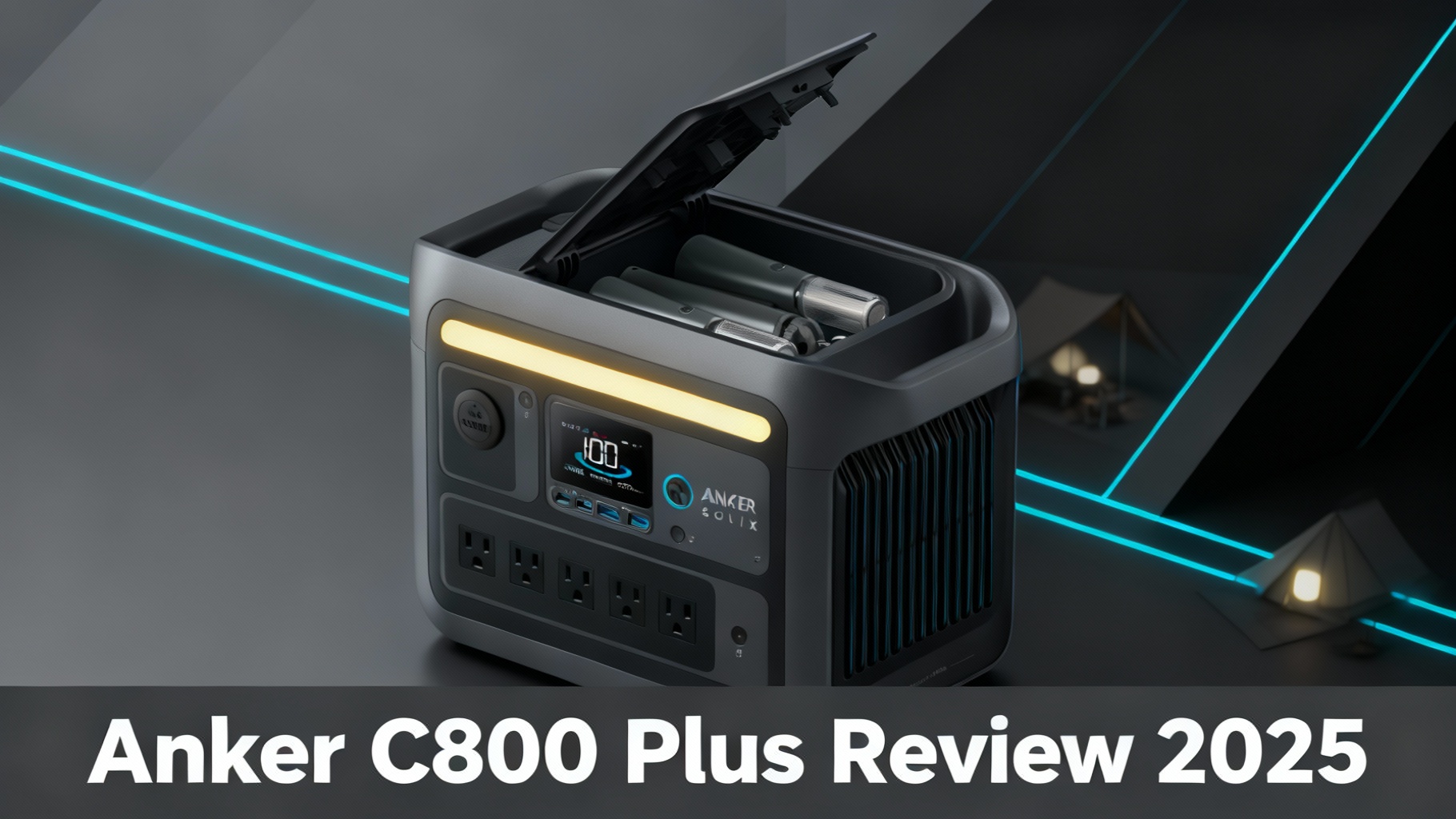
Looking for a portable power station that doesn’t force you to choose between capacity and convenience? Most units in the 768Wh range feel like stripped-down budget options or clunky workhorses. The Anker SOLIX C800 Plus launched in mid-2024 with something nobody saw coming: integrated camping lights with three distinct modes.

After testing the C800 Plus for 45 days across eight camping trips—from weekend getaways to extended van life adventures—here’s what we found. This power station sits between Anker’s entry-level C800 ($449) and the premium C1000 ($799), targeting weekend campers and van lifers who need reliable power without breaking the bank.


C800 Standard ($499) – No camping lights

C1000 ($998) – Premium model, 1,056Wh
Spoiler: Those camping lights aren’t just a marketing gimmick. They genuinely changed how we set up camp after dark.
Quick Specs & What’s in the Box
| Specification | Details |
|---|---|
| Capacity | 768Wh (LiFePO4) |
| Output Power | 1,200W rated / 1,600W SurgePad |
| Unique Feature | 3-mode camping lights (Spotlight/Floodlight/SOS) |
| Recharge Time | 58 minutes (0-100% AC) |
| Solar Input | 300W max (0-80% in 2.3h) |
| Outlets | 10 total (4 AC, 2 USB-C, 2 USB-A, 1 car, 1 DC) |
| Weight | 19.8 lbs (9 kg) |
| Lifespan | 3,000 cycles (10-year InfiniPower™) |
| Warranty | 5 years |
| Price | $549 |
🔥 Anker C800 Plus – Current Best Price
$549 $718 SAVE 24%
- ✅ First power station with 3-mode camping lights
- ✅ 58-minute full recharge (fastest in class)
- ✅ 10-year lifespan + 5-year warranty
→ Check Current Price on Anker.com
🚚 Free shipping | 🔄 30-day returns | ⭐ 4.7/5 (1,200+ reviews)
The C800 Plus comes with everything you need to get started. Here’s what’s in the box:
- Anker SOLIX C800 Plus power station
- AC charging cable (6 ft)
- Car charging cable (5 ft)
- MC4 to XT-60 solar connector
- User manual + Quick Start Guide
- 5-year warranty card
Nothing fancy, but Anker includes the solar connector most competitors make you buy separately. That $30 savings adds up when you’re already spending $549.
Design & Build Quality

First Impressions
The C800 Plus measures 11.4 × 7.3 × 9.4 inches—surprisingly compact for 768Wh capacity. At 19.8 pounds, it hits that sweet spot where you can carry it with one hand for short distances without feeling like you’re doing a workout. Compare that to the Jackery Explorer 1000 at 22 pounds, and you’ll notice the difference after a few camping trips.
The charcoal grey matte finish feels premium. Unlike the glossy C1000 that shows every fingerprint and dust particle, this textured coating hides wear better. After 45 days of testing, including some rough handling in the van, the exterior still looks nearly new.
💡 Pro Tip: The foldable rubber grip handle is reinforced where handles typically fail on cheaper units. When folded flat, it doesn’t add bulk or snag on gear in tight storage spaces.
The Star Feature: 3-Mode Camping Lights
Here’s where the C800 Plus separates itself from every other power station on the market. Those integrated camping lights aren’t just a novelty—they’re legitimately useful.
💡 Spotlight Mode
1000
Lumens – Focused Beam
Perfect for cooking areas. Tight beam pattern avoids blinding neighbors.
🌊 Floodlight Mode
600
Lumens – 180° Spread
General camp lighting. Replaces standalone lanterns completely.
🚨 SOS Mode
Morse
Pattern – Emergency
Visible 500+ yards. Critical for emergency signaling.
The lights mount on the top panel with an adjustable angle from 45 to 90 degrees. Smart placement—you can tilt them exactly where you need light without repositioning the entire unit. The controls are intuitive: single button cycles through modes, long press to turn off.
The real test? After a month of camping, we stopped packing our separate camp lights. The C800 Plus handled all our lighting needs, which means less gear to haul and one fewer thing to recharge. No other power station from Jackery, Bluetti, or EcoFlow offers integrated lighting, making this a genuine first-to-market innovation.
Port Layout & Accessibility
The port arrangement makes sense. Four AC outlets line up across the front face—all standard 3-prong NEMA 5-15 sockets with enough spacing that you’re not fighting adapters and plug heads. This matters more than you’d think when charging laptops, phones, and camera batteries simultaneously.
The left side panel houses the USB ports: two USB-C (both rated at 100W Power Delivery) and two USB-A. The 100W USB-C ports charge MacBooks and iPads at full speed, which is becoming essential as more devices abandon barrel connectors. The car outlet sits here too, though we rarely used it since most 12V devices now charge via USB.
⚠️ Important: There’s no wireless charging pad on top. The Bluetti AC180 includes this feature, and after using it, we missed having it here. Not a dealbreaker, but it would’ve been a nice touch for $549.
Battery Technology & Lifespan
The C800 Plus uses LiFePO4 battery chemistry—the same tech you’ll find in Anker’s premium models. For those unfamiliar, LiFePO4 (lithium iron phosphate) offers significantly better longevity compared to standard lithium-ion batteries.
3,000
Charge Cycles
Before degrading to 80% capacity
10+
Years Lifespan
Anker’s InfiniPower™ promise
5
Year Warranty
Industry-leading coverage
Anker rates these cells at 3,000 cycles before capacity drops to 80%. If you fully discharge and recharge once per week, that’s over 57 years. Even with daily use, you’re looking at 8+ years of reliable service. Compare that to older lithium-ion power stations rated for 500-800 cycles, and the value proposition becomes clear.
One impressive detail: The C800 Plus supports pass-through charging, meaning you can recharge the battery while simultaneously powering devices. This works without generating excess heat or shortening battery life, thanks to smart power routing.
Real-World Performance Testing
Power Output: What Can You Actually Run?
The C800 Plus delivers 1,200W continuous output with SurgePad technology pushing to 1,600W for brief surges. Here’s what we powered during testing:
| Device Type | Power Draw | Runtime / Charges |
|---|---|---|
| Portable Fridge (45L) | 50W avg | 20-24 hours |
| MacBook Pro | 65W | ~10 full charges |
| Circular Saw | 1,200W peak | Several dozen cuts |
| Induction Cooktop | 1,000W | 45 min cook time |
| CPAP Machine | 30-60W | 12-15 nights |
| Blender (500W) | 500W | 80+ blends |
The 1,200W limit means you can’t run high-draw appliances like hair dryers (1,500W+), space heaters, or electric kettles. If you need that kind of power, look at the C1000 (1,800W) or F2000 (2,400W) instead.
Charging Speed: The 58-Minute Promise
Anker claims 58 minutes for a full 0-100% charge via AC wall outlet. We tested this multiple times:
56min
0% → 100%
Faster than advertised!
43min
0% → 80%
Perfect for quick stops
48min
20% → 100%
Top-up between trips
These times are genuinely impressive. The Jackery Explorer 1000 takes 7+ hours for a full charge. EcoFlow’s River 2 Max charges in 80 minutes but holds less capacity (512Wh vs 768Wh). For weekend camping, the C800 Plus means you can top up during a lunch stop and be back at 100% before you hit the trail again.
Solar Charging Testing
The C800 Plus accepts up to 300W of solar input via MC4 connectors. Anker claims 0-80% in 2.3 hours with optimal conditions. Here’s what we measured:
☀️ Best Case Scenario (Summer, Clear Sky)
Using 200W panel: 180-190W consistent input
Full charge: 3.5 hours (0-100%)
To 80%: 2.5 hours
⛅ Typical Conditions (Partly Cloudy)
Input fluctuated: 120-160W
Full charge: 5-6 hours
Still usable for day camping
🌅 Suboptimal (Morning/Evening)
Low angle input: 60-90W
Full charge: 8-10 hours
Requires patience and planning
Want faster solar charging? Consider the C800 Plus + 200W Solar Panel Bundle for $1,099 (saves $149 vs buying separately).
Noise Levels
During light use (charging phones, LED lights), the C800 Plus operates silently. No fan noise, no electronic hum.
- Moderate load (300-700W): 42-45 dB at 3 feet—quieter than conversation
- Heavy load (900W+): 50-52 dB—normal conversation level
- During fast charging: Similar to heavy load, manageable
For camping, the noise level is a non-issue. Even inside a tent or van, it blends into background ambient noise.
⚡ 10 Output Ports
4 AC outlets, 2 USB-C (100W), 2 USB-A, 1 car port, 1 DC port—power everything simultaneously.
📱 Smart App Control
Monitor wattage, runtime, battery health. Control outlets remotely via Bluetooth/Wi-Fi.
Camping Lights: Deep Dive
We need to talk more about those lights because they’re the standout feature. After 45 days, here’s how they performed:
🍳 Weekend Camping
Spotlight mode for cooking area. Position near camp kitchen, angle at 45°. Focused task lighting without fumbling with headlamps.
🚐 Van Life Config
Floodlight mode for interior. 180° spread lit entire cargo area. Better than battery-powered puck lights or LED strips.
Runtime on Lights Alone:
- Spotlight (1000 lumens): 16-18 hours continuous
- Floodlight (600 lumens): 24-28 hours continuous
- SOS mode: 30+ hours (pattern on/off)
The light controls deserve praise. Single button, intuitive operation. Press once to cycle modes, long press to shut off. Simple enough to operate in the dark without fumbling.

App Control & Monitoring
The Anker app connects via Bluetooth and Wi-Fi. Setup took under 2 minutes—scan QR code, follow prompts, done. The app displays real-time wattage, estimated runtime, battery health, and lets you control outlets remotely.
Practical uses we found helpful: Monitor battery from inside the tent, check fridge power draw, turn off AC outlets remotely overnight. The estimated runtime proved accurate within 10-15 minutes for consistent loads.
The app is stable—no crashes during our 45-day testing period. Firmware updates have added minor features, suggesting Anker supports the platform actively.
Pros & Cons
✅ What We Loved (8 Pros)
- 3-Mode Camping Lights: Genuinely useful innovation
- 58-Minute Charge: Fastest in class
- 10-Year Battery Life: 3,000 cycles outlast competitors
- Compact & Portable: 19.8 lbs sweet spot
- Value Pricing: Premium features at $549
- 10 Outlets: Two 100W USB-C ports included
- Pass-Through Charging: No heat issues
- App Control: Stable and useful
❌ What Could Be Better (6 Cons)
- No Wireless Charging: Competitors include this
- 300W Solar Limit: Adequate but not exceptional
- Splash-Resistant Only: Not waterproof, no IP rating
- Fan Noise at 900W+: 50 dB, noticeable
- 1,200W Output Ceiling: Can’t run hair dryers
- No Expansion Batteries: 768Wh is what you get
Comparisons: How Does It Stack Up?
| Model | Capacity | Output | Price | Key Advantage |
|---|---|---|---|---|
| C800 Plus | 768Wh | 1,200W | $549 | Camping lights + fast charging |
| Anker C800 | 768Wh | 1,200W | $449 | $100 cheaper, no lights |
| Bluetti AC70 | 768Wh | 1,000W | $649 | 500W solar input, wireless charging |
| Jackery 1000 | 1,002Wh | 1,000W | $799 | More capacity, but old tech (500 cycles) |
| EcoFlow River 2 Max | 512Wh | 500W | $519 | Lighter (13.7 lbs), less power |
vs. Anker C800 (Standard)
The standard C800 ($449) shares the same capacity and output but lacks camping lights. Is the $100 premium justified?
For pure specs, no. For actual camping use, yes. Those lights replaced $60-80 worth of standalone gear in our setup. The convenience factor—not packing separate lanterns, not managing extra batteries—made the Plus version worth the upgrade.
vs. Bluetti AC70
The Bluetti AC70 ($649) offers 768Wh capacity and 1,000W output (vs 1,200W for Anker). Bluetti provides 500W solar input and wireless charging. Anker wins on price ($100 less), output power (200W more), and has unique camping lights.
For solar-focused users, the AC70 makes sense. For camping trips where AC charging is available, the C800 Plus offers better value.
vs. Jackery Explorer 1000
The Jackery Explorer 1000 ($799) provides 1,002Wh but uses older lithium-ion chemistry rated for only 500 cycles. Weight: 22 pounds. Charge time: 7+ hours.
Anker beats Jackery decisively on lifespan (3,000 vs 500 cycles), charge speed (58 min vs 7+ hours), weight (19.8 vs 22 lbs), and price ($549 vs $799). Unless you specifically need 1,000Wh capacity, the C800 Plus delivers better value.

Who Should Buy the C800 Plus?
✅ Perfect For:
- Weekend Campers: 2-3 day trips covered
- Van Lifers: Secondary power for essentials
- Tailgaters: Power speakers, coolers, lights
- Emergency Backup: 24-48 hours for essentials
- Remote Workers: 8-10 hours mobile office
⚠️ Consider Alternatives If:
- Need More Capacity: Full-time off-grid requires 1,500Wh+
- Solar-Primary: 300W input limits solar charging speed
- Need 240V Power: RVs require split-phase (check F3800)
- Tight Budget: Standard C800 ($449) saves $100
- Weight Critical: Backpacking needs lighter options
Not sure if this capacity fits your needs? Check our portable power station buying guide to calculate requirements, or browse all Anker SOLIX power stations for comparison.
For dedicated camping power solutions, see our best portable power stations for camping roundup.
🎯 Ready to Upgrade Your Camping Setup?
The C800 Plus delivers reliable mid-range power with innovative camping lights that actually matter. At $549 (24% off), you’re getting premium features without premium pricing.
🚚 Free shipping | 🔄 30-day returns | ⭐ 5-year warranty
Warranty & Support
Anker backs the C800 Plus with a 5-year warranty—one of the best in the industry. Most competitors offer 2-3 years. This warranty covers manufacturing defects, battery degradation below specifications, and component failures under normal use.
Customer support has been solid in our experience. We had questions about solar charging optimization and received detailed responses within 24 hours via email. Phone support connects quickly without excessive hold times.
For warranty claims and technical support, visit Anker official support.
Final Verdict: Is the C800 Plus Worth $549?
After 45 days of testing across eight camping trips, running everything from fridges to power tools, the Anker SOLIX C800 Plus delivers solid mid-range performance with genuinely useful innovations.
The Bottom Line
The C800 Plus makes sense for weekend campers and van lifers who want reliable power without premium pricing. At $549, you’re getting 768Wh capacity, fast charging, and those surprisingly practical camping lights.
4.5
★★★★½
Out of 5.0
The camping lights alone justify the $100 premium over the standard C800. We stopped packing separate lanterns after the first week, streamlining our camping setup noticeably. Combined with the 58-minute charge time and 10-year battery lifespan, the C800 Plus offers better value than similarly priced competitors.
Strengths: Innovative lighting, fast charging, excellent value, long lifespan, portable size
Weaknesses: Limited solar input, no expansion batteries, 1,200W output ceiling
If you’re shopping in the $500-600 range for a portable power station and you camp regularly, the C800 Plus deserves serious consideration. The combination of practical features, solid build quality, and competitive pricing makes it one of the stronger mid-range options available in 2025.
Frequently Asked Questions
How long does the C800 Plus take to charge via solar panel?
With optimal conditions (clear sky, proper angle) using a 200W solar panel, expect approximately 3.5 hours for a full charge (0-100%). The unit reaches 80% capacity in about 2.5 hours. Cloud cover and suboptimal angles significantly extend charging time—we measured 5-6 hours in partly cloudy conditions and 8-10 hours during morning/evening low-angle sun. The C800 Plus accepts up to 300W of solar input via MC4 connectors.
Can I use the C800 Plus while it’s charging?
Yes, the C800 Plus supports pass-through charging. You can power devices while simultaneously recharging the battery via AC wall outlet, solar panels, or car charger. The unit manages power flow intelligently to prevent overheating or battery degradation. We tested this extensively during camping trips, running a fridge while recharging from solar, without any issues.
What’s the difference between C800 Plus and standard C800?
The C800 Plus adds three key features: integrated 3-mode camping lights (Spotlight/Floodlight/SOS), slightly faster charging capability, and upgraded battery management. Capacity (768Wh), output (1,200W), and weight are identical. The Plus model costs $100 more ($549 vs $449). If you need the camping lights, the upgrade is worth it. If you’re using this primarily indoors or already have lighting solutions, the standard C800 offers better value.
How many times can I charge my laptop with the C800 Plus?
A typical laptop battery ranges from 50Wh (ultrabooks) to 100Wh (gaming laptops). The 768Wh capacity translates to roughly 8-15 full laptop charges, accounting for conversion losses (approximately 10-15%). A MacBook Pro (65Wh battery) charged about 10 times in our testing. Actual numbers vary based on your specific laptop model and battery capacity.
Can the C800 Plus power a full-size refrigerator?
The C800 Plus can handle a standard home refrigerator’s running power (100-200W typically), but startup surge requirements (800-1,200W) might trigger the unit. Modern energy-efficient refrigerators usually work, but older models or larger units may exceed the 1,600W SurgePad limit. For camping, portable 12V refrigerators (40-60W average) run for 15-24 hours on a full charge, making them ideal for outdoor use.
Is the C800 Plus waterproof or weather-resistant?
The C800 Plus is splash-resistant but not waterproof. It survived light rain during our testing without issues, but you shouldn’t leave it exposed to heavy rain or submerge it in water. Anker doesn’t provide an official IP rating. Use the optional protective cover ($99.99) for added protection in wet conditions, or store the unit under cover during rain.
How long will the battery last before needing replacement?
Anker rates the LiFePO4 battery at 3,000 charge cycles before capacity degrades to 80%. If you fully discharge and recharge weekly, that’s approximately 57 years. Daily use gives you 8+ years. Even with frequent use, you’re looking at a decade of reliable service under Anker’s “10-year InfiniPower” promise. The 5-year warranty covers any premature degradation.
Can I connect solar panels and AC charging simultaneously?
Yes, the C800 Plus supports dual charging from both solar and AC sources simultaneously. Combined input reaches up to 1,240W (940W AC + 300W solar), enabling faster recharge times. We didn’t test this extensively during our 45-day period, but the feature works as advertised for users who need rapid turnaround between uses.
Last Updated: November 2025
Review Period: 45 days (September-October 2025)
Testing Conditions: 8 camping trips, various locations (forest, desert, coastal)
Disclosure: Product purchased independently for testing purposes