
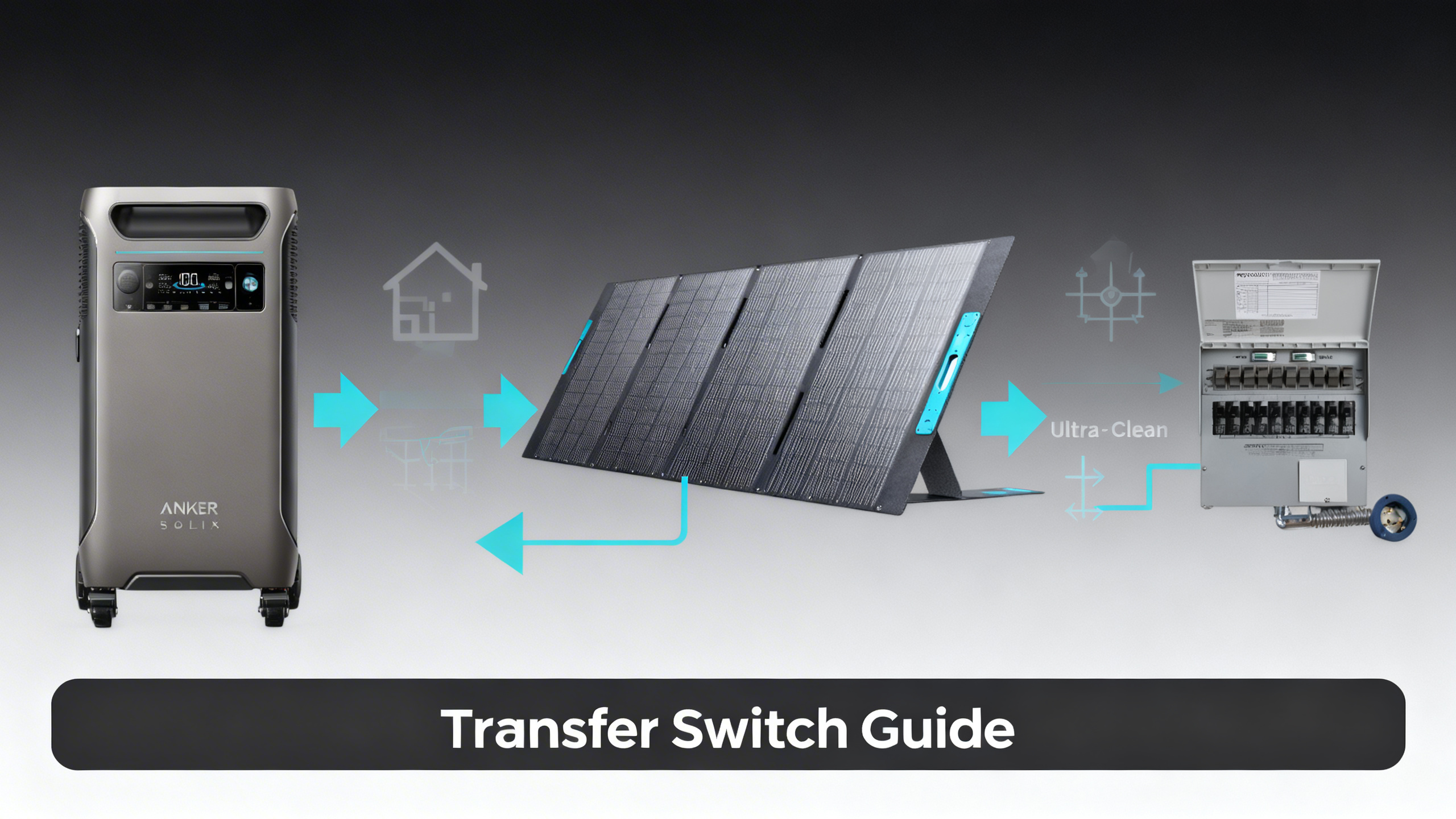
Not sure which Anker SOLIX transfer switch works with your power station? You’re not alone. The lineup includes three distinct switch models, each matched to a specific F-series unit, and choosing the wrong one means an incompatible inlet connector and a return trip to the store.
This guide covers every Anker SOLIX transfer switch option available in 2026: which switch pairs with which power station, how the specs differ, and what installation actually involves. If you own an F3800, an F2000, or anything in between, the compatibility data below points you directly to the right model.

10-Circuit Manual Transfer Switch
For Anker SOLIX F3800 / F3800 Plus (50A, 120V/240V)
$599 standalone
- 10 circuits: covers all essential home loads
- 120V/240V split-phase compatible
- UL 1008 certified, NEC Article 702 compliant
Own a Anker SOLIX? Get the owner's checklist.
Storage, cold weather, solar limits and battery health for your Anker SOLIX power station, in one email. After that, about one email a week with setup guides, plus a heads-up when compatible batteries or panels go on sale.
Unsubscribe in one click. We may earn a commission when you buy through our links, at no extra cost to you. Privacy Policy
What Is a Transfer Switch? (The 30-Second Answer)
A transfer switch is a device installed between your main electrical panel and an alternative power source (in this case, an Anker SOLIX power station). Its job is to ensure your home circuits connect to either the grid or the battery, never both simultaneously.
Think of it as a two-position switch: utility power or backup power. Flipping selected circuits to the backup position disconnects them from the grid and routes them through the power station instead. This eliminates back-feeding, which is the accidental flow of electricity back into the grid during an outage. Back-feeding is dangerous for utility technicians working on downed lines.
For a full breakdown of every Anker SOLIX product category, see our full Anker SOLIX brand review.
Why Transfer Switches Matter for Anker SOLIX Users
Three concrete reasons explain why a transfer switch is non-negotiable when connecting an Anker SOLIX station to your home panel: safety, legal compliance, and circuit-level control.
The Safety Case: Eliminating Back-Feeding Risk
Without a transfer switch, current from your power station can travel back through your panel and onto the utility lines. For technicians working on a line they believe is de-energized, that’s a potentially fatal hazard. The transfer switch provides galvanic isolation: the two sources are physically incapable of being connected at the same time.
The Legal Requirement: NEC Article 702
The NEC Article 702 optional standby systems requirements stipulate that any optional standby system connected to a building’s wiring must include a means of isolating it from the utility supply. In practice, this means a licensed electrician must perform the installation, and many jurisdictions require a permit. All three Anker SOLIX switch models are UL 1008 certified and NEC Article 702 compliant to satisfy this requirement.
Own a Anker SOLIX? Get the owner's checklist.
Storage, cold weather, solar limits and battery health for your Anker SOLIX power station, in one email. After that, about one email a week with setup guides, plus a heads-up when compatible batteries or panels go on sale.
Unsubscribe in one click. We may earn a commission when you buy through our links, at no extra cost to you. Privacy Policy
Which Transfer Switch Goes with Which Anker SOLIX Model?
All transfer switch options slot into a broader home backup strategy. Our Anker SOLIX home backup hub covers the full picture. Here, the focus is compatibility: three switch models, each designed for a specific subset of F-series power stations.
The critical differentiator is output voltage. The F3800 delivers 120V/240V split-phase power, which requires a different inlet connector (L14-30) than the 120V-only output of the F3000, F2600, and F2000, which use an L5-30 inlet. These connectors are not interchangeable.

Anker SOLIX Transfer Switch Compatibility
10-Circuit Switch: Best for F3800 (B17B31A1: $599)
The 10-circuit switch (B17B31A1) is the only Anker SOLIX transfer switch rated for the F3800’s 120V/240V split-phase output. It uses an L14-30 inlet, which matches the F3800’s generator-style output connector. At 50A total capacity, it can carry the F3800’s full rated load without constraint.
The circuit breakdown is practical: six 15A single-pole circuits for standard loads, one 20A double-pole for higher-draw appliances, and one 30A double-pole for a 240V appliance like a mini-split or well pump. The color-coded wattmeter built into the panel lets you monitor your load balance in real time, which matters when you’re managing the F3800’s available capacity during an extended outage.
Spec analysis confirms this switch is scalable up to 12kW and 53.8kWh when paired with the F3800 and expansion batteries. Our deep-dive into F3800 transfer switch setup covers how the 10-circuit kit integrates with the F3800’s split-phase output in detail.
Starter 6-Circuit: F3800 Entry Point (B17B81A1: $449)

The Starter Kit (B17B81A1) also uses the L14-30 inlet and supports 120V/240V, making it compatible with the F3800. The key difference: it covers 6 circuits instead of 10, at 30A instead of 50A. You can configure it as six 15A single-pole circuits, or as four 15A circuits plus one 20A double-pole circuit.
The practical trade-off is straightforward. At $449 versus $599, you save $150. But you’re also limiting yourself to six protected circuits rather than ten. For homeowners who only need to cover a refrigerator, a few lights, phone chargers, and perhaps a sump pump, six circuits is enough. Anyone with 240V appliances to protect, or who wants more flexibility, should step up to the 10-circuit model.
6-Circuit Switch: For F2000, F2600, F3000 (B17B71A1: $399)
The 6-circuit switch (B17B71A1) uses an L5-30 inlet for 120V output only. This matches the output spec of the F3000, F2600, and F2000, which do not produce 240V. The switch covers six 15A single-pole circuits at 30A total.
In practice, six 120V circuits is sufficient for the most critical home loads during an outage: refrigerator, lighting, phone and laptop chargers, a TV, and a sump pump. What it won’t cover is any 240V appliance (electric dryer, mini-split, well pump). That’s not a switch limitation; it’s a power station output limitation. If you need 240V circuit coverage, the F3800 is the platform that supports it.
The Science Behind Transfer Switches: How It Actually Works
The Core Components
Every Anker SOLIX manual transfer switch is built around the same core architecture, adapted for its specific power station. The panel contains color-coded toggle switches: each toggle controls one circuit, and the color code corresponds to the circuit’s wattage rating on the built-in wattmeter. Flipping a toggle from “line” to “generator” position physically disconnects that circuit from the utility feed and connects it to the power station inlet.
The inlet (L14-30 on F3800-compatible models, L5-30 on F-series 120V models) is the physical socket where your power station’s output cable plugs in. The wattmeter display lets you track total load in real time, so you can see when you’re approaching the power station’s output limit. The hinged, non-metallic cover protects the toggle switches and breakers from accidental contact during operation.
Step-by-Step: The Manual Switching Process
The manual transfer process follows a consistent four-step sequence, regardless of which switch model you own. The actual operation takes about two minutes once the switch is installed.
How the Anker SOLIX Manual Transfer Switch Works: 4 Steps
⚡
Step 1
Grid power fails. Your home loses utility power.
🔌
Step 2
Plug your Anker SOLIX station into the transfer switch inlet.
🔄
Step 3
Flip the circuit toggles for the loads you need to power.
🏠
Step 4
Your selected circuits run on battery power. Monitor via app.
When grid returns: flip toggles back, disconnect station, resume normal operation.
One practical note on load management: the color-coded wattmeters make it easy to see your total draw at a glance. If your selected circuits are pulling more than the power station’s continuous output rating, the station will signal an overload. Owner reports consistently recommend activating circuits one at a time rather than flipping all toggles simultaneously, which can cause a startup surge.
The UL 1008 Standard: What Certification Means
UL 1008 is the safety standard for transfer switches. Certification confirms that the switch provides adequate electrical isolation between sources, that its components are rated for the thermal and fault conditions they’ll encounter, and that the design eliminates back-feeding under all normal operating conditions. For homeowners, UL 1008 certification matters for two practical reasons: insurance compliance and permit approval.
Most homeowner’s insurance policies require that any backup power installation use UL-listed equipment. Similarly, local building departments typically require UL 1008 certification for permit approval. All three Anker SOLIX switch models carry this certification. For the full specification context, see the Pro/Tran transfer switch specifications from Reliance Controls, the manufacturer of the Pro/Tran 2 switches used across the Anker lineup.
E10 and the Smart Inlet Box: A Different Approach
The E10 Power Module does not use the manual transfer switches described above. E10 owners work with the Smart Inlet Box ($399, SKU: AS211141), which is a proprietary bidirectional connection point that integrates directly with the home’s electrical panel.

The key architectural difference: the Smart Inlet Box is designed for active, software-managed power flow rather than manual circuit selection. Where the F-series manual switches operate as simple bypass panels (you choose the circuits, you flip the toggles), the Smart Inlet Box connects the E10 to the full panel and lets the system manage load distribution dynamically.
E10 owners should consult the dedicated E10 installation guide for wiring diagrams specific to the Power Dock and Smart Inlet Box setup. That process is substantially more involved than F-series switch installation and requires specialized knowledge of whole-home battery system integration.

One option worth noting: Anker does offer an E10 bundle (B17E114T, $4,999) that includes the E10 system with a traditional transfer switch panel for those who prefer the manual-switch approach with E10-level capacity. This is the exception in the E10 lineup, not the default configuration.
Manual vs Automatic: What Anker SOLIX Offers
All three F-series transfer switches are manual. There is no automatic transfer switch (ATS) option in the Anker SOLIX lineup for F-series portable power stations. When the grid goes down, a person needs to plug in the station and flip the circuit toggles. This is a deliberate design choice for portable systems: an ATS adds significant cost and complexity that doesn’t suit the F-series use case.
Manual vs Automatic Transfer Switch: Which Do You Need?
✓ Manual Transfer Switch (Anker SOLIX)
- You’re home during most outages
- Budget is a priority ($399–$599)
- Outages are predictable (hurricanes, storms)
- You want a simpler, UL-certified installation
- F3800, F3000, F2600, or F2000 owner
⚡ Consider Automatic (or E10 Smart Inlet Box)
- Outages happen when you’re away or asleep
- Medical equipment requires zero-delay switching
- You’re building a whole-home backup system
- You want seamless grid-to-battery transition
- E10 system owner (Smart Inlet Box is the match)
For most homeowners who are present during storm-related outages, the manual approach works well. The two-minute process of plugging in the station and selecting circuits is not a significant burden when you’re already home managing the situation. The cost savings versus an ATS system are substantial.
Installation Overview: What to Expect
Before working through Anker-specific steps, reviewing transfer switch installation basics will clarify what the process involves for any manual switch. The Anker SOLIX installation follows that same framework: panel assessment, permit acquisition, electrician installation, and functional testing.

Certified data from UL 1008 compliance documentation confirms that installation by a qualified electrician is required. NEC Article 702 optional standby systems requirements make this explicit: any optional standby system connected to building wiring must be installed in compliance with the code. Many jurisdictions additionally require a permit before the work begins.
Typical installation cost ranges from $200 to $500 depending on panel accessibility and local labor rates. An experienced electrician generally completes the installation in 2 to 4 hours. The switch itself comes pre-wired, which simplifies the job considerably compared to hardwired generator connections.
What the Electrician Will Do
The electrician’s scope covers the permanent side of the installation. This includes identifying the circuits in your existing panel to be protected (refrigerator, lighting, sump pump, and so on), running conductors from those circuits to the transfer switch, connecting the switch to the main panel, and mounting the switch near the panel in an accessible location.
The electrician will also run a continuity and isolation test before sign-off, confirming that the switch properly isolates utility and backup sources and that each circuit toggle operates correctly. This test step is required for permit approval in most jurisdictions.
What You Can Do Yourself (After Installation)
Once the electrician has completed and certified the installation, the operational side belongs to the homeowner. Connecting the power station to the inlet, activating circuits via the toggle switches, and monitoring load via the Anker app are all owner-managed tasks. No additional licensing or certification is needed for day-to-day use of the switch.
💡 Pro Tip: Label each toggle switch in the panel with a brief description of the circuit it controls (e.g., “Fridge,” “Kitchen lights,” “Sump”). This makes the manual switching process faster and reduces the chance of activating a non-essential circuit under load pressure.
Conclusion: Choosing the Right Anker SOLIX Transfer Switch
The selection logic is straightforward. F3800 and F3800 Plus owners have two options: the 10-circuit switch (B17B31A1, $599) for maximum circuit coverage and 240V capability, or the Starter 6-circuit kit (B17B81A1, $449) for a lower entry cost with reduced circuit capacity. F3000, F2600, and F2000 owners use the 6-circuit switch (B17B71A1, $399) with the L5-30 inlet. E10 system owners work with the Smart Inlet Box, not the manual switches covered here.
Whether you’re starting with a portable F-series unit or planning a full E10 installation, home backup power planning covers the full decision framework to help you size your system correctly before you buy.
10-Circuit Manual Transfer Switch
$599
Best match for F3800: 10 essential circuits, 120V/240V
Price verified April 2026. Free shipping available
Frequently Asked Questions
Can I use the Anker SOLIX F3800 transfer switch with the F3000 or F2600?
No. The 10-circuit switch (B17B31A1) uses an L14-30 inlet designed for the F3800’s 120V/240V split-phase output. The F3000, F2600, and F2000 require the 6-circuit switch (B17B71A1) with an L5-30 inlet rated for 120V only. These inlet connectors are physically different and not interchangeable. Attempting to use the wrong switch creates a compatibility mismatch at the connector level.
Do I need an electrician to install the Anker SOLIX transfer switch?
Yes, in virtually all cases. All Anker SOLIX manual transfer switches are UL 1008 certified and NEC Article 702 compliant. NEC Article 702 requires that optional standby systems connected to building wiring be installed by a qualified electrician. Most states and many insurance policies reinforce this requirement. Some jurisdictions also require a permit before installation begins. Owner-side operation (plugging in the station, activating circuits) requires no license.
What’s the difference between the 6-circuit Starter kit ($449) and the 6-circuit F-series switch ($399)?
Both switches have 6 circuits and 30A capacity, but they’re designed for different power stations. The Starter Kit (B17B81A1, $449) uses an L14-30 inlet and supports 120V/240V, making it compatible with the F3800’s split-phase output. The F-series switch (B17B71A1, $399) uses an L5-30 inlet for 120V only, matching the F3000, F2600, and F2000. The voltage output of your specific power station determines which model applies.
Can the Anker SOLIX transfer switches switch automatically when power goes out?
No. All three F-series transfer switch models (B17B31A1, B17B81A1, B17B71A1) are manual switches. When the grid goes down, you connect the power station to the inlet and flip the circuit toggles yourself. For automatic switchover capability, the Anker SOLIX E10 system with its Smart Inlet Box provides active power management, but this is a separate, fixed residential installation rather than a portable power station accessory.
How many circuits can I power with the 10-circuit switch?
The 10-circuit switch (B17B31A1) covers up to 10 circuits: six 15A single-pole, one 20A double-pole, and one 30A double-pole. In practice, this is enough to cover a refrigerator, primary lighting, phone and laptop chargers, a TV, a sump pump, and one 240V appliance such as a mini-split or electric water heater. The built-in color-coded wattmeter helps you stay within the F3800’s continuous output limit as you activate circuits.
Does the Anker SOLIX transfer switch qualify for the 30% federal tax credit?
No. The 30% Residential Clean Energy Credit for home energy storage ended for systems installed after December 31, 2025, so neither the switch nor the battery it connects qualifies for a 2026 installation.
Originally published: April 6, 2026