
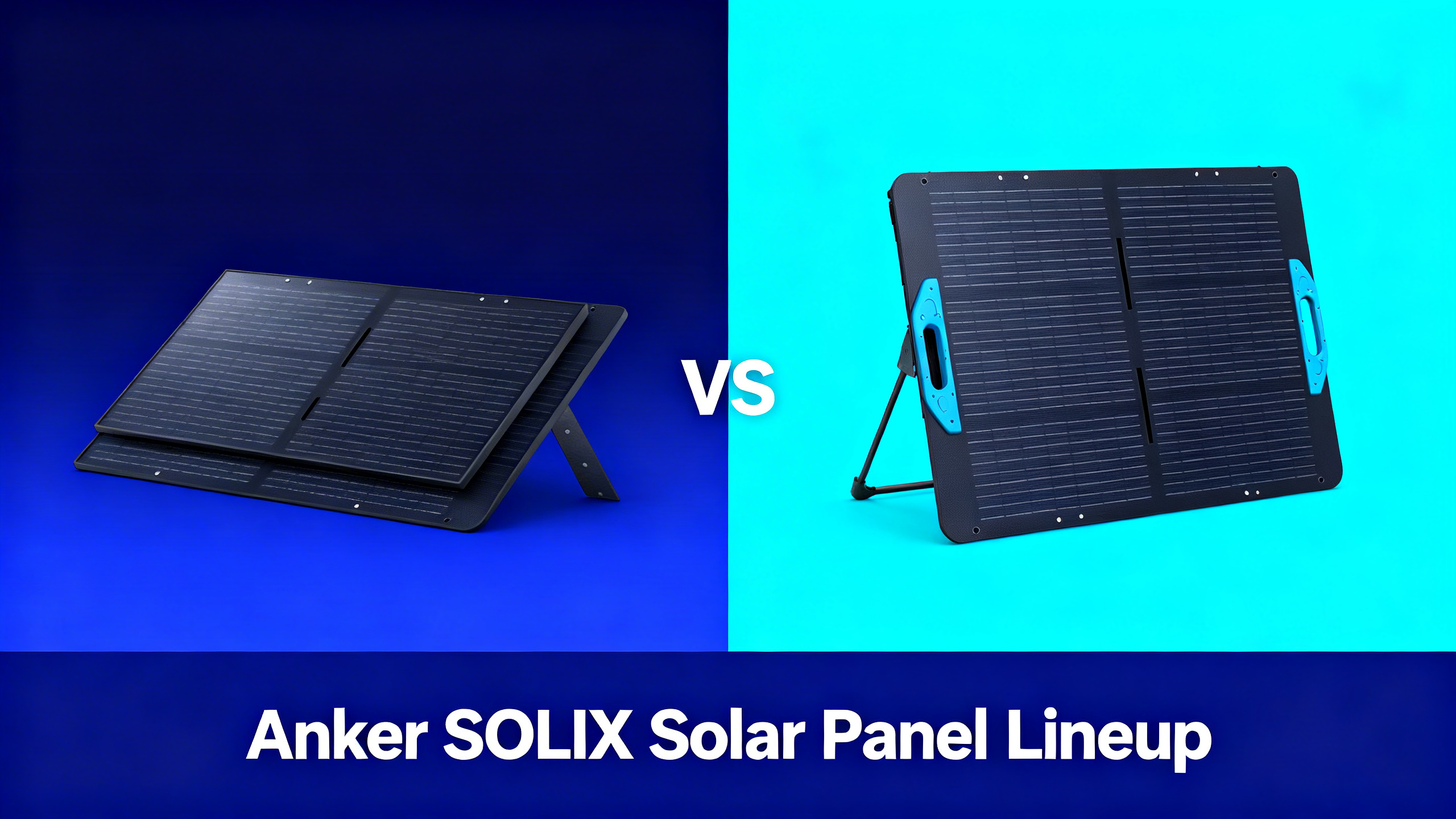
Five solar panels. One brand. A price range spanning $155 to $999. Choosing the right Anker SOLIX panel for your setup shouldn’t require a spreadsheet, but the lineup covers enough ground that picking the wrong one is easy. The 625 and PS100 both output 100W yet differ in price by $144. The 440W Rigid delivers 25% efficiency while every portable model tops out at 23%. And the PS400 at $899 costs nearly six times the entry-level 625.
This comparison covers all five panels, using published specifications and catalog data to match each model to specific power stations and use cases. All specs referenced here come directly from the Anker SOLIX official solar panel lineup. Here’s what the data shows.

Anker SOLIX PS400 Portable Solar Panel
$899.00
- 400W output, 23% efficiency, compatible with all SOLIX stations
- IP67 waterproof, 4 adjustable kickstand angles
- Best for mid-to-large capacity power stations (C1000 and up)
Anker SOLIX Solar Panel Overview: What’s in the Lineup?
The Anker SOLIX solar panel lineup currently spans five distinct models: the entry-level 625 ($155), the step-up PS100 ($299), the mid-range PS200 ($499), the high-output PS400 ($899), and the rigid 440W bifacial panel ($999 for a 2-pack, roughly $500 per panel). Four of the five are foldable monocrystalline units designed for portable use. The 440W Rigid is the outlier, built for permanent rooftop or RV mounting.
All four portable panels share 23% conversion efficiency and a foldable form factor. The differences come down to wattage, kickstand system, waterproofing rating, and station compatibility. For a complete look at the full product ecosystem, the Anker SOLIX brand overview covers all current models.
Which Anker SOLIX Solar Panel Fits Your Setup?
⚡
Tightest Budget
625 Panel
$155 | 100W | IP67. Pairs with C200X, C300X, and small camping setups.
🏕
Weekend Camper
PS100
$299 | 100W | 4-angle kickstand. Ideal for 535 and C300X with adjustable solar tracking.
🚐
Van Life / RV
PS200
$499 | 200W | IP67 portable. Best match for C800X and C1000 Gen 2 in mobile setups.
🏆
Best All-Around
PS400
$899 | 400W | IP67. Maximizes input on C1000 Gen 2, C2000 Gen 2, F3000, F3800.
🏠
Home / Permanent
440W Rigid
$500/panel (2-pack) | 440W | IP68 bifacial. Designed for rooftop and fixed RV mounting with E10 and F3800.
Head-to-Head Specs: All 5 Panels Compared
Spec-for-spec, the five panels divide cleanly into two categories: the portable foldable group (625, PS100, PS200, PS400) and the rigid fixed-mount group (440W). Within the portable group, the main differentiators are wattage and kickstand quality. The 440W Rigid separates itself on efficiency, waterproofing, and warranty length.
Anker SOLIX Solar Panel Lineup: Full Specs Comparison
| Spec | 625 | PS100 | PS200 | PS400 | 440W Rigid |
|---|---|---|---|---|---|
| Wattage | 100W | 100W | 200W | 400W | 440W |
| Efficiency | Up to 23% | Up to 23% | Up to 23% | Up to 23% | Up to 25% |
| Panel Type | Mono foldable | Mono foldable | Mono foldable | Mono foldable | Bifacial rigid |
| Waterproofing | IP67 | Weather-resistant | IP67 | IP67 | IP68 |
| Adjustable Angles | Foldable only | 30/40/50/80° | 30/40/50/80° | 30/40/50/80° | Fixed mount |
| Warranty | Not specified | 18 months | Not specified | Not specified | 10 yr panel / 30 yr linear |
| Price (unit) | $155 | $299 | $499 | $899 | ~$500/panel (2-pack) |
| Best For | Ultra-budget, C200X/C300X | C300X, camping basics | C800X, C1000, travel | C1000-F3000, full use | E10, F3800, roof/RV |
Anker SOLIX 625: The Entry-Level Option
At $155, the 625 is the only Anker SOLIX solar panel that clears the sub-$200 threshold, and that matters for budget-constrained buyers pairing it with smaller stations like the C200X or C300X. Published specs confirm the 625 delivers 100W output with up to 23% efficiency and IP67 waterproofing, which is stronger weather protection than the pricier PS100. The budget 625 panel review covers real-world performance numbers and compatibility specifics for the 625.

The trade-off is the kickstand system. Catalog data shows the 625 lacks the 4-angle adjustable kickstand found on the PS100, PS200, and PS400. You can fold and prop it, but you can’t precisely angle it at 30, 40, 50, or 80 degrees to track the sun throughout the day. For set-and-forget use at a single position, that’s a minor limitation. For all-day charging with manual repositioning, the 625 loses ground to its siblings.
Price-per-watt analysis places the 625 at $1.55/W, which is the second-best value in the portable lineup after the 440W Rigid. For readers new to solar, how solar panels convert sunlight to energy explains the underlying physics behind efficiency ratings like these.
Who Should Buy the 625?
The 625 is the right choice if your station is a C200X, C300X, or PowerHouse 521/535, your budget is firm under $200, and you don’t need adjustable angle tracking. It’s also the best pick for travelers who want a lightweight solar option without paying the PS100 premium for features their use case doesn’t require. If you need the kickstand system or plan to upgrade to a larger station soon, the PS100 is worth the extra $144.
Anker SOLIX PS100: The 100W Upgrade
The PS100 costs $299 and shares the same 100W output as the 625, which raises an obvious question: what does the extra $144 actually buy? According to catalog data, the primary additions are the 4-angle kickstand system (30/40/50/80 degrees), USB-C and USB-A direct output ports, and explicit compatibility with the PowerHouse 521, 535, and 757. The kickstand lets you optimize sun angle without repositioning the entire panel, which translates to meaningfully better daily yield over a long camping trip.

One limitation the specs make clear: the PS100 carries an 18-month warranty, shorter than what most buyers would expect at this price point. The 625’s warranty isn’t specified in catalog data, but the PS100’s 18-month figure stands as the weakest warranty commitment in the portable lineup. At $2.99/W, the PS100 also represents the highest cost-per-watt of any panel in the SOLIX range, including the 625.
Where the PS100 has a clear advantage over the 625 is the direct device charging. The dual USB-C and USB-A ports let you charge a phone or small device directly from the panel without routing through a power station first. For day hikers or ultralight campers who only need device-level power, that’s a real convenience.
Who Should Buy the PS100?
The PS100 makes sense if you own a PowerHouse 521, 535, or 757 and want an official compatibility-matched panel with a kickstand. It’s also the right call if direct USB charging from the panel is important to your workflow. Budget-conscious C300X owners, however, should weigh the 625 carefully: at 100W output with IP67 protection, the 625 delivers the same core charging performance for nearly half the price.
Anker SOLIX PS200: The Sweet Spot
The PS200 at $499 doubles the output of the 100W panels and brings IP67 waterproofing and the full 4-angle kickstand system. Published specifications confirm 200W output with up to 23% conversion efficiency, two MC4 extension cables (3m each), and an MC4 to XT-60 connector included in the box. For van lifers and extended campers who need meaningful daily charging without committing to the full PS400 footprint, the PS200 hits a practical balance point.

Spec analysis confirms the PS200 pairs well with the C800X (up to 300W solar input) and the C1000 Gen 2, covering a substantial portion of each station’s maximum solar input capacity without requiring a second panel. Two PS100 units in series would reach the same 200W, but at $598 total versus $499 for a single PS200, the math favors the single unit. The PS200 is also a more portable solution: one folded panel versus two.
At $2.50/W, the PS200 costs more per watt than the PS400 and the 440W Rigid. The premium reflects the portability and mid-range output position rather than raw efficiency gains. If your station can accept 400W solar input and your use case is stationary or vehicle-based, the PS400 often represents better value.
Who Should Buy the PS200?
The PS200 is the data-supported choice for van lifers, overlanders, and car campers running a C800X or C1000 Gen 2. It provides 200W in a single portable unit with IP67 protection and a full kickstand system, matching well to stations that cap out around 300-400W of solar input. If you’re trying to max out a C1000 Gen 2’s solar input with a single panel purchase, the PS400 at 400W makes a stronger argument for the extra spend.
Anker SOLIX PS400: Maximum Portable Output
The PS400 is the most capable portable panel in the Anker SOLIX lineup, and published specifications make the case clearly. At 400W with up to 23% efficiency, IP67 waterproofing, and the same 4-angle kickstand system as the PS200, it’s designed to max out the solar input of mid-to-large Anker stations in a single panel. Catalog data confirms compatibility with all Anker portable power stations, with the PS400 particularly well-suited to the C1000 Gen 2, C2000 Gen 2, F3000, and F3800 (which accept 600W solar input or more). If you don’t need the full 400W, a single PS200 paired with a C1000 Gen 2 still covers a solid share of the station’s solar input in one panel, without the second panel or cable management complexity a smaller-wattage pairing would require.


Catalog data also notes 1.5x faster charging versus previous generations, and the included MC4 cables (3m, two included) plus MC4 to XT-60 cable mean the PS400 is ready to connect out of the box. At $2.25/W, it costs less per watt than both the PS100 and PS200, making it the strongest value proposition among portable panels when matched with a station that can use the full 400W.
The limitation is size and weight: a 400W foldable panel is substantially larger than a 100W or 200W unit when deployed. For backpackers or travelers with strict portability requirements, the folded footprint may rule it out. For campers with vehicle access, van lifers, and RV users, the footprint is a non-issue.
Who Should Buy the PS400?
The PS400 is the strongest portable panel choice for owners of the C1000 Gen 2, C2000 Gen 2, F3000, or F3800 who want to maximize solar input without stacking multiple panels. At $2.25/W, it delivers more output per dollar than the PS100 or PS200 within the portable category. The ideal buyer has vehicle access, a large-capacity station, and wants to minimize recharge time during extended off-grid use.
440W Rigid Solar Panels: Permanent Installation Power
For a full technical breakdown, the 440W rigid panel review covers mounting, efficiency data, and sizing scenarios. The summary from catalog data: the 440W Rigid is the only panel in the Anker SOLIX lineup that reaches 25% conversion efficiency, the only one rated IP68 (versus IP67 for portables), and the only one backed by a 10-year panel warranty and 30-year linear performance guarantee. It’s sold as a 2-pack for $999, working out to approximately $500 per panel.

The bifacial design is the key differentiator. Published specifications indicate bifacial panels capture up to 30% more energy from reflected light on the rear side, which is particularly effective on light-colored rooftops, RV surfaces, and elevated ground installations. Combined with the 25% front-face efficiency, the 440W Rigid delivers the highest total energy yield of any Anker SOLIX panel per square meter of installation. When combining multiple 440W panels, understanding series vs parallel wiring is critical to staying within your station’s voltage limits.

The fixed-mount design means no adjustable kickstand angles, which is expected for a rigid panel. It’s built for rooftop installations and permanent RV mounting where panels stay in a fixed position. The IP68 rating offers superior weather durability compared to the IP67 on portables, making it well-suited for year-round outdoor exposure. Anker pairs it with the E10 and F3800 in their larger solar generator kits.
Who Should Buy the 440W Rigid?
The 440W Rigid is the right call for homeowners integrating solar with an Anker SOLIX E10 or F3800 system, RV owners who want a permanently mounted panel array, and anyone building a fixed installation where portability is irrelevant. At approximately $1.14/W (2-pack pricing), it offers the best raw value in the lineup. The 10-year warranty and 30-year performance guarantee also make it the only panel suited for multi-decade planning horizons.
Portable vs Rigid: Which Format Is Right for You?
The core decision comes down to use case, not specs. Portable foldable panels (625, PS100, PS200, PS400) are designed to move with you, deploy at different locations, and connect to stations you’ll transport. Rigid panels are built to stay in one place and generate power continuously over years or decades.
Price Per Watt: Anker SOLIX Solar Panel Lineup 2026
$1.14/W
Lowest cost per watt. Best value for permanent installs.
$1.55/W
Budget portable entry point, strong value for 100W class.
$2.25/W
Premium portable. Justified by portability and kickstand versatility.
$2.50/W
Mid-range versatility. Best balance of portability and output.
$2.99/W
Higher per-watt cost vs 625. Adds 4-angle kickstand and broader compatibility.
On efficiency, the rigid panel’s 25% rating and bifacial technology give it a clear edge. On portability, the portable panels win by design. IP67 handles rain and splashing; IP68 handles submersion. For anything outdoors and stationary long-term, the higher IP68 rating of the rigid panel is the stronger specification. The cost-per-watt data consistently favors the rigid option for permanent setups, while the portable panels command a premium for the convenience of mobility.
Which Panel Pairs Best With Your Power Station?
Station-to-panel matching is where the spec comparison becomes immediately practical. Each Anker station has a published maximum solar input wattage, and selecting a panel that approaches (without exceeding) that limit maximizes charging speed. Anker also bundles these panels into complete solar generator kits pre-matched for each station.
Anker SOLIX Buying Guide
Deciding between power stations too? This guide walks through the full lineup by budget and use case.
Our Verdict: The Best Anker SOLIX Solar Panel for Each Use Case
Spec analysis across all five panels points to clear winners by profile. For homeowners and permanent RV users, the 440W Rigid at $1.14/W with 25% efficiency and a 30-year performance guarantee is the unambiguous choice. For van lifers and extended car campers running a mid-to-large station, the PS400 at $899 delivers 400W in a portable, IP67 package that covers most stations’ maximum solar input. The PS200 is the practical sweet spot for C800X and C1000 owners who want a single portable panel without the PS400 price tag.
Budget campers and first-time solar buyers should look at the 625 first. At $155 with IP67 protection, it’s a capable entry point that pairs cleanly with the C200X and C300X. The PS100 earns its place for buyers who specifically need the kickstand system and PowerHouse 521/535/757 compatibility at 100W, but the 625 beats it on value for overlapping use cases. If you’re also deciding between power stations, the Anker SOLIX buying guide walks through the full lineup by budget and use case.
Anker SOLIX 440W Rigid Panels (2-Pack)
$999.00
Best choice for permanent home and RV rooftop installations
Price verified April 2026. Free shipping available.
FAQ
Which Anker SOLIX solar panel has the highest efficiency?
The 440W Rigid panel leads with up to 25% conversion efficiency, compared to 23% for all portable models (625, PS100, PS200, PS400). Its bifacial design also captures reflected light from the rear side, adding up to 30% more energy generation in the right conditions.
Is the Anker SOLIX PS200 compatible with the C800X?
Yes. Published specifications confirm the C800X accepts up to 300W solar input, making the PS200 a natural pairing. Two PS100 panels in series would also work, but the PS200 provides the same wattage in a single, more portable unit.
Can I use third-party solar panels with Anker SOLIX stations?
Anker SOLIX stations accept MC4-compatible panels via the XT-60 or dedicated solar input port. Compatibility data confirms that third-party panels work provided they stay within each station’s voltage and wattage limits. That said, Anker’s own panels are pre-matched for plug-and-play setup.
What is the difference between the 625 and the PS100?
Both output 100W, but the PS100 adds a 4-position adjustable kickstand (30/40/50/80 degrees) and broader station compatibility. The 625 is a more compact entry-level option at $155 vs $299, with no kickstand system. For C200X and C300X users on a budget, the 625 is the data-supported choice.
How many 440W Rigid panels does the Anker SOLIX E10 support?
The E10 accepts up to 2,400W of solar input. Spec calculations show that six 440W Rigid panels (2,640W total) would nominally exceed this, making four to six panels (1,760W to 2,640W) the practical range. Anker sells the 440W panels in 2-packs, 4-packs, 6-packs, and 8-packs to match various system sizes.
Originally published: April 6, 2026