
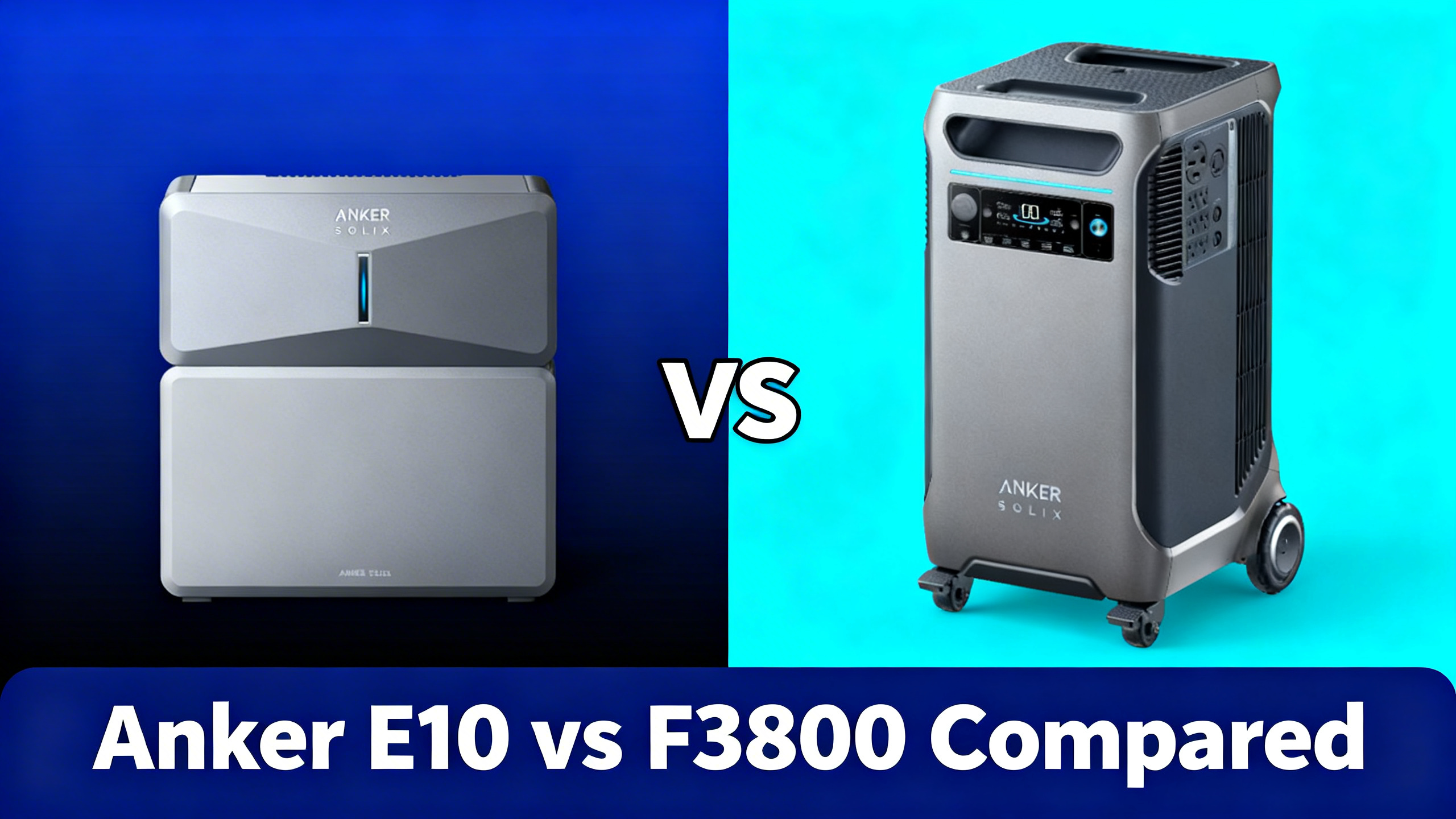
Choosing between the Anker SOLIX E10 and the F3800 for home backup isn’t really a question of which is better. It’s a question of what kind of backup system your home actually needs. Both carry Anker’s SOLIX branding, both handle serious power loads, and both connect to solar. But spec analysis confirms these two units represent entirely different philosophies: one is built into your home permanently, the other stays ready to move.
The entry price gap sits at roughly $2,500, but the real difference runs deeper than cost. Before diving into this head-to-head, readers looking for a broader overview can check out our full Anker SOLIX brand review covering the complete lineup.

At a Glance: The Core Difference
The simplest way to frame this comparison: the E10 stays put, the F3800 goes where you need it. The E10 is a residential-grade modular system wired into your home’s electrical panel, designed to power everything from HVAC to electric ranges without you lifting a finger during an outage. The F3800 is a high-capacity portable power station that can serve as home backup, but you connect it manually and you could just as easily roll it to a job site or campground.
Published specifications and certified documentation confirm the performance gap that justifies the price difference. The E10 delivers 9,600W at 240V with automatic failover. The F3800 delivers 6,000W, requires a separate transfer switch, and switches manually. Here’s the full spec picture side by side.
Anker SOLIX E10: The Modular Whole-Home System
For deeper analysis on the E10 system architecture, see our dedicated E10 modular review with full spec breakdown and installation considerations. But here’s what the core data reveals about what this system actually is.
The Anker SOLIX E10 combines a Power Module with one B6000 Battery at entry level, delivering approximately 5kWh of usable capacity and a certified 9,600W output at 240V split-phase. That output level matters in practice. Analysis of typical home electrical loads confirms 9,600W covers central HVAC systems, electric ranges, well pumps, and major appliances simultaneously. The F3800’s 6,000W ceiling doesn’t reach those loads.
The UL9540A certification is a detail worth understanding. UL9540A is the higher-tier fire safety standard for energy storage systems. Beyond safety, this certification matters for insurance eligibility and HOA compliance in jurisdictions that require it. Published data from Anker’s documentation confirms the E10 carries both UL9540 and UL9540A, while the F3800 holds UL9540 only.
Anker SOLIX E10 Review: Full System Breakdown
Deep dive into the E10 architecture, installation process, and real-world performance data.
Scalability is where the E10’s modular design shows its long-term value. The base configuration supports additional Power Modules and B6000 Battery units, growing the system to 15kWh or more without replacing any core hardware. For extended outages, the E10 pairs with the Smart Generator 5500 Tri-Fuel, providing an essentially unlimited backup window as long as fuel is available.
Anker SOLIX F3800: The Portable Powerhouse
The F3800 portable review covers runtime data and expansion options in full detail. Here’s the essential comparison picture. The F3800 packs 3,840Wh of capacity into a wheeled unit weighing approximately 139 lbs, with a 6,000W AC output across 120V and 240V split-phase. It’s genuinely high-capacity hardware, just in a form factor built for flexibility rather than permanent installation.

For home backup, the F3800 requires a separate manual transfer switch (sold separately, approximately $449 for the 6-circuit version or $749 for 10-circuit). This is an important cost and workflow distinction. Where the E10 with Power Dock switches automatically when grid power fails, the F3800 setup requires manual intervention: shutting down the grid breaker and switching circuits over to the unit. It’s workable, but it’s not invisible.
Two F3800 variants exist in the current catalog. The original F3800 supports up to 2,400W solar input via dual 60V inputs. The F3800 Plus (priced at $2,499) upgrades solar input to 3,200W with dual 165V capability and adds 240V bypass charging. For buyers who already own or plan to add significant solar capacity, that distinction matters. Expansion capacity on the F3800 reaches 53.8kWh via BP3800 external batteries, which puts it ahead of the E10’s base-tier scalability, though the E10’s modular Power Module architecture scales differently.

Mobility remains the F3800’s primary differentiator. Renters, frequent movers, and homeowners who want a unit that can also serve at a campsite, on a job site, or during a family evacuation have a clear argument for the F3800 over any permanently installed system.
Installation and Setup Requirements
Installation requirements represent one of the sharpest practical dividing lines in this comparison. The E10 is a permanent system that requires a licensed electrician. Depending on your home’s electrical panel configuration and local permitting requirements, installation labor typically adds $500 to $1,500 on top of the hardware cost. That cost doesn’t appear in Anker’s pricing but belongs in any honest budget calculation.
The E10 connects to your home in one of two ways. The Power Dock configuration (bundled at $5,799) includes an automatic transfer switch built into the system, so the failover from grid to battery happens in milliseconds without any manual action. The Smart Inlet Box configuration (bundled at $4,599) uses a manual connection point, requiring you to physically connect the E10 when the grid goes down. Both require licensed installation. Our E10 configuration guide walks through every bundle option and helps identify the right starting point for your home’s load requirements.


The F3800 setup is meaningfully simpler. The unit itself requires no installation. If you’re using it standalone with extension cords and power strips, it’s immediately operational. For proper home backup coverage, the manual transfer switch does require electrician installation, but the process is less involved than integrating a full modular system like the E10. Renters who cannot modify their electrical panels often find the F3800 to be the only viable option in this class.
Readers comparing Anker to other brands should also consult our guide on whole-home backup battery systems covering Tesla, Generac, and other alternatives.
Solar Charging Capabilities
Solar integration is a meaningful differentiator between these two systems. The E10 supports up to 4,000W of solar input, compatible with Anker’s 440W rigid panels and third-party panels within its voltage and current specifications. At 4,000W of solar input, charging time calculations based on the base 5kWh capacity suggest a full recharge in approximately 1.25 hours under optimal conditions. That’s a genuinely fast solar cycle for a whole-home system.

The F3800 accepts up to 2,400W of solar via dual 60V inputs, enough to fully recharge from empty in under two hours under optimal sunlight, per Anker’s published specifications. The F3800 Plus raises that ceiling to 3,200W with dual 165V inputs, which broadens compatibility with higher-voltage panel strings and reduces recharge time further. For homes with existing panel arrays, voltage compatibility with your current setup is worth verifying before choosing which F3800 variant to pursue.
Price Breakdown and What You Actually Get
The price picture for the E10 isn’t as simple as the $4,299 entry figure. That base price covers the Power Module plus one B6000 Battery, which is the functional unit without any home integration hardware. Adding the Smart Inlet Box for manual home connection brings the total to $4,599. The Power Dock bundle for automatic failover starts at $5,799. Adding a second battery and the Power Dock puts the system at approximately $7,799. These are hardware-only figures; licensed installation is additional.
The F3800 pricing structure is more transparent. The standalone unit at $1,799 is fully operational as a portable power station. Adding a 6-circuit manual transfer switch for home backup brings the total to approximately $2,248; the 10-circuit version runs roughly $2,548. The F3800 Plus at $2,499, combined with a Smart Home Power Kit, reaches approximately $3,599 all-in. Both the E10 and F3800 may qualify for the federal clean energy tax credit (up to 30%), which meaningfully changes the net cost calculation for qualifying installations. Consulting a tax professional before purchasing is advisable.
All-In Cost: What You Actually Pay
Anker SOLIX E10
Anker SOLIX F3800
Prices as of April 2026. Federal tax credit (30%) may apply. Installation costs not included for E10.

Anker SOLIX Home Backup: Full Options Guide
Compare every Anker SOLIX home backup configuration, from entry-level to whole-home scale.
Extended Outage Capability
For outages measured in days rather than hours, the E10’s ecosystem gives it a structural advantage. Paired with the Smart Generator 5500 Tri-Fuel, the system can run continuously as long as fuel supply holds, cycling between battery and generator input to maintain whole-home power. That combination covers scenarios where solar alone falls short, whether due to weather, season, or sustained demand.

The F3800 handles extended outages differently. Expansion via BP3800 batteries can push usable capacity toward 53.8kWh, enough to power a moderately loaded home for several days depending on consumption patterns. Recharge via solar (up to 2,400W on the base F3800) adds sustained generation. Connecting a compatible AC generator for recharging is also possible. The workflow is more hands-on than the E10 ecosystem, but for users who have already invested in a significant solar setup, the F3800 can serve as a capable multi-day hub.
For a 2,000 sq ft home running essential loads (refrigerator, lighting, internet, ceiling fans, and some device charging), a base F3800 at 3,840Wh covers approximately 12 to 20 hours depending on actual draw. The E10 base config at ~5kWh extends that window to roughly 15 to 25 hours, with the additional benefit of covering higher-draw appliances the F3800 cannot power simultaneously.
Which One Is Right for You?
For a broader view of all available configurations, our guide to Anker SOLIX home backup solutions covers options from entry-level to whole-home scale. But based on spec analysis and the documented capabilities of each system, the decision framework is reasonably clear.
The E10 fits homeowners who want a permanent, integrated solution that works automatically during an outage. The UL9540A certification, 9,600W output, and auto-transfer capability via Power Dock make it the stronger choice for anyone powering a full household, including high-draw systems like central HVAC. It requires upfront investment and professional installation, but it’s designed to stay for the life of the home.
The F3800 is the better fit when flexibility matters more than permanence. Renters who cannot modify their electrical panel, homeowners on a tight budget, and users who need a system that can travel with them all have a strong case for the F3800. The lower entry price and portable form factor open up use cases the E10 simply can’t address.
Which System Fits Your Situation?
Choose the E10 if…
- You want automatic whole-home failover
- You plan to install permanently and scale over time
- You need 240V for HVAC, electric range, or well pump
- Your home requires UL9540A certification (HOA, insurance)
- You want smart solar integration with future expansion
Choose the F3800 if…
- You want flexibility to move the unit (RV, travel, garage)
- You are renting or cannot make permanent electrical changes
- Budget is the primary constraint ($1,799 vs $4,299+)
- You need backup for circuits only (not whole home)
- You already own solar panels and want solar generator flexibility
Spoiler: there’s no universal winner here. The data points to the E10 for whole-home coverage and long-term integration; the F3800 for budget-conscious buyers and portable versatility. Our full Anker SOLIX brand review has additional context on where each product sits in the broader lineup. For anyone evaluating alternatives outside the Anker ecosystem, our guide on whole-home backup battery systems covers Tesla, Generac, and other competing solutions.
Conclusion
The Anker SOLIX E10 and F3800 are genuinely different products that happen to serve overlapping territory. Spec-for-spec analysis confirms the E10 is the more capable whole-home backup system, with higher output, automatic failover, dual UL certifications, and modular scalability built for permanent installation. The F3800 is a serious portable power station that can serve as home backup, and it does so at a meaningfully lower entry price with the added benefit of mobility.
For homeowners who want a backup system that works without thinking about it during an outage, the E10 is the right call. For buyers who need flexibility, face installation constraints, or are working with a tighter budget, the Anker SOLIX F3800 at $1,799 delivers substantial capability without the permanence requirement. Verify current pricing on the official E10 product page before purchasing, as promotions and bundle pricing change.
Anker SOLIX E10
$4,299
Best modular whole-home backup system 2026
Price verified April 2026. Free shipping available
Frequently Asked Questions
What is the main difference between the Anker SOLIX E10 and F3800?
The E10 is a modular residential system designed for permanent whole-home installation, with UL9540A certification and automatic transfer capability via the Power Dock. The F3800 is a high-capacity portable power station that can serve as home backup through a manual transfer switch but remains fully mobile. The E10 targets homeowners seeking a fixed backup solution; the F3800 suits those who need flexibility.
Which system provides more power output?
The E10 delivers 9,600W at 240V, versus the F3800’s 6,000W output. For large-load applications such as central HVAC systems, electric ranges, or well pumps, the E10’s higher output offers a practical advantage confirmed by its certified specifications.
Can the F3800 power an entire home like the E10?
The F3800 can power selected circuits via a manual transfer switch, covering critical loads such as refrigerators, lighting, and smaller appliances. Whole-home coverage comparable to the E10 requires significant battery expansion and does not include automatic failover, which is exclusive to the E10 with Power Dock.
Does the Anker SOLIX E10 qualify for the federal tax credit?
The E10 holds UL9540A certification, which positions it favorably for the Residential Clean Energy Credit (30%). Tax credit applicability depends on individual circumstances and installation details. Consulting a qualified tax professional is recommended before purchasing.
What is the total cost of the E10 vs F3800 with home backup capability?
An E10 entry setup (Power Module + Battery + Smart Inlet Box) starts at $4,599. With the Power Dock for automatic transfer, the starting price is $5,799. The F3800 with a 10-circuit manual transfer switch runs approximately $2,548. The F3800 Plus with the Smart Home Power Kit (auto transfer) reaches $3,599.
Is the Anker SOLIX F3800 being replaced by the F3800 Plus?
Both models remain available in the current Anker SOLIX catalog. The F3800 Plus introduces upgraded solar input (3,200W vs 2,400W) and 240V bypass charging capability. The original F3800 remains a valid option for buyers who do not require the additional solar capacity or bypass charging.
Originally published: April 6, 2026