
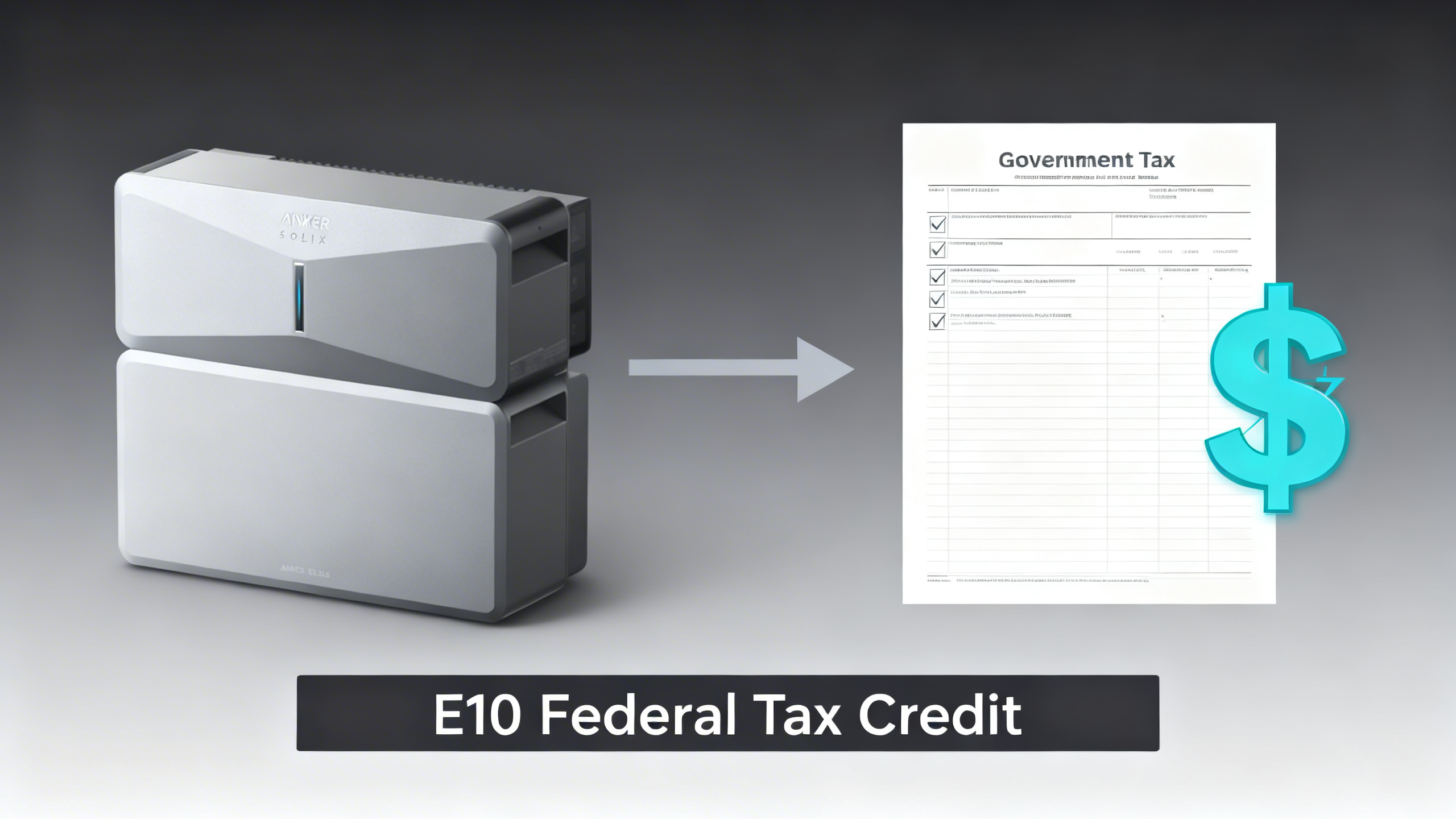
You're looking at a $4,299 home battery system. Before you commit, one question matters more than almost any other: can you recover 30% of that cost through a federal tax credit? For the Anker SOLIX E10, the short answer is yes, very likely, but the details matter.
The Residential Clean Energy Credit under IRS Section 25D covers home battery storage systems that meet specific eligibility requirements. A 2022 change to the law expanded these rules significantly, and the E10 is purpose-built for the type of installation that qualifies. This guide breaks down exactly how the credit works, which E10 configurations qualify, how much you can save, and how to claim it correctly on your return.
⚠️ Important: This article provides general information about federal tax incentives based on publicly available IRS guidance. It does not constitute tax, legal, or financial advice. Consult a qualified tax professional before making purchasing decisions based on expected tax credits.

Anker SOLIX E10 Whole-Home Backup
$4,299 UL9540 & 9540A Certified
- UL9540A-certified: key for tax credit eligibility
- 9.6kWh base capacity, expandable to 57.6kWh
- Whole-home 120V/240V backup power
What Is the Anker SOLIX E10? (Quick Context)
The Anker SOLIX E10 is a residential whole-home battery backup system, not a portable power station. That distinction matters for the tax credit: the IRS eligibility rules under Section 25D apply specifically to permanently installed storage systems at a primary residence.
This article focuses on the tax credit question specifically; for full specs and performance data, see our E10 system overview. Here's what's relevant to the credit analysis: the E10 base system provides 9.6kWh of usable storage capacity, delivers 120V/240V whole-home power, and carries both UL9540 and UL9540A certifications. It's designed to integrate with your home's electrical panel, either through a Smart Inlet Box or an automatic Power Dock transfer switch.
The system is modular and expandable: each additional Battery Module adds 9.6kWh, up to a maximum of 57.6kWh. At its base configuration priced at $4,299, it's positioned as a serious home energy solution rather than a consumer gadget. For a complete overview of all Anker SOLIX models and how they compare, see our full Anker SOLIX brand review.
The Federal Tax Credit for Home Battery Storage: How It Works
The Residential Clean Energy Credit (formally known as the Investment Tax Credit, or ITC) is a federal tax credit available to U.S. homeowners who install qualifying clean energy equipment at their primary residence. It's governed by Section 25D of the Internal Revenue Code.
The credit equals 30% of the total installed cost of qualifying equipment. That includes the hardware itself, professional labor for installation, and permitted accessories that are part of the system. The credit is applied directly against your federal income tax liability for the year you install the system.
For the IRS Residential Clean Energy Credit page, the complete eligibility criteria and current filing instructions are published annually and should be your primary reference alongside a qualified tax professional.
What Changed in 2022 with the Inflation Reduction Act
Before 2023, home battery storage only qualified for the credit if it was installed alongside a solar panel system. A standalone battery, no matter how capable, was excluded. The Inflation Reduction Act of 2022 changed this fundamentally.
Starting with tax year 2023, standalone battery storage systems qualify for the 30% credit independently, without any solar requirement. This single change opened the door for products like the Anker SOLIX E10 to qualify on their own merits. The IRA also extended the 30% rate through 2032, providing a decade of certainty for homeowners planning installations.
The practical impact is significant. A homeowner who wants backup power but doesn't want or need solar can now capture the same 30% credit that solar buyers have had access to for years.
What “30% of Installed Cost” Actually Means
The credit base is broader than just the sticker price of the equipment. IRS guidance indicates that the qualifying cost includes the purchase price of the battery system, labor costs for professional installation, permit fees, and any ancillary equipment required to connect the system (such as a transfer switch or automatic transfer panel).
This means the E10 + Power Dock bundle at $7,799, which includes installation-ready components, generates a larger credit base than the E10 base unit alone. Add professional electrician labor, and the qualifying amount increases further.
One important nuance: the credit is non-refundable. It reduces your federal tax liability dollar for dollar, but if the credit exceeds what you owe in a given year, you don't receive the difference as a refund. Under the IRA rules, unused credit can be carried forward to the following tax year.
How Much Can You Save? 30% Federal Tax Credit on E10 Configurations
E10 Base
$4,299
Purchase price
– $1,290
30% credit
$3,009 net
E10 + Smart Inlet
$6,599
Purchase price
– $1,980
30% credit
$4,619 net
E10 + Power Dock
$7,799
Purchase price
– $2,340
30% credit
$5,459 net
3× E10 + Power Dock
$29,999
Purchase price
– $9,000
30% credit
$20,999 net
* Credit amounts are estimates. Actual savings depend on tax liability. Consult a tax professional. Credit scheduled at 30% through 2032.
Does the Anker SOLIX E10 Qualify? The Short Answer
Based on analysis of IRS Section 25D requirements and the E10's published specifications: yes, the Anker SOLIX E10 very likely qualifies for the 30% Residential Clean Energy Credit. The system meets the three core technical criteria the IRS uses to determine eligibility for standalone battery storage.
The IRS treats whole-home backup systems differently depending on whether they are installed with solar or as standalone storage. For the E10, the standalone eligibility rules introduced by the IRA 2022 apply directly. Three conditions must be satisfied: minimum capacity, installation type, and property qualification. The E10 addresses each of them.
One caveat worth stating clearly: using an E10 as a portable unit, disconnected from your home's electrical system, does not qualify. The IRS requires permanent installation at a primary residence. The E10 is designed for exactly that use case, but installation method matters.
Section 25D Eligibility Checklist: Anker SOLIX E10
Battery capacity: 3kWh minimum
E10 base: 9.6kWh. Exceeds requirement.
UL certification
E10 is UL9540 & UL9540A certified.
Installed at primary U.S. residence
Must be your main home. Second homes: limited credit.
Permanent installation (2023+ rule)
Post-2023 IRA update: standalone storage qualifies without solar.
Professional installation recommended
Not required by IRS, but strengthens the credit claim for whole-home systems.
Portable use only: does NOT qualify
Camping use or non-permanent setups are excluded from Section 25D.
The Three Eligibility Requirements Explained
Section 25D sets three core requirements for battery storage systems to qualify. Let's break down how the E10 addresses each one and where you need to pay attention.
Requirement 1: Minimum Battery Capacity (3kWh)
The IRS establishes a minimum usable capacity threshold of 3kWh for qualifying battery storage. This requirement exists to distinguish genuine home energy storage from small uninterruptible power supplies or device-level batteries.
The E10 base system provides 9.6kWh of storage capacity, more than three times the minimum. Each additional Battery Module that you add to an expanded configuration contributes another 9.6kWh. In practice, every E10 configuration, from the base unit to the maximum 57.6kWh system, comfortably clears this threshold.
This requirement creates no ambiguity for E10 buyers. The capacity qualification is straightforward.
Requirement 2: Eligible Property (Primary Residence)
The credit applies to equipment installed at your primary residence in the United States. This is typically the home where you spend the majority of the year and file taxes from.
Second homes and vacation properties have limited eligibility: the credit is reduced proportionally based on time spent at the property. Rental properties do not qualify at all under Section 25D.
The E10's design as a fixed whole-home system supports primary residence installation. It connects permanently to your home's electrical infrastructure through either a Smart Inlet Box or Power Dock. This is fundamentally different from a portable power station that you might use in multiple locations.
Anker SOLIX for Home Backup: Complete Guide
Choosing the right configuration for whole-home backup, including sizing and installation options.
Requirement 3: Battery Must Store Electricity (Not Just Pass-Through)
The IRS requires that the system genuinely stores electrical energy, rather than simply routing or conditioning it. This distinction matters: a whole-home surge protector or an uninterruptible power supply with limited storage would not qualify.
The E10 is a true electrochemical storage system with its own battery management system (BMS) that handles charge and discharge cycles independently. It stores grid power (or solar, if paired) and delivers it on demand. This is precisely the type of system Section 25D is designed to incentivize.
The UL9540A certification the E10 carries is specifically relevant here. UL9540A is the standard for thermal runaway testing of energy storage systems, and its presence signals that the E10 meets the technical definition of a qualified energy storage system under applicable safety standards.

Anker SOLIX E10 + Power Dock Bundle
Includes transfer switch: required for whole-home backup credit
$7,799
Which E10 Configuration Qualifies? (Base vs Bundles)
All E10 configurations qualify under Section 25D, assuming installation at your primary residence. The difference between bundles isn't eligibility, it's the size of the credit. Here's how the main configurations compare:
| Configuration | Price | Estimated Credit | Eligible |
|---|---|---|---|
| E10 Base (B17E1141) | $4,299 | ~$1,290 | ✅ Yes |
| E10 + Smart Inlet Box (B17E1149) | $6,599 | ~$1,980 | ✅ Yes |
| E10 + Power Dock (B17E114A) | $7,799 | ~$2,340 | ✅ Yes |
| E10 3× + Power Dock (B17E114G) | $29,999 | ~$9,000 | ✅ Yes |
Credit estimates above are based on equipment cost only. Professional installation labor, permits, and eligible accessories would increase the qualifying base and therefore the actual credit.
For help choosing between the base configuration, Power Dock, and Smart Inlet Box bundles, our E10 buying guide covers configuration differences in detail.
Smart Inlet Box vs Power Dock: Which Matters for the Credit?
Neither the Smart Inlet Box nor the Power Dock is required by the IRS to qualify for the credit. The tax eligibility is tied to the battery storage system itself, not the connection method.
That said, both accessories are part of the qualifying installed cost. The Power Dock, which includes an automatic transfer switch rated for whole-home power management, carries a higher price point, and that higher price means a larger credit base. The $7,799 Power Dock bundle yields roughly $2,340 in estimated credit versus $1,290 for the base system.


Larger E10 Systems: More Capacity, Bigger Credit
The credit calculation scales linearly with your investment. A three-module E10 system with Power Dock at $29,999 generates a potential credit of approximately $9,000, before adding professional installation labor, which can add several thousand dollars to the qualifying base.
For homeowners who need whole-home coverage during multi-day outages, or who are sizing for solar-plus-storage, larger configurations make the credit even more impactful. The same 30% rate applies regardless of system size.

How Much Can You Actually Save?
The calculation is straightforward, though the actual outcome depends on your individual tax situation. The credit equals 30% of your total qualifying installed cost. That's not a deduction: it's a direct reduction of your federal tax bill.
For the E10 base at $4,299, the credit comes to roughly $1,290. Add a licensed electrician's installation (typically $500-$1,500 depending on your home's panel and local rates) and permit fees, and the qualifying base (and therefore the credit) grows accordingly.
The non-refundable nature of the credit is worth understanding before you purchase. If your federal tax liability for the year is $800 and the credit is $1,290, you apply $800 against your bill (bringing it to zero) and carry the remaining $490 forward to the following year. You don't lose the unused portion: you defer it.

Tax professionals generally recommend timing larger home energy purchases for years when your tax liability is highest, to maximize immediate utilization of the credit. If you're self-employed, had capital gains, or received a bonus this year, your liability may be elevated, making it an ideal year to install and claim.
Other Home Battery Systems That Also Qualify
The Section 25D rules are product-agnostic. Any battery storage system that meets the three core criteria (capacity, primary residence installation, genuine storage function) is eligible for the 30% credit, regardless of manufacturer.
Other whole-home battery platforms from major manufacturers apply the same eligibility analysis. EcoFlow, Jackery, and Bluetti each offer systems positioned for home backup, and buyers considering those alternatives should verify UL9540A certification and minimum capacity specs in the same way.
The credit's existence creates a meaningful level playing field for comparing systems. At 30% off, a $7,000 system becomes a $4,900 effective investment. This changes the competitive math significantly when comparing the E10 to alternatives. If the E10 is outside your budget, several alternatives also qualify; see our roundup of best solar generators 2026 for options across price points.
Regardless of which system you're evaluating, the same advice applies: consult a qualified tax professional before making purchasing decisions based on expected credits. Eligibility depends on your specific installation and tax situation, not just the product itself.
Best Solar Generators 2026: Top Home Battery Systems Compared
Full comparison of qualifying home storage systems across all price points, including tax credit analysis per model.
How to Claim the Credit: IRS Form 5695
The process for claiming the Section 25D credit is more straightforward than most homeowners expect. Here's the step-by-step path from purchase to refund.
Step 1: Keep Your Purchase Documentation
Before filing anything, assemble your documentation. This means the original purchase invoice from Anker SOLIX or your retailer, your installation contractor's invoice (if professionally installed), any permit documents from your local municipality, and any receipts for qualifying accessories.
Store both paper and digital copies. The IRS has a three-year window to audit returns, so keeping records for at least that period is prudent. A well-organized file documenting total installed cost makes the credit calculation straightforward and provides documentation if questions arise later.
Step 2: Complete IRS Form 5695
The Residential Energy Credits are reported on IRS Form 5695, which you file alongside your standard Form 1040. Section I of Form 5695 covers the Residential Clean Energy Credit (Section 25D).
You'll enter the total qualifying cost on the appropriate line, and Form 5695 calculates 30% of that figure as your credit. The credit then flows to Schedule 3 of your 1040, where it reduces your total tax liability. The DOE homeowner guide to residential energy credits provides a helpful walkthrough of the form alongside detailed eligibility notes.
If you use tax software (TurboTax, H&R Block, FreeTaxUSA), the credit is covered by the “Energy Credits” section. Answer the questions about your home battery installation and the software handles Form 5695 automatically.
Step 3: Apply the Credit to Your Tax Return
Once Form 5695 is complete, the credit amount carries over to your 1040 and directly reduces the tax you owe. If your credit is $1,290 and you owe $2,400 in federal taxes, your bill drops to $1,110. If your credit exceeds your liability, the remaining balance carries forward to the following year.
Working with a CPA or enrolled agent is strongly recommended for first-time energy credit filers, particularly for whole-home systems where the installed cost is significant and documentation needs to be thorough. An hour of professional tax advice is typically well worth the cost when the credit itself is $1,000 or more.
Common Questions About the E10 Tax Credit
Does the Anker SOLIX E10 qualify for the federal tax credit without solar panels?
Yes. Since the IRA 2022 amendment to Section 25D, effective for tax year 2023, standalone battery storage systems qualify for the 30% Residential Clean Energy Credit without any solar installation requirement. The E10's 9.6kWh base capacity far exceeds the 3kWh minimum threshold established by the IRS, and its UL9540A certification confirms it meets the technical standards for qualifying energy storage equipment. You don't need panels on the roof to claim the credit.
How much is the federal tax credit for the Anker SOLIX E10?
The credit equals 30% of your total qualifying installed cost. For the E10 base system at $4,299, that represents approximately $1,290. Larger configurations generate proportionally larger credits: the $6,599 E10 + Smart Inlet Box bundle yields roughly $1,980, and the $7,799 E10 + Power Dock bundle yields approximately $2,340. Professional installation labor and permit costs typically add to the qualifying base, increasing the credit further. The three-module configuration at $29,999 generates a potential credit approaching $9,000 on equipment cost alone.
Is the Anker SOLIX E10 tax credit refundable?
No. The Section 25D credit is non-refundable, meaning it reduces your federal tax liability but does not generate a cash refund if the credit exceeds what you owe in a given year. However, under current IRA rules, any unused credit carries forward to the following tax year. For example, if your credit is $1,290 but your tax liability is only $900, you apply $900 in the current year and carry the remaining $390 forward. You don't lose the unused portion.
Which E10 configuration is best for maximizing the tax credit?
Any E10 configuration qualifies, and the credit calculation is based on total installed cost, so larger systems generate larger credits. The E10 + Power Dock bundle at $7,799 and multi-module systems produce the highest credit amounts. That said, your configuration choice should be driven primarily by your actual power needs and budget, not solely by maximizing the credit. Buying a system larger than you need to capture a bigger credit doesn't make financial sense. Size appropriately for your home, and the credit will follow.
Does the E10 qualify for state-level incentives in addition to the federal credit?
Many states offer separate incentives for battery storage installation that can stack on top of the federal 30% credit. California, New York, and Texas, among others, maintain state-level programs for home battery storage. The DSIRE database (Database of State Incentives for Renewables and Efficiency) lists available programs by state and is the most comprehensive resource for identifying local incentives. Your total effective discount could be substantially higher than 30% depending on where you live.
Do I need professional installation to claim the tax credit?
The IRS does not explicitly require professional installation for the Section 25D credit. However, professional installation is strongly recommended for a whole-home system like the E10 for several reasons: it ensures the system qualifies as a permanent residential installation (a core IRS requirement), satisfies Anker SOLIX's warranty terms, and adds licensed electrician labor costs to your qualifying base, which increases the credit. For a system at this price point and complexity, the cost of professional installation is generally worth it both for the credit and for safety compliance.
When does the 30% federal tax credit expire?
Under current law, the 30% rate applies through 2032. The rate then steps down to 26% in 2033 and 22% in 2034, and is scheduled to expire entirely in 2035 unless Congress renews the program. Purchasing and installing before 2033 locks in the maximum 30% rate. Given the E10's positioning as a long-term home infrastructure investment, buying while the credit is at its peak makes meaningful financial sense.
The Bottom Line
The Anker SOLIX E10 very likely qualifies for the 30% federal Residential Clean Energy Credit under IRS Section 25D. The system's 9.6kWh base capacity exceeds the 3kWh minimum. Its UL9540 and UL9540A certifications align with the technical standards for qualified storage equipment. And its design as a permanently installed whole-home system satisfies the primary residence requirement.
The key condition is installation method. A permanently installed E10 at your primary residence is what the credit is designed for. Portable use doesn't qualify, and rental properties are excluded. Get the installation done properly, keep your documentation, and work with a tax professional to file Form 5695 in the year of installation.
At $4,299 for the base system, the potential ~$1,290 credit brings your effective cost to around $3,009. For the Power Dock bundle at $7,799, the ~$2,340 credit puts the net cost at approximately $5,459. That's meaningful savings on a system that protects your home through power outages and operates as a long-term energy asset.
The 30% rate holds through 2032. The sooner you install, the sooner the credit starts working for you.
Anker SOLIX E10
$4,299 (before credit)
Potential savings: ~$1,290 with 30% ITC
Price verified April 2026. Consult a tax professional for credit eligibility
Originally published: April 6, 2026