
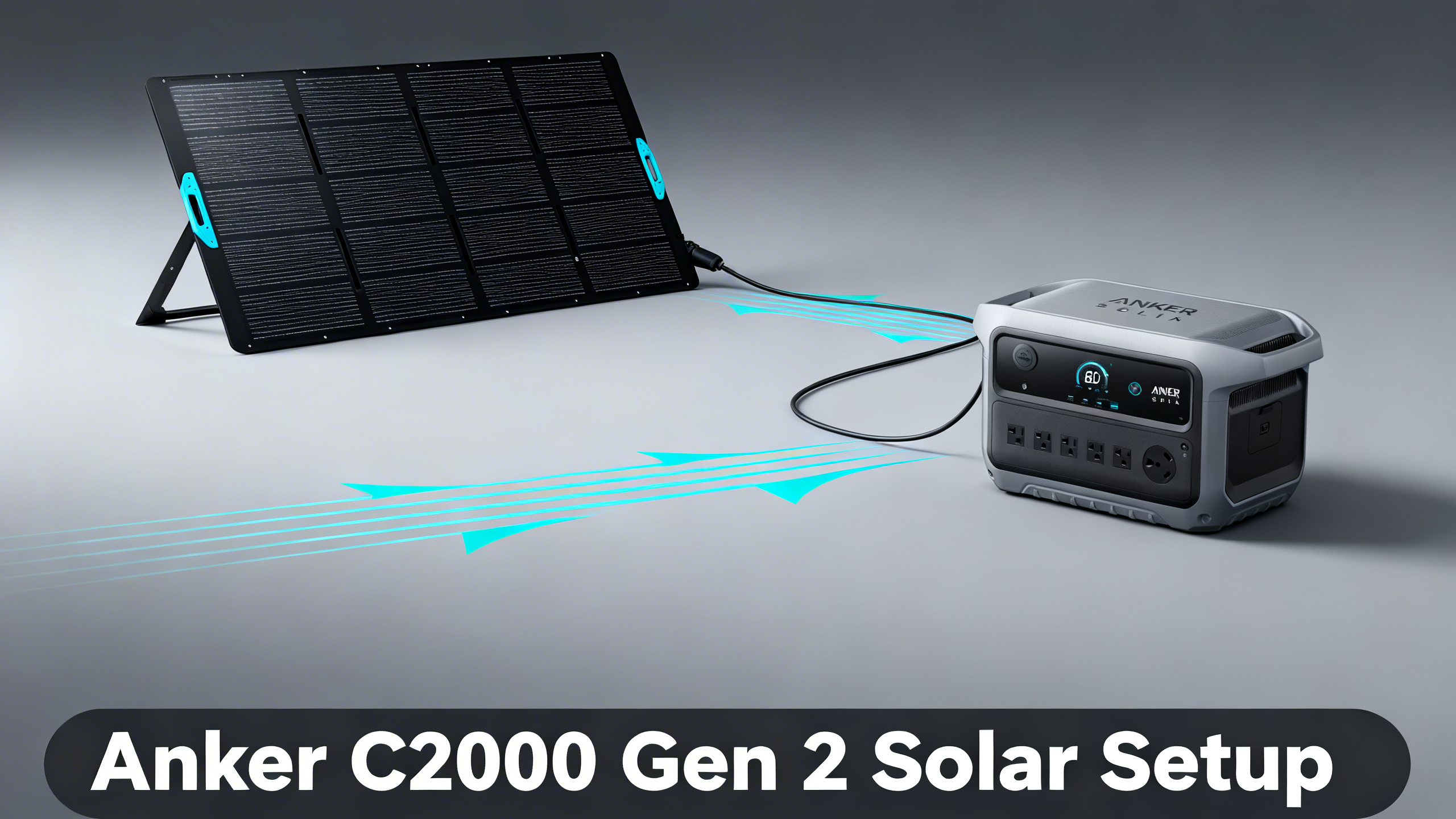
Want to run the Anker SOLIX C2000 Gen 2 entirely on solar? The specs make a compelling case: 1,200W max solar input, dual independent MPPT ports, and a 2,048Wh LFP battery that can theoretically reach full charge in around 2 hours under optimal sun. But getting there requires the right panel selection and wiring configuration.
This guide covers the C2000 Gen 2's solar charging specifications in detail, the best Anker panel pairings for every budget and use case, series vs parallel wiring decisions, and yield optimization tips. The C2000 Gen 2 sits at the heart of Anker's portable lineup. For a broader look at the brand, our full Anker SOLIX brand review covers every model in detail.

Anker SOLIX C2000 Gen 2
$799.99
- 2,048Wh LFP, 2,400W / 4,000W peak
- Max 1,200W solar input, dual MPPT
- 80% charge in 45 min (AC + solar)
Understanding the C2000 Gen 2's Solar Specs
This guide focuses on solar setup. For a full performance breakdown including runtime and ports, see our C2000 Gen 2 vs F2000 comparison.
The C2000 Gen 2 ships with two independent MPPT (Maximum Power Point Tracking) controllers. Each port accepts solar input in the 12-60V range, with a combined ceiling of 1,200W. Published specifications indicate that each port individually handles up to 600W, meaning you can run two separate panel strings without one affecting the other.
C2000 Gen 2: Solar Charging Specifications
How MPPT Works on the C2000 Gen 2
MPPT (Maximum Power Point Tracking) is the technology that continuously adjusts the electrical operating point of your panels to extract maximum power regardless of changing light or temperature conditions. The C2000 Gen 2's two independent MPPT controllers mean each panel string operates at its own optimal point. If one string is partially shaded, the other isn't dragged down with it. You'll know the controllers are working correctly when the input wattage reading on the display matches closely with expected panel output for current sun conditions.
Which Solar Panel Works with the C2000 Gen 2?
Before diving into configurations, our guide to the solar panel lineup 2026 covers the full PS100/PS200/PS400 and 440W Rigid range in one place.
Anker offers four panel options that pair directly with the C2000 Gen 2 via XT-60 input. Here's how they compare for this specific station:


PS100 (100W): The entry-level portable option. At 100W, charge time calculations show roughly 20+ hours to fill the 2,048Wh battery, making it best suited as a supplemental panel rather than a primary charging source. Practical for light top-up scenarios during multi-day off-grid trips.
PS200 (200W, $799): A solid mid-range portable option. Charge time analysis based on rated output indicates approximately 11 hours to full under optimal conditions. At $799 for the PS200, this suits users who prioritize portability over speed.
PS400 (400W, $899): The most capable portable panel in the lineup. One PS400 halves the charge time compared to the PS200, bringing the estimate down to approximately 5.5 hours. The PS400 at $899 is the recommended starting point for anyone who plans to rely primarily on solar.
440W Rigid Panels (pair, $999): Designed for fixed or semi-permanent installations. A pair provides 880W across both MPPT ports and brings charge time down to roughly 2.5 hours. The 440W rigid panel pair at $999 makes the most sense for cabin, van roof, or garage setups.
Compatible Third-Party Panels
Third-party panels work with the C2000 Gen 2 as long as they connect via XT-60 or include an MC4-to-XT-60 adapter (Anker sells the A24V7011 adapter for $29.99). The key constraint: open-circuit voltage must not exceed 60V per MPPT port. Exceeding this risks controller damage. Always check the panel's Voc spec before connecting, particularly when wiring panels in series.
Best Solar Panel Combinations for the C2000 Gen 2
Recommended Solar Configurations: C2000 Gen 2
Entry Setup
200W
1x PS200 (parallel, 1 MPPT port)
~11 hrs to full charge
Balanced Setup
400W
1x PS400 (1 MPPT port)
~5.5 hrs to full charge
Fast Setup
800W
2x PS400 (split across 2 MPPT ports)
~2.7 hrs to full charge
Max Input
1,200W
3x PS400 or 440W rigids (series/parallel split)
~2 hrs to full charge (optimal conditions)
1x PS400: The Balanced All-Rounder
For most campers and van lifers, one PS400 hits the practical sweet spot. Charge time analysis based on 400W input and 2,048Wh capacity points to approximately 5.5 hours under direct, unobstructed sun. The PS400 folds compactly and weighs under 30 lbs, which makes it genuinely portable rather than just nominally so. If you're parking in a sunny spot for a full day, one PS400 covers a full charge with time to spare.
2x PS400: Fastest Portable Setup
Connecting two PS400 panels, one to each MPPT port, delivers up to 800W of input and brings charge time to approximately 2.7 hours. This is the fastest practical portable configuration for the C2000 Gen 2. Each panel connects independently to its own port; no series or parallel wiring cables needed. The limitation here is cost: two PS400 panels run $1,798 before any discounts, which represents more than double the station's own price.
440W Rigid Panels: Best for Fixed Installations
The 440W rigid panels suit rooftop van installations, cabins, or any setup where the panels stay in place. A pair of 440W rigids ($999) across both MPPT ports delivers approximately 880W of input. Charge time calculations based on that input show a full charge in roughly 2.5 hours under optimal sun. The trade-off is obvious: rigid panels don't fold, they're heavier, and installation requires mounting hardware.
 rigid solar panels all-black design installation” />
Series vs Parallel Wiring for the C2000 Gen 2
Choosing between series and parallel wiring matters for your target. Our full technical breakdown of series vs parallel wiring explains the theory, while this section applies it directly to the C2000 Gen 2.
The core rule: the C2000 Gen 2 accepts up to 60V per MPPT port. That single constraint shapes every wiring decision for this station.
Series vs Parallel: Which for the C2000 Gen 2?
⚡ Series Wiring
Voltage adds up, current stays same
- Better for long cable runs
- Higher voltage = more efficient MPPT
- Performance dips if one panel is shaded
- Best: 2x PS200 in series (1 MPPT port)
⚡ Parallel Wiring
Current adds up, voltage stays same
- More resilient to partial shading
- Requires 3-in-1 or 5-port connector cable
- Lower voltage per run
- Best: 2x PS400 parallel via XT-60 hub
⚡ Mixed (Max Input)
Split panels across 2 MPPT ports
- Each MPPT port handles 600W max
- Combine 2x PS400 + 1x PS400 = 1,200W
- Maximizes solar input ceiling
- Requires 2 separate cable runs
When to Wire in Series
Series wiring adds voltage while keeping current constant. For the C2000 Gen 2, two PS200 panels (each around 20-24V Voc) wired in series stay safely within the 60V per-port ceiling and produce a combined 400W. This is the right call when cable runs are long (higher voltage travels more efficiently) or when panels are shaded inconsistently and you want MPPT efficiency. You'll know the series connection is correct when the input voltage reading sits between the two individual panel voltages added together.
When to Wire in Parallel
Parallel wiring combines current while voltage stays at a single panel's level. This is the safer choice for two PS400 panels on a single port: each PS400's Voc approaches 60V individually, meaning series wiring would exceed the port's limit. In parallel, voltage stays within range while current doubles for a combined 800W. The limitation is shading: if one panel in a parallel string is shaded, the whole string sees reduced output. For setups where panels are in the same sun conditions (open sky camping, van rooftop), parallel works cleanly.

⚠️ Important: Always verify the open-circuit voltage (Voc) of your specific panels before wiring in series. Exceeding 60V per MPPT port on the C2000 Gen 2 can damage the controller. When in doubt, use parallel wiring or split panels across the two independent ports.
Maximizing Solar Yield: Placement, Angle and Season
The difference between good and optimal solar yield often comes down to panel angle and orientation rather than panel count. Anker's portable panels (PS200, PS400) include adjustable kickstands with four angle settings: 30°, 40°, 50°, and 80°. For most mid-latitude locations, a 30-40° tilt facing true south (in the Northern Hemisphere) maximizes daily yield during summer months.
Partial shading is the single biggest yield killer. Even a small shadow on one panel section can reduce MPPT output disproportionately. Real-world data from the owner community consistently shows that repositioning panels away from intermittent shade sources (tree branches, building edges) recovers more yield than any wiring optimization. Published solar irradiance data from NREL confirms that peak solar hours vary significantly by latitude and season, which directly affects achievable charge times.
💡 Pro Tip: Angle your panels every 2-3 hours to track the sun's arc across the sky. Spec analysis of solar yield data indicates this active tracking approach can recover 20-30% more energy compared to a fixed morning angle.
Seasonal conditions matter significantly for achievable charge times. Winter sun angles are lower and peak solar hours are shorter. Our dedicated guide on winter solar charging tips addresses cold-weather panel performance in detail, including how temperature affects LFP battery acceptance rate on the C2000 Gen 2.
Expanding Capacity: BP2000 Gen 2 and Solar
For users who want more runtime, the BP2000 Gen 2 expansion battery doubles capacity to 4,096Wh and keeps the same 1,200W solar input ceiling.

Connecting the BP2000 Gen 2 expansion battery ($599) extends total capacity to 4,096Wh. The solar input ceiling does not change: the C2000 Gen 2 still accepts a maximum of 1,200W regardless of whether the expansion battery is connected. What changes is charge time. Calculations based on 1,200W input and a 4,096Wh system show a full charge taking approximately 3.4 hours under optimal conditions. That's still fast for an 8kWh-class system, but plan accordingly if you're relying on solar alone for daily top-ups.

Running the C2000 Gen 2 for Home Backup?
A 4,096Wh system with 1,200W solar input gives you a serious home backup setup. The BP2000 Gen 2 pairs directly.
FAQ: Anker SOLIX C2000 Gen 2 Solar Setup
What is the maximum solar input for the Anker SOLIX C2000 Gen 2?
Spec data confirms a maximum solar input of 1,200W via dual independent MPPT ports. Each port handles up to 600W individually, within a 12-60V voltage range. Connecting more than 1,200W of panels does not increase charge speed; the MPPT controller limits input at that ceiling.
How long does it take to charge the C2000 Gen 2 with solar panels?
Charging time depends on panel output. With 400W of panels, runtime calculations show approximately 5.5 hours under optimal sunlight conditions. With 800W (2x PS400), that drops to roughly 2.7 hours. At maximum 1,200W input, the C2000 Gen 2 can theoretically reach full charge in approximately 2 hours in peak sun. Combined AC and solar charging achieves 80% in 45 minutes.
Can I use non-Anker solar panels with the C2000 Gen 2?
Yes, according to published specifications. The C2000 Gen 2 accepts panels via XT-60 input connectors within the 12-60V range per MPPT port. Third-party panels with MC4 connectors work with an MC4-to-XT-60 adapter (sold separately by Anker as A24V7011 for $29.99). Verify that panel open-circuit voltage does not exceed 60V per port to avoid controller damage.
Should I wire two PS400 panels in series or parallel for the C2000 Gen 2?
Data analysis points to parallel wiring as the more practical option for most users with two PS400 panels. Parallel keeps voltage within the 60V ceiling while combining current for a total of approximately 800W. Series wiring with two PS400 panels would push voltage above 60V per port, risking MPPT controller issues. For a two-port split (one PS400 per MPPT port), neither series nor parallel is needed: each panel connects independently.
Can the BP2000 Gen 2 expansion battery increase solar input?
The BP2000 Gen 2 doubles total capacity to 4,096Wh but does not change the solar input ceiling. The C2000 Gen 2 remains limited to 1,200W of solar input regardless of whether the expansion battery is connected. What changes is total charge time to fill the expanded 4,096Wh system: at 1,200W input this takes approximately 3.4 hours under optimal conditions.
Are the 440W Rigid solar panels compatible with the C2000 Gen 2?
Yes, the 440W Rigid panels (SKU B6100119, $999 for a pair) are compatible with the C2000 Gen 2 via the XT-60 MPPT input. The open-circuit voltage of the 440W panels needs to be verified against the 60V per-port limit before wiring in series. For most users, connecting one 440W panel per MPPT port (880W total) is the safest configuration. Rigid panels are better suited to fixed installations than portable use given their size and weight.
Conclusion: Which Setup Should You Choose?
The right solar configuration for the C2000 Gen 2 depends on how you use it. For camping and van life where portability matters: one PS400 gives you a practical all-day charge with a single foldable panel. For faster charging without breaking the bank: two PS400s split across both MPPT ports deliver 800W and a full charge in under 3 hours. For fixed van rooftops or off-grid cabins: a pair of 440W rigid panels at $999 sits close to the 1,200W ceiling and charges the station in roughly 2.5 hours. Connecting a BP2000 Gen 2 ($599) adds runtime depth without changing the solar equation.
The C2000 Gen 2's dual-MPPT design makes it genuinely flexible: you can start with one panel and add a second later without changing your core setup. The official C2000 Gen 2 product page includes current compatibility details and bundle options.

Anker SOLIX C2000 Gen 2
$799.99
Best mid-range solar-ready power station 2026
Price verified April 2026. Free shipping available
Originally published: April 6, 2026