
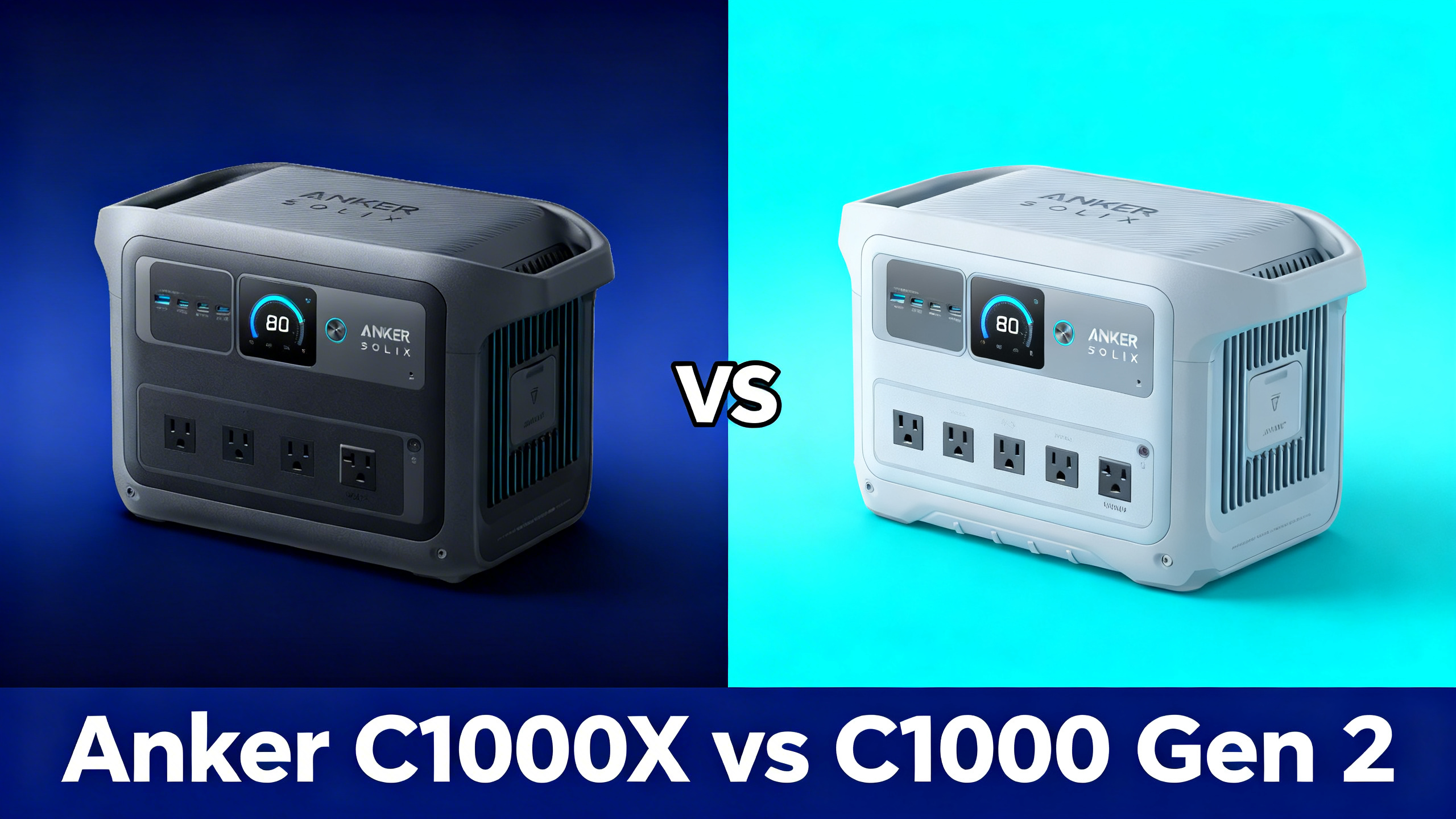
Choosing between the Anker SOLIX C1000X and the C1000 Gen 2 feels straightforward on paper: both sit around 1,024Wh, both use LiFePO4 chemistry, and both support 600W solar input. But the $399 price gap and a set of spec differences that genuinely matter make this comparison worth unpacking carefully. For a full picture of the Anker SOLIX lineup, our full Anker SOLIX brand review covers all models in detail.
Spec analysis of these two units points in a clear direction for most buyers. But the right answer depends entirely on how you plan to use your power station.

Quick Answer: Which Should You Buy?
The short answer: the C1000 Gen 2 wins for most buyers. At $499.99, it delivers 2,000W AC output (vs 1,800W on the C1000X), recharges in 49 minutes (vs 58 minutes), and rated for 4,000 cycles vs 3,000. It’s also 14% smaller and 11% lighter than comparable models in its class.
The C1000X makes sense in one specific scenario: you need expandable capacity. The C1000X is the only model of the two that supports an external expansion battery, pushing total capacity to 2,112Wh. If your power needs regularly exceed 1,000Wh, that’s a real advantage. If they don’t, the Gen 2 is the smarter buy at a significantly lower price.
Spoiler: there’s no universal winner here, but the data clearly favors the Gen 2 for everyday use cases.
Best Value
Anker SOLIX C1000 Gen 2
$499.99
- 1,024Wh | 2,000W output
- 49-min HyperFlash recharge
- 4,000 cycles / 10-year lifespan

For Expandability
Anker SOLIX C1000X
$899.00
- 1,056Wh | 1,800W output
- SurgePad: runs 2,400W loads
- Expandable to 2,112Wh
About the Anker SOLIX C1000 Gen 2
The C1000 Gen 2 is Anker’s most recent entry in the 1,000Wh class, and the specs reflect what a genuine generational update looks like. It packs 1,024Wh of LiFePO4 capacity into a form factor that is 14% smaller and 11% lighter than comparable models. The 2,000W continuous output (3,000W peak) puts it ahead of most competitors at this price point. For a deeper look at all its features, the full C1000 Gen 2 review covers charging tests, runtime data, and use-case scenarios.
What stands out most in the Gen 2’s spec sheet is the charging speed. HyperFlash technology delivers 1,600W AC input, bringing the unit from 0 to 100% in 49 minutes. That’s genuinely fast for a 1,024Wh unit. The InfiniPower battery is rated for 4,000 cycles while retaining 80% capacity, translating to a 10-year lifespan under typical use.
The unit also ships with a 10ms UPS switchover and Time-of-Use (TOU) mode via the Anker app. Both features matter for users who want seamless home backup or want to optimize electricity costs. Ten output ports cover the full range of devices most users need.
About the Anker SOLIX C1000X
The C1000X is an established workhorse in the Anker SOLIX lineup, built around a 1,056Wh LiFePO4 battery and a feature set that targets heavier off-grid and RV use. Its headline capability is SurgePad technology, which allows the unit to run loads up to 2,400W despite an 1,800W continuous output rating. For high-draw appliances like power tools, portable air conditioners, or small microwaves, that surge headroom is practical. Note that Anker has also released a refreshed version covered in the C1000X Gen 2 review, but this article focuses on the original C1000X against the Gen 2 C1000.
The C1000X’s other key differentiator is expandability. An optional external expansion battery (sold separately) pushes total system capacity to 2,112Wh. For RV users or extended off-grid stays where a single charge needs to last multiple days, this is a meaningful upgrade path that the C1000 Gen 2 simply doesn’t offer.
Battery longevity sits at 3,000 cycles, and the HyperFlash AC input reaches 100% in 58 minutes, which remains competitive. Eleven output ports give slightly more connection flexibility than the Gen 2’s ten.
Head-to-Head Specs Comparison
Comparing these two models at the spec level reveals where the $399 price gap comes from, and where the C1000 Gen 2 earns its position as the value leader.
Key Differences That Actually Matter
Output Power: 2,000W vs 1,800W
On raw output wattage, the C1000 Gen 2 leads with 2,000W continuous and a 3,000W peak, versus the C1000X’s 1,800W continuous. For most appliances, a 200W difference rarely matters in practice. A mini-fridge, laptop, TV, and phone chargers running simultaneously still fall well within both units’ limits.
Where the C1000X reclaims ground is its SurgePad technology. Published specifications confirm the C1000X can handle loads up to 2,400W via SurgePad, which covers appliances like portable air conditioners or power tools that spike above 2,000W on startup. The Gen 2’s 3,000W peak covers many scenarios too, but SurgePad offers a sustained high-draw capability that’s distinct from a simple peak rating.
Charging Speed: Who Recharges Faster?
Spec data gives a clear edge to the C1000 Gen 2 here. Its 1,600W HyperFlash input brings the unit from 0 to 100% in 49 minutes. The C1000X reaches full charge in 58 minutes via its own HyperFlash implementation. That’s a 9-minute difference, which adds up meaningfully if you’re recharging multiple times per week.
For users who depend on fast turnaround, say, charging overnight during off-peak electricity hours and running devices through the day, the Gen 2’s faster recharge is a real operational advantage.
Battery Longevity: 4,000 vs 3,000 Cycles
This is one of the most underappreciated differences in the comparison. The C1000 Gen 2’s InfiniPower battery carries a 4,000-cycle rating at 80% capacity retention. The C1000X is rated for 3,000 cycles. At one full cycle per day, that’s an additional 2.7 years of lifespan on the Gen 2.
For occasional campers, the difference may never surface in real use. For daily home backup or frequent van life use, 4,000 cycles is a meaningful long-term value advantage that offsets the Gen 2’s lower price even further.
Expandability: Only the C1000X Can Grow
The C1000X holds a clear structural advantage here. An optional Anker SOLIX C1000X expansion battery doubles total capacity to 2,112Wh, turning the system into a serious off-grid setup. The C1000 Gen 2 has no equivalent expansion pathway. Its 1,024Wh is its ceiling.

If you’re planning a week-long off-grid camping trip, powering a full-size refrigerator overnight, or running a mobile workstation all day, 2,112Wh is a qualitatively different level of capability. The C1000X’s expandability is the primary reason its $899 price tag can still make sense for the right buyer.
UPS Mode and Smart Features
The C1000 Gen 2 lists a 10ms UPS switchover, which is fast enough to protect most sensitive electronics (computers, medical devices, networking equipment) during a grid outage. The C1000X does not list a documented UPS rating in its published specifications, which is a meaningful gap for home backup use cases.
The Gen 2 also includes TOU (Time-of-Use) mode via the Anker app, allowing the unit to charge during off-peak electricity hours and discharge during peak pricing. For users with a TOU electricity plan, that’s a practical cost-saving feature. Both units offer app-based remote control via the Anker app.
Solar Charging: Both Tie at 600W
On solar charging, the two models reach parity. Both accept a maximum of 600W solar input and complete a full solar recharge in approximately 1.8 hours under optimal conditions. Panel compatibility is identical, and both units work with standard MC4-compatible solar panels.

Performance data shows no meaningful solar advantage for either model. If your primary use case is solar charging, both units perform the same. See the official C1000X product page for full solar input specifications.
Anker SOLIX Buying Guide
Map every current Anker SOLIX model to its ideal use case before you buy.
Portability and Design
Published specs confirm the C1000 Gen 2 is 14% smaller and 11% lighter than comparable models in its class. That translates to a more manageable unit for car camping, tailgating, or moving it frequently between rooms during power outages.

The C1000X is a standard-sized unit for its capacity class. It’s not heavy by power station standards, but it doesn’t match the Gen 2’s compact footprint. For users who transport their power station frequently, the Gen 2’s size reduction is a practical everyday benefit.
Who Should Buy the C1000 Gen 2?
Spec analysis points to the C1000 Gen 2 as the better fit for a wide range of buyers. The value-per-watt figure is compelling at $499.99, and its combination of fast recharge, high output, and 4,000-cycle longevity covers most use cases.
Which Model Fits You?
✅ Choose C1000 Gen 2 if…
- You want the lowest price per Wh
- You need faster recharge (49 min)
- You want TOU / UPS features
- You prioritize a longer battery lifespan (4,000 cycles)
✅ Choose C1000X if…
- You want expandable capacity (up to 2,112Wh)
- You regularly run 2,400W loads via SurgePad
- You need 11 output ports
- You want a proven workhorse for RV or camping
The C1000 Gen 2 is particularly well-suited for home backup, emergency preparedness, weekend camping, and van life where you don’t need more than 1,024Wh per charge. Its compact size also earns it a spot among the best compact power stations ranked for 2026. For detailed specs, see the official C1000 Gen 2 product page.
Who Should Buy the C1000X?
The C1000X makes a strong case for a narrower but legitimate buyer profile. If your power needs regularly push past 1,000Wh per day, the expansion battery option changes the calculus entirely. A 2,112Wh system covers multi-day off-grid scenarios that a single 1,024Wh unit can’t reliably handle.
RV users running a residential refrigerator, lighting, a CPAP, and device charging simultaneously will find the C1000X’s SurgePad and expandability more practical than the Gen 2’s raw speed advantage. The same logic applies to contractors using power tools on job sites where 2,400W surge loads are routine. The C1000X is a proven, capable workhorse for demanding use cases.
The Third Option: C1000X Gen 2 (Dark Grey)
Worth a brief mention: Anker has also released the C1000X Gen 2 in Dark Grey at $799. It bridges the gap between the original C1000X ($899) and the C1000 Gen 2 ($499.99) by combining the C1000X’s expandability with updated Gen 2 features, including HyperFlash recharging and a 10-year lifespan rating. If you want expandability but find the original C1000X price difficult to justify, the C1000X Gen 2 review covers whether that middle-ground price point holds up.

The C1000X Gen 2 Dark Grey at $799 is a compelling option if expandability matters but the original C1000X’s $899 feels like too much.
What Can 1,024Wh Actually Power?
Both units land at approximately the same usable capacity, so runtime estimates apply to either model. Based on published capacity and typical appliance draw figures, here’s what you can expect from a full charge.
What Can 1,024Wh Power?
❄️
Mini-Fridge
~17 hrs
60W avg
💻
Laptop
~14 hrs
45W draw
📺
65″ TV
~8 hrs
120W avg
😴
CPAP Machine
~40 hrs
25W avg
Runtime calculations based on 1,024Wh capacity at typical efficiency. Actual results vary with load.
Anker SOLIX C1000 Gen 2
$499.99
Best value 1,024Wh power station in 2026
Price verified April 2026. Free shipping available
Final Verdict
The anker solix c1000 vs c1000x comparison resolves clearly for most buyers. Spec analysis confirms the C1000 Gen 2 delivers more value at $499.99: faster recharge, higher output, longer cycle life, and a more compact form factor. For weekend campers, home backup users, van lifers, and anyone who doesn’t need more than 1,024Wh, the Gen 2 is the right call.
The C1000X earns its place for buyers who need the expansion battery pathway or who regularly run 2,400W loads via SurgePad. At $899, it’s a harder sell against the Gen 2 unless one of those specific capabilities applies to your situation. Buyers upgrading from the original C1000 should also read our C1000 generational comparison to understand exactly what changed.
If you are still weighing models beyond these two, our complete Anker SOLIX buying guide maps every current model to its ideal use case. And for the full picture of where both models sit in the broader lineup, the full Anker SOLIX brand review covers the entire portfolio in detail.
Frequently Asked Questions
What is the difference between the Anker SOLIX C1000X and the C1000 Gen 2?
The C1000X offers 1,056Wh capacity, 1,800W AC output with SurgePad (2,400W surge support), and expandable capacity up to 2,112Wh via an external battery. The C1000 Gen 2 offers 1,024Wh, a higher 2,000W AC output (3,000W peak), faster 49-minute HyperFlash recharge, 4,000 battery cycles, and is 14% smaller. The Gen 2 focuses on speed and longevity; the C1000X focuses on expandability and high surge loads.
Is the Anker SOLIX C1000 Gen 2 worth the upgrade from the C1000X?
For users who do not need the expansion battery, spec analysis confirms the C1000 Gen 2 delivers more output wattage, faster recharging, and a longer battery lifespan at a lower price point. Published specifications indicate a clear efficiency advantage for the Gen 2 in everyday use scenarios.
Can the Anker SOLIX C1000 Gen 2 run a CPAP machine?
Runtime calculations based on 1,024Wh capacity show the C1000 Gen 2 can power a CPAP machine (approximately 25W average draw) for around 40 hours. The 10ms UPS switchover ensures seamless transition during power outages, protecting sensitive medical equipment.
Which has better solar charging, the C1000X or C1000 Gen 2?
Both units support a maximum of 600W solar input and reach a full solar recharge in approximately 1.8 hours under optimal conditions. Performance data shows no meaningful difference in solar charging between the two models.
Is there a newer version of the C1000X?
Yes. Anker has released the C1000X Gen 2 in Dark Grey at $799, which incorporates updated Gen 2 features including HyperFlash recharging and a 10-year lifespan rating. It bridges the gap between the original C1000X ($899) and the C1000 Gen 2 ($499.99).
Originally published: April 6, 2026