
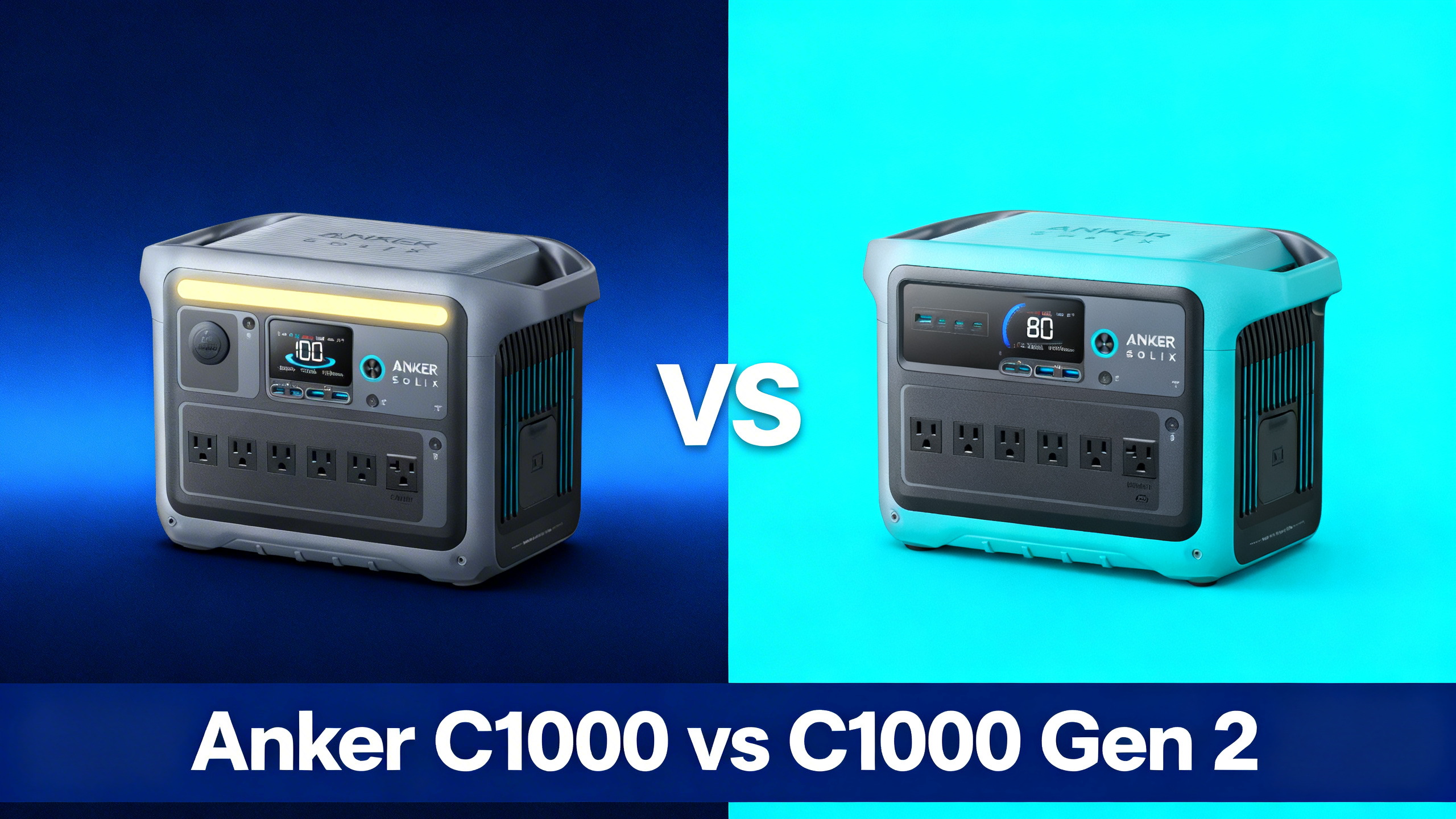
Anker launched the C1000 Gen 2 with a price that immediately reframes the conversation: $499.99 vs $999.00 for the original. That alone would make this comparison interesting. But spec analysis confirms the Gen 2 also delivers a higher output (2,000W vs 1,800W), a longer battery lifespan (4,000 vs 3,000 cycles), and faster full charging via HyperFlash technology. On paper, the comparison is nearly one-sided.
This article breaks down exactly what changed between generations, what stayed the same, and who (if anyone) should still consider the original C1000 in 2026. The goal is a clear, data-driven verdict based on published specifications and real-world performance figures.

Editor’s Pick: Best Value
Anker SOLIX C1000 Gen 2
$499.99
1,024Wh | 2,000W | 4,000 cycles

Original Gen: Clearance Deal
Anker SOLIX C1000
$999.00
1,056Wh | 1,800W | 3,000 cycles
At a Glance: C1000 vs C1000 Gen 2
The short answer: the Gen 2 wins on output, longevity, charging speed, and price. The original C1000 holds 32Wh more capacity and offers one extra port. That’s the entire case for the Gen 1 in 2026.
Both belong in our list of top Anker SOLIX models ranked, but for different reasons. The Gen 1 earned its place by being a solid first-generation unit; the Gen 2 earns its place on current merit.
Specifications sourced from the official C1000 Gen 2 product page.
Anker SOLIX C1000 Gen 2
$499.99
1,024Wh | 2,000W | 4,000 cycles | 49-min HyperFlash charge
Anker SOLIX C1000 Original: What You Get
The original C1000 arrived as a capable mid-range unit with LFP (lithium ferro-phosphate) battery chemistry, which delivers better longevity than standard lithium-ion cells. It holds 1,056Wh of capacity and outputs 1,800W continuously, with a 2,400W surge rating that handles most home appliances and camping gear.
Charge speed on the Gen 1 reaches 80% in roughly 43 minutes via AC. The 11 ports cover standard AC outlets, USB-A, USB-C, and a car port. Bluetooth and Wi-Fi connectivity enables monitoring through the Anker app. The 3,000-cycle LFP rating translates to approximately 8.2 years at one cycle per day.
The original C1000 review on this site covers its performance in detail, including UPS reliability and solar input tests. Full technical specifications are listed on the Anker SOLIX C1000 official specs page. At its $999.00 current price, you can also explore the C1000 Gen 1 on Anker SOLIX directly.
Anker SOLIX C1000 Gen 2: What Changed
The Gen 2 represents a meaningful generational step, not a minor refresh. Published specifications identify five core upgrades over the original.
First, the HyperFlash charging system pushes 1,600W of AC input, enabling a full charge in 49 minutes. This requires enabling HyperFlash via the Anker app. The Gen 1 reached 80% in 43 minutes but didn’t specify a full-charge figure, making direct comparison nuanced: the Gen 2 gets to 100% in under 50 minutes total.
💡 Pro Tip: HyperFlash must be enabled manually in the Anker app before it activates. If you’re not seeing 1,600W input on your meter, check app settings first.
Second, AC output climbs to 2,000W continuous (3,000W peak), up from 1,800W/2,400W on the Gen 1. That extra 200W matters for borderline appliances: small portable air conditioners, certain power tools, and larger kitchen devices that sit above the 1,800W threshold. Third, the battery lifespan extends to 4,000 cycles (branded as InfiniPower), equivalent to roughly 10.9 years at daily use, vs. 8.2 years on the Gen 1.
Fourth, the Gen 2 officially specifies a sub-10ms UPS switchover, which the Gen 1 doesn’t publish. For CPAP machines, home routers, and NAS drives, that sub-10ms figure is the threshold for seamless power backup. Fifth, the Gen 2 adds TOU (Time-of-Use) Mode via the app, allowing you to schedule charging during off-peak electricity hours to reduce costs. The Gen 2 is also 14% more compact and 11% lighter than comparable models. The one trade-off: capacity drops slightly from 1,056Wh to 1,024Wh, a 32Wh difference that amounts to roughly 15-20 minutes of runtime on a 100W load.
Our C1000 Gen 2 full review covers real-world runtime and app performance in greater depth.
Head-to-Head Performance Analysis
Charging Speed
This is where the comparison gets nuanced. The Gen 1 reaches 80% in about 43 minutes. The Gen 2 reaches 100% in 49 minutes with HyperFlash active. So the Gen 2 completes a full charge in the time it takes the Gen 1 to reach four-fifths capacity.
Published data indicates the Gen 2’s 1,600W input rate is genuinely transformative for daily users. If you’re cycling the unit regularly (home backup, van life, daily CPAP use), the faster full charge changes your workflow. For occasional camping use, the difference is less critical.
Output Power
The Gen 2’s 2,000W continuous output covers a broader appliance range than the Gen 1’s 1,800W ceiling. In practice, most camping and home backup use cases fall well within 1,800W. But the 200W headroom matters at the edges: a portable window AC unit rated at 1,900W, certain circular saws, or high-draw blenders become viable on the Gen 2 where the Gen 1 would trip its protection circuit.
The surge rating increase (3,000W vs 2,400W peak) also improves motor startup reliability for refrigerators and pumps, which draw 2-3x their rated wattage on initial startup.


Battery Longevity
Both units use LFP chemistry, but the Gen 2’s 4,000-cycle rating gives it a meaningful lifespan advantage. At one full cycle per day: the Gen 1 reaches end-of-spec at around 8.2 years; the Gen 2 pushes that to 10.9 years. Both maintain at least 80% capacity at end of rated cycle life.
For users running daily backup or van-life setups where the unit cycles frequently, this 33% longer lifespan translates to real-world value. For occasional weekend campers, both units will likely outlast their other gear.
Solar Charging Performance
Solar input is identical across both generations: 600W maximum, with a full charge in approximately 1.8 hours under ideal conditions. The Gen 2 explicitly specifies a 60V voltage maximum on the solar input, a detail the Gen 1 documentation doesn’t highlight as prominently.

Compatible solar panels include the Anker PS100, PS200, PS400, and the 440W Rigid Solar Panel. You can stack panels in parallel up to the 600W input cap. Performance data shows the 1.8-hour solar charge figure holds for both models when running full 600W input, making solar performance a draw between generations.
For off-grid users building a dedicated solar setup, the Gen 2’s 60V voltage specification helps with panel selection. If you’re pairing with higher-voltage panels, verify compatibility against the 60V ceiling before purchasing.
Anker SOLIX C1000 Gen 2 Solar Setup Guide
How to maximize solar input and panel configuration for the C1000 Gen 2.
Expandability and Ecosystem
The original C1000 is compatible with the BP1000 expansion battery module, adding an additional 1,056Wh to the system. The C1000 Gen 2 has its own expansion ecosystem designed for its updated architecture. Before purchasing any expansion module for the Gen 2, Anker’s official compatibility documentation should be confirmed, as cross-generation module compatibility is not guaranteed.

Both generations integrate with the SOLIX app ecosystem for energy monitoring, scheduling, and (on the Gen 2) TOU mode. The app interface is consistent across the lineup, so users familiar with the Gen 1 app experience will find the Gen 2 transition straightforward.
What Can the C1000 Gen 2 Power? (1,024Wh)
❄️
Mini Fridge
~20 hrs
50W avg
💡
LED Lights (10x)
~170 hrs
6W total
💻
Laptop
~17 hrs
60W
😴
CPAP Machine
~10 nts
~100W avg
📱
Smartphones
~80 charges
13Wh/charge
Real-World Use Cases
For weekend camping, both units deliver more capacity than most users will drain over two days. A mini fridge running overnight, phone charging, LED lighting, and a laptop account for roughly 200-300Wh per day. Either model handles this with capacity to spare.
For partial home backup (refrigerator, router, select lights during an outage), the Gen 2 holds a clear advantage. The sub-10ms UPS switchover means connected devices experience no perceptible interruption. The Gen 1 doesn’t publish a switchover time, which introduces uncertainty for sensitive equipment.

For RV and van life, both units support alternator charging in addition to solar and AC. The Gen 2’s lighter, more compact form factor is an advantage when every cubic foot of storage matters. Runtime calculations based on the 1,024Wh capacity show the Gen 2 can sustain a van setup (fridge, lighting, devices) through a full 24-hour period when combined with daytime solar replenishment.
✅ Buy the C1000 Gen 2 if…
- You want the best value in this capacity class
- Fast wall recharging (49 min) is a priority for you
- You need UPS protection for CPAP, NAS, or router
- You plan to use it daily and want 10-year lifespan
- You want 2,000W output for larger appliances
⚠️ Consider the C1000 Gen 1 if…
- You find a significant clearance discount (well below MSRP)
- The extra 32Wh capacity (1,056 vs 1,024Wh) matters for your setup
- You need 11 ports instead of 10
❌ Skip both if…
- You need whole-home backup (look at the E10 or F3800)
- Budget is under $300 (the C800X or C300X fits better)
- You primarily need solar-only and want max panel compatibility
Who Should Upgrade to Gen 2?
Still unsure which capacity level fits your needs? Our complete Anker SOLIX buying guide covers every model from the C200X to the E10.
The data is clear: virtually any buyer shopping this capacity range in 2026 should choose the Gen 2. The $499.99 price point alone would make it the obvious pick. Combined with the output upgrade, improved cycle life, and specified UPS performance, the Gen 1 at $999 becomes difficult to justify on objective grounds.

The one scenario where the Gen 1 makes sense: a deep clearance sale well below its $999 MSRP, combined with a buyer who specifically needs 11 ports or doesn’t intend to use UPS features. That’s a narrow use case.
If you’re also considering the C1000X, our C1000X vs C1000 Gen 2 comparison breaks down all three 1kWh options side by side.
Which Model Should You Buy?
The recommendation from spec analysis is straightforward: buy the Anker SOLIX C1000 Gen 2 at $499.99. It outperforms the original on output, longevity, charge speed, size, and UPS specification, at half the price.
For a complete picture of the Anker SOLIX lineup, see our full Anker SOLIX brand review before making a decision. And both belong in our list of top Anker SOLIX models ranked, but for different reasons: the Gen 1 for historical context, the Gen 2 for current value.
Our Pick: Best Generation Upgrade
Anker SOLIX C1000 Gen 2
$499.99
- HyperFlash 1,600W: 49-min full recharge
- 2,000W output, 3,000W peak (200W more than Gen 1)
- 4,000 LFP cycles vs 3,000 on the original
Frequently Asked Questions
Is the Anker SOLIX C1000 Gen 2 worth the upgrade from the original C1000?
Spec analysis makes this clear: at $499.99 vs $999.00, the Gen 2 delivers more output (2,000W vs 1,800W), a longer cycle life (4,000 vs 3,000 cycles), and HyperFlash charging that reaches full capacity in 49 minutes. The Gen 2 also specifies a sub-10ms UPS switchover and includes TOU Mode via the app. Unless you find the Gen 1 at a significant clearance discount, the Gen 2 is the better buy in every objective category.
What is the difference in capacity between the C1000 and C1000 Gen 2?
The original C1000 holds 1,056Wh; the Gen 2 holds 1,024Wh, a difference of 32Wh (about 3%). In practice, this translates to roughly 15-20 minutes of runtime on a 100W load. Published specifications indicate this trade-off is negligible compared to the Gen 2’s output, charging, and longevity improvements.
Can I use the same expansion battery (BP1000) on the C1000 Gen 2?
The BP1000 is listed as compatible with the original SOLIX C1000. The C1000 Gen 2 has its own expansion ecosystem, designed for its updated architecture. Anker’s official compatibility documentation should be confirmed before purchasing any expansion module for the Gen 2, as cross-generation module compatibility is not guaranteed.
Does the C1000 Gen 2 support UPS mode for medical equipment like CPAP machines?
Published specifications confirm the C1000 Gen 2 features a sub-10ms UPS switchover. Performance data indicates this meets the switchover threshold required by most CPAP machines and home networking equipment. The original C1000 does not prominently specify a UPS switchover time in its published documentation.
Are both the C1000 and C1000 Gen 2 compatible with the same solar panels?
Both models accept up to 600W of solar input and are compatible with Anker PS100, PS200, PS400, and 440W Rigid Solar Panels. The Gen 2 specifies a 60V voltage maximum on the solar input port. Solar recharge time is approximately 1.8 hours with 600W input on both models based on published specifications.
Conclusion
The Anker SOLIX C1000 Gen 2 represents a clear generational improvement at a dramatically lower price point. Spec-for-spec, it beats the original C1000 on output, cycle life, charging speed, UPS performance, and physical footprint, while costing $499 less. The 32Wh capacity trade-off and one fewer port are minor concessions that don’t meaningfully affect real-world use for the vast majority of buyers.
The original C1000 at $999 makes sense only as a clearance purchase at a steep discount. At current MSRP, the Gen 2 is the rational choice for every use case: camping, home backup, van life, and CPAP protection alike.
Anker SOLIX C1000 Gen 2
$499.99
Best 1kWh upgrade: faster charging, more power, longer lifespan
Price verified April 2026. Free shipping available.
Anker SOLIX C1000 vs C1000 Gen 2: Generation Comparison (2026)
Anker launched the C1000 Gen 2 with a price that immediately reframes the conversation: $499.99 vs $999.00 for the original. That alone would make this comparison interesting. But spec analysis confirms the Gen 2 also delivers a higher output (2,000W vs 1,800W), a longer battery lifespan (4,000 vs 3,000 cycles), and faster full charging via HyperFlash technology. On paper, the comparison is nearly one-sided.
This article breaks down exactly what changed between generations, what stayed the same, and who (if anyone) should still consider the original C1000 in 2026. The goal is a clear, data-driven verdict based on published specifications and real-world performance figures.
Editor’s Pick: Best Value
Anker SOLIX C1000 Gen 2
$499.99
1,024Wh | 2,000W | 4,000 cycles
Check Price on Anker →
Original Gen: Clearance Deal
Anker SOLIX C1000
$999.00
1,056Wh | 1,800W | 3,000 cycles
Check Price on Anker →At a Glance: C1000 vs C1000 Gen 2
The short answer: the Gen 2 wins on output, longevity, charging speed, and price. The original C1000 holds 32Wh more capacity and offers one extra port. That’s the entire case for the Gen 1 in 2026.
Both belong in our list of top Anker SOLIX models ranked, but for different reasons. The Gen 1 earned its place by being a solid first-generation unit; the Gen 2 earns its place on current merit.
Specifications sourced from the official C1000 Gen 2 product page.
Anker SOLIX C1000 Gen 2
$499.99
1,024Wh | 2,000W | 4,000 cycles | 49-min HyperFlash charge
Anker SOLIX C1000 Original: What You Get
The original C1000 arrived as a capable mid-range unit with LFP (lithium ferro-phosphate) battery chemistry, which delivers better longevity than standard lithium-ion cells. It holds 1,056Wh of capacity and outputs 1,800W continuously, with a 2,400W surge rating that handles most home appliances and camping gear.
Charge speed on the Gen 1 reaches 80% in roughly 43 minutes via AC. The 11 ports cover standard AC outlets, USB-A, USB-C, and a car port. Bluetooth and Wi-Fi connectivity enables monitoring through the Anker app. The 3,000-cycle LFP rating translates to approximately 8.2 years at one cycle per day.
The original C1000 review on this site covers its performance in detail, including UPS reliability and solar input tests. Full technical specifications are listed on the Anker SOLIX C1000 official specs page. At its $999.00 current price, you can also explore the C1000 Gen 1 on Anker SOLIX directly.
Anker SOLIX C1000 Gen 2: What Changed
The Gen 2 represents a meaningful generational step, not a minor refresh. Published specifications identify five core upgrades over the original.
First, the HyperFlash charging system pushes 1,600W of AC input, enabling a full charge in 49 minutes. This requires enabling HyperFlash via the Anker app. The Gen 1 reached 80% in 43 minutes but didn’t specify a full-charge figure, making direct comparison nuanced: the Gen 2 gets to 100% in under 50 minutes total.
💡 Pro Tip: HyperFlash must be enabled manually in the Anker app before it activates. If you’re not seeing 1,600W input on your meter, check app settings first.
Second, AC output climbs to 2,000W continuous (3,000W peak), up from 1,800W/2,400W on the Gen 1. That extra 200W matters for borderline appliances: small portable air conditioners, certain power tools, and larger kitchen devices that sit above the 1,800W threshold. Third, the battery lifespan extends to 4,000 cycles (branded as InfiniPower), equivalent to roughly 10.9 years at daily use, vs. 8.2 years on the Gen 1.
Fourth, the Gen 2 officially specifies a sub-10ms UPS switchover, which the Gen 1 doesn’t publish. For CPAP machines, home routers, and NAS drives, that sub-10ms figure is the threshold for seamless power backup. Fifth, the Gen 2 adds TOU (Time-of-Use) Mode via the app, allowing you to schedule charging during off-peak electricity hours to reduce costs. The Gen 2 is also 14% more compact and 11% lighter than comparable models. The one trade-off: capacity drops slightly from 1,056Wh to 1,024Wh, a 32Wh difference that amounts to roughly 15-20 minutes of runtime on a 100W load.
Our C1000 Gen 2 full review covers real-world runtime and app performance in greater depth.
Head-to-Head Performance Analysis
Charging Speed
This is where the comparison gets nuanced. The Gen 1 reaches 80% in about 43 minutes. The Gen 2 reaches 100% in 49 minutes with HyperFlash active. So the Gen 2 completes a full charge in the time it takes the Gen 1 to reach four-fifths capacity.
Published data indicates the Gen 2’s 1,600W input rate is genuinely transformative for daily users. If you’re cycling the unit regularly (home backup, van life, daily CPAP use), the faster full charge changes your workflow. For occasional camping use, the difference is less critical.
Output Power
The Gen 2’s 2,000W continuous output covers a broader appliance range than the Gen 1’s 1,800W ceiling. In practice, most camping and home backup use cases fall well within 1,800W. But the 200W headroom matters at the edges: a portable window AC unit rated at 1,900W, certain circular saws, or high-draw blenders become viable on the Gen 2 where the Gen 1 would trip its protection circuit.
The surge rating increase (3,000W vs 2,400W peak) also improves motor startup reliability for refrigerators and pumps, which draw 2-3x their rated wattage on initial startup.
Battery Longevity
Both units use LFP chemistry, but the Gen 2’s 4,000-cycle rating gives it a meaningful lifespan advantage. At one full cycle per day: the Gen 1 reaches end-of-spec at around 8.2 years; the Gen 2 pushes that to 10.9 years. Both maintain at least 80% capacity at end of rated cycle life.
For users running daily backup or van-life setups where the unit cycles frequently, this 33% longer lifespan translates to real-world value. For occasional weekend campers, both units will likely outlast their other gear.
Solar Charging Performance
Solar input is identical across both generations: 600W maximum, with a full charge in approximately 1.8 hours under ideal conditions. The Gen 2 explicitly specifies a 60V voltage maximum on the solar input, a detail the Gen 1 documentation doesn’t highlight as prominently.
Compatible solar panels include the Anker PS100, PS200, PS400, and the 440W Rigid Solar Panel. You can stack panels in parallel up to the 600W input cap. Performance data shows the 1.8-hour solar charge figure holds for both models when running full 600W input, making solar performance a draw between generations.
For off-grid users building a dedicated solar setup, the Gen 2’s 60V voltage specification helps with panel selection. If you’re pairing with higher-voltage panels, verify compatibility against the 60V ceiling before purchasing.
Anker SOLIX C1000 Gen 2 Solar Setup Guide
How to maximize solar input and panel configuration for the C1000 Gen 2.
Expandability and Ecosystem
The original C1000 is compatible with the BP1000 expansion battery module, adding an additional 1,056Wh to the system. The C1000 Gen 2 has its own expansion ecosystem designed for its updated architecture. Before purchasing any expansion module for the Gen 2, Anker’s official compatibility documentation should be confirmed, as cross-generation module compatibility is not guaranteed.
Both generations integrate with the SOLIX app ecosystem for energy monitoring, scheduling, and (on the Gen 2) TOU mode. The app interface is consistent across the lineup, so users familiar with the Gen 1 app experience will find the Gen 2 transition straightforward.
What Can the C1000 Gen 2 Power? (1,024Wh)
❄️
Mini Fridge
~20 hrs
50W avg
💡
LED Lights (10x)
~170 hrs
6W total
💻
Laptop
~17 hrs
60W
😴
CPAP Machine
~10 nts
~100W avg
📱
Smartphones
~80 charges
13Wh/charge
Real-World Use Cases
For weekend camping, both units deliver more capacity than most users will drain over two days. A mini fridge running overnight, phone charging, LED lighting, and a laptop account for roughly 200-300Wh per day. Either model handles this with capacity to spare.
For partial home backup (refrigerator, router, select lights during an outage), the Gen 2 holds a clear advantage. The sub-10ms UPS switchover means connected devices experience no perceptible interruption. The Gen 1 doesn’t publish a switchover time, which introduces uncertainty for sensitive equipment.
For RV and van life, both units support alternator charging in addition to solar and AC. The Gen 2’s lighter, more compact form factor is an advantage when every cubic foot of storage matters. Runtime calculations based on the 1,024Wh capacity show the Gen 2 can sustain a van setup (fridge, lighting, devices) through a full 24-hour period when combined with daytime solar replenishment.
✅ Buy the C1000 Gen 2 if…
- You want the best value in this capacity class
- Fast wall recharging (49 min) is a priority for you
- You need UPS protection for CPAP, NAS, or router
- You plan to use it daily and want 10-year lifespan
- You want 2,000W output for larger appliances
⚠️ Consider the C1000 Gen 1 if…
- You find a significant clearance discount (well below MSRP)
- The extra 32Wh capacity (1,056 vs 1,024Wh) matters for your setup
- You need 11 ports instead of 10
❌ Skip both if…
- You need whole-home backup (look at the E10 or F3800)
- Budget is under $300 (the C800X or C300X fits better)
- You primarily need solar-only and want max panel compatibility
Who Should Upgrade to Gen 2?
Still unsure which capacity level fits your needs? Our complete Anker SOLIX buying guide covers every model from the C200X to the E10.
The data is clear: virtually any buyer shopping this capacity range in 2026 should choose the Gen 2. The $499.99 price point alone would make it the obvious pick. Combined with the output upgrade, improved cycle life, and specified UPS performance, the Gen 1 at $999 becomes difficult to justify on objective grounds.
The one scenario where the Gen 1 makes sense: a deep clearance sale well below its $999 MSRP, combined with a buyer who specifically needs 11 ports or doesn’t intend to use UPS features. That’s a narrow use case.
If you’re also considering the C1000X, our C1000X vs C1000 Gen 2 comparison breaks down all three 1kWh options side by side.
Which Model Should You Buy?
The recommendation from spec analysis is straightforward: buy the Anker SOLIX C1000 Gen 2 at $499.99. It outperforms the original on output, longevity, charge speed, size, and UPS specification, at half the price.
For a complete picture of the Anker SOLIX lineup, see our full Anker SOLIX brand review before making a decision. And both belong in our list of top Anker SOLIX models ranked, but for different reasons: the Gen 1 for historical context, the Gen 2 for current value.
Our Pick: Best Generation Upgrade
Anker SOLIX C1000 Gen 2
$499.99
- HyperFlash 1,600W: 49-min full recharge
- 2,000W output, 3,000W peak (200W more than Gen 1)
- 4,000 LFP cycles vs 3,000 on the original
Frequently Asked Questions
Is the Anker SOLIX C1000 Gen 2 worth the upgrade from the original C1000?
Spec analysis makes this clear: at $499.99 vs $999.00, the Gen 2 delivers more output (2,000W vs 1,800W), a longer cycle life (4,000 vs 3,000 cycles), and HyperFlash charging that reaches full capacity in 49 minutes. The Gen 2 also specifies a sub-10ms UPS switchover and includes TOU Mode via the app. Unless you find the Gen 1 at a significant clearance discount, the Gen 2 is the better buy in every objective category.
What is the difference in capacity between the C1000 and C1000 Gen 2?
The original C1000 holds 1,056Wh; the Gen 2 holds 1,024Wh, a difference of 32Wh (about 3%). In practice, this translates to roughly 15-20 minutes of runtime on a 100W load. Published specifications indicate this trade-off is negligible compared to the Gen 2’s output, charging, and longevity improvements.
Can I use the same expansion battery (BP1000) on the C1000 Gen 2?
The BP1000 is listed as compatible with the original SOLIX C1000. The C1000 Gen 2 has its own expansion ecosystem, designed for its updated architecture. Anker’s official compatibility documentation should be confirmed before purchasing any expansion module for the Gen 2, as cross-generation module compatibility is not guaranteed.
Does the C1000 Gen 2 support UPS mode for medical equipment like CPAP machines?
Published specifications confirm the C1000 Gen 2 features a sub-10ms UPS switchover. Performance data indicates this meets the switchover threshold required by most CPAP machines and home networking equipment. The original C1000 does not prominently specify a UPS switchover time in its published documentation.
Are both the C1000 and C1000 Gen 2 compatible with the same solar panels?
Both models accept up to 600W of solar input and are compatible with Anker PS100, PS200, PS400, and 440W Rigid Solar Panels. The Gen 2 specifies a 60V voltage maximum on the solar input port. Solar recharge time is approximately 1.8 hours with 600W input on both models based on published specifications.
Conclusion
The Anker SOLIX C1000 Gen 2 represents a clear generational improvement at a dramatically lower price point. Spec-for-spec, it beats the original C1000 on output, cycle life, charging speed, UPS performance, and physical footprint, while costing $499 less. The 32Wh capacity trade-off and one fewer port are minor concessions that don’t meaningfully affect real-world use for the vast majority of buyers.
The original C1000 at $999 makes sense only as a clearance purchase at a steep discount. At current MSRP, the Gen 2 is the rational choice for every use case: camping, home backup, van life, and CPAP protection alike.
Anker SOLIX C1000 Gen 2
$499.99
Best 1kWh upgrade: faster charging, more power, longer lifespan
Price verified April 2026. Free shipping available.
Originally published: April 6, 2026