
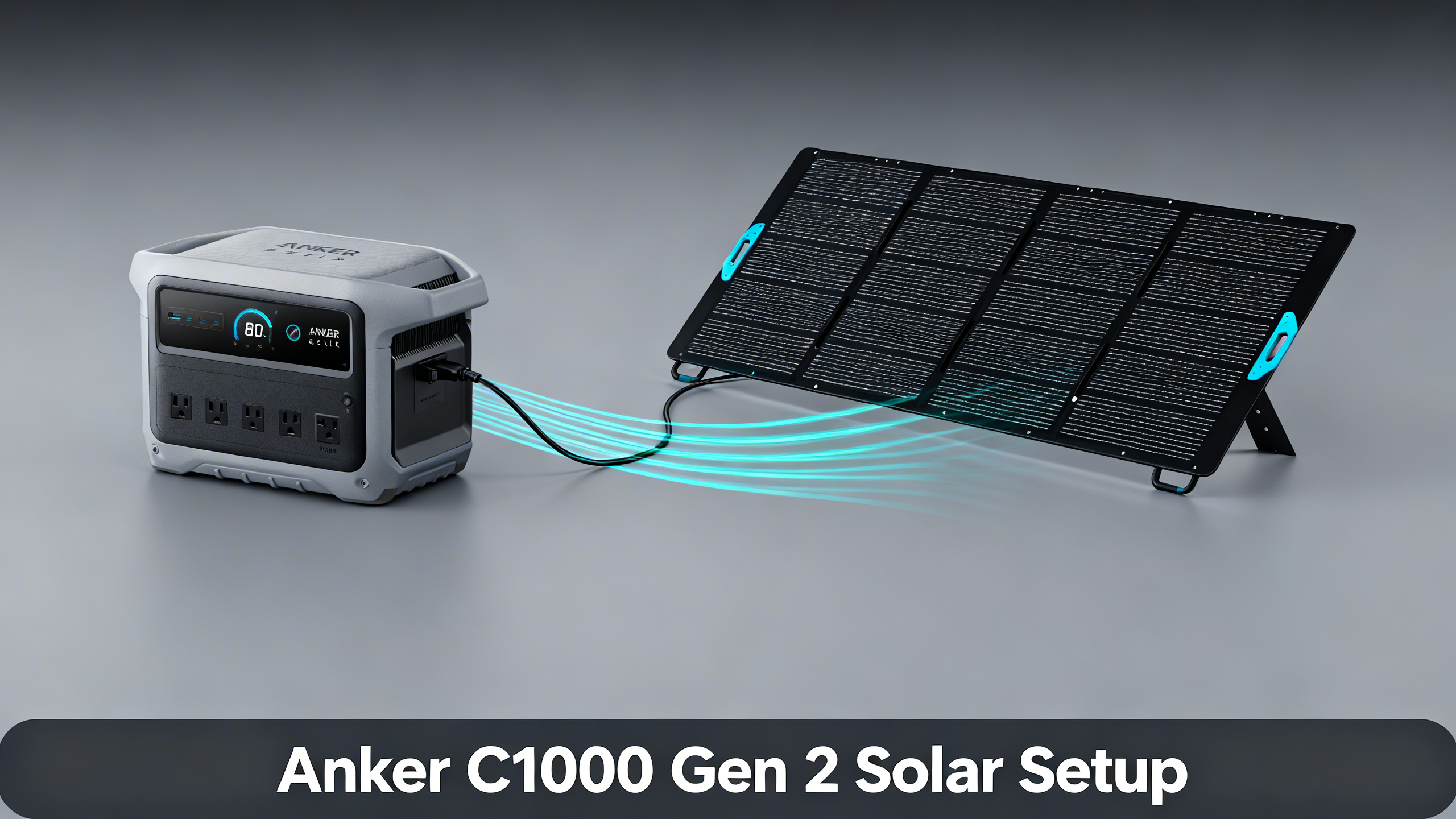
Not sure which solar panel pairs best with your Anker SOLIX C1000 Gen 2? The station accepts up to 600W of solar input, but choosing the right panel (or combination) depends on your use case, your budget, and how fast you actually need to recharge. This guide covers every compatible Anker SOLIX panel, calculates real charge times, and explains the wiring rules you need to know before connecting anything.
If you want to assess whether this station fits your needs before committing to a solar setup, the C1000 Gen 2 full review covers performance in detail. Otherwise, let’s get into the solar specifics.

Anker SOLIX C1000 Gen 2
$499.99
- 1,024Wh capacity, 2,000W AC output
- 600W max solar input, 49 min HyperFlash recharge
- LiFePO4 chemistry, 10 output ports
Anker SOLIX C1000 Gen 2 Key Specs: What Solar Can It Accept?
Before picking a panel, you need to understand two hard limits the C1000 Gen 2 imposes: a maximum of 600W input and a maximum of 60V. The wattage cap is handled by the MPPT controller, which throttles any input above 600W. The voltage limit is a hard electrical boundary: exceed it and you risk damaging the charge controller permanently.
What this means in practice: you can stack panels to reach 600W, but the wiring configuration matters. Series connections add voltage; parallel connections add amperage. Keep that distinction in mind as you read through the options below.
See the official C1000 Gen 2 specifications for complete technical documentation. For a broader look at the complete product lineup, the full Anker SOLIX brand review covers all current models and how they compare.
Every Compatible Solar Panel: Charge Times Compared
Anker SOLIX makes several panels that work with the C1000 Gen 2, ranging from the portable 200W PS200 up to a 440W rigid bifacial panel built for permanent installs. Charge time calculations below are based on the 1,024Wh capacity at approximately 85% efficiency under ideal conditions.
Anker SOLIX PS200 (200W): The Versatile All-Rounder
At $499.99 and 200W output, the PS200 is the panel most C1000 Gen 2 owners should start with. Charge time calculations indicate roughly 5.5 to 6 hours to fill the C1000 Gen 2 from empty under good sun, which makes solar viable as a primary recharge method rather than just a top-up. It handles daily campsite and van-life recharging comfortably without any multi-panel wiring to manage.

The IP67 rating and fold-and-go design make it genuinely portable despite the higher output, and the 23% monocrystalline cells hold up well in less-than-perfect light. If you want one panel that covers most real-world charging without fuss, it’s the sweet spot. Check the current price on the PS200 if versatility is your main criterion.
On a Tight Budget? Start With the PS200
Anker no longer sells a current 100W foldable panel for this class of station, so budget-minded buyers who want serious solar charging should step up to the 200W PS200 rather than hunt for a smaller unit. It costs a little more up front but roughly halves your recharge time and remains the cheapest panel that can realistically refill the C1000 Gen 2 within a single day of sun.

Four adjustable angles and IP67 waterproofing come standard, and the 23% monocrystalline efficiency is competitive for a portable foldable panel. For budget-conscious buyers doing occasional weekend camping where AC is available at home between trips, it’s the most sensible entry point. Check the PS200 price here.
PS200 vs PS400: Which Single Panel?
At $499.99, the PS200 delivers roughly 5.5 to 6 hours to full from empty, comfortably within a single day of good sun. The PS400 halves that again to around 3 hours, but it costs $899. Whether the extra speed is worth the premium comes down to how often you start a day from a fully drained battery.

The PS200 carries an IP67 rating and 4-angle adjustability and is fully compatible across the SOLIX lineup. For regular campers and weekend van lifers who don’t want to manage multi-panel wiring, it’s the most versatile single-panel option. Step up to the PS400 only if you routinely need a full recharge inside a morning.
Anker SOLIX PS400 (400W): Maximum Single-Panel Speed
The PS400 at $899 is the fastest portable single-panel solution available for the C1000 Gen 2. Charge time calculations based on 400W output and 1,024Wh capacity indicate approximately 2.8 to 3 hours under full sun. That’s a complete recharge cycle within a morning of good weather.

The 23% monocrystalline efficiency and IP67 protection are consistent with the rest of the SOLIX panel lineup. For van lifers and off-grid users who rely on the C1000 Gen 2 daily, the PS400 is the practical all-in-one answer: one panel, one cable, fast turnaround. Check the PS400 price here.
C1000 Gen 2 Solar Charge Times : 1,024Wh Capacity
Estimates based on 1,024Wh capacity at ~85% efficiency under ideal conditions. Real-world times vary with cloud cover, temperature, and angle.
Multi-Panel Configurations: How to Hit the 600W Cap
If a single panel isn’t fast enough for your use case, combining panels is the path to the full 600W input. There are three practical multi-panel setups worth considering for the C1000 Gen 2.
PS400 + PS200 in Parallel: The Fastest Portable Combo
Combining the PS400 (400W) and PS200 (200W) in parallel delivers 600W nominal, hitting the C1000 Gen 2’s maximum solar input cap. Charge time calculations indicate approximately 1h45 to 2 hours under full sun conditions. This is the most efficient portable setup you can run with Anker SOLIX panels. Use a Y-branch (parallel combiner) cable rated for at least 20A: positives join together, negatives join together, voltage stays at single-panel level, and the currents add up. Do not wire these two panels in series. Their open-circuit voltages stack to roughly 96V, far above the 60V input limit, and that can permanently destroy the charge controller.


2x PS200 in Parallel: Balanced Budget Option
Two PS200 panels wired in parallel deliver 400W total at roughly the same recharge time as a single PS400 (around 3 hours). The advantage is that parallel wiring keeps voltage identical to a single panel, so there’s no voltage math to worry about. The tradeoff is cost: two PS200 panels at $499.99 each runs to about $1,000, compared to $899 for a single PS400 that delivers the same output. The parallel option makes more sense if you already own a PS200 and want to add capacity incrementally.
2x 440W Rigid Panels: For Semi-Permanent Setups
Two 440W rigid panels generate 880W nominal, but the C1000 Gen 2’s MPPT controller caps input at 600W regardless. The benefit of oversizing isn’t speed (charge time is identical to the PS400 + PS200 combo), it’s resilience: with 47% excess capacity, performance remains strong even at suboptimal panel angles, partial cloud cover, or cooler temperatures that reduce efficiency.

The 440W rigid panels are bifacial (up to 30% additional rear-side gain), rated IP68, and backed by a 10-year panel warranty plus a 30-year linear performance guarantee. They’re designed for RV rooftops, ground mounts, or any semi-permanent installation where portability isn’t a factor. For a mobile setup, the PS400 wins on practicality. For a stationary install, these panels offer considerably better long-term durability. Check the 440W Rigid Panel 2-pack pricing here.
Wiring Guide: Series vs Parallel for the C1000 Gen 2
Getting the wiring right is the most important step in any multi-panel setup. The key distinction is this: series wiring adds voltage, while parallel wiring adds amperage. Both increase total wattage, but they do it differently, and the voltage limit on the C1000 Gen 2 makes this distinction critical.
In a series configuration, you connect the positive terminal of one panel to the negative terminal of the next. Voltages add up. If each panel has an open circuit voltage (Voc) of 25V, two panels in series equal 50V, which is within the 60V limit. Three panels in series at 25V each would reach 75V and damage the charge controller.
⚠️ Important: Always calculate combined Voc (open circuit voltage) before wiring panels in series. The Voc must stay at or below 60V for the C1000 Gen 2. Exceeding this limit can permanently damage the MPPT charge controller. Concretely, that rules out series wiring for the PS400 + PS200 combo (roughly 96V combined) and for any pair that includes a PS400. Connect those in parallel instead.
In a parallel configuration, you connect positive to positive and negative to negative. Voltage stays constant (same as a single panel), and amperage adds up. Parallel wiring is electrically safer for the C1000 Gen 2 because voltage never exceeds a single panel’s Voc. The tradeoff is that total wattage output is typically lower than a series setup for the same number of panels.
For the winter solar charging tips guide, panel angle adjustments and wiring strategies are covered in depth, including how to compensate for the efficiency drops that come with cold or overcast conditions.
Seasonal and Real-World Considerations
Published charge times assume ideal conditions: peak sun hours, optimal panel angle, and mild temperatures. Real-world data shows consistent variation from those figures depending on the season and environment. Understanding these factors helps you plan your solar setup for reliability rather than best-case performance.
Panel output drops significantly in cold or overcast conditions. The guide on solar charging on cloudy days shows that even at 20 to 40% output, a 600W setup still makes meaningful progress on a 1,024Wh battery. At 20% efficiency, a PS400 + PS200 combo delivers roughly 120W effective input, which translates to approximately 9 to 10 hours to fill the C1000 Gen 2, workable for an overnight recharge if the weather clears by morning.
💡 Pro Tip: LiFePO4 chemistry handles cold weather better than standard lithium-ion, but charging efficiency still drops below 0°C (32°F). In winter, an oversized setup (like 2x 440W rigid panels) provides the headroom to maintain meaningful charging throughput even when temperature and cloud cover reduce panel output.
The solar panel efficiency standards published by the U.S. Department of Energy provide useful context for understanding why monocrystalline panels at 23% efficiency outperform older polycrystalline designs in low-light conditions. All of the Anker SOLIX panels in this guide use monocrystalline cells, which helps maintain relatively consistent output when the sun isn’t at its peak.
Which Solar Setup Should You Buy?
If you’re still deciding between all available options, the complete solar panel lineup 2026 comparison covers every Anker SOLIX panel side by side. For the C1000 Gen 2 specifically, the data points to four clear scenarios.
Which Solar Setup Is Right for You?
PS200 ($499.99)
Best for:
- Casual to regular camping
- Daily single-panel recharge
- Budget-conscious buyers
~5.5-6h recharge. Best entry point.
PS400 ($899)
Best for:
- Full off-grid day trips
- Van life daily charging
- Emergency preparedness
~3h recharge. Best portable value.
PS400 + PS200 ($1,399)
Best for:
- Max speed portable setup
- Full-time van or RV use
- Daily high-load users
~1h45 recharge (parallel). Hits 600W limit.
The solar input specs represent one of the biggest upgrades from the first generation, which the C1000 vs C1000 Gen 2 comparison breaks down in full. If you’re upgrading from the original C1000, the solar capability improvement is the primary reason to make the switch.
Frequently Asked Questions
What is the maximum solar input for the Anker SOLIX C1000 Gen 2?
The C1000 Gen 2 accepts up to 600W of solar input at a maximum of 60V. Published specifications confirm this MPPT limit applies across all compatible panels. Exceeding 60V risks damaging the charge controller, so series configurations must be voltage-checked before connecting.
How long does it take to solar charge the C1000 Gen 2 with the PS400?
Charge time calculations based on the 1,024Wh capacity and 400W nominal panel output indicate approximately 2.8 to 3 hours under ideal conditions (direct sun, optimal angle, mild temperature). Real-world conditions (clouds, shade, suboptimal angle) typically add 30 to 60 minutes to that estimate.
Can I use two PS400 panels on the C1000 Gen 2?
Two PS400 panels wired in parallel would deliver 800W nominal, which exceeds the 600W cap. The MPPT controller will cap input at 600W, so performance is identical to the PS400 + PS200 combination. Voltage remains within limits in parallel, but the investment in a second PS400 does not reduce charge time further.
Are third-party solar panels compatible with the C1000 Gen 2?
The C1000 Gen 2 accepts MC4 solar input, which is the industry standard connector. Any panel array delivering 60V or less with MC4 output is electrically compatible. Efficiency and performance, however, are validated against Anker SOLIX panels and may vary with third-party products.
What is the difference between the 440W Rigid panels and the PS400 for this setup?
Both deliver similar or identical input to the C1000 Gen 2 (both get capped at 600W), but the 440W rigid panels are bifacial with IP68 rating, designed for fixed or semi-permanent installations such as RV rooftops or ground mounts. The PS400 is foldable and portable. For mobile use, the PS400 wins on practicality. For stationary setups, the 440W rigid panels offer better long-term durability and a 30-year performance guarantee.
Conclusion
The Anker SOLIX C1000 Gen 2’s 600W solar ceiling is generous for a 1,024Wh station, and there’s a compatible panel configuration for every use case. For most portable users, the PS400 at $899 delivers the best single-panel balance of speed and practicality (roughly 3 hours to full under good sun). For maximum solar throughput, the PS400 + PS200 combination, wired in parallel, hits the 600W cap at around $1,399 total and brings recharge time down to under 2 hours. The 440W rigid panels are the right call if you’re mounting to an RV roof or a fixed structure and want long-term durability over portability.
Anker SOLIX C1000 Gen 2
$499.99
Best 1kWh portable with 600W solar capability
Price verified April 2026 : Free shipping available For pre-configured panel-and-station bundles, check our solar generator kits roundup.
Originally published: April 6, 2026