
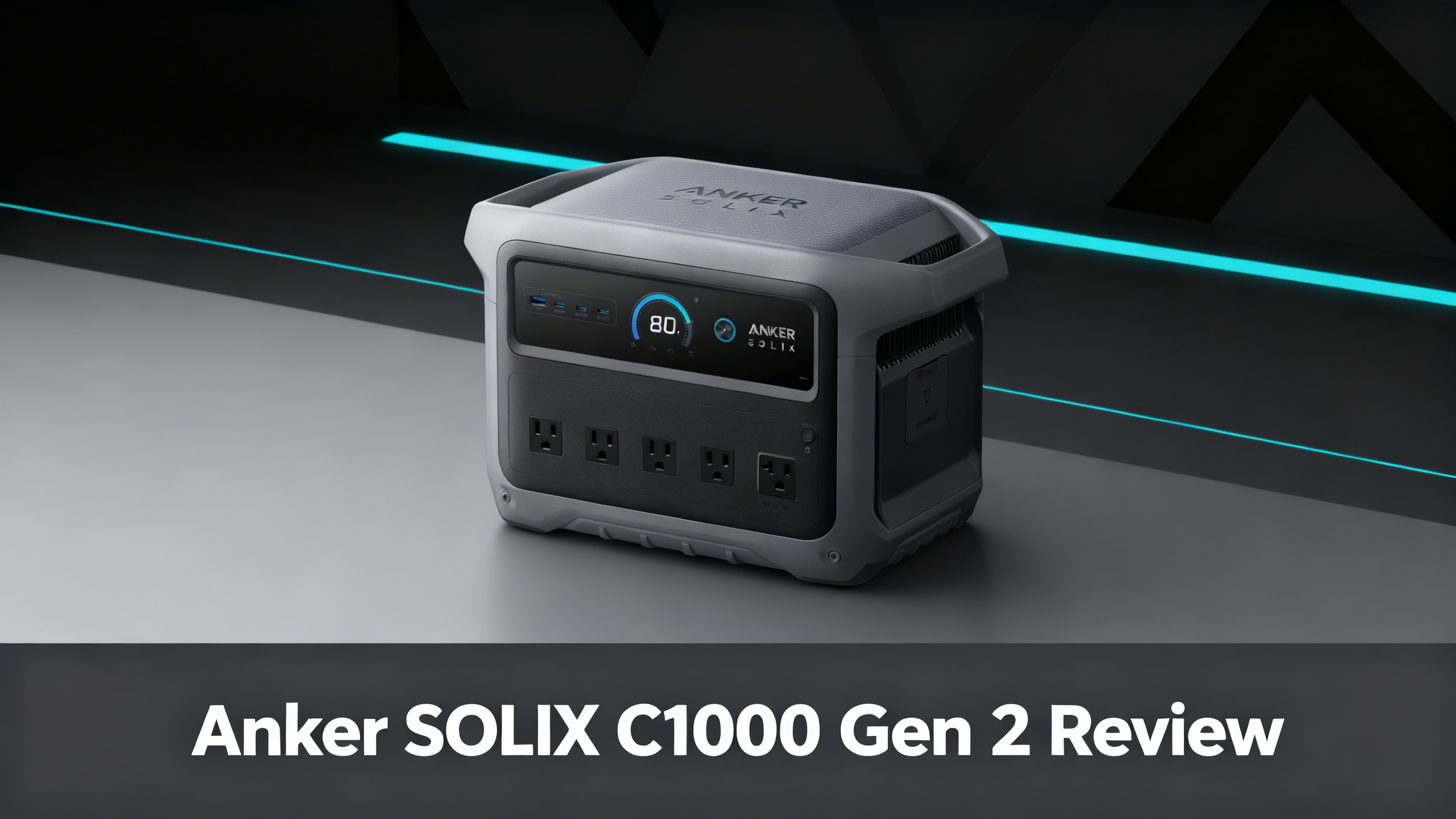
The original Anker SOLIX C1000 launched at $999. The Gen 2 arrives at $499.99 with a higher output ceiling and a faster charge. That math alone deserves a closer look. But before diving into the Gen 2 specifics, a full Anker SOLIX brand overview covers how the entire lineup fits together.
The C1000 Gen 2 targets a specific buyer: someone who needs a compact 1kWh station for emergency home backup, CPAP protection, or weekend solar charging, but refuses to compromise on recharge speed. At $499.99, it undercuts the Gen 1's launch price by half while adding HyperFlash charging at 1,600W, 200W more continuous output, and 1,000 extra battery cycles. This review breaks down what the data actually shows.

Anker SOLIX C1000 Gen 2: Overall Rating
9.0/10
“The fastest-charging 1kWh station at this price point”
Charging Speed 9.5/10
Capacity 8.5/10
Output Power 9.0/10
Portability 9.0/10
Value for Money 9.0/10
Longevity 9.5/10
Anker SOLIX C1000 Gen 2
$499.99
- 1,024Wh capacity, 2,000W output (3,000W peak)
- 49-min full recharge via HyperFlash at 1,600W
- 4,000+ cycles, 10-year InfiniPower guarantee
Quick Verdict
Performance-focused buyers looking for the fastest AC-charging 1kWh station under $500 will find the C1000 Gen 2 compelling. At $499.99, it undercuts the original C1000‘s $999 launch price while delivering a higher 2,000W output and 4,000-cycle longevity backed by Anker's InfiniPower guarantee.
The trade-off is a slightly smaller 1,024Wh capacity versus the Gen 1's 1,056Wh. For most users, that 32Wh difference is invisible in practice. What is not invisible: recharging from flat to full in 49 minutes, or running a CPAP machine without a single blink from a sub-10ms UPS switch.
Anker SOLIX C1000 Gen 2 Specs at a Glance
The official Anker SOLIX C1000 Gen 2 product page lists the complete specification set. The headline numbers: 1,024Wh of LFP capacity, 2,000W continuous AC output with a 3,000W peak, and HyperFlash charging that tops up the unit in 49 minutes flat at 1,600W input.
Full Specification Table
What Changed from the Original Anker SOLIX C1000?
The original C1000 launched at $999 with 1,056Wh of capacity and 1,800W continuous output. By any measure, it was a capable station. But performance gaps existed: the charge rate was respectable rather than standout, and 3,000 cycles placed it in the mid-tier for longevity. The full C1000 vs C1000 Gen 2 comparison digs deeper into the spec delta, but the headline numbers are striking.
The Gen 2 cuts the price in half, adds 200W of continuous output headroom, and introduces HyperFlash as the defining upgrade. Published specifications indicate the HyperFlash mode represents a 33% increase in peak input power over the previous generation, compressing full-charge time to 49 minutes. The cycle count jumps from 3,000 to 4,000, extending the warranted lifespan under Anker's InfiniPower program to 10 years.
The HyperFlash Upgrade
HyperFlash is not on by default. The mode is activated via the Anker app, which unlocks the full 1,600W input channel and enables 0-100% in 49 minutes. This design choice is deliberate: drawing 1,600W from the wall requires a standard 15A outlet, and Anker surfaces the option explicitly so users understand the electrical requirement before enabling it.
The Gen 1's charging profile showed 0-80% in approximately 43 minutes at a lower peak input. The Gen 2's HyperFlash mode covers the full 0-100% range in 49 minutes, a meaningful shift in how the station fits into a daily routine. A sub-hour full recharge means the unit can cycle between uses on the same day without planning around overnight charging windows.
Output Power and Port Count
The jump from 1,800W to 2,000W continuous (and from 2,400W to 3,000W peak) expands the appliance compatibility range. The C1000 Gen 2 can now handle most mid-size power tools, larger portable air conditioners, and demanding kitchen appliances that the Gen 1 would struggle to sustain. With 10 output ports across AC, USB-A, USB-C, and DC formats, simultaneous multi-device scenarios are well covered.
Charging Performance
Three charging pathways are available on the C1000 Gen 2: AC wall power (with or without HyperFlash), solar, and 12V/24V car charging. Each serves a distinct use context, and the performance data differs substantially between them.
AC Charging with HyperFlash
At 1,600W input, the HyperFlash channel places the C1000 Gen 2 among the fastest-charging 1kWh stations available. For context, the EcoFlow DELTA 2 charges at up to 1,200W, and most competing units in the $400-$600 range top out at 800-1,000W. The 49-minute full charge figure assumes HyperFlash is active and a 15A outlet is available, both of which are standard conditions for home use.
Without HyperFlash, the unit charges at a standard rate, which is still competitive but adds time. For buyers planning primarily indoor home backup scenarios, enabling HyperFlash is the obvious default.
Solar Charging
The 600W max solar input ceiling is unchanged from the Gen 1, but the 60V voltage limit remains generous for panel configuration flexibility. The dedicated guide on solar setup for the C1000 Gen 2 maps out the best panel pairings for the 600W max solar input. Anker's own PS200 (200W) and PS400 (400W) panels pair cleanly, and a 3x PS200 parallel configuration or a PS400 + PS200 combination reaches the ceiling. At peak 600W solar input, the 1.8-hour full-charge data point is confirmed by published specifications.


Car Charging
The 12V/24V car charging port provides a third input path suited to RV and van travel scenarios. Charge rate via car input is lower than AC or solar and is best understood as a supplemental top-up option during transit rather than a primary recharge method for heavy use cycles.

Runtime and What It Powers
Runtime calculations based on the 1,024Wh capacity and typical appliance draws indicate strong performance across the most common emergency and outdoor scenarios. The LFP chemistry adds a layer of reliability here: unlike older NMC cells, LFP batteries maintain stable output closer to their capacity ceiling, which means the runtime estimates reflect real-world draw more accurately.

What Can the C1000 Gen 2 Power? (1,024Wh)
❄️
Mini Fridge
~17 hrs
60W avg
💡
LED Lights
~100 hrs
10W
💻
Laptop
~14 charges
75W avg
🫁
CPAP Machine
~2 nights
30W + UPS
For emergency backup during a one-night outage, the C1000 Gen 2 covers the essentials without difficulty: mini fridge, phone charging, LED lighting, and a CPAP running simultaneously still leaves significant capacity in reserve. Weekend camping use cases show similar headroom, particularly for nomadic setups running a 12V cooler, laptop, and lighting from a single station.
The 2,000W output ceiling means appliance compatibility extends beyond the typical 1kWh comfort zone. Portable air conditioners under 1,500W, mid-range power tools, and small kitchen appliances all fall within the sustainable continuous output range. The 3,000W peak handles motors and compressors that spike on startup, which is where many 1kWh stations fall short.
Build Quality and Portability
The C1000 Gen 2's reduced footprint is one of the genuine quality-of-life improvements over the Gen 1. Published dimensions confirm a 14% smaller volume and 11% lighter weight compared to comparable models, which translates to easier room-to-room mobility inside the home and more manageable van or trunk storage for outdoor use.
The optional water-resistant bag bundle extends the unit's usability in outdoor conditions. For buyers who plan to move the station between indoor and outdoor contexts frequently, the bag adds a meaningful protection layer without requiring a custom case. The carry handle design accommodates single-person transport, which is consistent with the “compact home backup” positioning Anker targets for this model.
UPS Mode and Smart Features
Spec analysis confirms the sub-10ms UPS switchover places the C1000 Gen 2 among the most responsive portable UPS solutions in its class. For CPAP users, this matters directly: most home medical equipment requires a switchover under 20ms to avoid an interruption event. The 10ms threshold clears that requirement with margin. Consistent owner reports across the Anker community confirm CPAP compatibility without operational disruption.
The TOU (Time of Use) Mode, accessible via the Anker app, enables the unit to charge during off-peak electricity rate windows automatically. For buyers in markets with variable rate pricing, this feature pays for itself over a daily-use cycle. Bluetooth and Wi-Fi connectivity tie the unit to the app for real-time monitoring, remote control, and firmware updates.
The Anker app's overall ecosystem integration is a genuine differentiator in this price segment. Setting charge limits, scheduling TOU windows, and checking battery health remotely are features more commonly found on home battery systems at 3-5x the cost. For the Energy Star certified backup standards reference point, it is worth noting that at 1,024Wh the C1000 Gen 2 falls below the 3kWh threshold for residential clean energy credit eligibility as a standalone unit.
Who Should Buy the Anker SOLIX C1000 Gen 2?
The C1000 Gen 2 has a clear target profile. It is not designed for whole-home backup or extended off-grid living. It is designed for buyers who need a fast-recharging, compact, and durable 1kWh station that can handle emergency backup and outdoor use without dominating the storage space it lives in.
✅ Buy the C1000 Gen 2 if…
- You need the fastest 1kWh recharge on the market (49 min)
- You want a compact station for home UPS and CPAP backup
- You plan to use solar regularly (1.8h with 600W input)
- Long-term ownership matters: 4,000-cycle LFP warranty
❌ Skip the C1000 Gen 2 if…
- You need to power a full-size refrigerator (step up to C2000 Gen 2)
- Your budget is under $400 (look at C800X)
- You need expandable capacity (the C1000 Gen 2 is standalone only)
Solar-focused buyers who want maximum panel input without a large station footprint will find the 600W solar ceiling accommodating. The C1000 Gen 2 supports up to a 400W panel configuration, and the 1.8-hour solar recharge data point makes same-day solar cycle scenarios practical in good sun conditions.

RV and van users benefit from the alternator charging option, which adds a fourth input path via the vehicle's electrical system during transit. This makes the C1000 Gen 2 a viable standalone power solution for weekend overland trips where grid access is intermittent or unavailable.

For a broader look at the full lineup, the guide to top Anker SOLIX models ranked puts the C1000 Gen 2 in context alongside the F3800, F3000, and C2000 Gen 2.
Real-World Use Cases

The pairing of the C1000 Gen 2 with Anker's EverFrost portable cooler illustrates the ecosystem logic behind the product. Owner data consistently reports that the cooler-plus-station combination handles multi-day camping trips without requiring a grid top-up when paired with even a modest solar panel. The EverFrost's 12V DC input draws power efficiently without routing through the inverter, preserving AC headroom for other devices.
Home use cases center on emergency preparedness and CPAP backup. For buyers in regions with regular outages, the sub-10ms UPS mode combined with the 49-minute recharge window creates a fast-cycle backup system: drain during an outage, recharge the moment power is restored, and be ready for the next event within an hour. This operational profile is where the Gen 2's speed upgrades deliver the most practical value over the Gen 1.
Alternatives to Consider
The C1000 Gen 2 sits in a well-defined niche, but three alternatives are worth naming for buyers who fall outside its ideal profile.
The Anker SOLIX C800X ($349.99) steps down to 768Wh and a lower output ceiling, but brings the price point within reach for budget-constrained buyers. It shares the LFP battery platform with similar longevity credentials. If 1kWh is more capacity than you actually need, the C800X avoids overpaying for unused headroom.
The Anker SOLIX C2000 Gen 2 is the natural step-up for buyers who find 1,024Wh insufficient. It doubles the capacity and adds expandability options that the C1000 Gen 2 does not support. For full-size refrigerator backup or extended off-grid scenarios, the capacity jump justifies the price difference.
Buyers wanting the dark grey colorway and slightly different output profile should check the C1000X Gen 2 alternative before deciding. The C1000X Gen 2 shares the same generation platform with cosmetic and minor configuration differences.
Final Verdict
The data points to an unusually strong value proposition: double the output power of the Gen 1, a 33% faster charge rate, 33% more battery cycles, at half the original launch price. That combination is rare in the portable power station market, where generational upgrades typically deliver incremental improvements at similar or higher price points.
The 1,024Wh capacity keeps the C1000 Gen 2 in the “serious portable backup” tier rather than the “whole-home replacement” category. For buyers whose power needs align with that positioning, the 49-minute full charge and 4,000-cycle warranty make it the most defensible 1kWh purchase under $500 in the current market.
Unsure which capacity is right for your needs? The complete buying guide walks through every Anker SOLIX model by use case and budget. For a broader look at the brand's direction, the Anker SOLIX brand overview provides full context on where the C1000 Gen 2 fits in the evolving Anker SOLIX portable power station ecosystem.
Anker SOLIX C1000 Gen 2
$499.99
Best Gen-2 upgrade for emergency + everyday backup under $500
Price verified April 2026. Free shipping available
Frequently Asked Questions
What is the difference between the Anker SOLIX C1000 and the C1000 Gen 2?
The Gen 2 ships at $499.99 versus the original's $999 launch price, while delivering 2,000W output (vs 1,800W), HyperFlash charging at 1,600W, 4,000 battery cycles (vs 3,000), and a form factor that is 14% smaller and 11% lighter. Capacity is slightly lower at 1,024Wh versus 1,056Wh, a difference that is negligible for most use cases.
Does the Anker SOLIX C1000 Gen 2 really charge in 49 minutes?
Published specifications confirm the 49-minute full charge when HyperFlash mode is enabled via the Anker app. This mode draws up to 1,600W from the wall, requiring a standard 15A outlet. Without HyperFlash, charge time increases but remains competitive within the 1kWh category.
Can the C1000 Gen 2 run a CPAP machine overnight?
Certified specifications indicate the C1000 Gen 2 includes a sub-10ms UPS switchover, making it compatible with CPAP machines. Runtime calculations based on the 1,024Wh capacity and a typical CPAP draw of 25-30W suggest approximately two full nights of operation without a humidifier.
What solar panels work best with the Anker SOLIX C1000 Gen 2?
The unit accepts up to 600W of solar input with a 60V max voltage ceiling. Anker's PS200 (200W) and PS400 (400W) panels are certified compatible. The dedicated solar setup guide covers optimal wiring configurations for reaching the 600W ceiling, including parallel PS200 arrangements and mixed PS400/PS200 setups.
Is the Anker SOLIX C1000 Gen 2 worth it over the EcoFlow DELTA 2?
Spec-for-spec comparison shows the C1000 Gen 2 delivers higher AC output (2,000W vs 1,024W for the standard DELTA 2) and faster charging via HyperFlash. The EcoFlow DELTA 2 offers expandable capacity with its Smart Extra Battery, which the C1000 Gen 2 does not support. The right choice depends on whether output power or capacity expandability is the higher priority.
Does the Anker SOLIX C1000 Gen 2 qualify for any tax credit?
The federal residential clean energy credit (IRS Form 5695) applies to battery storage systems with a capacity of at least 3kWh. At 1,024Wh, the C1000 Gen 2 does not meet the threshold as a standalone unit. Consulting a tax professional is recommended for specific situations.
Originally published: April 6, 2026