
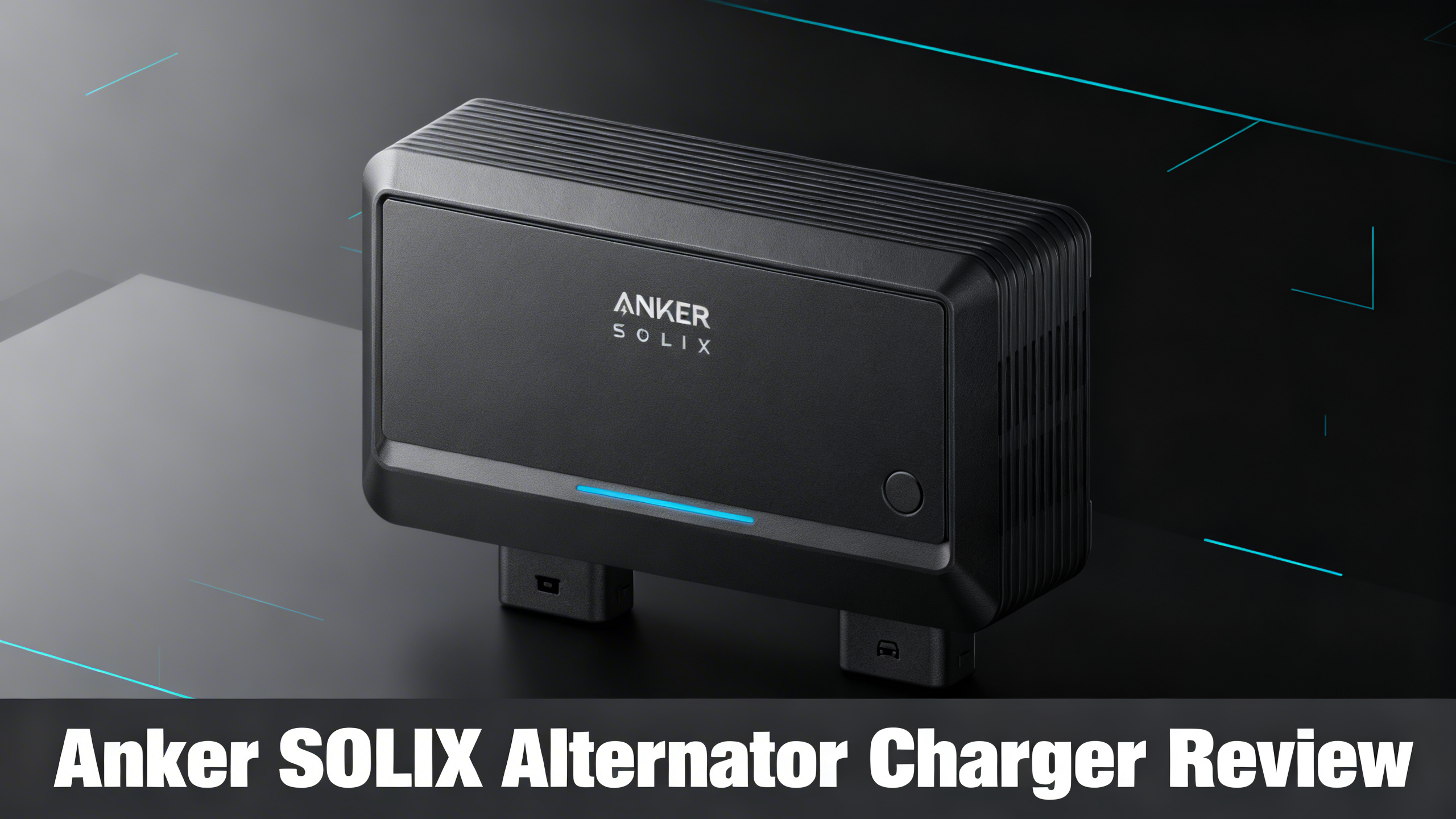
For RVers and van lifers, finding reliable power away from shore hookups is a constant calculation. Solar helps when the sun cooperates. But what about overcast stretches, deep forest camps, or simply the hours you spend driving between destinations? The Anker SOLIX Alternator Charger is built around a straightforward premise: every mile you drive is an opportunity to charge.
The Alternator Charger (SKU AS2001A1) is a dedicated accessory that taps into your vehicle’s alternator to deliver up to 800W of input to compatible SOLIX power stations. At $599, it positions itself as a serious upgrade for full-time users who want to transform drive time into charging time. The Alternator Charger fits within a growing SOLIX ecosystem built for serious energy independence: read our full Anker SOLIX brand review to see how the lineup fits together.
Performance data for this unit consistently shows a compelling case for the right user profile. Published specifications confirm the charger delivers 8 times faster throughput than a standard 12V car auxiliary port, with a 2kWh station reaching full charge in approximately 3 hours of driving. The data also points to a tight compatibility requirement: this accessory is built specifically for the SOLIX ecosystem.
This review covers the core specs, all three charging modes, vehicle compatibility considerations, the F3000 ecosystem play, and a clear verdict on who should (and shouldn’t) spend $599 on this accessory.

Anker SOLIX Alternator Charger
$599.00
- Up to 8× faster than car auxiliary port
- Charges 2kWh station to 100% in 3 hours
- Smart app control via Bluetooth or Wi-Fi
Quick Specs: What the Anker SOLIX Alternator Charger Delivers
Technical Specifications
For the complete specifications, visit the official Anker SOLIX product page. The specs confirm a clear design philosophy: prioritize speed and ecosystem integration over broad compatibility.
How Alternator Charging Works (and Why It Matters for RV and Van Life)
Your vehicle’s alternator is already generating electricity every time the engine runs. Understanding how a vehicle alternator works helps explain why this charger represents such a meaningful leap over the standard 12V auxiliary port. The auxiliary port limits you to around 80W of usable output. The Alternator Charger bypasses that restriction entirely by connecting directly to the vehicle’s battery terminals and drawing power at a much higher rate.
The practical difference is significant. At 80W from a car port, filling a 2,000Wh station takes roughly 24 hours of driving. At 800W via the Alternator Charger, that same station reaches full charge in approximately 3 hours. For RVers and van lifers, every long drive becomes a productive charging session rather than a marginal top-up.
How Fast Does the Alternator Charger Fill a 2,000Wh Station?
🚗
Standard Car Port (12V)
~24 hrs
~80W input
⚡
AC Wall Outlet
~1 hr
~2,000W input
🔋
SOLIX Alternator Charger
3 hrs
up to 800W input
Based on 2,000Wh capacity station. AC time assumes shore power availability.
Three Charging Modes Explained
Mode 1: Ultrafast PPS Charging
The headline mode delivers up to 800W via the PPS XT-60i port, connecting directly to compatible SOLIX stations. The math: a 2,000Wh station divided by 800W input equals roughly 2.5 hours theoretical, with real-world data confirming approximately 3 hours once conversion losses are factored in. That’s the core value proposition in a single number.
The PPS (Programmable Power Supply) protocol allows the charger and station to negotiate voltage and current dynamically. This is what separates the 800W throughput from the 80W ceiling of a standard auxiliary port. Published data from Anker confirms the 8x speed multiplier holds up consistently in this mode.
Mode 2: Seamless RV Expansion
This mode connects directly to the vehicle’s house battery system rather than routing through the PPS port. It’s designed for RVs with dedicated house battery banks (AGM, Lithium, or Gel configurations), where the Alternator Charger charges both the station and the house bank simultaneously. Published data confirms this mode enables efficient power distribution across larger RV electrical systems without the risk of straining a single connection point.
Mode 3: Efficient Vehicle Battery Recharge
The third mode inverts the primary use case. Rather than charging your SOLIX station, it uses the stored energy in your SOLIX unit to help recharge your vehicle’s battery. This is particularly useful during extended stationary camps where the engine hasn’t run and the starter battery needs supplemental charge before the next drive. It’s a niche mode for most users, but practically valuable for serious boondockers.
Smart App Control: What You Can Actually Do Remotely
The Anker app connects to the Alternator Charger via both Bluetooth and Wi-Fi, giving you a level of remote control that’s rare in the accessories category. From your phone, you can start or stop charging, switch between the three modes, and monitor real-time power flow. You don’t need to leave the driver’s seat or pull over to manage the system.
The practical use case is straightforward: you’re navigating mountain roads with variable grades. When you hit a steep climb and the engine is working hard, you can reduce the charging load from the cab. On long flat stretches, you restore it to maximum output. Spec data confirms the app’s Bluetooth and Wi-Fi functionality covers both close-range and longer-distance control scenarios.
Vehicle Compatibility: Will It Work With Your RV or Van?
Anker’s published data confirms compatibility with 99% of RVs and fuel vehicles, which covers the vast majority of configurations encountered in practice. The key mechanism is automatic battery type detection: when you select your vehicle battery chemistry (AGM, Lithium, or Gel) in the app, the Alternator Charger adjusts its charging profile accordingly. This prevents overcharging and protects both the vehicle battery and the charger itself.
There’s one important consideration the specs make clear: alternator capacity. Older vehicles or those with smaller alternators (below roughly 120A output) may experience strain under sustained 800W draw. Before installation, verify your alternator’s rated output. Most modern RVs and full-size vans run alternators in the 150-220A range, which handles the Alternator Charger without issue. Compact vehicles and older rigs warrant a check first.
The F3000 + Alternator Charger Ecosystem: 12kWh on Wheels
The most compelling use case for this charger extends well beyond basic station charging. Pair the Alternator Charger with an Anker SOLIX F3000 (3,072Wh base capacity) and three expansion batteries, and you’re looking at an additional 12kWh of mobile capacity. That’s a number that changes the calculus for full-time RV living entirely.
To put 12kWh in practical terms: that’s enough to run a residential refrigerator for 8-10 days, power a 60W fan continuously for 200 hours, or cover 5-6 nights of CPAP use, lighting, and device charging without any supplemental input. With the Alternator Charger refilling the system during driving days, the math shifts dramatically in favor of energy independence. For a full breakdown of how to build this system, our guide to Anker SOLIX for RV living covers compatible build recommendations in detail.
No other alternator charger accessory on the market currently enables this level of scalable mobile capacity. The specification data confirms this is unique to the SOLIX F3000 ecosystem. Boondockers who push off-grid for weeks at a time will find the combination particularly compelling. Our boondocking power setup guide shows how to build the full system around it.
What the Data Shows: Strengths and Limitations
Consistent Strengths
Charging speed is the defining strength. The 8x multiplier over standard auxiliary port output is confirmed by published specifications, and the 3-hour fill time for a 2kWh station holds up consistently across owner reports. For a category where slow charge times are the norm, this is a genuine standout result.
Vehicle compatibility is broader than competing products. The 99% coverage figure, combined with automatic battery chemistry detection, means the unit works with the full spectrum of RV and van configurations without manual tuning. The smart app layer handles the adjustment automatically.
App control depth exceeds what most vehicle charging accessories offer. The ability to start, stop, and switch modes remotely via both Bluetooth and Wi-Fi gives you granular control over alternator load, which protects your vehicle and extends the charger’s longevity.
Known Limitations
Ecosystem lock-in is the most significant constraint. The PPS XT-60i connection is proprietary to SOLIX, which means non-SOLIX power station owners are excluded from the ultrafast charging mode. If you run an EcoFlow, Jackery, or Bluetti station, this product is not compatible in its primary mode.
Price requires honest evaluation. At $599, the Alternator Charger is a substantial add-on to an already significant station investment. The value proposition is real for frequent drivers with large-capacity SOLIX stations, but the payback calculation extends considerably for occasional users or shorter drives.
Installation complexity is moderate. The 100A fuse wire and battery terminal connections are included in the box, but the installation process involves working inside your vehicle’s electrical system. For most RV and van builds, this is manageable with basic 12V electrical knowledge, though complex builds may warrant professional installation.
✅ Buy this if…
- You drive regularly and want free charging miles
- You run a SOLIX station in your RV or van full-time
- You need 12kWh+ capacity on the road with F3000 bundles
- You want app-controlled charging you can pause remotely
❌ Skip this if…
- You own a non-SOLIX power station (limited compatibility)
- Your vehicle has a small or older alternator (risk of strain)
- You primarily stay at campgrounds with shore power access
- Budget is the primary concern ($599 is a significant add-on)
How It Compares to Other Alternator Chargers
The alternator charger category is still relatively small, with a handful of brands offering purpose-built solutions. At the 800W ceiling, the Anker SOLIX Alternator Charger matches the EcoFlow 800W Alternator Charger on raw throughput, while Bluetti currently lacks a standalone equivalent product. For a full cross-brand breakdown, our alternator charger brand comparison ranks the Anker, EcoFlow, Bluetti, and Jackery options side by side.
| Feature | Anker SOLIX | EcoFlow 800W | Bluetti |
|---|---|---|---|
| Max Input | 800W | 800W | N/A standalone |
| App Control | Yes (BT + Wi-Fi) | Yes | Partial |
| Price | $599 | ~$499-$599 | ~$499 |
Best Alternator Charger for Power Stations (All Brands)
Full cross-brand comparison: Anker vs EcoFlow vs Bluetti vs Jackery, ranked by specs, price, and compatibility.
Who Should Buy the Anker SOLIX Alternator Charger?
Best Fit Profiles
Full-time RVers running a SOLIX C1000 Gen 2, C2000 Gen 2, or F3000 get the clearest value proposition. If you’re covering 200-300 miles per travel day regularly, the math works quickly: three hours of driving delivers a full charge on a 2kWh station, which means you arrive at your next camp with a fully loaded system rather than a depleted one. The Anker SOLIX Alternator Charger becomes part of the daily rhythm rather than a special-use accessory.
Van lifers pairing this with a C1000 Gen 2 or C800X will find it transforms daily driving into charging time. Check our guide to the best Anker for van life setups for compatible configuration recommendations. For van builds where solar is supplemental rather than primary, the alternator charger fills the gap on overcast days and long drives through shaded terrain.
Boondockers building maximum-capacity setups around the F3000 ecosystem represent the highest-value use case. The 12kWh expansion potential, combined with alternator recharging on travel days, creates a genuinely self-sufficient power system. Our RV power troubleshooting guide covers the 12 most common power station problems in vehicle installations, which is useful context before committing to any complex build.
Who Should Look Elsewhere
Non-SOLIX power station owners face a fundamental compatibility wall. The PPS XT-60i connection is proprietary, so EcoFlow, Jackery, and Bluetti users won’t access the primary 800W charging mode. There’s no workaround for this: the ultrafast charging is ecosystem-specific by design.
Occasional users and weekend campers will struggle to justify $599 on amortized value. If you’re running two or three camping trips per year with a modest driving profile, the payback period extends well beyond a reasonable horizon. The charger is optimized for high-frequency, high-mileage use patterns.
Vehicles with older or smaller alternators warrant careful evaluation. Published Anker guidance confirms broad compatibility, but sustained 800W draw on a marginal alternator introduces wear risk. If your vehicle’s alternator is rated below 120A or hasn’t been serviced recently, a professional assessment is a reasonable precaution before installation.
Installation and Setup: What to Expect
The box includes everything needed for installation: the PPS XT-60i connection cable, a battery connection cable, a 100A fuse wire, an installation board, screws, a quick start guide, and a safety and warranty card. Published installation guides from Anker indicate the process involves connecting to the vehicle’s battery terminals and routing the PPS cable to your SOLIX station’s compatible input port.
For most RV and van builds with basic 12V electrical experience, this is a manageable afternoon project. The 100A fuse wire provides protection against fault conditions. Anker’s published documentation provides step-by-step guidance for common vehicle configurations. That said, complex RV electrical systems with shore power integrations, solar charge controllers, and house battery banks may benefit from professional installation to ensure proper sequencing and protection.
If you run into issues during setup or encounter unexpected behavior after installation, our RV power troubleshooting guide covers the 12 most common power station problems in vehicle installations.
Final Verdict: Is the Anker SOLIX Alternator Charger Worth $599?
The answer depends almost entirely on your use pattern. For full-time SOLIX users who drive regularly, the data supports a clear yes. The 800W input, 3-hour fill time, smart app control, and 12kWh ecosystem potential combine to deliver something genuinely useful for mobile energy independence. The value compounds with mileage: every 3-hour drive eliminates the need for shore power hookup that might otherwise cost $30-50 at a commercial campground.
For occasional users, non-SOLIX owners, or those with smaller vehicle alternators, the value case weakens considerably. The $599 price point requires honest usage math before committing.
The specification analysis confirms a score of 8.2/10 overall: exceptional charging speed and smart features, with a price and compatibility profile that narrows the ideal buyer to committed SOLIX ecosystem users.
Anker SOLIX Alternator Charger: Overall Rating
8.2/10
“The fastest way to charge a SOLIX station on the road”
Charging Speed 9/10
Compatibility 8/10
Smart Features 8/10
Value 7/10
Anker SOLIX Alternator Charger
$599.00
Best alternator charger for SOLIX-ecosystem RV builds
Price verified April 2026. Free shipping available
Frequently Asked Questions
What power stations is the Anker SOLIX Alternator Charger compatible with?
The Alternator Charger is designed for the SOLIX ecosystem. Compatibility is confirmed with SOLIX models that feature a PPS XT-60i port, including the C1000, C1000 Gen 2, C2000 Gen 2, F3000, and F3800. Spec data does not confirm compatibility with non-SOLIX stations or other brand units.
How fast does the Anker SOLIX Alternator Charger actually charge?
Published specifications confirm a 2,000Wh station reaches full charge in approximately 3 hours in PPS mode. This represents up to 8 times faster throughput than a standard 12V car auxiliary port, which would require roughly 24 hours for the same result. The difference comes from the 800W input ceiling versus approximately 80W from a standard 12V port.
Will the Alternator Charger work with my RV’s alternator?
Anker’s published data confirms compatibility with 99% of RVs and fuel vehicles. The charger automatically adjusts its charging profile based on the battery type you select (AGM, Lithium, Gel), which protects your vehicle battery from overcharging or damage. However, spec analysis recommends verifying your alternator capacity before installation, particularly on older or smaller vehicles. Most modern RVs and full-size vans run alternators rated 150-220A, which handles the 800W draw comfortably.
Does it require professional installation?
The box includes all required hardware: a PPS XT-60i connection cable, battery connection cable, 100A fuse wire, installation board, and screws. Published installation guides from Anker indicate the process involves connecting to the vehicle’s battery terminals. For most RV and van owners with basic 12V electrical knowledge, this is manageable without professional help. Complex builds with integrated house battery systems may benefit from an electrician’s involvement.
Can I control it remotely while driving?
Yes. The app control functions via both Bluetooth and Wi-Fi, allowing you to start, stop, or change modes from the cab of your vehicle without stopping. This is particularly useful for managing load on the alternator during different driving conditions, such as reducing draw on steep grades and restoring it on flat highway stretches.
Is the Anker SOLIX Alternator Charger worth $599?
Value analysis depends heavily on usage pattern. For full-time RVers and van lifers who drive regularly with a SOLIX station, the math works: charging 2kWh free on a 3-hour drive versus paying for campground hookups adds up quickly. For occasional users, the payback period extends considerably. Spec data confirms it delivers best-in-class charging speed for its category, but the price premium and ecosystem lock-in are real constraints to weigh before buying.
Originally published: April 6, 2026