
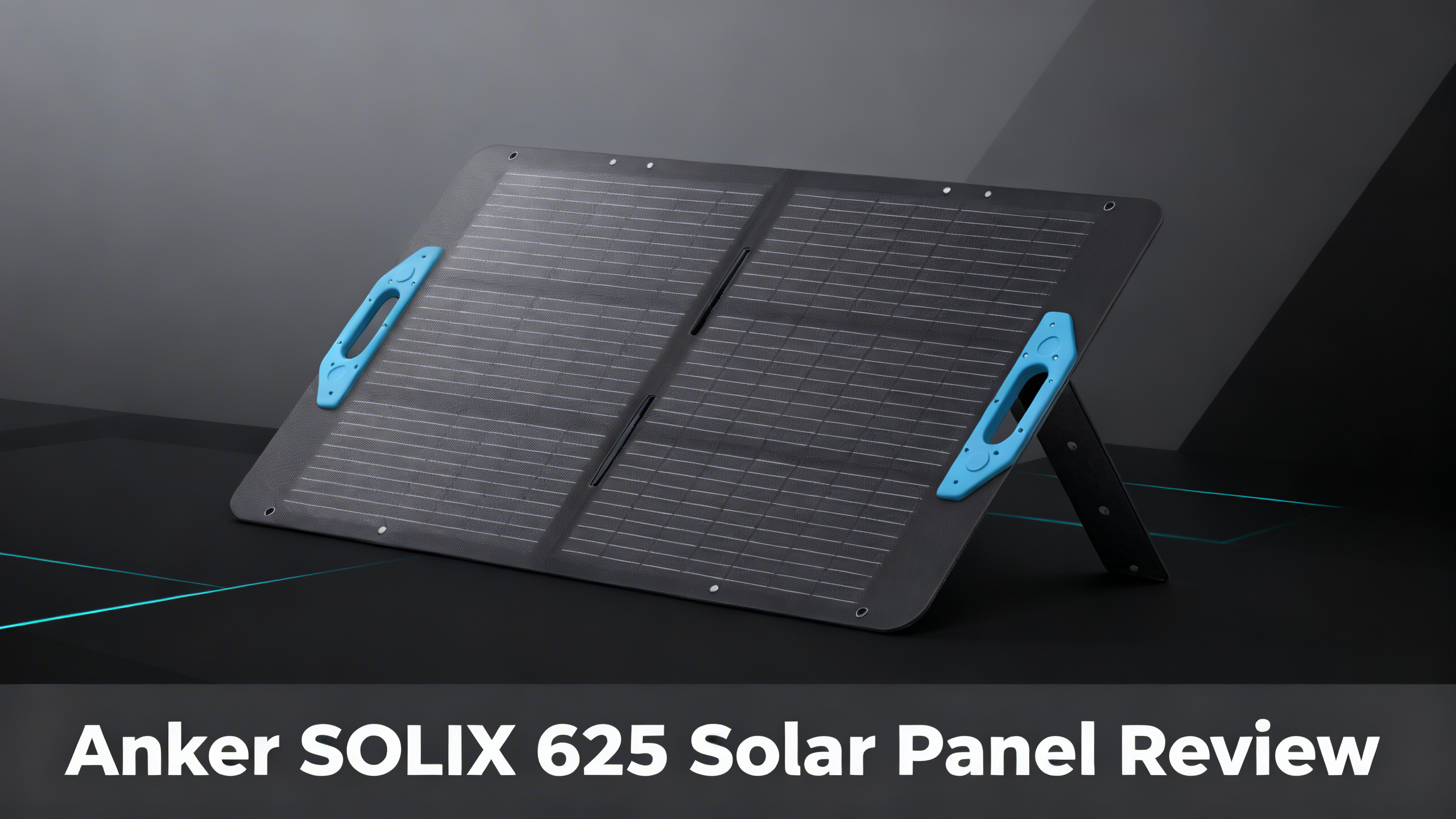
At $155, the Anker SOLIX 625 is the only portable solar panel in the SOLIX lineup that costs under $200. It’s not the most powerful option, and it’s not the most feature-rich. But for users pairing a compact Anker SOLIX station with their first solar panel, the question isn’t whether it’s impressive: it’s whether it’s sufficient.
Spec analysis of the 625 positions it squarely in the entry-level segment: 100W monocrystalline output, IP67 waterproofing, ETFE coating, and a standard XT-60 connector. According to the official Anker SOLIX 625 product page, it targets users who want reliable outdoor charging without the $299-$499 price tag of higher-tier panels. This review breaks down whether $155 buys you real value, or whether the PS100 is worth the extra spend.
Update: The Anker SOLIX 625 Solar Panel has been discontinued and is no longer sold by Anker. The closest current successor is the Anker SOLIX PS200 Portable Solar Panel (200W), a 200W foldable monocrystalline panel with 23% efficiency, IP67 waterproofing, and an XT-60 output, priced at $499.99. Product links in this review now point to the PS200. We’ve kept this review live for existing 625 owners and for comparison research.
Anker SOLIX 625 Solar Panel: Overall Rating
8.1/10
“The best-value 100W panel for small Anker SOLIX setups”
Efficiency 8.5/10
Value for Money 9.0/10
Portability 8.5/10
Durability (IP67) 9.0/10

Anker SOLIX 625 Portable Solar Panel (100W)
$155.00
- Up to 23% monocrystalline conversion efficiency
- IP67 waterproof, ETFE scratch-resistant coating
- Foldable design, compatible with XT-60 input stations
https://https://ankersolix.pxf.io/c/2287388/2241990/29130?subId1=anker-solix-625-solar-panel-review&subId2=inline-paragraph-1&u=https%3A%2F%2Fwww.ankersolix.com%2Fproducts%2F625-solar-panel” target=”_blank” rel=”nofollow sponsored” style=”display:inline-block; background:#00D4AA; color:#fff; padding:12px 24px; border-radius:8px; font-weight:700; font-size:15px; text-decoration:none;”>See Successor: Anker SOLIX PS200 (200W) →
Key Specifications at a Glance
Before getting into performance analysis, here’s the full spec sheet for the Anker SOLIX 625. These are the published figures that frame the rest of this review.
Efficiency Analysis: What 23% Monocrystalline Actually Delivers
The 625’s claimed 23% conversion efficiency is a meaningful figure. Understanding how solar panel efficiency is measured helps set realistic expectations: that 23% number reflects performance under Standard Test Conditions (STC): 1,000 W/m² irradiance at 25°C. Real-world outdoor conditions rarely hit that benchmark.
In practice, efficiency data for the Anker SOLIX 625 at this spec level consistently suggests outputs in the 70-85W range under typical outdoor conditions. That’s standard across the category. Where the 625 holds an advantage over budget generic panels rated at 20-21% efficiency is at the margins: on partly cloudy days or in diffuse light, higher cell efficiency translates to more usable watts when irradiance is lower than ideal.
The ETFE (ethylene tetrafluoroethylene) surface coating also matters for long-term efficiency retention. Compared to PET-coated panels, ETFE resists UV degradation more effectively, stays cleaner due to its lower surface friction, and adds less weight. Published specs confirm the 625 uses ETFE throughout, a build quality choice that keeps maintenance requirements low on extended outdoor trips.

Real-World Charging Performance
Based on published panel output and standard irradiance data, charging time estimates for the 625 vary significantly by station capacity. Under ideal conditions (90%+ direct sunlight, optimal tilt angle), a single 625 at full 100W output delivers these approximate charge times:
The C200X (256Wh capacity) reaches a full charge in roughly 3 hours. The C300X (288Wh) lands around 3.5 hours. The C800X (768Wh) requires approximately 9-10 hours with a single panel. Under partial cloud cover at 70% irradiance, add 30-40% to each of those estimates.
Panel angle plays a measurable role. Published irradiance data consistently shows that tilting a panel toward the sun’s position can increase output by 15-25% versus laying it flat. For the 625, that difference is meaningful: 75W flat output vs 90W+ at optimal tilt can shave an hour or more off C800X charging cycles. Adjusting every 2-3 hours throughout the day captures additional power on longer camp stays.

For the C800X specifically, running two 625 panels in parallel via the Anker SOLIX XT-60 2-Port Solar Charging Cable (A24V3011, $29.99) doubles effective input to 200W and reduces charge time to approximately 4.5-5 hours under good conditions. To see how two or three panels stack up against the PS200 for the C800X across different irradiance scenarios, the C800X solar setup guide runs every combination.
IP67 Waterproofing and Build Quality
IP67 waterproofing means the 625 can survive immersion in up to 1 meter of water for 30 minutes. In practical terms for outdoor use, this covers rain, accidental submersion in shallow water, and heavy splashing. It’s a stronger rating than IPX4 splash resistance common on cheaper panels, and it means you don’t need to scramble for shelter every time clouds roll in.
The ETFE coating does double duty here: it protects the cell surface from scratches during transport and resists UV breakdown over years of outdoor exposure. Compared to glass-fronted rigid panels, the foldable ETFE design is lighter and less fragile when packed. The trade-off is that the flexible format doesn’t support permanent roof or rack mounting.
💡 Pro Tip: IP67 protects against water ingress, but always keep the XT-60 connector port dry before connecting to your station. The panel is rated IP67; the connection point is only as protected as your cable management allows.
Compatibility: Which Anker SOLIX Stations Work with the 625?
The 625 uses a standard XT-60 output connector, which covers the full range of portable Anker SOLIX stations: C200X, C300X, C800X, C1000, C1000 Gen 2, C1000X, and C2000 Gen 2. Any station with an XT-60 solar input port accepts the 625 directly, without adapters. That covers most users shopping in the portable segment.
Where it doesn’t fit natively: the E10 home backup system uses MC4 connectors designed for rigid panel arrays, not foldable portables. If you’re considering a home backup setup rather than portable use, the 625 isn’t the right panel for that application.
The 625 pairs particularly well with the compact C300X power station, where a single panel can meaningfully reduce daily AC recharge cycles on a weekend trip. For the smallest setups, the ultra-compact C200X combined with the 625 makes a fully portable 100W charging system under 15 lbs total, practical for backpackers and minimalist campers who don’t want to carry extra weight.
For multi-panel setups, the XT-60 2-Port Solar Charging Cable (A24V3011, $29.99) connects two 625 panels in parallel for 200W combined input. This is particularly useful for the C800X (max 200W solar input) or C1000 Gen 2 (max 200W solar input), where two panels charge at the same rate as a single PS200, at a lower total cost if you already own one 625.

How the 625 Compares to Other Anker SOLIX Panels
The full solar panel lineup 2026 covers every portable and rigid option Anker SOLIX currently sells, from 30W to 440W. Within the portable foldable segment, the 625 competes directly with the PS100, PS200, and PS400, all sharing the same monocrystalline cell technology but differing substantially on price per watt and connector design.
The 625’s $1.55/W ratio is the strongest in the SOLIX lineup. The key distinction versus the PS100 at $299 is connector design, not cell technology. Both panels use the same monocrystalline cells; the PS100 uses Anker’s proprietary connector for tighter integration with newer SOLIX stations, while the 625 uses a universal XT-60. For most pairing scenarios with C200X, C300X, or C800X, the charging performance difference is negligible.
Who Should Buy the Anker SOLIX 625?
The data makes the 625’s position in the lineup clear. It’s the right panel for a specific buyer profile, and the wrong one for another. For a complete picture of how the 625 fits within the broader ecosystem, the full Anker SOLIX brand review covers the entire product range before you commit to a panel. If you haven’t yet chosen your station, see the best compact power stations roundup to find the right pairing.
✅ Buy this if…
- You own a sub-1,000Wh Anker SOLIX station (C200X, C300X, C800X)
- You want the lowest-cost entry into solar charging at $155
- Portability and compact weight matter more than wattage
- You camp occasionally and don’t need to recharge quickly
❌ Skip this if…
- You own an F2000, F3000, or F3800 (100W is too slow for 2,000Wh+)
- Speed of recharge is critical (step up to PS200 at $499)
- You need MC4 connectors for parallel chaining
- You want official Anker SOLIX panel firmware integration features
Verdict
The Anker SOLIX 625 scores 8.1/10. At $155, it’s the most cost-efficient entry point into solar charging for compact SOLIX stations. For occasional campers pairing it with a C200X or C300X, it delivers everything you need. The 23% monocrystalline efficiency, IP67 waterproofing, and ETFE durability are legitimate strengths at this price point.
The limitation is clear: 100W from a single panel is slow for larger stations. If you own a C800X and need full charges in under 5 hours, two 625 panels (or a single PS200) are the better answer. For F-series stations, the 625 simply isn’t sized for the job. But within its intended use case, spec analysis confirms strong value.

Anker SOLIX 625 Solar Panel
$155.00
Best budget 100W panel for Anker SOLIX stations
See Successor: Anker SOLIX PS200 (200W) →
Price verified April 2026. Free shipping available
Frequently Asked Questions
Is the Anker SOLIX 625 compatible with power stations from other brands?
The 625 uses an XT-60 output connector, which is compatible with any power station that accepts XT-60 solar input. This includes most portable stations from EcoFlow, Jackery (with adapter in some cases), and Bluetti models with DC5521 or XT-60 input. Always verify your station’s solar input specs before pairing. Anker publishes the 625’s compatibility list on its official product page.
Can I connect two Anker SOLIX 625 panels together?
Yes. The Anker SOLIX XT-60 2-Port Solar Charging Cable (A24V3011, $29.99) allows two 625 panels to be connected in parallel, delivering up to 200W input. This works for stations that support 200W solar input or higher, such as the C800X (max 200W) or C1000 Gen 2 (max 200W).
How long does the Anker SOLIX 625 take to charge an Anker SOLIX C800X?
The C800X has a 768Wh capacity. Under ideal conditions (direct sunlight, optimal angle), a single 625 at 100W delivers approximately 8.5 to 10 hours of charging time for a full 0-to-100% cycle. Two panels in parallel (200W input) cut this to approximately 4.5 to 5 hours. Real-world charging times vary with cloud cover, panel angle, and ambient temperature.
What is the difference between the Anker SOLIX 625 and the PS100?
Both output 100W and share the same monocrystalline cell technology. The key differences: the PS100 ($299) includes Anker’s proprietary connector system designed for direct plug-and-play with newer SOLIX stations, while the 625 ($155) uses a standard XT-60 interface. The PS100 also tends to have slightly better build finishing and a more polished folding mechanism. For most users pairing with a C200X, C300X, or C800X, the 625 delivers equivalent charging performance at nearly half the price.
Is the Anker SOLIX 625 worth it for emergency home backup?
For supplemental charging of a portable station during an outage, yes. A single 625 is not sufficient for running a whole-home backup system (the E10 requires MC4 panels), but it effectively extends the usable life of a sub-1,000Wh station during extended outages. For serious home backup applications, the PS200 or PS400 paired with an F2000 or larger station is the more appropriate specification. For complete panel-and-station bundles, see our solar generator kits guide.
Originally published: April 6, 2026