
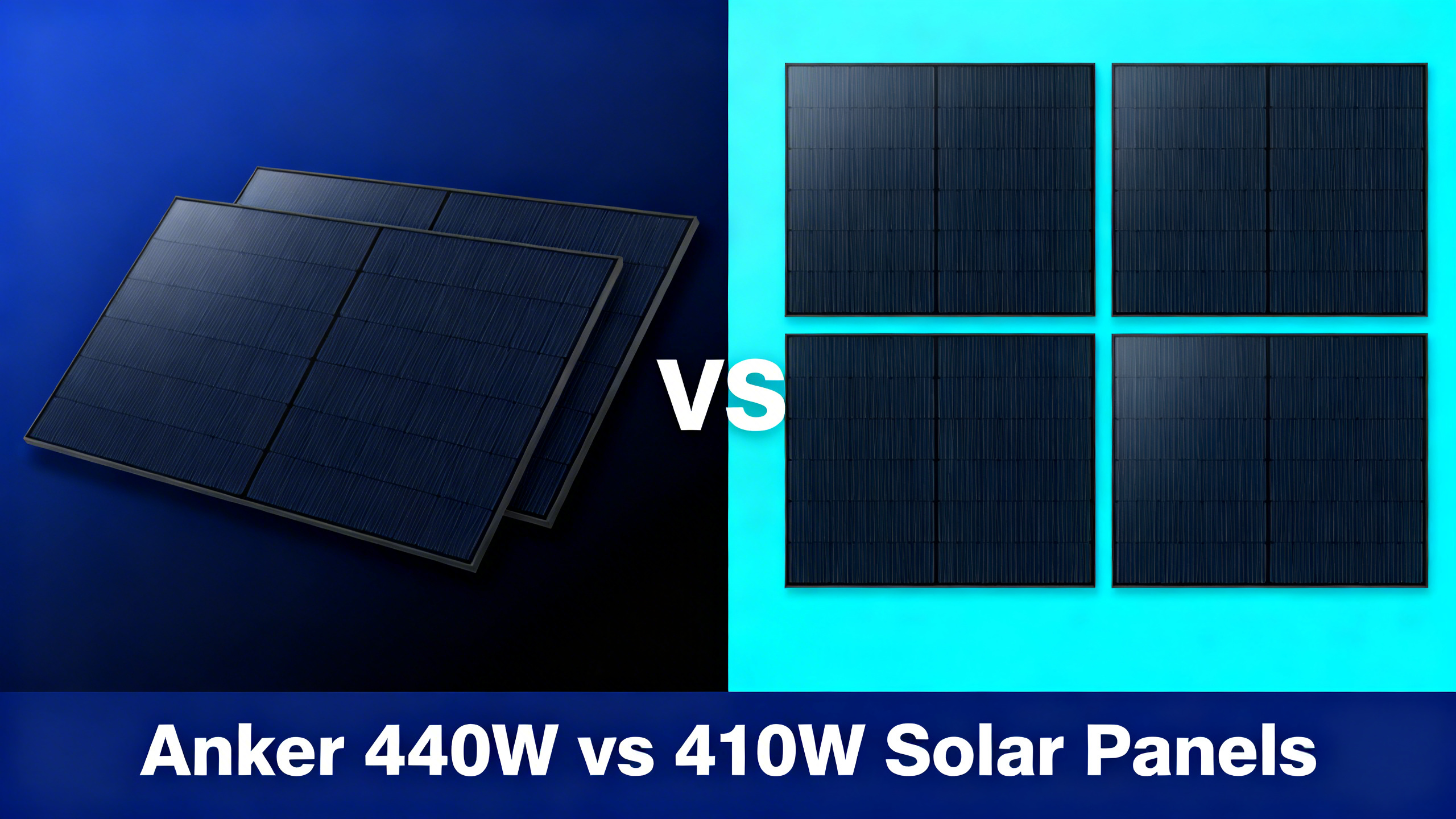
The Anker SOLIX 410W rigid solar panel is gone. If you've been shopping for rigid panels to pair with a SOLIX F3800, F3000, or E10 system, you've likely noticed the lineup has shifted. The 440W is now the only rigid panel option, and the question worth answering is simple: what actually changed, and does the upgrade matter for your setup?
This spec-by-spec analysis covers every meaningful difference between the two generations, from efficiency gains and cell technology to weather ratings, warranty terms, and station compatibility. The goal is to clarify whether current 410W owners should act and whether the 440W justifies its position as the sole rigid option going forward.

Anker SOLIX 440W Rigid Solar Panel (2-Pack)
$999.00 for 2 panels
- Up to 25% conversion efficiency (bifacial design)
- Captures up to 30% more energy from rear side
- IP68-rated, built for permanent outdoor installation
Quick Verdict
The 440W wins on every measurable spec. Efficiency moved from 22-23% up to 25%. Cell technology shifted from monofacial to bifacial, adding rear-side energy capture of up to 30%. The weather rating upgraded from IP65 to IP68. The performance guarantee extended from 25 to 30 years. The panel warranty held at 10 years on both models.
This isn't a comparison between two available products. The 410W is discontinued. For anyone building a new SOLIX system with rigid panels, the 440W is the only path forward. The more relevant question is whether 410W owners have a compelling reason to replace panels that are still performing correctly. The data suggests the answer depends on whether you're expanding an existing array or running a system that's already sized for your needs.
Quick Specs: 440W vs 410W
For a broader look at all portable and rigid options from PS100 through the 440W, the complete panel lineup comparison covers every model in the current SOLIX catalog. The table below focuses specifically on the two rigid generations.
SPECIFICATION COMPARISON
The efficiency gap is the most important number in that table. Moving from 22-23% to 25% represents roughly a 2-point improvement in conversion rate, which translates to measurably more output per square foot of panel surface. In a permanent ground or rooftop array where panel count is fixed, that gain compounds across every hour of sunlight.
The 440W Panel: What's New
The 440W positions itself as a direct replacement for the 410W, but the specification changes go deeper than a nameplate increase. Published catalog data confirms three substantive upgrades: rated power output, conversion efficiency, and cell architecture.
Performance data for the 440W is covered in depth in the full 440W panel review. This article focuses specifically on what changed from the 410W and what those changes mean in practice.

The jump from 410W to 440W nominal output is a 7.3% increase in rated capacity per panel. More significant than the wattage figure is the efficiency rating. At up to 25%, the 440W sits at the high end of what mainstream rigid monocrystalline panels deliver in 2026. The 410W at 22-23% was a competitive spec when it launched, but the technology has moved. Catalog specifications confirm the 440W uses next-generation monocrystalline cells rather than standard mono cells, which accounts for the efficiency improvement. The physical panel dimensions accommodate the same wattage in a comparable footprint, meaning installations that were designed around 410W panel placement will accommodate 440W panels without layout changes.
Bifacial Technology: The Real Upgrade


The shift from monofacial to bifacial cell technology is the most structurally significant change between the two generations. Monofacial panels capture energy only on the front face. Bifacial panels capture energy on both sides, using the rear surface to collect diffuse and reflected light from the ground or mounting surface below.
Catalog data confirms the 440W delivers up to 30% additional energy from rear-side capture under optimal conditions. Understanding what “optimal” means is important before factoring this into system sizing. For a clear explanation of how efficiency ratings translate to real-world output, what solar panel efficiency ratings actually mean is a useful reference from EnergySage.
Rear-side gain depends heavily on installation geometry. Ground-mount arrays elevated 12-18 inches above a light-colored substrate (concrete, gravel, white membrane) see meaningful bifacial gains throughout the day. Rooftop installations flush to a dark-colored roof with no clearance see near-zero rear contribution. Elevated racking on a reflective rooftop surface falls somewhere between those extremes. If your planned installation is a flat, close-mounted rooftop array, the bifacial specification matters less than the efficiency and wattage improvements. If you're planning a ground-mount with proper elevation, the 30% rear-side figure becomes a real part of your energy calculation.
IP68 vs IP65: Why the Rating Matters for Permanent Installs
IP ratings follow a two-digit format: the first digit covers dust protection (6 is fully dust-tight in both cases), and the second digit covers water protection. IP65 means the panel withstands water jets from any direction. IP68 means the panel can withstand continuous submersion in water beyond one meter depth.
For a panel installed outdoors year-round, the practical difference shows up in long-term durability in rain-heavy climates. IP65 was an adequate spec for a semi-permanent installation in most North American climates. IP68 is the appropriate rating for panels that will face standing water on a flat surface, heavy sustained rainfall, or installation in coastal or high-humidity environments. The junction box seal and frame sealing on the 440W reflect that tighter standard. For permanent ground arrays or rooftop systems that will run for 10-30 years without removal, the IP68 rating is a meaningful step forward, not just a spec improvement on paper.
Which SOLIX Stations Work Best with the 440W Panel

HOW MANY 440W PANELS CAN YOUR SOLIX STATION USE?
SOLIX F3800
5-6 panels
2,400W max solar
SOLIX F3000
5-6 panels
2,400W max solar
SOLIX E10
Up to 8+
3,200W max (F3800 Plus)
SOLIX C1000/C2000
1-2 panels
600-1,000W max, portable panels preferred
The F3800 and F3000 both accept up to 2,400W of solar input and operate with a 60V maximum input voltage. At approximately 50V open-circuit voltage per 440W panel, wiring two panels in series brings you to roughly 100V, which exceeds the 60V input ceiling on standard SOLIX portable stations. This means safe series wiring maxes out at two panels for portable models, while parallel configurations work for any panel count. For flagships like the F3800, a 5 or 6-panel parallel array is the practical configuration that approaches the 2,400W input ceiling.
For a complete analysis of how rigid panels pair with the full Anker SOLIX ecosystem, including the full Anker SOLIX brand review covering every product line is the right starting point. For guidance on mounting configurations, wiring setups, and pairing strategies, the rigid panel setup guide goes deeper on installation.

The C1000 Gen 2 and C2000 Gen 2 accept 600W and 1,000W of solar input respectively. A single 440W panel is technically compatible with the C800X (400W solar max, at the ceiling) and works in a 1-2 panel configuration with C-series stations. That said, the 440W rigid panel is sized and priced for flagship systems. C-series owners will get better value per dollar from portable panels like the PS200 or PS400, which are designed to match that station category.
Wiring Configuration and System Integration

Whether to wire in series or parallel depends on your station's voltage input range. The series vs parallel wiring guide explains the math behind each approach in full. The short version for 440W rigid panels: series wiring increases voltage, parallel wiring increases current. Most SOLIX flagship stations (F3800, F3000) accept a 11-60V input range on standard configurations. Two 440W panels in series produce approximately 90-100V open-circuit voltage, which exceeds that 60V ceiling.
The practical configuration for F3800 and F3000 owners is a parallel array of 5-6 panels, staying within voltage limits while approaching maximum solar input. Each 2-pack ships with 4 MC4 cables and 1 MC4-to-XT60i adapter, so a 4-panel array requires two 2-packs and standard MC4 Y-connectors to combine strings. For the E10 ecosystem operating with an F3800 Plus base unit and its higher 3,200W solar ceiling, 7-8 panels in a parallel configuration is the practical maximum. Ready-made 440W bundles are also available through the solar generator kits page, which lists pre-configured pairings with F3800, F3000, and E10 systems.
Should 410W Owners Upgrade?
The 410W panel is discontinued but not incompatible. Published specifications confirm the 440W panels use standard MC4 connectors, meaning they connect directly alongside existing 410W panels in a mixed array. There is no compatibility break between the two generations. Existing 410W systems continue to operate normally.
The upgrade math for 410W owners works like this: replacing 6 panels rated at 410W with 6 panels rated at 440W adds 180W of nominal capacity to the array. The bifacial rear-side gain adds additional output on top of that, depending on installation geometry. For a system already producing adequate daily energy, that improvement doesn't justify the cost of full panel replacement. For owners who are expanding an existing array and adding capacity, buying 440W panels for new positions while retaining 410W panels in established slots is the more practical approach. Mixed arrays work without issue since both generations use the same connector standard.
💡 Note on mixed arrays: When combining 410W and 440W panels in a parallel configuration, each panel string operates independently. Output differences between panels in parallel don't cause mismatch losses, making mixed-generation parallel arrays a viable approach for phased upgrades.
Verdict and Who Should Buy
✅ Buy the 440W if…
- You have a ground-mount or rooftop setup where rear-side diffuse light is available
- You're building a new home backup system from scratch with F3800, F3000, or E10
- You need the best long-term output per panel (25% efficiency, 30-year guarantee)
- Permanent outdoor installation is the goal (IP68 is the right spec for exposed arrays)
❌ Skip this if…
- You need a portable, foldable option for camping or travel (wrong panel category entirely)
- You own the 410W and it's performing fine (there's no compatibility break)
- Your SOLIX station has a solar input below 400W (e.g., C300X): overkill per panel
- Budget is the primary concern: portable PS400 at $299 covers most portable needs
For anyone building a new SOLIX rigid panel system in 2026, the 440W is the only option and it's a strong one. Efficiency, durability, and warranty terms all represent genuine improvements over the 410W generation. The 2-pack at $999 (approximately $499.50 per panel) positions the 440W competitively against comparable 400W-class rigid panels from other brands at the same efficiency tier.
Existing 410W owners running a complete, correctly sized system have no urgent reason to swap. A functioning array that meets your daily energy needs doesn't need new panels. If your system is undersized, adding 440W panels in parallel is the right approach and mixes cleanly with existing 410W hardware. You can find the official 440W rigid solar panel page on Anker SOLIX directly for current bundle configurations and availability.
Discontinued
410W Panel
Discontinued
410W Rigid Solar Panel
22-23% efficiency, monofacial
No longer sold
Anker SOLIX 440W Rigid Solar Panel
$999 for 2-pack
Best rigid panel upgrade for SOLIX F3800, E10 and large home setups
Price verified April 2026. Ships from Anker SOLIX directly
Frequently Asked Questions
Is the 410W Anker SOLIX solar panel still available?
The 410W rigid panel has been discontinued and is no longer sold directly by Anker SOLIX. The 440W is the direct replacement. Existing 410W panels continue to function normally with all current SOLIX stations, but replacement units, new purchases, and system expansions now use the 440W generation exclusively.
Are the 440W panels compatible with older SOLIX stations like the F3800 or C1000?
Yes. The 440W panels use standard MC4 connectors and are compatible with all current and previous SOLIX portable power stations that accept external solar input. The key constraint is each station's maximum solar input wattage: the F3800 and F3000 accept up to 2,400W, the C1000 Gen 2 accepts up to 600W, and the C2000 Gen 2 accepts up to 1,000W. Wiring more panels than the station's solar input ceiling supports will not damage the station, but panels above the threshold will not contribute to charging.
Does bifacial technology work on rooftop installations?
Bifacial panels deliver rear-side energy gains primarily when elevated off a reflective surface. Flat rooftop mounts with no clearance between the panel and the roof surface see minimal rear gain. Ground mounts with a light-colored substrate (concrete, gravel, white membrane) and adequate elevation (typically 12 inches or more) benefit most from bifacial design. Elevated rooftop racking on a reflective surface falls between those two extremes. The catalog figure of up to 30% rear-side gain applies under optimal ground-mount conditions.
How many 440W panels do I need for an F3800?
The F3800 accepts up to 2,400W of solar input. A parallel array of 5 panels rated at 440W each produces 2,200W of potential input, and 6 panels produce 2,640W, which slightly exceeds the station's ceiling but is a common configuration since panels rarely produce full rated output simultaneously. For maximum utilization, a 5 to 6-panel parallel array is the target range. Wiring in series is limited to 2 panels maximum due to the F3800's 60V voltage input ceiling.
What is included in the box with the 440W panels?
Each 2-pack includes 2 x 440W rigid solar panels, 4 x MC4 cables, and 1 x MC4-to-XT60i cable for direct connection to compatible SOLIX stations. The MC4-to-XT60i adapter allows direct connection without additional adapters for stations that use the XT60i input port.
Do the 440W panels qualify for the federal solar tax credit?
Solar panels installed as part of a qualified home energy system may be eligible for the Residential Clean Energy Credit (Form 5695). Qualification depends on installation type, how the system is used, and the taxpayer's filing status. Portable power station configurations may not qualify under the same terms as permanently installed solar arrays. Consulting a tax professional is the recommended approach for confirmation on a specific setup.
Originally published: April 6, 2026