
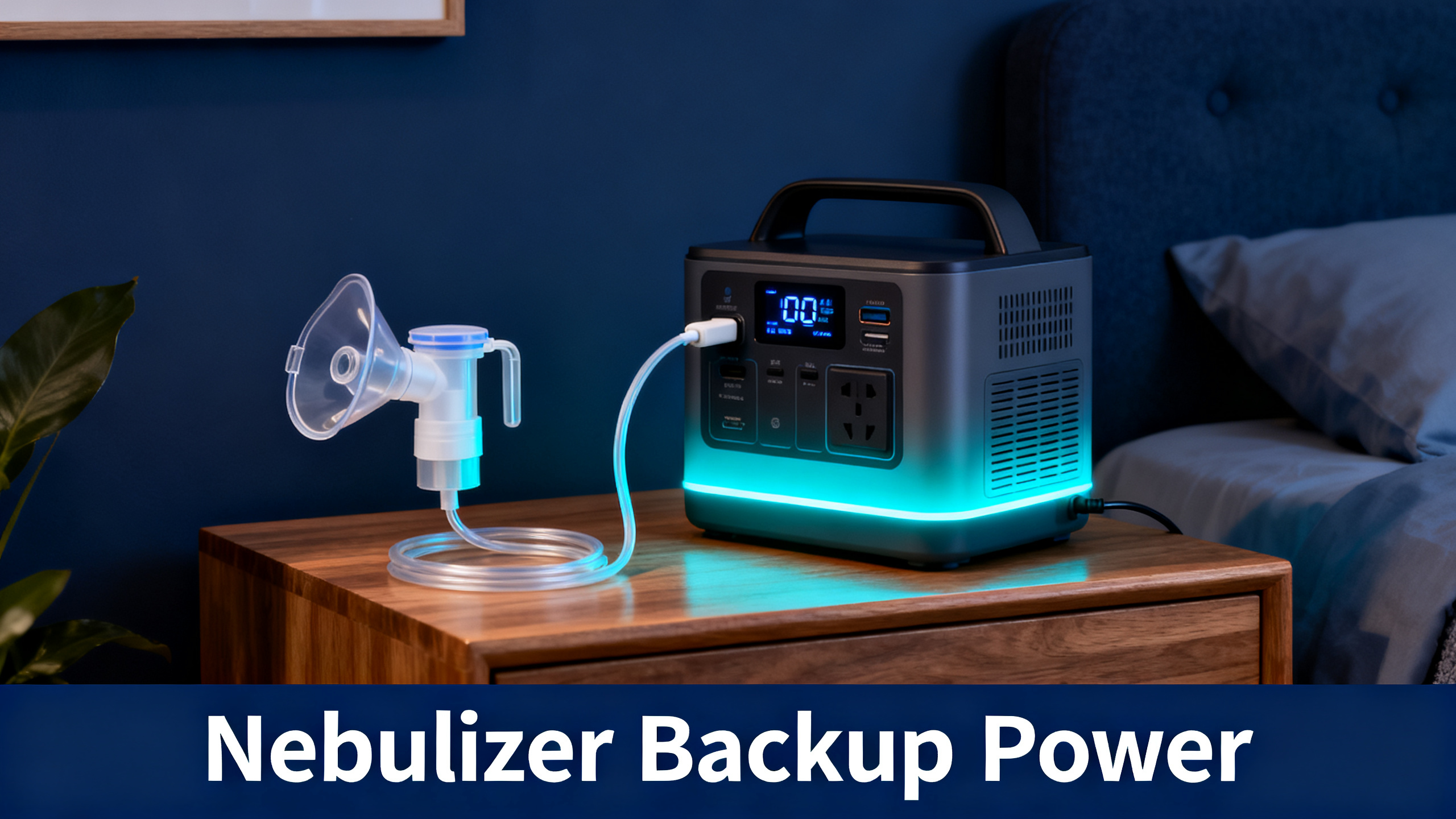
It’s 2 a.m. The power goes out. Your nebulizer is mid-treatment.
For the 25 million Americans living with asthma, and the 16 million managing COPD, a grid outage isn’t just an inconvenience. It’s a medical event. A standard compressor nebulizer stops instantly when power cuts. The medication stops. The treatment restarts from zero, or doesn’t restart at all if you can’t get the unit running again quickly. For patients managing acute respiratory conditions, that gap matters.
This guide covers the three portable power stations best suited for nebulizer backup: the Jackery Explorer 300, the Bluetti AC70, and the EcoFlow RIVER 3. Each was selected based on verified specifications, compressor compatibility, noise data, and runtime calculations specific to home nebulizer use. Whether you depend on a CPAP, oxygen concentrator, or nebulizer, our medical devices backup power guide covers every device with sizing recommendations and runtime data.
⚠️ Important: This article provides backup power planning information only. Always consult your healthcare provider for medical equipment recommendations and follow your nebulizer manufacturer’s electrical safety guidance.

Get our Black Friday alerts for power stations
We track live prices on 40+ models from Jackery, EcoFlow, BLUETTI and Anker SOLIX. When a deal beats the lowest price we've recorded, you'll hear from us. During Black Friday week, one short recap a day at most.
Unsubscribe in one click. We may earn a commission when you buy through our links, at no extra cost to you. Privacy Policy
Why Nebulizer Users Need Backup Power
The risk of mid-treatment outages
A compressor nebulizer converts liquid medication into a fine aerosol mist through continuous electrical operation. Unlike a metered-dose inhaler, there’s no on-demand mechanism. The treatment requires 10 to 20 minutes of uninterrupted power delivery. When the grid drops, the compressor stops, the aerosol stops, and the patient has to decide whether to restart the treatment or abandon it.
For most people, restarting is the answer. But for patients mid-rescue treatment during an acute attack, that interruption carries real risk. asthma management resources from the American Lung Association consistently identify medication delivery reliability as a key variable in attack severity outcomes.
Who is most affected
Nebulizer dependency spans several respiratory conditions. Asthma patients use them for rescue and maintenance treatments. COPD patients, whose airways narrow progressively over time, often rely on nebulized bronchodilators multiple times daily, as documented in resources covering COPD symptoms and treatment. Cystic fibrosis patients use nebulizers for inhaled antibiotics and airway clearance therapies. Pediatric patients and elderly users often lack the hand-eye coordination required to use inhalers effectively, making nebulizers their primary delivery method.
Each of these profiles shares a common need: the nebulizer cannot stop mid-cycle. A power station changes that calculus entirely.
Why backup power matters for nebulizer users
⚠️ The Risk
- Sudden grid outage during a treatment
- Nebulizer compressor stops mid-cycle
- Acute asthma or COPD attack with no medication delivery
- ER visit risk increases significantly
✓ The Solution
- Power station with AC outlet and UPS function
- Switchover under 20 ms keeps treatment running
- 3+ full treatments per charge
- Whisper-quiet operation for nighttime use
Understanding Your Nebulizer Power Requirements
Typical wattage of compressor nebulizers
Most home compressor nebulizers draw between 50 and 80 watts during operation. High-output clinical-grade units can reach 100 W, but the standard Pari, Philips Respironics, or Omron home models consistently measure in the 50 to 80 W range. For sizing purposes, 60 W is a reliable planning figure for the vast majority of home users.
This draw is well within the output capacity of every power station covered here. A 300 W continuous AC output handles a 60 W nebulizer with significant headroom. You could run the nebulizer, charge your phone, and power a small lamp simultaneously without approaching the unit’s limits.
How long is one treatment?
Standard medication delivery takes 10 to 20 minutes per treatment session. Most prescribed regimens call for 2 to 4 treatments per day. That translates to a total daily draw of 20 to 80 minutes of active compressor runtime. At 60 W, that’s 2 to 8 watt-hours (Wh) consumed per day under typical usage conditions.
Calculating total daily Wh needs
The math is straightforward. Take your compressor wattage (check the label, typically 50 to 80 W), multiply by treatment duration in hours, then multiply by the number of daily treatments. A 60 W unit running four 15-minute sessions consumes 60 W x 1 hour = 60 Wh per day. Even the smallest power station here (245 Wh on the EcoFlow RIVER 3) provides four full days of treatment under normal use before needing a recharge.
For a personalized calculation, the portable power station calculator on this site handles nebulizer inputs directly and outputs runtime and capacity recommendations specific to your usage pattern.
Jackery Explorer 300
$309.00
- 293 Wh, 300 W output (500 W surge)
- Lightweight, quiet 36.4 dB operation
- Charges to full in about 2.5 hours
Get our Black Friday alerts for power stations
We track live prices on 40+ models from Jackery, EcoFlow, BLUETTI and Anker SOLIX. When a deal beats the lowest price we've recorded, you'll hear from us. During Black Friday week, one short recap a day at most.
Unsubscribe in one click. We may earn a commission when you buy through our links, at no extra cost to you. Privacy Policy
Top 3 Power Stations for Nebulizer Backup
Jackery Explorer 300: best portable for daily backup
The Explorer 300 is the most portable option in this roundup, light enough for practical single-hand carrying between rooms. Spec analysis confirms the 293 Wh capacity and 300 W continuous output (500 W surge) handle any compressor nebulizer on the market with capacity to spare. At 60 W draw, that’s approximately 4 hours of continuous operation, or roughly 16 standard 15-minute treatments per charge.
Quiet operation is the standout specification here for medical use. Jackery rates the Explorer 300 at just 36.4 dB, below normal conversation level and well suited to nighttime bedroom use. It also refills fast, reaching a full charge in about 2.5 hours on AC power, so it’s easy to keep plugged in, topped up, and ready between outages. The 300 W AC output leaves headroom to run the nebulizer and charge a secondary device at the same time.
Where it falls short: 293 Wh is enough for typical outage scenarios (hours, not days), but multi-day outages or patients who need to run additional medical devices continuously will want more capacity. For a deeper look at performance and runtime data on this model, see our full Jackery Explorer 300 review.


Bluetti AC70: best capacity for extended outages
The AC70 is the capacity leader here. At 768 Wh, it delivers roughly 42 standard 15-minute nebulizer treatments per charge, based on a typical 60 W compressor draw. That’s enough backup to cover nearly three full days of four-treatments-per-day regimens without recharging. For patients in areas prone to multi-hour or multi-day grid disruptions, that margin is meaningful.
The 1,000 W continuous AC output (with Power Lifting Mode pushing to 2,000 W for higher-draw appliances) gives the AC70 flexibility beyond the nebulizer itself. You can simultaneously run a nebulizer, charge a phone, power a lamp, and run a small fan for comfort during an outage, without approaching the unit’s limits. The 0-to-80% charge in 45 minutes means you can restore most of your capacity during a brief grid restoration before the next outage window.
The trade-off is weight. At 22.5 lbs, the AC70 is not a one-hand carry. It’s a bedside or home-station unit rather than a travel companion. Our complete Bluetti AC70 review breaks down the 1,000 W output, Power Lifting Mode, and expansion options for medical use.


EcoFlow RIVER 3: best UPS protection for sensitive equipment
The RIVER 3 carries a specification that neither of the other two units can match: a sub-20-millisecond UPS switchover. In practical terms, this means that if grid power cuts during a nebulizer treatment, the RIVER 3 takes over in less than 20 ms, a transition imperceptible to the compressor motor. The treatment continues without interruption, without a reset, without a missed dose of medication.
For patients who use the nebulizer as a permanent bedside device, left plugged into the grid with the RIVER 3 acting as an inline UPS, this is the most medically relevant feature in the entire roundup. Manufacturer-published noise data rates operation at under 30 dB, which is below normal conversation level and well within acceptable range for nighttime bedroom use.
The trade-off is capacity. At 245 Wh, the RIVER 3 holds slightly less than the Explorer 300. Runtime calculations place it at roughly 13 standard 15-minute treatments per charge at a 60 W draw. For patients who face frequent short outages (minutes to hours), the UPS function provides the most direct protection. For multi-day outage scenarios, the AC70’s capacity advantage becomes more significant. We cover the sub-20 ms UPS function and X-Boost capability in our complete EcoFlow RIVER 3 review.

Quick Comparison: Which Power Station Wins for Your Situation?
The specs table below lays out the key decision variables side by side. The right choice depends on your specific situation: how long your typical outage lasts, how many devices you need to power, and whether UPS continuity is non-negotiable.
Which model fits your situation?
Choose Jackery 300 if…
- You want the most portable, lightweight unit
- You travel often or commute
- Your nebulizer is your only critical device
- You value fast recharging and quiet operation
Choose Bluetti AC70 if…
- You need 24-plus hour runtime backup
- You also charge phones, tablets, lights
- You face multi-hour outages regularly
- You want expandability for the future
Choose EcoFlow RIVER 3 if…
- UPS protection is non-negotiable
- You also use a CPAP at night
- You want IP54 dust/water protection
- You need the most affordable option
How Long Will Each Power Station Run a Nebulizer?
Runtime calculations follow a simple formula: divide total capacity (Wh) by the device wattage (W) to get hours of runtime, then convert to treatment sessions. A 60 W compressor nebulizer running 15-minute sessions completes 4 treatments per hour of runtime.
Keep in mind that inverter efficiency affects actual runtime. Most modern power stations operate at 85 to 90% inverter efficiency, meaning you lose a small percentage of rated capacity to heat conversion. The figures below use 85% efficiency to provide conservative, real-world estimates.
How many nebulizer treatments per full charge?
Jackery 300
💨
293 Wh • 60 W draw
~16
15-min treatments
Bluetti AC70
💨
768 Wh • 60 W draw
~42
15-min treatments
EcoFlow RIVER 3
💨
245 Wh • 60 W draw
~13
15-min treatments
Estimates based on average compressor nebulizer draw of ~60 W and 15-minute treatment cycles at 85% inverter efficiency. Actual figures vary by device.
Other Respiratory Devices to Consider
Nebulizers rarely exist in isolation within a medical home setup. Many patients who use a nebulizer for daytime treatments also rely on a CPAP or BiPAP machine at night for sleep-disordered breathing. The power requirements differ significantly: CPAP machines typically draw 30 to 60 W, BiPAP units slightly more. But the sizing logic is similar, and a power station sized for your nebulizer will usually handle your CPAP as well.
If you also use a CPAP machine at night, our dedicated CPAP backup power guide covers nightly runtime sizing and UPS requirements specific to sleep therapy. Oxygen concentrators are a different category entirely. They draw 150 to 400 W continuously, which puts them outside the capacity of the compact units here. A dedicated guide or a larger-capacity station (500 Wh or more, with 500 W minimum output) is the appropriate starting point for concentrator backup planning.
Best Power Stations for Medical Equipment at Home
Complete sizing guide covering CPAP, concentrators, nebulizers, and more.
Safety Considerations for Medical Backup Power
Two battery chemistries dominate the portable power station market: lithium nickel manganese cobalt (NMC) and lithium iron phosphate (LiFePO₂). For medical applications, LiFePO₂ carries a clear advantage. It operates at lower temperatures, carries significantly lower thermal runaway risk, and maintains stable chemistry across thousands of charge cycles. The Bluetti AC70 and EcoFlow RIVER 3 recommended here both use LiFePO₂ cells specifically for these durability and safety reasons, and whichever unit you choose, confirm the battery chemistry on the product page before buying.
Pure sine wave AC output is non-negotiable for medical equipment. Modified sine wave inverters, common in cheaper power stations, produce a stepped waveform that some compressor motors handle poorly. It can cause overheating, erratic operation, or premature motor failure in sensitive medical devices. Every unit in this guide outputs pure sine wave AC, which matches utility grid power and is safe for compressor nebulizers, CPAP machines, and other medical-grade equipment.
For storage and maintenance: keep the unit charged to 80 to 90% when in standby mode rather than 100%, which reduces calendar aging on LiFePO₂ cells. Store in a climate-controlled environment, away from extreme heat. Test the unit monthly by running a full treatment cycle to verify operational readiness. Review the FDA medical device safety guidance for recommendations on electrical safety standards for home medical equipment.
FAQ: Nebulizer Backup Power Solutions
Can a portable power station run a nebulizer machine?
Yes. Most home compressor nebulizers draw between 50 and 80 watts during operation, well within the 300 W output range of even compact power stations like the Jackery Explorer 300 or EcoFlow RIVER 3. Pure sine wave AC output is essential for medical equipment, which all three recommended models provide.
How long will a 300 Wh power station run a nebulizer?
A 300 Wh power station running a typical 60 W nebulizer compressor will deliver approximately 4 to 5 hours of continuous operation, or roughly 16 to 20 standard 15-minute treatments. Actual runtime varies by compressor efficiency and battery temperature.
Do I need a UPS function for my nebulizer power station?
A UPS function is highly recommended but not strictly required. Without UPS, a grid outage during a treatment will interrupt the compressor for 1 to 3 seconds while the inverter switches over, causing the cycle to restart. With UPS under 20 milliseconds (such as the EcoFlow RIVER 3), the transition is imperceptible to the device.
Is LiFePO₂ better than lithium-ion for medical backup?
LiFePO₂ chemistry is generally preferred for medical backup applications. It offers 3,000 to 4,000-plus charge cycles versus 500 to 1,000 for standard lithium-ion, runs cooler, and is significantly more thermally stable. The Bluetti AC70 and EcoFlow RIVER 3 in this guide use LiFePO₂ cells; check the product page to confirm the chemistry of whichever model you pick.
Can I use a power station for nebulizer treatments while flying?
Most power stations exceed FAA carry-on lithium battery limits (100 Wh maximum). The Jackery Explorer 300 (293 Wh), Bluetti AC70 (768 Wh), and EcoFlow RIVER 3 (245 Wh) all exceed this threshold and cannot be brought on commercial aircraft as carry-on items. For air travel, plan to use medical batteries below 100 Wh designed specifically for in-flight use and consult your airline before travel.
Should I leave my power station plugged in 24/7 for emergency readiness?
Modern LiFePO₂ power stations are designed for grid pass-through and can be left plugged in continuously. To extend cycle life, manufacturers often recommend setting a charge ceiling of 80 to 90% during pass-through mode. Check your specific model’s app or settings for battery management options. The EcoFlow RIVER 3’s UPS function is specifically designed for this always-on-standby use case.
EcoFlow RIVER 3
$199.00 $239.00
Best UPS protection: <20 ms switchover, whisper-quiet <30 dB
Price verified at publication. Free shipping available.
Conclusion
For most nebulizer users managing asthma or COPD at home, the right power station comes down to one question: what matters more, portability or capacity?
The Jackery Explorer 300 wins on portability: it’s lightweight, quiet at 36.4 dB, recharges in about 2.5 hours, and holds enough capacity (293 Wh) for roughly 16 treatments per charge. It’s the pick for patients who need to move the unit between rooms or take it to appointments. The Bluetti AC70 wins on capacity: 768 Wh delivers 42 treatments and multi-day backup coverage for households with extended outage risk. The EcoFlow RIVER 3 wins on protection continuity: its sub-20 ms UPS function keeps your treatment running without a single-second interruption when the grid cuts.
Whichever you choose, having backup power means one less worry on outage days. If portability matters above all, see our roundup of the best compact power stations for travel-ready medical backup solutions.
Originally published: April 30, 2026