
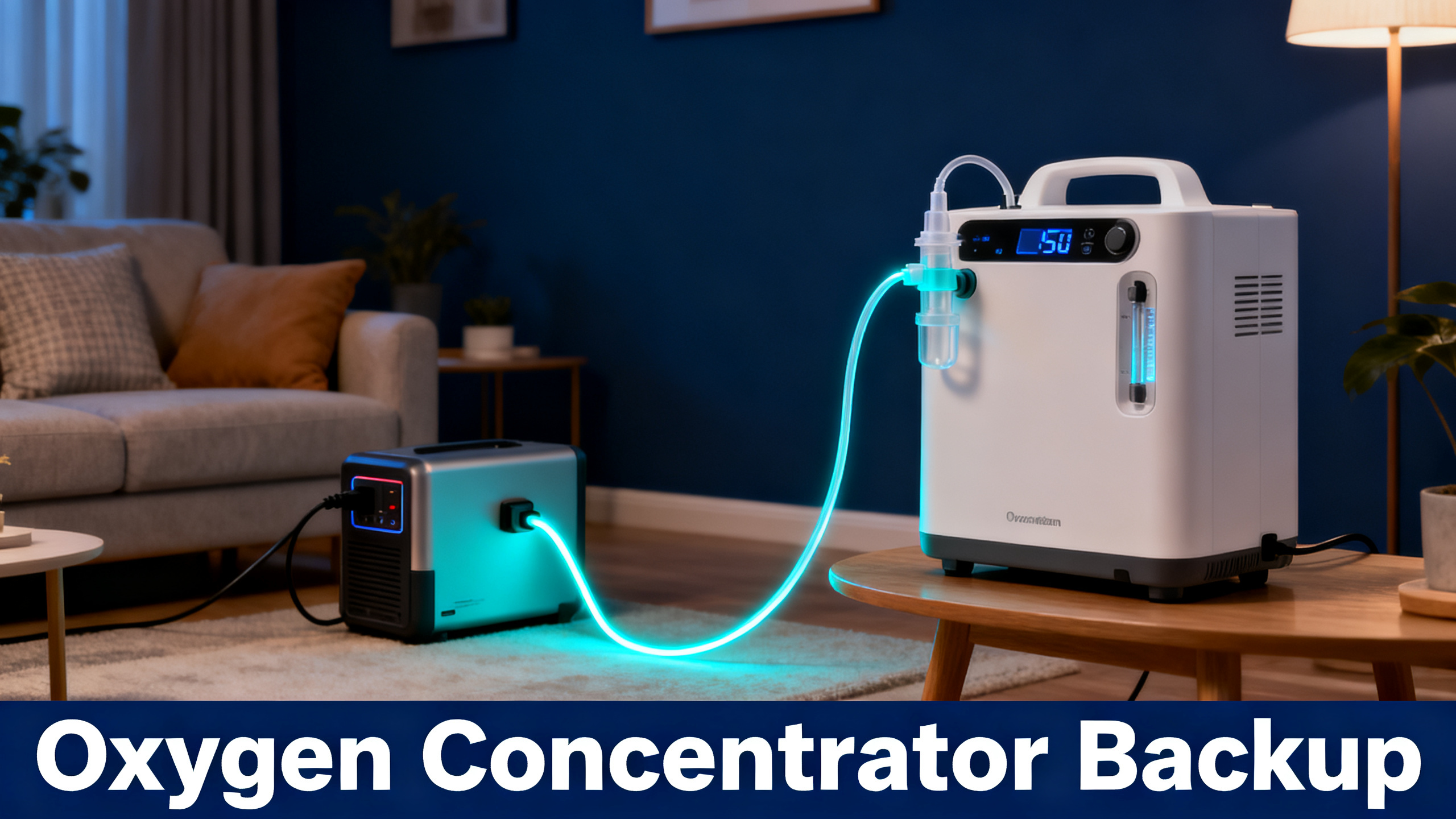
If your home runs on a prescribed oxygen concentrator, a power outage isn’t an inconvenience. It’s a clinical event. Building on our complete medical equipment power guide, this article zeroes in on one of the most safety-critical use cases: keeping an oxygen concentrator running through a power outage. According to the American Lung Association on supplemental oxygen, more than 1.5 million Americans rely on prescribed oxygen therapy at home, and most of them are using stationary 5L concentrators that shut down within seconds of an outage.
This guide walks through what oxygen concentrators actually draw, how to size a backup correctly, which power stations have the AC headroom and surge tolerance needed for medical-grade reliability, and what to avoid. Two products anchor the recommendations: the Anker SOLIX F2000 for 5L stationary use and overnight backup, and the EcoFlow DELTA Pro 3 for high-flow concentrators and UPS-grade switchover. Both are positioned as complementary picks for different patient profiles, not as a head-to-head duel.

⚠️ Medical disclaimer: This article provides general information about backup power for oxygen concentrators and is not medical advice. Patients dependent on prescribed oxygen therapy should discuss outage preparedness with their prescribing physician and durable medical equipment provider. In a serious outage, contact emergency services or your local utility’s medical baseline program.
Get the 1-page outage plan
What to plug in first, how long a fridge really runs on a battery, and the 3 safety rules for connecting a power station to your home. Printable, sent by email.
About one email a week. Unsubscribe in one click. We may earn a commission when you buy through our links, at no extra cost to you. Privacy Policy
Why Oxygen Concentrators Need Reliable Backup
The Stakes of an Outage
A stationary oxygen concentrator pulls room air, separates the nitrogen, and delivers concentrated oxygen at a prescribed flow rate. The moment AC power drops, the compressor stops and oxygen output ceases. For a patient on continuous prescribed oxygen, this is not a delay you can absorb the way a smartphone shutoff is. Symptoms can escalate within minutes for some clinical profiles, depending on the underlying condition and the prescribed flow rate.
The FDA guidance on oxygen concentrators explicitly recommends that users prepare for power outages with an alternate power source. That recommendation is the regulatory baseline. The practical question is which alternate source has the AC headroom, capacity, and switchover behavior to actually do the job.
What “Reliable” Actually Means for Medical Backup
Reliability for a medical device backup has three components. First, AC inverter output must comfortably exceed the device’s continuous draw, with surge headroom for compressor startup. Second, capacity (in watt-hours) must cover the planned outage window plus a safety margin. Third, switchover behavior should match the device’s tolerance: most concentrators handle a brief drop and restart, but the equation changes if a CPAP or BiPAP is paired in the same setup.
Cheap backup units marketed as “UPS” rarely meet medical-grade switchover thresholds, and their inverters often stall on a real concentrator’s startup surge. The cost of underspeccing here is measured in patient outcomes, not refunds.
Editor’s Pick for Oxygen Backup
Anker SOLIX F2000
$1,999
- 2,048Wh capacity, 2,400W AC (3,600W surge)
- 10-year InfiniPower lifespan, 5-year warranty
- 0 to 80% recharge in 1.4 hours
Common Concentrator Power Draws by Type
Oxygen concentrators span a wide power range, and matching backup capacity to a specific device starts with knowing the actual draw. The figures below come from manufacturer specifications and verified owner reports across the three main concentrator categories.
Portable Pulse-Dose Units (1-3L)
Portable concentrators like the Inogen One G5 or Philips SimplyGo Mini deliver oxygen in metered pulses synchronized with breath. They draw roughly 40 to 90W continuously and are designed around their own internal batteries. For these units, an external power station mainly serves as a recharge source rather than a runtime extender.
Stationary 5L Continuous-Flow
This is the segment where most home backup planning happens. A 5L stationary concentrator draws between 280 and 400W continuously at typical flow settings, with surge spikes around 600W when the internal compressor cycles. Reference data from the Inogen At Home stationary specs shows a typical draw of around 100W at flow setting 2, while the Philips Respironics EverFlo and similar 5L units sit closer to 300-350W.
High-Flow 8-10L Units
High-flow concentrators like the DeVilbiss 1025 or Respironics Millennium M10 push 450 to 650W continuously and surge above 900W during compressor cycling. These units are where surge handling becomes the real bottleneck: a power station rated 1,500W AC can technically run them in steady state but stall on startup. X-Boost or equivalent surge-handling modes become essential at this scale.
Get the 1-page outage plan
What to plug in first, how long a fridge really runs on a battery, and the 3 safety rules for connecting a power station to your home. Printable, sent by email.
About one email a week. Unsubscribe in one click. We may earn a commission when you buy through our links, at no extra cost to you. Privacy Policy
Sizing Your Backup: How Many Watt-Hours Do You Need?
The Quick Formula
The math is straightforward. Take your concentrator’s continuous draw in watts, multiply by the number of hours you want to cover, and divide by 0.85 to account for AC inverter efficiency losses. A 5L unit drawing 330W for 8 hours overnight needs roughly (330 × 8) / 0.85 = 3,106Wh of available battery, which means a 2,048Wh power station gets you about 5-6 hours, and a 4,096Wh unit gets you full overnight with comfortable margin.
To get a precise figure for your specific concentrator model and prescribed flow rate, use our oxygen concentrator runtime calculator, which factors in flow setting, ambient temperature, and the specific power station model.
Real-World Multipliers (Inverter Efficiency, Altitude)
Two factors push runtime below the textbook calculation. Inverter efficiency typically runs 85-90% on modern LiFePO4 power stations, meaning roughly 10-15% of battery energy is lost converting DC to AC. Altitude matters too: concentrators at higher elevations work harder to deliver the same prescribed flow, increasing draw by 5-15% above 4,000 feet.
💡 Pro Tip: Always size for 1.3x your calculated need. If math says 8 hours of backup requires 3,100Wh, plan for at least 4,000Wh. Real-world conditions, prescription changes, and degradation over the battery’s life all eat into theoretical capacity.
Overnight vs Multi-Day Targets
Overnight backup (8-10 hours) is the minimum credible target for any prescribed-oxygen household. A 2,048Wh unit covers a 5L concentrator at flow 2 for a full night. For 24-hour storm events, plan for 4,096Wh or pair a smaller unit with a generator. For multi-day grid-down scenarios, the only realistic strategy is a battery system with solar recharge plus generator backup, sized as a layered solution rather than a single device.
Best Power Stations for Oxygen Concentrators
Two units cover the realistic spectrum of home oxygen backup needs in 2026: the Anker SOLIX F2000 for standard 5L stationary use with overnight reliability priorities, and the EcoFlow DELTA Pro 3 for high-flow concentrators and setups that demand zero-interruption switchover. They solve different problems.

Editor’s Pick: Anker SOLIX F2000
The F2000 lands as the editor’s pick for households running a single 5L concentrator who prioritize long-term reliability over maximum capacity. Anker’s InfiniPower architecture pushes the design life to 10 years and 3,000 cycles to 80%+ capacity, backed by a full 5-year device warranty. For a household where the power station sits in a closet and gets cycled monthly for tests, that lifespan matters more than raw watt-hours.
Best for High-Flow + UPS: EcoFlow DELTA Pro 3
The DELTA Pro 3 is the choice when the concentrator profile demands more headroom or the setup includes paired CPAP/BiPAP equipment that resets on power loss. Its UPS function delivers under 30ms switchover, which is fast enough to keep most medical devices online without registering an interruption. The X-Boost feature handles up to 6,000W of surge, comfortably absorbing the compressor startup spike on 8-10L high-flow units.
Match the Power Station to Your Concentrator
✅ Anker F2000 fits if…
- You have a 5L stationary or portable pulse concentrator
- You need overnight to single-day backup (8-12 hours)
- 10-year warranty peace-of-mind matters more than UPS speed
- Your outage planning is for 12-24 hour scenarios
🔵 EcoFlow DELTA Pro 3 fits if…
- You run a high-flow 8-10L unit (X-Boost handles surge)
- You need UPS <30ms switchover (no concentrator reset)
- You want 48-hour+ runtime with expansion batteries
- You’ll add solar for indefinite off-grid backup
❌ Both are overkill if…
- You only use a battery-powered portable concentrator
- Your outages typically last under 2 hours
- You already have a whole-home generator
- Budget under $1,200 (consider Anker C1000 instead)
Recommended Models in Detail
Anker SOLIX F2000: Spec Walkthrough
The F2000 packs 2,048Wh of LiFePO4 battery into a unit rated for 2,400W continuous AC output and 3,600W surge. The InfiniPower architecture is engineered for a 10-year design life, with the LiFePO4 cells holding 80%+ capacity through 3,000 charge cycles. Recharge from empty to 80% takes 1.4 hours on AC, which means you can top off between outages without an overnight wait.
The unit carries 12 ports total, including 6 AC outlets, USB-C with PD, and DC outputs. WiFi and Bluetooth app control let you monitor remaining capacity remotely, useful for caregivers checking backup readiness without being on-site. For full specs, port layout, and runtime testing notes, see our detailed Anker SOLIX F2000 with 10-year warranty review.
For a 5L concentrator drawing 330W, the F2000 delivers around 5-6 hours of runtime in standard conditions. That’s enough for most overnight scenarios at typical flow settings. The Anker SOLIX F2000 ships with a 5-year full-device warranty, the longest in the segment for non-expandable single-unit power stations.
Anker SOLIX F2000 Full Review
Detailed spec walkthrough, port layout, and runtime breakdowns.
EcoFlow DELTA Pro 3: Spec Walkthrough
The DELTA Pro 3 doubles the F2000’s battery to 4,096Wh and pushes AC output to 4,000W with X-Boost to 6,000W. The capacity is expandable to 48 kWh with optional batteries, which moves this unit from “overnight backup” territory into “multi-day grid-down” territory. UL9540 certification confirms it meets residential safety standards for stationary energy storage.
Two features matter specifically for oxygen backup. First, the UPS function switches over in under 30ms, fast enough to keep concentrators, CPAP machines, and BiPAP units online without triggering a reset. Second, X-Boost handles surge spikes that would stall smaller units when a high-flow concentrator’s compressor cycles. Users with high-flow units like the Inogen At Home or 5-10L stationary concentrators should look at the EcoFlow DELTA Pro 3 for high-flow concentrators, where the X-Boost feature handles the compressor surge that smaller units stall on.
Recharge speed is a strength here too. AC recharge from 0 to 80% takes roughly 50 minutes, and the unit accepts up to 2,600W of solar input for off-grid operation. The 4,000-cycle rating to 80% capacity matches Anker’s longevity claims, with EcoFlow backing the unit with a 5-year warranty.
Anker F2000 Runtime by Concentrator Type (2,048Wh capacity)
🩺
Portable Pulse
~24 hrs
~70W draw
🏠
5L Stationary
~5-6 hrs
~330W draw
💨
10L High-Flow
~3 hrs
~580W draw
🌙
5L Overnight
Full night
8-9 hrs at flow 2
Estimates based on 85% AC inverter efficiency. Actual runtime varies with flow setting, altitude, and ambient temperature.
Powering 5L+ High-Flow Concentrators
The Compressor Surge Problem
High-flow concentrators draw their continuous load steadily, but the internal compressor cycles on and off, and each cycle triggers a brief inrush current spike. On a 10L unit, that spike can hit 900-1,200W for fractions of a second. Power stations with marginal AC inverters detect this as an overcurrent event and either stall, fault out, or reset.
The practical effect is that a unit rated 1,500W AC may run a high-flow concentrator perfectly in steady state, then trip the moment the compressor restarts. For medical use, this is a hard fail: the concentrator stops, the patient loses oxygen flow until the unit is reset, and the cycle can repeat.
Why X-Boost Matters Here
X-Boost is EcoFlow’s surge-handling mode that lets the inverter momentarily exceed its rated continuous output. On the DELTA Pro 3, this means the unit can absorb up to 6,000W of brief surge, which comfortably covers any home oxygen concentrator on the market plus headroom for paired devices. The Anker F2000’s 3,600W surge handles 5L stationary units cleanly but lacks margin for high-flow setups.
Combined Use: Oxygen + Other Respiratory Equipment
Adding a CPAP or BiPAP
Many users running an oxygen concentrator at night also rely on a CPAP machine, in which case our CPAP backup if also used guide explains how to size a single power station for both. The combined draw is straightforward: a 5L concentrator at flow 2 plus a typical CPAP totals roughly 350-380W, well within either recommended unit’s continuous output.
The complication is switchover behavior. CPAPs and BiPAPs typically reset on power loss, requiring the user to wake up and reinitialize the device. UPS-grade switchover under 30ms prevents this, which is why the DELTA Pro 3 becomes the better fit for combined sleep-equipment setups even when capacity isn’t the binding constraint.
Concentrator + Nebulizer
Nebulizer use is intermittent (10-15 minutes per treatment, several times per day) and adds 60-100W during operation. Sizing for a concentrator already covers nebulizer overhead with margin, since treatments are short and don’t run concurrently with the main backup load in any meaningful way. Plan for one nebulizer treatment in your overall watt-hour budget and don’t worry about it beyond that.
Real-World Scenarios
Scenario 1: Single Overnight Outage
A storm knocks out power at 9 PM and crews restore service by 6 AM. For a 5L stationary user at flow 2 (around 280-330W), the F2000’s 2,048Wh delivers a full overnight with battery to spare. Switchover happens within seconds for a non-UPS unit, which most concentrators handle without operator intervention.
Scenario 2: 24-Hour Storm Event
Hurricane aftermath knocks out power for a full day. A single F2000 won’t cover this on its own at 5L continuous flow, so the strategy shifts to either a DELTA Pro 3 (which gets you 12-14 hours and stretches further with reduced ambient activity) or pairing the F2000 with a small inverter generator that runs daytime to recharge the battery for nighttime use.
Scenario 3: Multi-Day Grid-Down
Wildfire-related Public Safety Power Shutoffs in California, ice storms in Texas, and major hurricanes routinely produce outages of 3-7 days. No single power station covers this without recharge inputs. The realistic configuration is a DELTA Pro 3 or comparable expandable unit, paired with 800-1,600W of solar panels and a backup generator for cloudy stretches.
Long Outages: Multi-Day Strategy
Battery Expansion
The DELTA Pro 3’s expandability to 48 kWh means a single base unit plus expansion batteries can cover several days of 5L continuous oxygen use without solar input. The F2000 is not expandable, which limits it to single-night scenarios in its base configuration. For households planning around extended outages, expandability is a hard requirement.
Solar Recharge Realities
Solar panel output is wildly variable. A 400W array delivers its rated wattage only under ideal conditions: midday sun, clear sky, panels angled correctly, no shade. Real-world daily yield typically lands at 50-65% of rated capacity. For a 5L concentrator drawing 7,920Wh per day (330W × 24 hours), you’d need roughly 1,200W of solar panels to fully cover daily draw with battery storage absorbing nighttime use.
Generator Pairing
An inverter generator running 2-3 hours per day to recharge the battery is often the most cost-effective multi-day strategy. A small 2,000W inverter generator burns roughly 0.5 gallons per hour at half load, meaning 1-2 gallons of fuel per day to keep a power station topped up. For multi-day outage scenarios, our emergency oxygen planning resource walks through stockpiling, generator pairing, and evacuation triggers.
Safety Considerations
Cooling and Ventilation
Power stations under sustained load generate heat. Both the F2000 and DELTA Pro 3 have active cooling, but they need clear airflow around the chassis. Don’t bury the unit in a closet or against a wall during extended use. Keep at least 6 inches of clearance on all vented surfaces, and avoid placing the unit on carpet that can block bottom intake vents.
Surge Protection
When grid power returns, the surge can damage sensitive medical electronics. A power station running in pass-through mode acts as a buffer, but during a transition back to grid, brief over-voltage events do occur. UPS-mode units (DELTA Pro 3) handle this transition cleanly. For non-UPS units, consider plugging the concentrator into the power station via a quality surge protector for the first few minutes after grid restoration.
When to Evacuate Instead
For severe events with predicted outages exceeding your tested backup capacity, evacuation to a hospital, hotel with power, or designated emergency shelter is the right call. Local utilities maintain “medical baseline” registries for prescribed-oxygen households, and many emergency management agencies provide priority shelter access. Don’t ride out a multi-day grid-down event on a backup system you haven’t actually tested.
⚠️ Important: Never adjust your prescribed oxygen flow rate to extend battery runtime. Reducing flow without medical guidance can cause serious harm. If your backup capacity is insufficient for the expected outage duration, contact your prescribing physician about evacuation options or alternate arrangements.
What to Avoid
Underspeccing the AC Inverter
The most common mistake is buying a 1,000W power station for a 5L concentrator because the continuous draw is “only” 330W. Surge tolerance is what matters. Target at least 2,000W AC continuous with 3,000W+ surge for any 5L stationary unit, and 3,000W+ continuous for high-flow configurations.
Trusting Cheap UPS-Marketed Units
Computer-grade UPS units (the kind you’d plug a desktop into) are not designed for the sustained load and surge profile of a medical concentrator. Their batteries hold minutes of runtime, not hours, and their inverters often distort the AC waveform in ways that can damage concentrator electronics. Stick to power stations specifically rated for medical-grade equipment use.
Skipping Annual Tests
A backup system that hasn’t been exercised in 12 months is not a backup system. Run a monthly self-test: unplug the concentrator from grid power, plug it into the power station, and verify it operates normally for at least 30 minutes. Annual full-discharge tests catch capacity degradation before a real outage exposes it.
Conclusion
Backup power for a prescribed oxygen concentrator is one of the most consequential purchases in the home power station category. The Anker SOLIX F2000 fits households running a single 5L concentrator who prioritize 10-year reliability and overnight coverage. The EcoFlow DELTA Pro 3 fits high-flow setups, paired-CPAP scenarios, and multi-day outage planning. The right pick depends on the specific concentrator, the planned outage window, and whether sleep equipment is in the loop.
Whichever unit you choose, validate the configuration with a 30-minute test on day one and a full-discharge test annually. A backup that hasn’t been proven on your specific concentrator is a hypothesis, not a plan.
Anker SOLIX F2000
$1,999
10-year design life. The reassurance you want behind a vital device.
Price verified April 28, 2026 · Free shipping on most orders
Frequently Asked Questions
Will a Jackery run a 5L oxygen concentrator?
Most 5L stationary concentrators draw 280 to 400W continuously and surge near 600W when the compressor kicks in. A Jackery Explorer 1000 v2 (1,070Wh, 1,500W AC) will run a 5L unit for roughly 2.5 to 3 hours. For overnight use, target a 2,000Wh+ unit such as the Anker SOLIX F2000 or EcoFlow DELTA Pro 3.
Do home oxygen concentrators have battery backup built in?
Stationary 5L home concentrators typically do not include internal batteries. Most rely entirely on AC mains and shut down within seconds of an outage. Some portable pulse-dose units (Inogen One G5, SimplyGo Mini) include integrated batteries good for 4 to 13 hours, but those are different devices used for ambulation.
Can I run my concentrator on solar alone?
Solar can extend runtime indefinitely if conditions cooperate, but cloudy days and nighttime mean solar must be paired with a battery (the power station). A 400W solar array can offset most of a 5L concentrator’s daytime draw on a clear day, leaving the battery to cover nights.
What’s the safest power station for oxygen during a hurricane?
Look for three features: AC output of at least 2,000W with surge headroom for compressor startup, capacity of 2,000Wh or more for overnight runtime, and a UPS-grade switchover under 30ms (EcoFlow DELTA Pro 3 is currently the leading option). Pair with a generator for multi-day events.
How long should my backup last for a CPAP-and-oxygen setup?
Plan for at least 8 to 10 hours of combined runtime. A 5L concentrator at flow 2 plus a typical CPAP draws around 350W combined, which means a 2,048Wh unit (Anker F2000) covers a full night with margin. For 24-hour events, add an expansion battery or generator.
Is a UPS function necessary for oxygen concentrators?
Strictly necessary, no. Most oxygen concentrators tolerate a brief power drop and restart within seconds. UPS-grade switchover (under 30ms) becomes important if your concentrator is paired with a CPAP, BiPAP, or sleep equipment that resets on power loss, or if you live in an area with frequent brief outages.
Originally published: April 30, 2026