
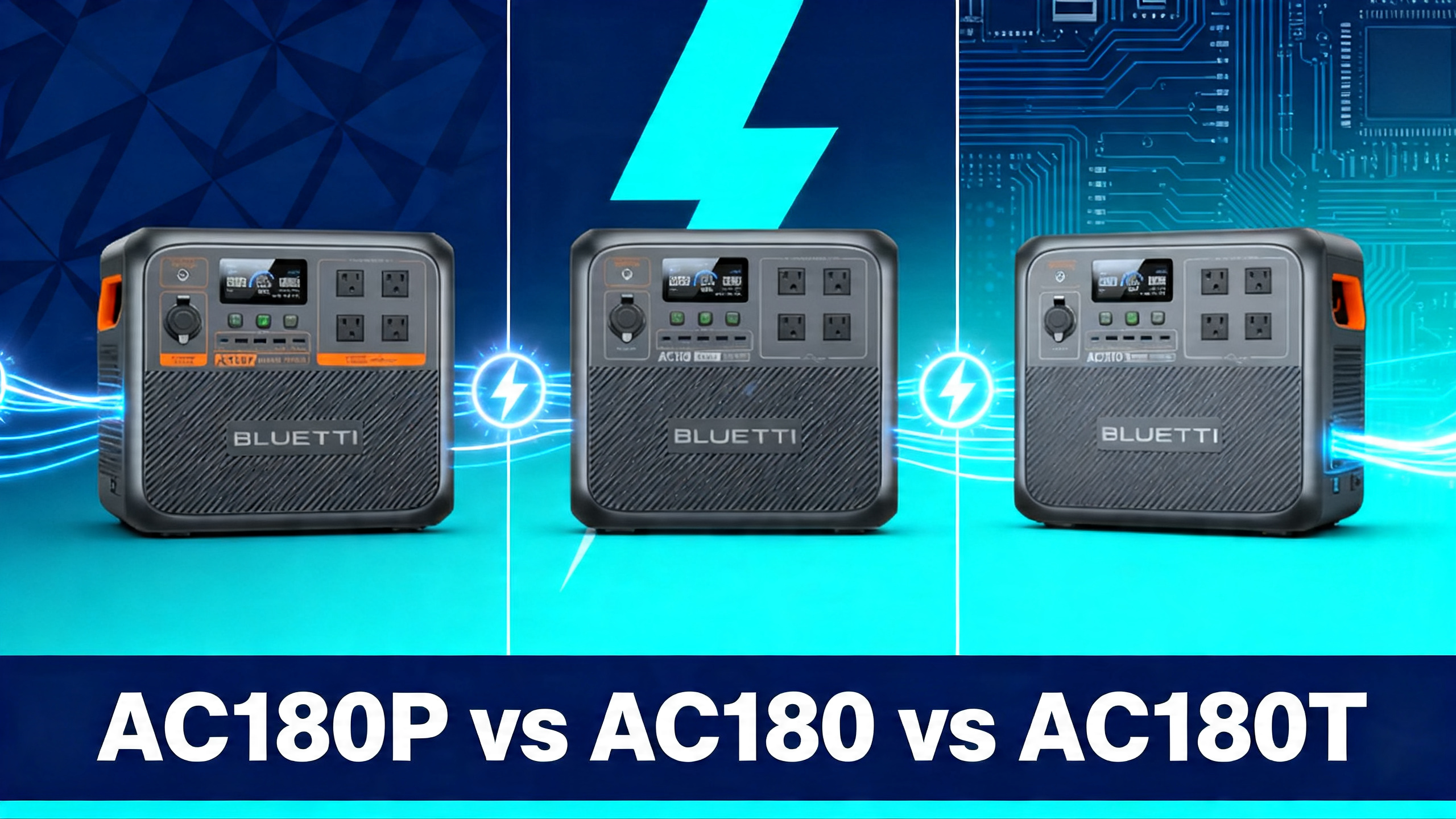
Choosing between the AC180, AC180P, and AC180T feels confusing at first glance. All three share the same 1,800W output, the same LFP battery chemistry, and the same fast 1.5-hour charge time. The prices run from $449 to $799, yet the spec sheets look nearly identical on the surface.
Here’s how the family actually breaks down. The AC180 is the entry point: 1,152Wh at $449, built for occasional users who want proven reliability without paying for capacity they won’t use. The AC180P steps up to 1,440Wh at $649, adding 288Wh of storage for $200 more. The AC180T (Pioneer MD) lands at $799 with 1,433.6Wh across two swappable LFP battery packs, a fundamentally different architecture from the other two.


This analysis covers the differences that actually matter for your buying decision: capacity, price-per-watt-hour, real-world runtime implications, and the specific scenarios where each upgrade pays off.
Spoiler: for most buyers, the AC180P wins the value argument. But the AC180T has a genuine advantage that the specs alone don’t capture, and the base AC180 remains a rational choice for its target audience.
BLUETTI AC180P
$649 $999
- 1,440Wh capacity (288Wh more than AC180)
- 1,800W AC output with LFP battery (3,500+ cycles)
- 500W max solar input, charges in ~1.5 hours
Get our Black Friday alerts for BLUETTI
We track live prices on 40+ models from Jackery, EcoFlow, BLUETTI and Anker SOLIX. When a deal beats the lowest price we've recorded, you'll hear from us. During Black Friday week, one short recap a day at most.
Unsubscribe in one click. We may earn a commission when you buy through our links, at no extra cost to you. Privacy Policy
At a Glance: Key Differences
Before diving into the detailed breakdown, here’s what separates these three 1,800W stations at a glance.
- The AC180P delivers 25% more capacity for 44% more money than the AC180. For regular users, the math favors the upgrade.
- All three share identical output (1,800W), solar input (500W), and charge speed. The differences are capacity and battery architecture only.
- The AC180T’s swappable Pioneer MD batteries are a genuine differentiator, not a marketing label. Whether that differentiator matters to you is the key question.
AC180 Deep Dive: The Value Baseline
The AC180 is priced at $449 (down from $699) and stores 1,152Wh of energy. At $0.39 per watt-hour, it has the best raw cost-per-capacity ratio in the family. The output is 1,800W continuous, and it uses LFP (lithium iron phosphate) chemistry, which means 3,500+ cycles before significant degradation.
Runtime calculations based on the 1,152Wh capacity and 85% system efficiency put a 60W mini-fridge at roughly 16 hours, a laptop (45W average) at around 21 charges, and a CPAP machine (30W average) at approximately 12 nights. For occasional users, those numbers comfortably cover a weekend camping trip or a short power outage.

Where the AC180 shows its limits: multi-day outages with several appliances running simultaneously, or van life scenarios where you’re running a fridge continuously and charging devices overnight. At 1,152Wh, the buffer gets thin. Owners looking for deeper analysis should consult the full AC180 review before deciding.
Best fit: weekend camping (1-2 nights), emergency home backup for essentials, occasional power needs where the lower entry price is the primary constraint.
Get our Black Friday alerts for BLUETTI
We track live prices on 40+ models from Jackery, EcoFlow, BLUETTI and Anker SOLIX. When a deal beats the lowest price we've recorded, you'll hear from us. During Black Friday week, one short recap a day at most.
Unsubscribe in one click. We may earn a commission when you buy through our links, at no extra cost to you. Privacy Policy
AC180P Deep Dive: The Sweet Spot
The AC180P is priced at $649 (down from $999) and stores 1,440Wh. That’s 288Wh more than the base AC180 for $200 more. Breaking down the incremental cost: you’re paying roughly $0.69 per additional watt-hour, which is higher than the AC180’s base rate, but the overall price-per-Wh lands at $0.45, still reasonable for LFP chemistry at this output level.
The output, solar input, and charge speed are identical to the AC180. There’s no significant weight difference. What changes is the energy reservoir: 25% more stored capacity means 25% longer runtime on every device you connect.

Runtime calculations for the AC180P at 85% efficiency: mini-fridge runs approximately 20 hours, laptop charges around 28 times, portable AC unit (200W average) gets roughly 6 hours. That extra margin matters in multi-day scenarios where the AC180 would run thin by day two. For a complete specification breakdown and runtime analysis, see our full AC180P review.


For a regular user (camping 3-4 times per year, occasional home backup), the cost per cycle over the LFP lifespan (3,500+ cycles) slightly favors the AC180P: more energy delivered per cycle at a per-Wh acquisition cost that’s only marginally higher. The incremental $200 buys meaningful headroom, not a marginal spec bump.
Best fit: home backup as the primary power source, van life, multi-day camping trips, users who run a fridge overnight and charge multiple devices. This is the option that handles the most common use cases without overpaying for features most users won’t need.
See the official AC180P product page for the complete technical specifications.
AC180T Deep Dive: The Pioneer MD Difference
The AC180T (Pioneer MD) is priced at $799 (down from $1,299) and stores 1,433.6Wh across two physically swappable LFP battery packs of 716.8Wh each. The output specs are identical to the AC180P: 1,800W continuous, 500W solar input, 1.5-hour charge time. On paper, you’re paying $150 more than the AC180P for 6.4Wh less capacity.
The premium is entirely in the Pioneer MD architecture. Those two battery packs can be physically removed and replaced with freshly charged units. In practice, this means a field user with two or three spare packs can swap depleted batteries mid-trip without waiting for an AC charge. No other model in the AC180 family offers this.

That said, the swappable system only justifies the premium if swapping is actually part of your workflow. If you always recharge from AC at home or at a campsite with hookups, the AC180T’s defining feature sits unused. In that scenario, spec analysis indicates the AC180P offers better value at $150 less. The swappable-battery mechanism is covered in detail in the full AC180T review.

Best fit: expeditions or remote field use where AC charging is unavailable for extended periods, RV users who charge multiple packs simultaneously and rotate them, anyone building a Pioneer MD ecosystem for long-term off-grid flexibility. For specs and compatibility details, visit the Pioneer MD technology page.
Solar Charging Performance
All three models accept up to 500W of solar input using the same MPPT (maximum power point tracking) controller technology. Solar compatibility is identical across the family, and all three support the same BLUETTI panel lineup (SP200L, PV350D, and others).

With a full 500W array (five 100W panels or equivalent), estimated solar recharge times are approximately 2.5 hours for the AC180 (1,152Wh), 3 hours for the AC180P (1,440Wh), and 3 hours for the AC180T (1,433.6Wh). Real-world conditions, panel angle, and cloud cover will affect actual times. All three models share identical 500W solar input specs. Our guide to the best solar panels for the AC180 family covers compatible options across budgets.
Solar performance does not differentiate the buying decision here. If solar capability is your primary criterion, all three models are interchangeable on this dimension.
Who Should Buy Each Model
Which AC180 Model Is Right for You?
Buy the AC180 ($449) if…
- Budget is the primary constraint
- Use is occasional (camping weekends, power outages)
- 1,152Wh covers your typical device list
- You want the proven, most popular option
Buy the AC180P ($649) if…
- You want 25% more capacity for $200 more
- Frequent users who need extra overnight runtime
- Home backup for refrigerator + lights + devices
- Best overall value in the family for most buyers
Buy the AC180T ($799) if…
- Field use where AC charging is unavailable
- Swappable batteries are genuinely useful to you
- RV/van life with multiple battery packs in rotation
- Pioneer MD ecosystem appeals for future expansion

Price-Per-Watt Analysis: Is the Upgrade Worth It?
The numbers tell a clear story when you break down the cost per watt-hour across all three models.
| Model | Price | Capacity | $/Wh | Verdict |
|---|---|---|---|---|
| AC180 | $449 | 1,152Wh | $0.39/Wh | Best for budget buyers |
| AC180P | $649 | 1,440Wh | $0.45/Wh | Best overall value |
| AC180T | $799 | 1,433.6Wh | $0.56/Wh | Premium for swappable system |
What Can the AC180P Power? (1,440Wh @ 85% efficiency)
🔌
Mini Fridge
~20 hrs
60W avg
💻
Laptop
~28 charges
45W avg
❄️
Portable AC
~6 hrs
200W avg
📱
Smartphone
~100 charges
14W avg
🔦
LED Lights
~70 hrs
18W avg
Runtime calculations based on 1,440Wh capacity at 85% system efficiency. Actual runtime varies with load and temperature.
For a regular user (3 sessions per week over the LFP lifespan of 3,500 cycles), the cost per use across all three models is close. But the AC180P delivers meaningfully more energy per session than the AC180, and meaningfully more value than the AC180T unless the swappable system is actually part of your workflow. Budget-constrained buyers looking for a compact option should consider the Elite 100 V2 as a smaller alternative at $399.
Verdict: Our Recommendation
Performance data across all three models points to the AC180P as the right choice for most buyers in this comparison. At $649, it delivers 1,440Wh of LFP storage, 25% more capacity than the AC180, with identical output and solar specs. The $200 premium over the base model buys real-world headroom, not a marginal spec improvement.
Pick the AC180 if your budget is under $500 and your use is genuinely occasional (a camping trip twice a year, backup for a short outage). Pick the AC180T if field use without AC access is a real part of your life, not a theoretical scenario. For the remaining 80% of buyers, the AC180P represents the best compromise in the family.
Conclusion
The AC180 family gives you three distinct entry points into the same 1,800W platform. The AC180 at $449 is the rational budget choice for occasional users. The AC180P at $649 is the capacity upgrade that makes sense for regular use, home backup, and van life. The AC180T at $799 is the specialist option for field users who genuinely need swappable battery packs.
Spec analysis consistently points to the AC180P as the best overall value for most buyers comparing these three models. It delivers 25% more capacity for 44% more than the AC180, while the AC180T’s additional $150 buys a feature that only matters in specific off-grid scenarios.
For a broader look at where these models fit in the full Bluetti lineup, our Bluetti brand overview covers every current model from $199 to $5,000+.
BLUETTI AC180P
$649
Best all-rounder in the AC180 family
Price verified April 2026. Free shipping available
Frequently Asked Questions
What is the difference between the BLUETTI AC180 and AC180P?
The AC180P has 1,440Wh compared to the AC180’s 1,152Wh, a 25% capacity increase for $200 more. Both deliver 1,800W AC output, accept 500W solar input, and use the same LFP battery chemistry. The output specs are identical. The upgrade is purely in stored energy, not performance.
Is the BLUETTI AC180T worth the extra cost over the AC180P?
The AC180T costs $150 more than the AC180P yet offers slightly less capacity (1,433.6Wh vs 1,440Wh). The premium is justified only by the Pioneer MD swappable battery system. If you regularly need to swap battery packs in the field during remote expeditions or extended off-grid use, the AC180T makes sense. For home backup and camping with grid access, spec analysis indicates the AC180P offers better value.
Can the BLUETTI AC180P power a refrigerator?
Runtime calculations based on the 1,440Wh capacity and an average 60W refrigerator draw show approximately 20 hours of runtime at 85% system efficiency. Full-size refrigerators averaging 150W reduce that estimate to around 8 hours. The AC180P handles a mini-fridge comfortably through the night and into the next day.
Which BLUETTI AC180 model is best for camping?
For 1-2 night trips with minimal devices, the AC180 at $449 covers the needs without overpaying. For 3+ night trips or van life where running a fridge overnight is expected, the AC180P’s 1,440Wh provides meaningful additional buffer. The AC180T targets off-grid users who specifically need battery swapping capability rather than standard camping scenarios.
Do all three AC180 models support expansion batteries?
The AC180 and AC180P are compatible with the B80 expansion battery module. The AC180T uses a different system: its two internal 716.8Wh LFP packs can be swapped out for additional charged packs, which is a different expansion philosophy from the B80 add-on approach used by the other two models.
Originally published: April 16, 2026