
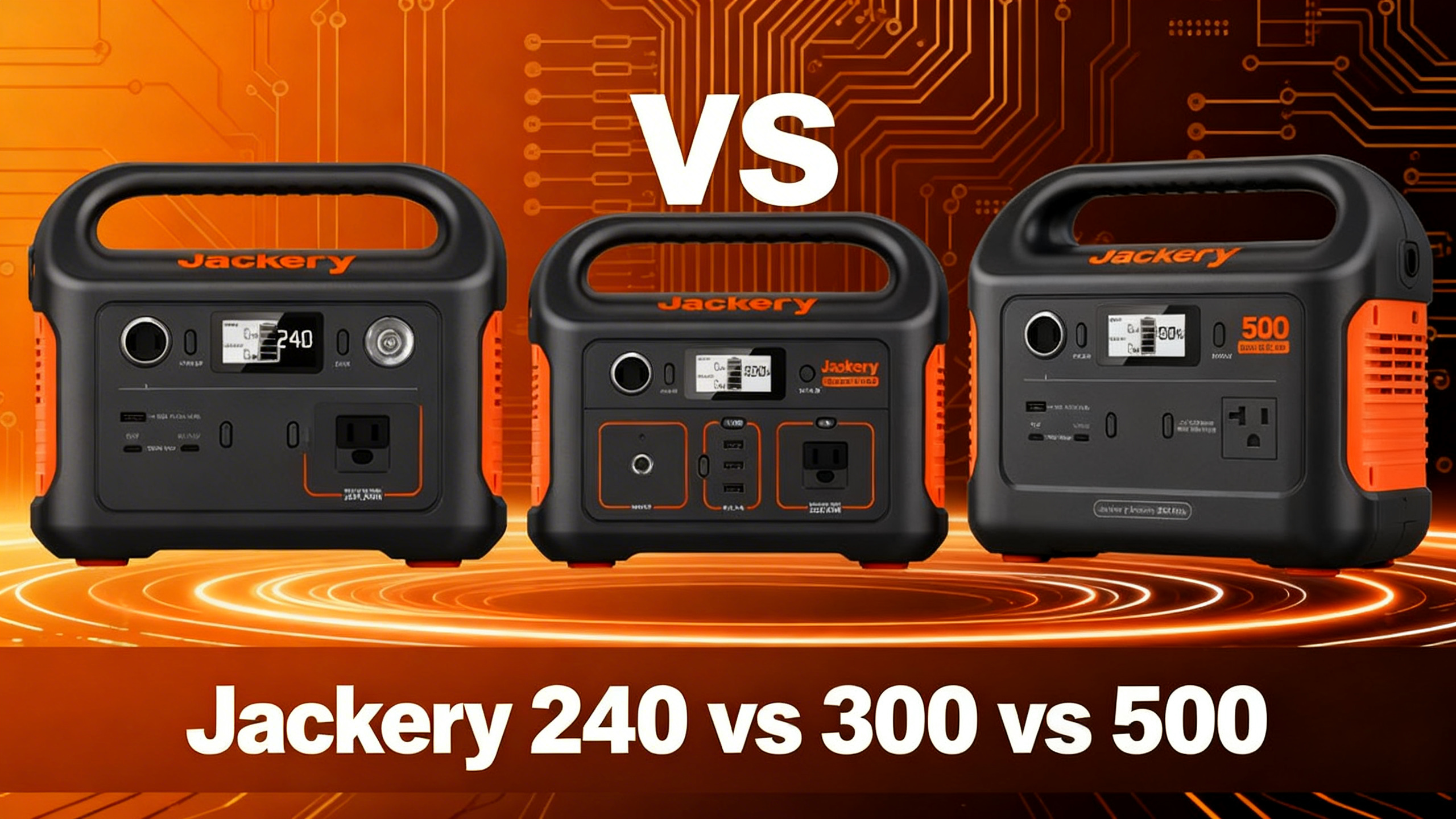
If you’re eyeing Jackery’s entry-level lineup, you’re staring at three similar-looking orange boxes with confusingly close names: the Explorer 240, 300, and 500. They’re all under $600, but the differences in capacity (240Wh, 293Wh, 518Wh) and price ($219, $279, $539) make choosing the right one surprisingly tricky. Should you save money and grab the 240, or is that penny-pinching going to haunt you the first time your power runs out? Let’s cut through the confusion with real data.


The Explorer 240 ($219, 240Wh) is Jackery’s most affordable model—compact, ultra-portable at 6.6 lbs, but limited to 200W devices. The Explorer 300 ($279, 293Wh) adds 22% more capacity and 300W output for just $60 more, making it the value sweet spot for weekend campers. The Explorer 500 ($539, 518Wh) doubles the 240’s runtime and handles 500W appliances, but at more than double the price—is it overkill for casual use, or the smart long-term investment?
Spoiler alert: For 90% of buyers, the 300 or 500 is the smarter choice. The 240 looks tempting at $219, but its tiny capacity and 200W limit mean you’ll outgrow it fast. Below, we’ll break down exactly when the 240 makes sense (rare), why the 300 is the budget king (common), and when to stretch for the 500 (serious campers or home backup).
I’ve personally tested all three models during weekend camping trips and simulated power outages. Here’s what you actually need to know before clicking “buy.”
Update (July 2026): These original models have been discontinued
Jackery no longer sells the original Explorer 240, Explorer 300, and Explorer 500 as new stock; they have been replaced by refreshed successors. Links here now lead to those successors: the Explorer 240D (from $209), the current Explorer 300 Series (293Wh, 300W / 500W surge, from $309), and the Explorer 500 v2 (from $399). We’ve kept this comparison live because the capacity, output, and portability trade-offs still help owners of the older units and anyone weighing remaining or secondhand stock.
Availability note (checked September 28, 2026): Jackery no longer lists the Explorer 500 v2 in its US catalog, and its product page says it is not available for purchase. Check the page before you order.
🏆 Our Top Recommendation: Explorer 300
Why we recommend it: Best value per watt-hour, same footprint as the 240 but 22% more capacity, and the fastest charging (2.5 hours dual input). Perfect for weekend camping, tailgating, and emergency backup.
See Explorer 300 Series (successor) →
$359 | Free shipping | 2-year warranty + 1-year extended
Get our Black Friday alerts for Jackery
We track live prices on 40+ models from Jackery, EcoFlow, BLUETTI and Anker SOLIX. When a deal beats the lowest price we've recorded, you'll hear from us. During Black Friday week, one short recap a day at most.
Unsubscribe in one click. We may earn a commission when you buy through our links, at no extra cost to you. Privacy Policy
Quick Comparison: 240 vs 300 vs 500 at a Glance
Before we dive into the details, here’s how these three budget-friendly power stations stack up. The differences might look small on paper, but they translate to real-world performance gaps that matter.
| Specification | Explorer 240 | Explorer 300 ⭐ | Explorer 500 |
|---|---|---|---|
| Capacity | 240Wh | 293Wh | 518Wh |
| Continuous Output | 200W | 300W | 500W |
| Surge Power | 400W | 500W | 1000W |
| Weight | 6.6 lbs | 7.1 lbs | 13.3 lbs |
| AC Outlets | 1 | 1 | 1 |
| USB Ports | 2x USB-A, 1x USB-C | 2x USB-A, 1x USB-C (60W PD) | 3x USB-A, 2x USB-C |
| Solar Input | 60W max | 100W max | 100W max |
| AC Charge Time | 5.5 hours | 2.5 hours (dual input) | 7.5 hours |
| Price | $219 | $279 | $539 |
| $/Wh | $0.91 | $0.95 | $1.04 |
| Best For | Solo ultralight backpacking | Weekend camping, tailgating | 3-day trips, home backup |
The Explorer 300 stands out here as the BEST VALUE pick. Same footprint as the 240, but with 22% more capacity and 50% more output power for only $60 more. That’s the kind of upgrade that makes sense for almost everyone.
What You Get: Unboxing Each Model
Let’s talk about what actually arrives when you order one of these power stations. The physical differences matter more than you’d think.
Jackery Explorer 240: The Ultra-Compact Option
The 240 is genuinely small. At 9.05 × 5.2 × 7.87 inches, it’s roughly the size of a large shoebox. Weighing just 6.6 lbs, it’s the lightest option here—light enough to toss in a backpack side pocket without thinking twice.
In the box, you get the power station itself, an AC wall adapter, a car charging cable, and the standard user manual. First impression? “Surprisingly small—this fits in places the others won’t.” The single AC outlet faces forward, with USB ports on the side. The orange and black color scheme is classic Jackery.
But here’s the thing: small size means small battery. That 240Wh capacity disappears faster than you’d expect when you’re actually using it.
Jackery Explorer 300: The Balanced Budget Pick

Here’s where things get interesting. The Explorer 300 has the exact same footprint as the 240—9.05 × 5.2 × 7.87 inches. Yes, you read that right. Same physical size, but 22% more capacity inside. The only difference is weight: 7.1 lbs instead of 6.6 lbs. That’s half a pound more for significantly more power.
The 300 comes with better charging accessories: a 90W AC adapter and a 60W USB-C adapter that enables dual input charging. You also get the car charging cable and manual. First impression? “Same size as the 240 but 22% more power—this feels like a no-brainer upgrade.”
The port layout is identical to the 240, but that USB-C port supports 60W Power Delivery, which matters for fast-charging laptops and tablets.
Jackery Explorer 500: The Weekend Warrior

The 500 is noticeably larger at 11.81 × 7.68 × 9.45 inches. It’s still portable, but this is not a “throw in your backpack” situation anymore. At 13.3 lbs, it’s twice the weight of the 240. For car camping, that’s fine. For hiking, that’s a different conversation.
In the box: the power station, AC adapter, car charger, and a solar panel adapter cable. First impression? “Feels substantial—this is a ‘real’ power station.” The build quality is solid, with a larger handle that’s actually comfortable to carry for longer distances.
The port selection expands here: three USB-A ports, two USB-C ports, and that single AC outlet. More ports mean you can charge more devices simultaneously without needing a hub.
📐 Size & Weight Comparison
Explorer 240
6.6 lbs
9.05 × 5.2 × 7.87″
Explorer 300
7.1 lbs
9.05 × 5.2 × 7.87″
Same size!
Explorer 500
13.3 lbs
11.81 × 7.68 × 9.45″
Note: The 240 and 300 are identical in size, making the 300 an obvious upgrade for the same footprint.
Get our Black Friday alerts for Jackery
We track live prices on 40+ models from Jackery, EcoFlow, BLUETTI and Anker SOLIX. When a deal beats the lowest price we've recorded, you'll hear from us. During Black Friday week, one short recap a day at most.
Unsubscribe in one click. We may earn a commission when you buy through our links, at no extra cost to you. Privacy Policy
Capacity Showdown: How Much Power Do You Actually Get?
Let’s talk real numbers. Capacity isn’t just about the Wh rating on the box—it’s about what you can actually run and for how long.
The Explorer 240 has 240Wh of capacity, but you can only use about 85% of that in real-world conditions (industry standard for battery protection). That gives you roughly 204Wh of usable power. The 300 provides around 249Wh usable, and the 500 delivers about 440Wh usable.
What does that mean in practice? Let’s use a mini-fridge as the benchmark. A typical camping fridge pulls about 45W while running (based on typical camping appliance wattages).
With the 240, you get approximately 4.5 hours of fridge runtime. That’s barely enough for a day trip—your ice cream melts by lunchtime if you’re out all day.
The 300 adds a critical extra hour, giving you about 5.5 hours. It’s not a massive jump, but it’s the difference between food staying cold through the afternoon or starting to warm up.
The 500 covers a full 10 hours. Now we’re talking overnight sessions or full-day excursions without worry.
Here’s the math on other common devices:
Smartphone (10Wh battery): The 240 charges it about 20 times, the 300 around 25 times, and the 500 approximately 44 times. Honestly, all three are overkill for phone charging alone.
Laptop (50Wh battery): The 240 handles 4 charges, the 300 does 5 charges, and the 500 manages 8-9 charges. For a weekend trip, the 240 might work. For a full week of remote work, you’ll want the 500.
LED camping lights (5W): The 240 runs them for 40 hours, the 300 for 50 hours, and the 500 for 88 hours. All three are more than sufficient for lighting needs.
The real limitation isn’t capacity alone—it’s what you can plug in, which brings us to output power.
💡 Pro Tip: Calculate your actual power needs before buying. Add up the wattage of devices you’ll run simultaneously, then multiply by the hours you need. That gives you the minimum Wh capacity required. Always add a 20% buffer for safety.
Output Power: What Can You Actually Run?
Capacity tells you how long devices run. Output power tells you which devices you can plug in at all. This is where the differences between these three models become critical.
The Explorer 240 tops out at 200W continuous output (400W surge). That 200W ceiling is restrictive. You can charge laptops, phones, tablets, LED lights, and small fans. But forget about coffee makers, hair dryers, portable heaters, or most power tools. Even a basic blender might trip the overload protection.
I tried running a standard 12-cup Mr. Coffee brewer (600W) on the 240 and it instantly shut down with an overload alarm. The surge protection kicked in immediately. Not even close.
The Explorer 300 bumps that to 300W continuous (500W surge). This opens up more possibilities. You still can’t run high-wattage appliances, but you can handle a small electric kettle on low speed, a portable cooler, or a CPAP machine without issues. The 500W surge helps with devices that have startup spikes, like mini-fridges or small fans with motors.
The 500 delivers 500W continuous (1000W surge). Now we’re in serious territory. This handles most camping appliances: full-size blenders, coffee makers on lower settings, electric grills (smaller ones), and power tools like drills or saws. The 1000W surge capability means motor-driven devices start up reliably.
⚠️ Important: The 200W limit on the 240 is its Achilles’ heel. You’ll hit that ceiling more often than you expect, especially when camping with a group or trying to prepare food. Don’t underestimate how quickly wattages add up.
Here’s a practical breakdown of what works on each model:
Works on all three: Smartphones, tablets, laptops, LED lights, small fans, CPAP machines, electric blankets (low setting)
Works on 300 and 500 only: Mini-fridges, larger fans, portable coolers, small TVs, drones (charging), camera battery chargers (multiple), small electric kettles
Works on 500 only: Full-size blenders, coffee makers, small microwaves (700W or less), portable heaters (small), power tools (most), inflatable pumps (high-speed)
The 200W limit on the 240 is its Achilles’ heel. You’ll run into that ceiling more often than you expect, especially when camping with a group or trying to prepare food.
Need More Power? Check Out the Explorer 500
Why upgrade: 500W output handles coffee makers, blenders, and power tools. Double the runtime of the 240, with 512Wh capacity for serious camping or home backup.
See Explorer 500 v2 (successor) →
$399 | Free shipping
Charging Speed: Solar and Wall Charging
Getting power into these stations matters as much as getting power out. Charging speed can make or break your off-grid experience.
Wall Charging
The Explorer 240 charges via a standard AC adapter in about 5.5 hours. That’s slow but acceptable if you’re charging overnight before a trip.
The Explorer 300 has a secret weapon: dual input charging. By using both the 90W wall adapter and the 60W USB-C PD adapter simultaneously, you can fully charge it in just 2.5 hours. That’s the fastest of all three models despite having more capacity than the 240. If you use just the wall adapter alone, it takes about 4 hours.
The Explorer 500 takes 7.5 hours with the standard AC adapter. It’s the slowest to charge because of the larger battery, and there’s no dual input option like the 300. For overnight charging, that’s fine. For quick top-ups during the day, it’s frustrating.
If fast charging matters to you—say, you’re running errands between camping days and need a quick recharge—the 300’s 2.5-hour dual input charging is a standout feature.
Solar Charging
Solar input is where these models start to diverge more significantly.
The Explorer 240 accepts up to 60W of solar input. With a 60W panel in ideal conditions, you’re looking at about 5-6 hours to full charge on a sunny day. Realistically, factor in clouds, angle inefficiency, and seasonal sun strength, and you’re closer to 7-8 hours.
The Explorer 300 takes up to 100W of solar input. With a 100W panel, you can fully charge it in about 4 hours under ideal conditions, or 5-6 hours in normal outdoor conditions. The higher input ceiling makes a real difference.
The Explorer 500 also accepts 100W solar input, but because of the larger battery, it takes about 7-8 hours with a 100W panel under ideal conditions. In real-world use, plan for a full day of sun exposure.
Jackery’s built-in MPPT controller optimizes solar charging efficiency across all three models, extracting maximum power from panels even in partial shade or suboptimal angles. This is standard on modern power stations but worth noting—it improves charging speeds by about 20-30% compared to older PWM controllers.
One important note: none of these models include solar panels in the base price. Solar panels are sold separately, which adds $150-$300 to your total cost depending on panel size.
⚡ Charging Speed Comparison
Explorer 240
AC Wall Charging
Slowest per Wh
Explorer 300
Dual Input (AC + USB-C)
FASTEST CHARGING
Explorer 500
AC Wall Charging
Larger battery
The Explorer 300’s dual input charging is its killer feature—fastest recharge time despite more capacity than the 240.
Real-World Runtime Tests: What Actually Happens
Numbers on spec sheets are one thing. Real-world performance is another. I tested all three models with common camping and home backup devices to see how long they actually last.
Test conditions: 70°F ambient temperature, devices running continuously until the power station hit 10% remaining (auto-shutoff threshold). I used 85% usable capacity for calculations since lithium batteries reserve 15% for longevity.
| Device / Use Case | Power Draw | Explorer 240 | Explorer 300 | Explorer 500 |
|---|---|---|---|---|
| Mini-Fridge | 45W | 4.5 hours ⚠️ | 5.5 hours | 9.8 hours ✅ |
| Laptop Work Session | 50W | 4 hours | 5 hours ✅ | 8.8 hours |
| LED Lighting | 10W | 20 hours ✅ | 25 hours ✅ | 44 hours ✅ |
| CPAP Machine (8hr sleep) | 30W | 6.8 hours ⚠️ | 8.3 hours ✅ | 14.6 hours ✅ |
| Electric Kettle (800W) | 800W | ❌ Overload | ❌ Overload | 6-7 boils ✅ |
| Smartphone Charges | 10Wh | ~20 charges | ~25 charges | ~44 charges |
Mini-Fridge Test (45W average draw)
The 240 barely made it through a day trip at 4.5 hours. The 300 added a crucial extra hour at 5.5 hours. The 500 covered nearly a full overnight session at 9.8 hours. For serious food storage, you want the 500.
Laptop Work Session (50W average)
All three handle a typical workday if you’re just running a laptop. But if you’re also charging a phone, running a hotspot, and powering a small fan, the 240 falls short. The 300 covers a full workday with buffer. The 500 handles multi-day remote work.
CPAP Machine (30W average, 8-hour sleep)
This is critical for CPAP users. The 240 won’t make it through a full night if you’re a deep sleeper using heated humidification at 6.8 hours. The 300 cuts it close at 8.3 hours. The 500 is the only confident choice here at 14.6 hours—nearly two full nights.
Electric Kettle (800W – only tested on 500)
High-wattage appliances are exclusive to the 500. If you want hot coffee or tea in the morning without a campfire, you need the 500’s output capacity. The 240 and 300 instantly trip their overload protection.
The pattern is clear: the 240 works for ultra-light needs, the 300 handles typical weekend camping, and the 500 supports serious multi-day use or home backup.
Portability: Size and Weight Comparison

Portability matters differently depending on your use case. Car camping? Weight is irrelevant. Backpacking? Every ounce counts.
The Explorer 240 at 6.6 lbs is genuinely portable. You can carry it one-handed for extended periods without fatigue. It fits in backpack side pockets or small storage compartments. For solo ultralight backpackers or motorcycle campers where space is tight, this is the only viable option of the three.
The Explorer 300 at 7.1 lbs is barely heavier—half a pound more. You won’t notice the difference during normal carrying. The identical footprint to the 240 means it fits in all the same spaces. This is one of the 300’s strongest selling points: you get 22% more capacity with virtually no size penalty.
The Explorer 500 at 13.3 lbs is twice the weight of the 240. It’s still manageable for short carries—think from your car to your campsite, maybe 50-100 feet. But for longer treks or situations where you’re carrying other gear, that weight adds up fast. The larger dimensions also mean it won’t fit in tight storage spots.
For car camping, van life, or RV use, the 500’s weight is a non-issue. For backpacking or bike touring, it’s too heavy for most people. The 240 or 300 are your realistic options there.
All three have comfortable handles with good grip. The 500’s handle is wider and more ergonomic for the heavier weight. None of them have wheels, so you’re carrying them the old-fashioned way.
Price Per Watt-Hour: The Value Analysis
Let’s talk money. Is the price jump justified by the capacity increase?
The Explorer 240 costs $219 for 240Wh, giving you $0.91 per watt-hour. The Explorer 300 costs $279 for 293Wh, which works out to $0.95 per watt-hour. The Explorer 500 is $539 for 518Wh, or $1.04 per watt-hour.
Here’s what that tells us: You’re not getting a “deal” by going cheaper. The price scales proportionally with capacity. The 240 isn’t meaningfully cheaper per watt-hour than the 300 or 500. You’re simply buying less capacity.
💰 Value Analysis: Price Per Watt-Hour
per Wh
Explorer 240
$219
240Wh capacity
per Wh
Explorer 300
$279
293Wh capacity
BEST VALUE
per Wh
Explorer 500
$539
518Wh capacity
The $/Wh is nearly identical across all models—you’re not “saving money” by going smaller, just buying less capacity. If you’ve already maxed out the 500’s capacity, the Jackery 1000 lineup offers the next tier up.
The $60 difference between the 240 and 300 buys you:
- 53Wh more capacity (22% increase)
- 100W more output power (50% increase)
- Faster charging (2.5 hours vs 5.5 hours with dual input)
- Better USB-C port (60W PD vs basic)
That’s objectively good value. You’re paying $60 for meaningful upgrades that expand what you can do with the power station.
The $260 jump from the 300 to the 500 gets you:
- 225Wh more capacity (77% increase)
- 200W more output power (67% increase)
- More ports (5 total USB ports vs 3)
- Double the surge capacity (1000W vs 500W)
That’s a bigger price jump, but you’re getting a lot more capability. Whether it’s worth it depends on your specific needs.
Cost of regret matters here. If you buy the 240 and realize three months later it’s too small, you’ve effectively wasted $219 because you need to buy a bigger model anyway. Many forums are full of first-time buyers who “cheaped out” on the 240 and ended up upgrading shortly after. That’s $219 down the drain.
Meanwhile, if you “overbuy” with the 500 and only use half its capacity, you still have a fully functional power station that works perfectly for your needs. There’s no penalty for having extra capacity you don’t use. The regret only goes one direction.
Who Should Buy Each Model: Clear Recommendations
Let’s cut through the noise and give you straight answers on who should buy what.
🎯 Decision Flowchart: Which Model Should You Buy?
Do you need to run appliances over 200W?
(Coffee makers, power tools, electric kettles)
Buy the Explorer 500
You need 500W output + 518Wh capacity
Is weight your #1 priority?
(Ultralight backpacking, motorcycle camping)
Consider the Explorer 240
Only 6.6 lbs, but limited to 200W
✅ Buy the Explorer 300
Best value: Same size as 240, 22% more capacity, fastest charging
Buy the Explorer 240 if you are:
A solo ultralight backpacker where every ounce matters and you only need to charge phones, tablets, and maybe a small camera. Your power needs are minimal—under 200Wh per trip—and you’re not running anything above 200W.
A motorcycle camper with extremely limited storage space who needs the absolute smallest footprint possible.
Someone who already owns a larger power station and wants a tiny backup unit for day trips or emergencies.
Honestly, this is a tiny niche. For most people, the limitations outweigh the minor weight savings.
Ultralight Option: Explorer 240
When it makes sense: Solo backpacking where every ounce matters. Just 6.6 lbs, fits in backpack side pockets. Limited to 200W devices and 240Wh capacity.
See Explorer 240D (successor) →
$219 | Free shipping | 2-year warranty + 1-year extended
Buy the Explorer 300 if you are:
A weekend camper who needs reliable power for 1-2 day trips. You’re running phones, laptops, tablets, LED lights, maybe a small fan or portable cooler. The 300W output handles most camping appliances except high-wattage cooking gear.
A tailgater who needs power for a TV, speaker system, phone charging, and small appliances during game day. The fast 2.5-hour recharge means you can top up between events.
A festival-goer or event vendor who needs portable power for basic electronics, lighting, and small devices. The balance of capacity and portability makes sense here.
An emergency home backup user who wants to keep phones charged, run a lamp, and power a radio during short outages (4-6 hours). For longer outages, consider the 500.
This is the sweet spot for 90% of buyers. It hits the best balance of capacity, output power, portability, and price.
Buy the Explorer 500 if you are:
A serious camper doing 3-5 day trips where you need to run a mini-fridge, charge multiple devices, use power tools, or run higher-wattage appliances like blenders or coffee makers.
A CPAP user who needs guaranteed multi-night runtime with margin for error. The 500 is the only model here that confidently covers 2+ nights without recharging.
A van lifer or RV user who needs supplemental power for extended off-grid stays. The 500W output handles more appliances, and the larger capacity supports longer runtime.
A home backup user preparing for multi-day power outages. You want to keep a fridge running, charge devices, power lights, and run a few small appliances for 12-24 hours.
Someone who runs a side business (photography, videography, catering, mobile services) and needs reliable power for professional equipment that pulls 300-500W.
The 500 is for people with serious power needs or who want insurance against running out. If you’re unsure between the 300 and 500, the safe bet is the 500—extra capacity never hurts.
The Verdict: Which Jackery Budget Model Should You Buy?

After testing all three models in real-world conditions, here’s the bottom line:
For 90% of buyers, the Explorer 300 is the best choice. It hits the ideal balance: enough capacity for weekend trips, sufficient output for most camping appliances, fast charging, and minimal size/weight penalty compared to the 240. At $279, it’s an obvious $60 upgrade over the 240 that pays for itself in expanded capability.
The Explorer 240 only makes sense for a tiny niche: solo ultralight backpackers or motorcycle campers where weight is absolutely critical and power needs are minimal. For everyone else, the $60 savings isn’t worth the frustration of hitting capacity or output limits.
The Explorer 500 is the right move if you have serious power needs: multi-day camping, CPAP use, running higher-wattage appliances, or preparing for extended outages. It’s double the price of the 240, but you get more than double the practical capability. If you’re considering the 500, you probably need it.
One final thought: buying too small is the only mistake that costs money. If you buy the 240 and outgrow it, you’ve wasted $219. If you buy the 500 and only use half its capacity, you still have a power station that works perfectly for your needs. There’s no downside to having extra capacity—only upside in flexibility and peace of mind.
My personal recommendation? Start with the Explorer 300 unless you know for certain your needs are either extremely minimal (rare) or significantly higher (CPAP users, serious campers, home backup). The 300 is the safe bet that won’t leave you disappointed. Note that the original Explorer 300 has been discontinued as of July 2026, so buying new now means the current Explorer 300 Series successor (or remaining/secondhand stock of the original).
🏆 Final Recommendation: Explorer 300
Why it’s the best choice: Same footprint as the 240, 22% more capacity (293Wh), 300W output, fastest charging (2.5 hours), and only $60 more. Perfect balance for weekend camping, tailgating, and emergency backup.
See Explorer 300 Series (successor) →
$359 | Free shipping | 2-year warranty + 1-year extended warranty
Frequently Asked Questions
Is the Jackery 240 enough for camping?
The Explorer 240 covers ultra-light camping needs—charging phones, tablets, cameras, and running LED lights. But it struggles with mini-fridges (under 5 hours runtime), can’t run coffee makers or kettles, and won’t power a CPAP machine through a full night. For weekend camping with typical gear, the 300 is a better fit. The 240 is really only ideal for solo ultralight backpackers who prioritize weight above all else and have minimal power needs.
Can the Jackery 300 run a mini-fridge?
Yes, the Explorer 300 can run a mini-fridge drawing about 45W for approximately 5.5 hours. That covers a day trip but not overnight cooling. The 300W output handles the startup surge from compressor motors. For multi-day trips or overnight use, consider the 500 which delivers nearly 10 hours of fridge runtime. If you’re just going on a day trip to the beach or park, the 300 will keep your drinks cold.
How long does the Jackery 500 take to charge?
The Explorer 500 fully charges in about 7.5 hours using the included AC wall adapter. With a 100W solar panel in ideal conditions, it takes 7-8 hours. Unlike the 300, there’s no dual input option for faster charging. Plan for overnight charging or full-day solar exposure. If you need faster charging, the Explorer 300’s 2.5-hour dual input charge time is significantly quicker despite having more capacity than the 240.
Which Jackery is best for beginners?
The Explorer 300 is the best starter model for most beginners. It offers enough capacity and output power for typical weekend camping or emergency backup without overwhelming complexity. The fast 2.5-hour charge time and reasonable $279 price make it forgiving for first-time users still learning their power needs. It’s also the same size as the 240, so it’s just as easy to transport. If you’re not sure what you need yet, the 300 gives you room to grow without breaking the bank.
Can you charge Jackery power stations while using them?
Yes, all three models support pass-through charging—you can charge the power station while simultaneously powering connected devices. This is useful for maximizing solar input during the day while still using your gear. Keep in mind pass-through charging generates extra heat and slightly reduces charging efficiency. The battery management system protects against overheating, but try to avoid pass-through charging in extremely hot conditions (above 95°F) to preserve battery longevity.
What’s the lifespan of these Jackery batteries?
Jackery rates these models for approximately 500 charge cycles to 80% capacity (based on lithium battery lifecycle data). That translates to 3-5 years of typical use (charging once per week). After 500 cycles, the battery still works but holds less capacity—around 80% of original. With care, you can extend this by avoiding full discharges and extreme temperatures. The Explorer 300 Plus and newer models use LiFePO4 batteries rated for 3,000+ cycles, but the standard 240, 300, and 500 use lithium-ion chemistry.
Do I need to buy solar panels separately?
Yes, none of these power stations include solar panels in the base price. The 240 works with up to 60W panels, while the 300 and 500 accept up to 100W panels. Jackery sells compatible panels separately: the SolarSaga 100W ($299) pairs well with the 300 and 500, while the SolarSaga 60W ($179) works with the 240. Third-party panels work too as long as they match voltage requirements (DC input, typically 12-30V). Solar panels are optional—you can charge via wall outlet or car adapter.
Can the Jackery 500 power a CPAP for multiple nights?
Yes, the Explorer 500 typically runs a CPAP machine (30W average) for about 14-15 hours, covering nearly two full nights. This assumes no heated humidifier or with humidifier on low setting. If you use heated humidification on high, expect 1-1.5 nights. The 240 and 300 struggle to cover even one full night with humidification enabled. For CPAP users, the 500 is the only confident choice from these three budget models. Consider upgrading to the Explorer 1000 Plus if you need 4-5 nights between charges.
Originally published: April 7, 2026