
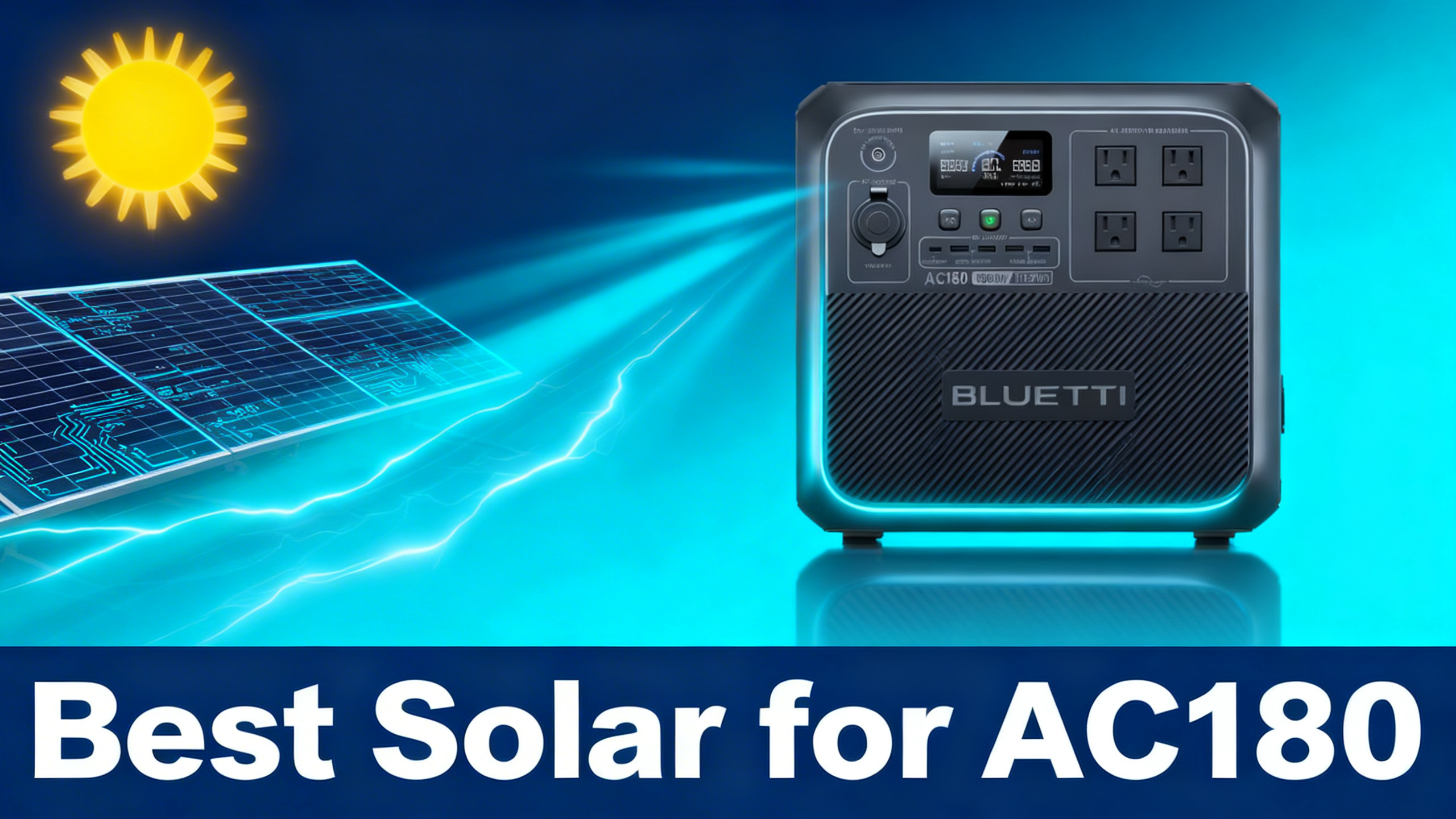
The Bluetti AC180 ships ready to charge from solar. What it doesn’t include is a panel. That gap matters more than most buyers realize: panel wattage is the single biggest variable in how quickly you replenish the AC180’s 1,152Wh battery. Spec analysis of the compatible lineup confirms the difference is not marginal. Going from 100W to 200W cuts charge time nearly in half. Adding a 350W panel brings a full recharge under four hours in strong sunlight.
This guide covers the three Bluetti-native panels that connect directly to the AC180 with zero adapters required. Each is ranked by the use case it serves best, with charge time calculations based on the AC180’s published capacity and an 85% MPPT efficiency factor. For a full breakdown of every Bluetti panel available, the full Bluetti solar panel lineup review covers all current models.

At a Glance: Best Solar Panels for Bluetti AC180
* Estimate based on 1,152Wh capacity at peak efficiency. Real-world results vary by sunlight conditions. Input capped at 500W for AC180.
Budget Pick
Bluetti SP100L — 100W Solar Panel
$199 $299
- 100W max output, foldable monocrystalline design
- Plugs directly into AC180 solar input port
- Charges AC180 in approx. 11.5 hrs (ideal conditions)
Get our Black Friday alerts for BLUETTI
We track live prices on 40+ models from Jackery, EcoFlow, BLUETTI and Anker SOLIX. When a deal beats the lowest price we've recorded, you'll hear from us. During Black Friday week, one short recap a day at most.
Unsubscribe in one click. We may earn a commission when you buy through our links, at no extra cost to you. Privacy Policy
AC180 Solar Input Specs: What the Numbers Tell Us
Before choosing a panel, the AC180’s input window sets hard boundaries. Published specs confirm the station accepts 12V to 60V DC input at up to 10A, with a 500W total solar cap. The MPPT (Maximum Power Point Tracking) controller manages that incoming energy and optimizes conversion efficiency. Exceed the voltage ceiling or push past 500W combined, and you risk damaging the controller. The aviation-style DC input port is proprietary to Bluetti, but every panel in this guide ships with a compatible MC4-to-aviation cable that plugs in without any additional hardware.
For a complete breakdown of the station’s features and performance, the full AC180 review covers every spec in detail. Users who upgraded to the AC180T enhanced version will find the same panel compatibility applies, with a higher 300W input ceiling on that model.

One detail worth understanding: rated panel wattage is a peak figure measured under Standard Test Conditions (25°C cell temp, 1,000 W/m² irradiance). Real-world output typically runs 15 to 20% lower depending on cloud cover, ambient temperature, and panel angle. The charge time estimates throughout this guide apply an 85% efficiency factor to reflect that reality.
How We Evaluated These Panels
The methodology behind this comparison is straightforward. Charge time projections are calculated using the AC180’s published 1,152Wh capacity, each panel’s rated wattage, and an 85% combined MPPT and real-world efficiency factor: 1,152Wh / (wattage × 0.85) = estimated hours to full. Panel weights, folded dimensions, and connector specs come directly from Bluetti’s published product data. Field performance patterns draw on owner community feedback across camping and van life forums. Efficiency benchmarks reference solar panel efficiency standards from NREL’s ongoing research program.
All three panels use monocrystalline PERC cells, Bluetti’s standard across the current lineup. The key differentiators are wattage, form factor (foldable vs. rigid), and the use cases each design realistically serves.
💡 Note on third-party panels: The AC180 accepts any panel within its 12-60V, 10A, 500W window using an MC4-to-aviation adapter. The three panels below are the Bluetti-native options that ship with that cable included. Third-party compatibility is covered in the FAQ section.
Get our Black Friday alerts for BLUETTI
We track live prices on 40+ models from Jackery, EcoFlow, BLUETTI and Anker SOLIX. When a deal beats the lowest price we've recorded, you'll hear from us. During Black Friday week, one short recap a day at most.
Unsubscribe in one click. We may earn a commission when you buy through our links, at no extra cost to you. Privacy Policy
#1 — Bluetti SP100L (100W): Best Budget Panel for the AC180
The SP100L is the entry point into Bluetti’s solar ecosystem. At $199 (marked down from $299), it’s the most portable option in the lineup and the easiest to justify for someone buying their first panel. The foldable monocrystalline design packs down to a compact form that fits in a large daypack alongside the AC180 itself.
Key Specs at a Glance
Rated output sits at 100W. Charge time calculations for the AC180 show approximately 11.5 hours from empty under ideal direct sunlight conditions. The panel connects directly to the AC180’s aviation port using the included MC4 cable, no adapters required. It’s one of the lightest foldable panels Bluetti makes, which is the main argument for choosing it over the SP200L.

Who should buy the SP100L? Budget-conscious buyers who charge overnight rather than during a single solar day, and users who prioritize weight and packability for hiking or backpacking trips. The 11.5-hour estimate assumes strong, uninterrupted sun. Overcast conditions push that number considerably higher. If you need a reliable full recharge within one sunny day, the math doesn’t work here. The SP200L is the right step up.
The Bluetti SP100L fits the casual weekend camper who isn’t running heavy loads and is comfortable with slower solar replenishment between trips. For full-time off-grid use or van life where daily recharge matters, it falls short.
#2 — Bluetti SP200L (200W): Editor’s Pick — Best Balance
The SP200L is the panel most AC180 owners should buy. At $349 (down from $499), it delivers nearly twice the output of the SP100L in a design that remains genuinely portable. Charge time data based on the AC180’s 1,152Wh capacity shows approximately 5.8 hours to full at 85% efficiency, which fits within a single long summer day of direct sun.
Key Specs at a Glance
The SP200L runs 200W rated output with monocrystalline PERC cells and a foldable build. It folds down smaller than the PV350D rigid panel and significantly outperforms the SP100L on charge speed. Two SP200L panels connected in parallel through an MC4 combiner deliver up to 400W combined, staying comfortably within the AC180’s 500W input ceiling. That dual-panel configuration is the most effective way to maximize solar charging speed on this station without hitting the cap.


The SP200L targets van lifers, car campers, and anyone running the AC180 on multi-day trips with consistent power draws. At 5.8 hours to full in ideal conditions, you can realistically deplete the AC180 overnight running a CPAP or a 12V fridge and recover most or all of that capacity the next day. That loop is what makes it practical for sustained off-grid use.
Panel Specs vs AC180 Input Limits
#3 — Bluetti PV350D (350W): Fastest Charge, Fixed Setup
The PV350D delivers the fastest solar recharge the AC180 can accept from a single panel. Charge time calculations based on 350W rated output and 85% efficiency show approximately 3.3 hours to full in direct sun. That’s a number that genuinely changes how you use the station: run heavy loads all morning, recharge in an afternoon, repeat.
Key Specs at a Glance
The PV350D is a rigid monocrystalline panel, which explains both its performance and its limitations. Rigid construction means higher structural integrity and consistent cell spacing, which contributes to slightly better efficiency than foldable designs under the same conditions. It also means no folding, no carrying handle for backpacking, and a form factor that commits to a fixed or semi-fixed installation.

Best use cases for the PV350D: RV roof mounting, cabin deck installations, and any stationary setup where the panel stays in place and fast daily recharge is the priority. Owner feedback consistently points to this panel for users who run the AC180 as a daily driver rather than a trip-specific tool. The tradeoff is clear: speed and output in exchange for portability.
At $599 (down from $849), the PV350D costs more than the station itself when the AC180 is on sale. That math works if you’re relying on solar power daily. It’s harder to justify for occasional camping where the SP200L at $349 delivers adequate performance with a form factor that actually travels.

Can You Use Two Panels on the AC180?
Yes, with one important condition: the AC180 has a single solar input port. To connect two panels simultaneously, you need a parallel MC4 combiner cable (Y-connector). Two SP200L panels in parallel deliver up to 400W combined, which falls comfortably within the AC180’s 500W input ceiling. Charge time for a dual SP200L setup drops to roughly 2.9 hours at 85% efficiency. That’s a significant improvement without risking the MPPT controller.

Two PV350D panels in parallel would deliver 700W combined, far exceeding the 500W cap. That configuration would likely trigger protection circuits at best, or damage the MPPT controller at worst. One PV350D is the correct single-panel maximum for this station. Two SP100L panels in parallel reach 200W, which matches what a single SP200L delivers at roughly double the hardware cost. That combination doesn’t make economic sense.
⚠️ Important: Always verify that your combined panel wattage stays within the AC180’s 500W solar input cap before connecting multiple panels. Exceeding the cap risks permanent damage to the MPPT controller, which is not covered under warranty if caused by overvoltage.
Which Panel Wattage Should You Choose?
The decision comes down to three variables: how you use the AC180, where you use it, and how quickly you need it recharged. The use case cards below lay out the clearest decision path for each panel.
Which Panel Fits Your Situation?
SP100L — Choose if…
- Budget is the main concern
- You charge overnight and time is flexible
- You need maximum portability for hiking/backpacking
- Occasional weekend camping use only
SP200L — Choose if…
- You want a full charge within a day
- Car camping or van life setup
- Best balance of size, weight, and output
- Multi-day trips with medium power draw
PV350D — Choose if…
- Speed matters more than portability
- Fixed installation (RV roof, cabin deck)
- Heavy daily use requires fast turnaround
- Budget allows for premium option
Bundled options that include both the station and a compatible panel are listed in the AC180 solar kits roundup, which is worth checking if you’re starting from scratch. For first-time setup instructions, the dedicated solar charging setup guide walks through cable connections, panel orientation, and input verification step by step.
How to Set Up Bluetti Solar Charging
Step-by-step wiring guide for connecting solar panels to your Bluetti station for the first time.
Frequently Asked Questions
What solar panels are compatible with the Bluetti AC180?
The AC180 accepts solar panels via an MC4-to-aviation adapter cable. Published input specs confirm the station accepts between 12V and 60V at up to 10A, with a 500W total cap. The Bluetti SP100L, SP200L, and PV350D connect directly using the included MC4 cable with no additional adapters. Third-party panels with MC4 connectors work provided they fall within the same voltage and amperage window. Check the panel’s open-circuit voltage against the AC180’s 60V ceiling before connecting any third-party option. The official AC180 product page lists full input specifications.
How long does it take to charge the Bluetti AC180 with solar?
Charge time calculations based on the AC180’s 1,152Wh capacity and an 85% MPPT efficiency factor show: approximately 11.5 hours with a 100W panel, 5.8 hours with a 200W panel, and 3.3 hours with a 350W panel in ideal direct sunlight conditions. Real-world results vary with cloud cover, panel angle, ambient temperature, and whether the station is in use while charging. Overcast conditions can reduce effective output by 50 to 70%, significantly extending these estimates.
Can I use third-party solar panels with the Bluetti AC180?
Yes. The AC180 accepts any panel that falls within its published input window: 12-60V, maximum 10A, maximum 500W combined. Third-party panels with MC4 connectors work with the included MC4-to-aviation cable. Before connecting a third-party panel, verify its open-circuit voltage (Voc) stays below 60V in cold weather conditions, as panel voltage rises as temperature drops. Staying within spec protects the MPPT controller from overvoltage damage.
Can I connect two solar panels to the AC180 at the same time?
Yes, using a parallel MC4 combiner cable (Y-connector). The AC180 has a single solar input port, so a combiner is required to connect two panels. Two SP200L panels in parallel deliver up to 400W combined, which stays within the 500W cap and reduces charge time to roughly 2.9 hours. Two PV350D panels in parallel would reach 700W, exceeding the cap and risking MPPT controller damage. That combination is not recommended.
Is the Bluetti SP200L worth the price premium over the SP100L?
Charge time data shows the SP200L cuts recharge time from roughly 11.5 hours down to 5.8 hours in strong sun, a near-50% improvement. For users who rely on the AC180 for more than occasional weekend use, the $150 price difference between the $199 SP100L and $349 SP200L buys a panel that fits within a single solar day. The SP100L remains the better fit for infrequent use, overnight charging, or situations where weight and packability are the priority. If you’re running the AC180 regularly and need reliable daily recharge, the SP200L is the clear value pick.
Conclusion: Which Panel Should You Buy?
For most AC180 owners, the SP200L at $349 is the right answer. It delivers a full recharge within a single long day of sun, folds to a portable form factor, and hits the sweet spot between cost and performance. The $150 premium over the SP100L is justified by cutting charge time nearly in half.
The SP100L at $199 earns its place for budget-conscious buyers or anyone who charges overnight and doesn’t need same-day solar recovery. Backpackers and ultralight campers will also appreciate the weight advantage.
The PV350D at $599 is a specialized tool for stationary installations where speed outweighs portability. It makes sense on an RV roof or cabin deck, running the AC180 as a daily driver. It doesn’t make sense in a backpack or car camping kit where the SP200L covers the same role at 60% of the price.
Bluetti Solar Generator Kits 2026
Bundled AC180 + panel configurations with current pricing and compatibility notes.
For a wider view of Bluetti’s entire ecosystem and where it stands against competitors, the Bluetti brand overview is the definitive resource.
Bluetti SP200L — 200W
$349
Best overall panel for AC180: ideal charge speed and portability
Price verified April 2026 — Free shipping available
Originally published: April 7, 2026