
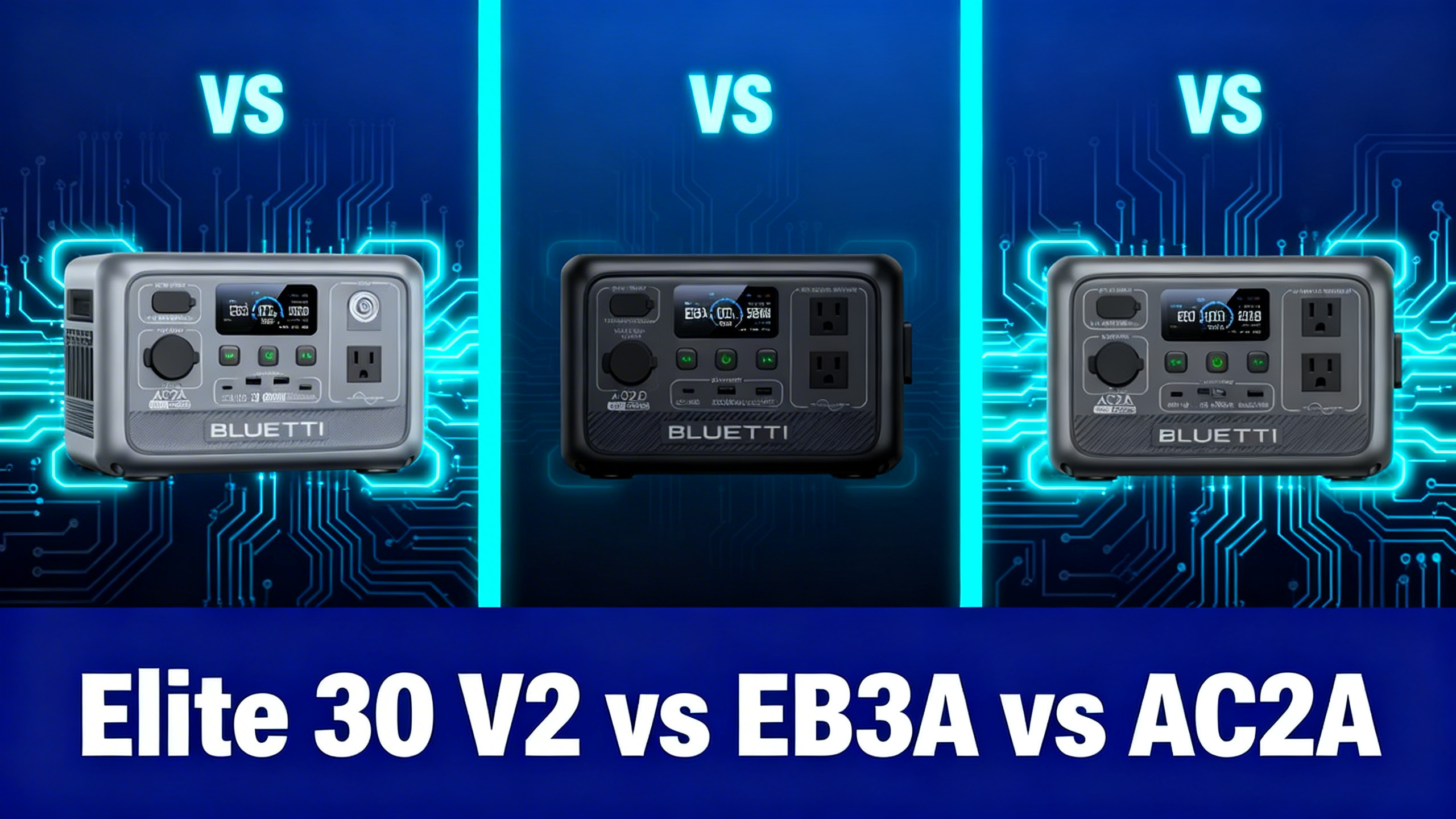
Choosing between the EB3A, the Elite 30 V2, and the AC2A isn’t straightforward. All three are Bluetti LiFePO4 stations priced under $250, and all three target the same broad audience: campers, travelers, and anyone who wants reliable backup power without spending $500+. Yet the specs diverge more than the price tags suggest.
Here’s the short version: the AC2A costs $139 and delivers 204Wh at 300W. The Elite 30 V2 runs $219 for 288Wh at 600W. The EB3A lands at $239 for 268Wh at 600W, with a standout 1-hour recharge time that neither competitor matches. For a complete look at every model Bluetti offers, the Bluetti brand overview covers the full lineup from entry-level to flagship.

This comparison breaks down capacity, output, charging speed, portability, and price-per-Wh across all three models. The goal: match each station to the right buyer, not crown a universal winner. Spoiler: each model leads in at least one key category.
Let’s break down exactly where each one earns its place.
Bluetti EB3A: 268Wh / 600W
$239 $269
- LiFePO4, 2,500+ cycles
- Charges 0-80% in ~45 min (AC)
- Compact 10.1 lbs with 600W output
Get our Black Friday alerts for BLUETTI
We track live prices on 40+ models from Jackery, EcoFlow, BLUETTI and Anker SOLIX. When a deal beats the lowest price we've recorded, you'll hear from us. During Black Friday week, one short recap a day at most.
Unsubscribe in one click. We may earn a commission when you buy through our links, at no extra cost to you. Privacy Policy
At a Glance: Key Differences
Before diving into the detail, here’s how the three models line up across the specs that matter most for day-to-day use.
Four takeaways stand out immediately. The AC2A is the only sub-$150 option and the lightest by a wide margin. The Elite 30 V2 delivers the most raw capacity at the lowest price per Wh. The EB3A is the fastest to recharge. And all three share the same LiFePO4 chemistry, meaning longevity is strong across the board, regardless of which you pick.
Bluetti EB3A Overview
The EB3A has been one of Bluetti’s most consistent sellers since its launch, and the numbers explain why. At $239, it offers 268Wh of LiFePO4 capacity, a 600W continuous AC output that scales to 1,200W via Power Lifting technology, and an AC recharge time of approximately 1 hour at 270W input. That combination of speed and output is genuinely rare at this price point.
Weight sits at 10.1 lbs, which is competitive for a 600W station. The port selection covers most daily needs: 2x AC outlets, 2x USB-A, 1x USB-C at 100W, and a 12V DC output. Solar input accepts up to 200W, so pairing it with a single 200W panel gives a realistic full charge in 2 to 3 hours of direct sun.
💡 Pro Tip: The EB3A’s Power Lifting mode lets it run appliances rated slightly above 600W, such as certain coffee makers and small blenders. Verify your device’s actual draw before relying on this feature for sustained use.
The LiFePO4 battery carries a 2,500-cycle rating, which translates to roughly 6 to 7 years of daily use before capacity drops to 80%. That’s a meaningful durability advantage over older lithium-ion alternatives in the same price range. For a deeper look at the EB3A’s performance data and owner feedback, read the EB3A full review.
Get our Black Friday alerts for BLUETTI
We track live prices on 40+ models from Jackery, EcoFlow, BLUETTI and Anker SOLIX. When a deal beats the lowest price we've recorded, you'll hear from us. During Black Friday week, one short recap a day at most.
Unsubscribe in one click. We may earn a commission when you buy through our links, at no extra cost to you. Privacy Policy
Bluetti Elite 30 V2 Overview
The Elite 30 V2 is Bluetti’s newest entry in this segment, released in 2026 with an updated port layout and a slightly larger battery than the EB3A. At $219, it delivers 288Wh of LiFePO4 capacity with a 600W continuous AC output and 200W solar input, matching the EB3A on those two specs at a $20 lower price.

Where the Elite 30 V2 trades ground is on charging speed: AC recharge takes approximately 1.5 hours versus the EB3A’s 1 hour. For many users this won’t matter. But for anyone who needs to top up quickly between uses, that 30-minute gap is noticeable. The cycle rating improves to 3,000+ cycles, edging past the EB3A’s 2,500.
The updated design brings a cleaner port layout compared to earlier Bluetti compact models. At roughly 9.9 lbs, it’s marginally lighter than the EB3A. A more detailed breakdown of the Elite 30 V2’s specs is available in the Elite 30 V2 full review.
Bluetti AC2A Overview
The AC2A occupies a different niche than the other two. At $139, it’s the entry point into the Bluetti LiFePO4 ecosystem: 204Wh of capacity, 300W continuous AC output (with a 600W surge), and a weight of just 6.3 lbs. For context, that’s roughly the weight of a large water bottle, making it genuinely pocketable for day bags and carry-on luggage.

The tradeoffs are real. Solar input maxes out at 100W, half of what the EB3A and Elite 30 V2 accept. The 300W output excludes heavier appliances like full-size coffee makers, microwaves, and power tools. Port selection is leaner: 1x AC outlet, 2x USB-A, 1x USB-C at 45W, and 12V DC. But for the use cases it’s designed for, phones, lights, a CPAP machine, a laptop, those limitations rarely come into play.
The LiFePO4 battery provides the same long-term durability as its siblings at a fraction of the price, which is arguably the AC2A’s headline achievement. Getting 2,500+ cycle longevity at $139 is genuinely uncommon in this category. The AC2A full review goes further into the unit’s real-world limitations and optimal use scenarios.
Technical Specs Compared
Price tells part of the story. Specs tell the rest. Looking beyond the sticker price, the differences between these three stations run deeper than the watt-hour count suggests.
All three units use LiFePO4 battery chemistry explained in detail by Battery University: lithium iron phosphate cells that prioritize thermal stability and cycle life over raw energy density. This matters because it places all three Bluetti models in a different durability tier than many competing stations using standard lithium-ion at similar prices. Cycle ratings range from 2,500 (EB3A) to 3,000+ (Elite 30 V2), with the AC2A landing in the 2,500+ range as well.
Power output diverges more significantly. The EB3A and Elite 30 V2 both deliver 600W continuous, covering a much wider range of appliances than the AC2A’s 300W ceiling. The EB3A adds Power Lifting technology, a mode that temporarily boosts surge capacity to 1,200W, allowing it to start some appliances rated slightly above its continuous limit. The AC2A has a 600W surge as well, but its 300W sustained output excludes most cooking appliances and power tools entirely. For the official EB3A specifications, Bluetti’s product page details the full port configuration and rated performance.


Solar input is where the AC2A falls behind most clearly. Its 100W maximum solar input means a full charge from a single panel takes a full day in good conditions. The EB3A and Elite 30 V2 both accept up to 200W, cutting that time roughly in half and making them practical options for off-grid scenarios where wall power isn’t available for days at a time.
Battery Capacity and Runtime
Watt-hours (Wh) function like the size of a fuel tank: more capacity means more runtime, assuming equal efficiency. At 85% inverter efficiency, which is a standard estimate for this class of station, runtime calculations across common appliances give a useful practical picture.
The EB3A at 268Wh delivers approximately 5 hours of laptop runtime at 45W draw, around 4.5 hours for a box fan at 50W, and roughly 15 smartphone charges at 15Wh per charge. The Elite 30 V2’s 288Wh improves those figures by about 7% across the board, which adds up to real time in extended use scenarios. The AC2A at 204Wh runs about 25% less than the EB3A: roughly 3.5 hours for a laptop, around 11 smartphone charges.
What Can the EB3A Power? (268Wh)
💻
Laptop (45W)
~5h
💡
LED Lamp (10W)
~22h
📱
Smartphone (15Wh)
~15x
🌀
Box Fan (50W)
~4.5h
Runtime estimates assume 85% inverter efficiency. AC2A (204Wh) runs approximately 25% less; Elite 30 V2 (288Wh) runs approximately 7% more.
For CPAP users specifically: a standard CPAP drawing 30 to 60W runs 3 to 6 hours on the AC2A, enough for one night at moderate pressure settings. The EB3A extends that to roughly 4 to 8 hours, and the Elite 30 V2 slightly more. All three can handle a single night without humidifier use.
⚠️ Important: Heated humidifier use with a CPAP machine can triple the power draw, cutting runtime estimates significantly for all three stations. If you use a humidifier nightly, plan accordingly or consider disabling it when running on battery.
Charging Speed Comparison
This is where the EB3A separates itself clearly from both competitors. Spec data confirms AC recharge time of approximately 1 hour at 270W input, hitting 0 to 80% in around 45 minutes. That’s fast enough to top up meaningfully during a lunch break or while running an errand.
The Elite 30 V2 and AC2A both take approximately 1.5 hours for a full AC charge. The difference might sound marginal, but in practice a 30-minute gap matters if you’re working on a quick turnaround: departing for a camping trip after work, prepping for a power outage, or cycling the station daily. For occasional use, the extra time is a non-issue.

Solar charging adds another dimension to the comparison. The EB3A and Elite 30 V2 both accept 200W of solar input, meaning a single 200W panel can realistically fill either unit in 2 to 3 hours of direct sun. The AC2A’s 100W solar ceiling doubles that time under the same conditions. For anyone relying on solar as a primary recharge method, that gap is significant. The EB3A full review includes additional detail on real-world solar performance data under variable conditions.
Portability and Weight
The AC2A wins this category without contest. At 6.3 lbs, it’s roughly 37% lighter than the EB3A and Elite 30 V2, both of which land just under 10 lbs. In concrete terms: the AC2A fits in a large purse or a small daypack. The EB3A and Elite 30 V2 need a dedicated bag or backpack.
For commuters, flight travelers, or anyone carrying a station long distances on foot, that 3.5-lb difference translates to real fatigue savings. For car campers or home use where the station stays on a shelf or in a truck bed, the weight gap matters much less.


Between the EB3A and Elite 30 V2, the weight difference is negligible: roughly 0.2 lbs. Neither offers a meaningful portability advantage over the other, so that decision comes down to other factors entirely.
Value Analysis: Price Per Watt-Hour
Price per watt-hour ($/Wh) is one of the cleanest ways to compare storage value across portable power stations. Here’s how the three models stack up:
- AC2A: $139 / 204Wh = $0.68/Wh (best value)
- Elite 30 V2: $219 / 288Wh = $0.76/Wh
- EB3A: $239 / 268Wh = $0.89/Wh
The AC2A wins on raw storage efficiency. But the EB3A’s premium buys something the $/Wh metric doesn’t capture: the fastest recharge in the segment. If your workflow depends on quick turnarounds, that 1-hour AC charge is a real differentiator, not a marketing claim. The Elite 30 V2 full review includes a deeper comparison of value-per-spec for buyers prioritizing capacity over speed.
For solar users specifically, the Elite 30 V2 offers the most capacity at the same 200W solar ceiling as the EB3A and a lower price. Spec-for-spec, it’s the strongest value for anyone charging primarily from panels rather than the wall.
Winner by Use Case
Best for Camping and Outdoor Use
The EB3A is the strongest camping option in this group. Its 1-hour AC recharge lets you top up before hitting the road. The 200W solar input handles a full day’s recharge with one good panel. The 600W output with Power Lifting covers a camp coffee maker, a portable cooler fan, and USB charging simultaneously without straining the unit. Performance data across owner reports consistently puts the EB3A as the first recommendation for weekend and multi-day camping scenarios.
Best for Everyday Carry and Travel
The AC2A’s 6.3-lb form factor makes it the only option in this group that realistically fits into a travel routine. At $139, it’s also low enough in cost that losing it to baggage mishaps or theft carries less sting. For digital nomads who need a laptop top-up in a cafe or a hotel room charge for phones and accessories, the AC2A handles those scenarios without the bulk. For buyers weighing even more options in this price range, the extended budget comparison includes additional models from the Bluetti lineup.
Best for Home Emergency Backup
The Elite 30 V2 takes this category on capacity alone. At 288Wh for $219, it stores more energy than the EB3A at a lower price point, which matters when the goal is keeping a CPAP running, a phone charged, and some lighting on through an outage. The 1.5-hour recharge time is fine for home use where you typically have advance notice before a storm or planned outage.
Best on a Tight Budget
The AC2A at $139 is the clear answer here. Getting LiFePO4 battery chemistry and 300W of AC output for that price is a real value. The capacity is limited, but the durability profile matches its more expensive siblings. For light users who don’t need to run high-draw appliances, it’s hard to justify spending more.
Best If You Use Solar Panels
The EB3A or Elite 30 V2, not the AC2A. The 200W solar input on both of the larger models is what separates them from the AC2A for solar-first buyers. The Elite 30 V2 edges ahead on capacity-per-dollar when solar is the primary charging method, since you’re filling a larger tank at no additional input cost. The EB3A wins if you also need the faster AC backup charge on cloudy days.
Which Should You Buy? Final Recommendation
💙 Choose EB3A if…
- You need the fastest recharge (1h AC)
- Running 600W appliances regularly
- Off-grid solar charging is a priority (200W)
- You want the best balance of capacity and speed
✅ Choose AC2A if…
- Budget is the top priority ($139)
- Ultra-portability matters (6.3 lbs)
- Powering phones, lights, and small fans only
- Occasional use, not daily dependency
⚖️ Choose Elite 30 V2 if…
- You want the highest capacity (288Wh)
- Spending $219 for the most Wh per dollar
- Newer model with updated design appeals to you
- 200W solar input and 600W AC are both required
If you’re still unsure how much capacity you actually need, the portable power station calculator gives a precise answer based on your appliances.
Based on published specs and owner feedback across the Bluetti community: the EB3A at $239 is the strongest all-around pick for most buyers. The 1-hour recharge is genuinely useful, the 600W output with Power Lifting covers a wide range of devices, and the LiFePO4 battery delivers long-term reliability. It costs $20 more than the Elite 30 V2 and $100 more than the AC2A, but those premiums buy something concrete: speed and versatility.
That said, the AC2A at $139 is the right call for anyone whose priority is portability or budget, and the Elite 30 V2 at $219 is the logical choice for buyers who want maximum watt-hours per dollar and don’t need the fastest possible recharge. None of these is a bad purchase. The decision comes down to which constraints matter most in your situation.
Bluetti EB3A
$239
Best overall budget station under $250
Price verified April 2026. Free shipping available
Frequently Asked Questions
Is the Bluetti EB3A worth the extra $100 over the AC2A?
If fast recharging and higher wattage matter, performance data confirms the EB3A justifies the premium. The 1-hour AC charge and 600W output with Power Lifting open up appliances and use cases the AC2A can’t cover. For light use: phones, lights, and occasional laptop sessions, the AC2A at $139 handles those reliably at a better price-per-Wh ratio. The extra $100 buys speed and output headroom, not just capacity.
What is the difference between the EB3A and the Elite 30 V2?
Capacity data shows the Elite 30 V2 has slightly more storage: 288Wh versus 268Wh for the EB3A. The EB3A charges significantly faster, approximately 1 hour AC versus 1.5 hours, and its Power Lifting mode pushes surge output to 1,200W. The Elite 30 V2 is the newer 2026 model with an updated port layout and a higher cycle rating of 3,000+. Both accept 200W of solar input and deliver 600W continuous AC output. The $20 price difference favors the Elite 30 V2 on raw capacity, but the EB3A wins on charging speed.
Can the Bluetti AC2A run a CPAP machine?
Runtime analysis for a standard CPAP drawing 30 to 60W shows the AC2A’s 204Wh capacity delivers 3 to 6 hours of operation. That covers one night at pressure settings between 6 and 10 cmH2O without a heated humidifier. Humidifier use can increase power draw significantly, cutting that estimate by half or more. For nightly CPAP use with full features, the EB3A or Elite 30 V2 offer more comfortable margins.
Which Bluetti under $250 is best for camping?
The EB3A is the strongest camping option in this group. Its 200W solar input, 1-hour AC recharge, and 600W output with Power Lifting deliver the widest range of camping capability under $250. The Elite 30 V2 offers slightly more capacity for a lower price with the same solar performance, making it a solid alternative for solar-first campers who don’t need the fastest AC recharge.
Do all three Bluetti models use LiFePO4 batteries?
Verified specs confirm all three models use lithium iron phosphate (LiFePO4) chemistry. The AC2A and EB3A are rated at 2,500+ cycles; the Elite 30 V2 reaches 3,000+ cycles. All three significantly outperform older Bluetti models using standard lithium-ion in long-term durability. This chemistry also delivers better thermal stability, which matters for safe indoor use and storage in warm environments.
Can I charge these stations from a car outlet?
All three units support 12V car charging via the DC input. Published data indicates typical car charge speeds reach approximately 60 to 100W, meaning a full charge takes several hours on the road. Car charging works well as a supplementary option on long drives, but it’s not practical as a primary charging method for frequent use. Wall or solar charging is faster and more efficient for all three models.
Originally published: April 7, 2026