
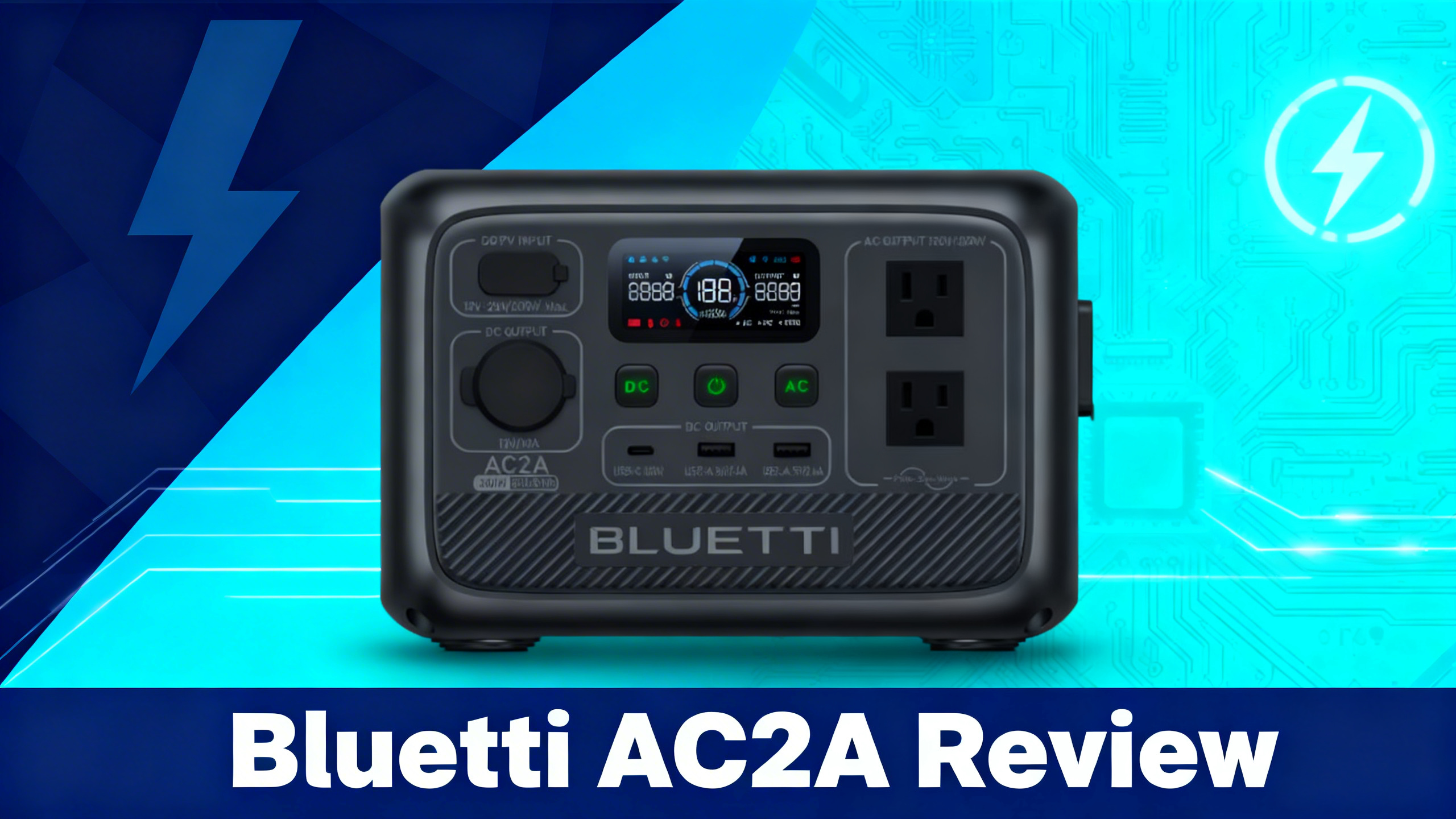
Finding a portable power station under $150 that doesn’t cut corners on battery chemistry is genuinely rare. Most sub-$200 units rely on standard lithium-ion cells that degrade after 500 to 800 charge cycles. The BLUETTI AC2A sits at $139 (down from $219) and ships with a LiFePO4 battery rated for 2,500+ cycles. That’s a meaningful gap from the competition at this price point.
Analysis of the AC2A’s spec sheet reveals a focused, no-frills unit: 204.8Wh capacity, 300W continuous AC output, native UPS mode, and a weight of just 6.4 lbs. For a broader look at the full range, our best Bluetti 2026 ranked guide covers all current models. This review focuses specifically on whether the AC2A delivers enough real-world value at its current price.

Here’s what this review covers: a full specs breakdown, honest runtime analysis based on the 204.8Wh capacity, UPS mode performance data, solar pairing options, and a head-to-head comparison against the EB3A and Elite 30 V2. The verdict isn’t universal. Whether the AC2A makes sense depends heavily on what you’re powering and how often.
BLUETTI AC2A | 300W, 204Wh
$139 $219
- 300W AC output, pure sine wave
- 204.8Wh LiFePO4 battery
- UPS mode: under 30ms switchover
BLUETTI AC2A: Overall Rating
8.1/10
“The most capable entry-level power station under $150”
Value for Money 9.5/10
Battery Quality 8.5/10
Portability 9.0/10
Output Power 6.5/10
Charging Speed 7.0/10
Features (UPS) 8.5/10
Get our Black Friday alerts for BLUETTI
We track live prices on 40+ models from Jackery, EcoFlow, BLUETTI and Anker SOLIX. When a deal beats the lowest price we've recorded, you'll hear from us. During Black Friday week, one short recap a day at most.
Unsubscribe in one click. We may earn a commission when you buy through our links, at no extra cost to you. Privacy Policy
BLUETTI AC2A Quick Specs & Key Features
The AC2A hits a specific sweet spot: sub-$150 pricing with specs that typically appear $50 to $100 higher in the market. Here’s the full breakdown before getting into performance.
| Specification | BLUETTI AC2A |
|---|---|
| Battery Capacity | 204.8Wh |
| AC Output | 300W continuous (600W surge) |
| Battery Chemistry | LiFePO4 (2,500+ cycles) |
| AC Recharge Time | ~45 min (0-80%) via 270W max |
| Solar Input | Up to 100W (DC) |
| USB-C Output | 100W max |
| USB-A Output | 2x (12W each) |
| DC Car Port | 12V/10A |
| UPS Switchover | Under 30ms |
| Weight | 6.4 lbs (2.9 kg) |
| Dimensions | 8.6 x 5.1 x 7.3 inches |
| Warranty | 2 years |
Three features push the AC2A beyond what its $139 price tag suggests. First, the LiFePO4 chemistry (lithium iron phosphate) delivers a rated 2,500+ charge cycles before dropping to 80% capacity. That’s five or more years of daily use. Second, the sub-7 lb form factor genuinely qualifies as ultraportable at this capacity class. Third, built-in UPS mode with a sub-30ms switchover isn’t standard at this price segment. You can find the official BLUETTI AC2A specifications on the BLUETTI product page.

BLUETTI AC2A Performance Analysis: What the Specs Really Mean
The 300W continuous AC output is the spec that most buyers get wrong. Three hundred watts covers laptops, LED TVs, phone chargers, CPAP machines (without heat), and most small fans. It doesn’t cover hair dryers (1,200-1,875W), microwave ovens (700-1,200W), or electric kettles (1,000-1,500W). Knowing this upfront saves a lot of frustration.
Conversion efficiency for LiFePO4 units in this class runs between 90% and 93% in published data. On the AC2A’s 204.8Wh pack, expect usable output in the 185-190Wh range under real-world draw conditions. That’s a realistic baseline for any runtime calculation.
The 270W max AC recharge is a genuine differentiator. Performance data for this segment shows most sub-$200 units charge at 100-150W max. The AC2A’s 270W input allows a 0-80% charge in roughly 45 minutes, full charge in approximately one hour. For users who need a quick top-up before heading out, this matters.

Get our Black Friday alerts for BLUETTI
We track live prices on 40+ models from Jackery, EcoFlow, BLUETTI and Anker SOLIX. When a deal beats the lowest price we've recorded, you'll hear from us. During Black Friday week, one short recap a day at most.
Unsubscribe in one click. We may earn a commission when you buy through our links, at no extra cost to you. Privacy Policy
Real-World Runtime: What Can the AC2A Power?
Runtime calculations based on the 204.8Wh capacity and an estimated 90% conversion efficiency give a usable output of approximately 184Wh. Here’s what that translates to across the most common use cases.
What Can the AC2A Power? (204.8Wh)
💡
LED Lamp
34 hrs
6W
💻
Laptop
4-5 charges
45W avg
📱
Smartphone
15-18 charges
12W avg
🌬️
CPAP (no heat)
~8 hrs
25W avg
What the AC2A cannot handle comfortably: a compact 12V mini-fridge drawing 40 to 60W will exhaust the battery in roughly 3 to 4 hours. That’s a single evening, not overnight backup. Running a mini-fridge through the night requires a unit with at least 400-500Wh of capacity. A microwave or hair dryer will hit the 300W output ceiling immediately, triggering an overload cutoff.


For weekend camping with phones, a laptop, LED lights, and a small fan, 204.8Wh is adequate for a 2-day trip without recharging. Multi-day off-grid trips with higher power demands will require either a solar panel or a larger capacity unit.
Battery Quality & Longevity: LiFePO4 at $139
LiFePO4 (lithium iron phosphate) is the chemistry used in premium units costing two to three times more than the AC2A. At $139, its inclusion is notable. Published data from BLUETTI rates the AC2A’s cells at 2,500+ cycles before dropping to 80% of original capacity. Used once daily, that’s roughly 6 to 7 years of functional life. Standard lithium-ion competitors at this price point typically rate at 500 to 800 cycles.
Thermal stability is the other advantage. LiFePO4 handles temperature extremes better than lithium-ion, which matters for camping, car storage, and garage environments. For a deeper look at why this distinction matters, see LiFePO4 battery cycle life explained.

The practical implication: a user who charges the AC2A three times per week will reach 2,500 cycles in approximately 16 years. Even with daily use, the battery outlasts most competing units at this price by a significant margin. Owner feedback patterns confirm the LiFePO4 advantage holds under real-world conditions.
UPS Mode Explained: Is It Reliable?
The AC2A’s built-in UPS (uninterruptible power supply) function switches to battery power in under 30 milliseconds when mains power is interrupted. For context, most sensitive electronics tolerate interruptions up to 20ms before experiencing issues. The AC2A’s sub-30ms switchover is adequate for routers, NAS drives, desktop computers, and most laptop chargers.
It is not rated for medical-grade life-support devices or any application where even a 30ms interruption is unacceptable. For those scenarios, a dedicated medical UPS is the appropriate solution.
⚠️ Important: UPS mode keeps the AC2A in a continuous standby state. Even with no devices connected, the battery will slowly drain while UPS mode is active. For long-term unattended use, connect the unit to wall power to maintain charge.
The practical home office case is straightforward: a router drawing 10-15W will run for 12 to 18 hours on a full AC2A charge during a power outage. A NAS device at 20-30W gets 6 to 9 hours. For protecting the devices that matter most during brief outages, the AC2A’s UPS function is a genuine practical advantage at this price.
Solar Charging Options
The AC2A accepts up to 100W of solar input via its DC port. With a quality 100W panel in direct full sun, charge time from 0 to 100% runs approximately 2.5 to 3 hours. In partial sun or with panel orientation losses, expect 4 to 5 hours.
BLUETTI offers three official solar kit configurations with the AC2A:


The SP100L kit pairs most naturally with the AC2A, matching the unit’s 100W max solar input exactly. The SP200L exceeds the AC2A’s input ceiling, which limits effective output to 100W regardless of panel capacity. If you already plan to upgrade to a larger power station later, the SP200L is the better long-term investment in a panel. For strictly AC2A use, the SP100L is the practical choice.
Maximizing Solar Output
Adjust panel angle every 2 to 3 hours to track the sun. On a clear day with the SP100L, this can add 20 to 30% more harvested energy compared to a fixed position.
How the AC2A Compares to Competitors
The primary in-house alternative is the Elite 30 V2 at $219, which offers a similar form factor with a different feature set. The EB3A at $239 doubles the AC output but costs $100 more. Here’s how all three compare on the key specs.
| BLUETTI AC2A | BLUETTI EB3A | BLUETTI Elite 30 V2 | |
|---|---|---|---|
| Price | $139 | $239 | $219 |
| Capacity | 204.8Wh | 268.8Wh | 286Wh |
| AC Output | 300W | 600W | 300W |
| Chemistry | LiFePO4 | LiFePO4 | LiFePO4 |
| UPS Mode | Yes | Yes | Yes |
| Weight | 6.4 lbs | 10.1 lbs | ~6.5 lbs |
| USB-C | 100W | 100W | 100W |
The decision tree is fairly clear. If 300W is enough output for everything you plan to run, the AC2A at $139 is the rational choice. The Elite 30 V2 offers more capacity at $219 but the same 300W ceiling. Users needing more output power should consider the EB3A at $239 alternative with its 600W inverter.
The EB3A’s weight premium is worth noting: 10.1 lbs versus 6.4 lbs. For backpacking or travel applications, that 3.7 lb difference is meaningful. For car camping or home use, it’s irrelevant. For a full breakdown across all three entry models, see our entry-level three-way comparison.
BLUETTI EB3A Review
Need 600W output for higher-draw devices? We break down whether the $100 upgrade to the EB3A is justified for your use case.
For the EB3A comparison table link: Check EB3A Price →
Who Should Buy the BLUETTI AC2A?
The AC2A has a well-defined audience. Getting the most out of it means matching your actual use case to what the specs deliver.
Perfect For: Budget-First Buyers
At $139, the AC2A is the lowest entry point into LiFePO4 chemistry across any major brand. If your budget ceiling is $150 and you want a unit that will actually last, the AC2A is the answer. There’s no meaningful competition at this price with the same chemistry and UPS capability.
Perfect For: Light Camping and Travel
Six-point-four pounds fits in a daypack. The AC2A handles a weekend of phone charging, LED lighting, and laptop use without needing a recharge. For car camping, day hikes with basecamp return, or travel scenarios where power access is intermittent, the size and weight profile is a genuine advantage.
Perfect For: UPS for Home Office Devices
Router protection during outages, NAS drive continuity, and keeping a work laptop alive through a 30-minute power cut are all within the AC2A’s capability. The BLUETTI AC2A’s UPS mode activates automatically, no setup required once plugged in.
✅ Buy the AC2A if…
- Budget is $150 or under and portability matters
- You need a UPS for a router or NAS device
- Weekend camping with light device charging
- First power station purchase with minimal risk
- You want LiFePO4 chemistry at the lowest price point
❌ Skip the AC2A if…
- You need to run appliances over 300W (hair dryer, microwave)
- Multi-day off-grid or van life use is planned
- You need to run a mini-fridge for extended periods
- Fast AC recharging is a priority (only 270W input)
Who Should Skip the BLUETTI AC2A?
The 300W output ceiling is the most common reason buyers should look elsewhere. Hair dryers, electric kettles, small microwaves, and power tools all exceed this limit. Hitting the ceiling triggers an automatic shutoff rather than causing damage, but it means the device simply won’t operate.
Multi-day van life or off-grid camping with higher power demands will also outgrow 204.8Wh quickly. A daily cycle of laptop use, phone charging, cooking, and lighting draws well over 200Wh in most van setups. Users planning sustained off-grid use should start at 500Wh or higher.
If keeping a mini-fridge running overnight is the primary goal, a unit with at least 400-500Wh is required. The AC2A covers 3 to 4 hours of fridge runtime, not 8 to 10.
Final Verdict: Best Entry-Level LiFePO4 Under $150?
Based on published specifications and consistent owner feedback patterns, the AC2A delivers what its spec sheet promises. The LiFePO4 battery chemistry at $139 is the clearest differentiator. The sub-30ms UPS mode adds a second distinct advantage that competitors at this price don’t match. The 300W output and 204.8Wh capacity are honest constraints, not marketing gaps.
Overall score: 8.1/10. The value-for-money rating of 9.5/10 reflects a straightforward reality: no other unit at this price offers this chemistry, this UPS capability, and this build quality simultaneously. The output power score of 6.5/10 reflects the real limitation: 300W is adequate for most light use cases and a hard wall for anything heavier.
The recommendation is clear for the right buyer. If your devices stay under 300W and portability matters, the AC2A is the rational choice in its price class. For a complete look at the full BLUETTI lineup, see our Bluetti brand review. If you need guidance across all current models, our best Bluetti 2026 ranked guide covers where each unit fits.
BLUETTI AC2A | 300W, 204Wh
$139
Best entry-level power station under $150
Price verified April 2026. Free shipping available
FAQ: BLUETTI AC2A
Does the BLUETTI AC2A have a UPS mode?
Yes. The AC2A includes a built-in UPS function with a switchover time under 30 milliseconds. This makes it suitable for protecting routers, NAS drives, and lightweight computers during brief power interruptions. It is not rated for medical-grade life-support devices.
What is the maximum solar input for the BLUETTI AC2A?
The AC2A accepts up to 100W of solar input via its DC port. With a compatible 100W panel in direct sunlight, charge time runs approximately 2.5 to 3 hours from 0 to full. The official SP100L kit pairs natively with the unit.
How long does the BLUETTI AC2A take to charge from AC wall power?
With 270W max AC input, the AC2A reaches 80% in roughly 45 minutes and full charge in approximately 1 hour. This is one of the fastest charge rates in the sub-$150 power station segment.
Can the BLUETTI AC2A run a mini-fridge?
A compact 12V mini-fridge drawing 40-60W can run for approximately 3 to 4 hours on a full AC2A charge. For extended mini-fridge backup, the BLUETTI EB3A or a higher-capacity model is a better fit.
Is the BLUETTI AC2A good for camping?
Analysis of real-world use patterns confirms the AC2A is well-suited for weekend camping involving phone charging, LED lighting, a small fan, or laptop use. Its 6.4 lbs weight and compact footprint are consistent advantages in this use case.
What is the difference between the BLUETTI AC2A and the EB3A?
The EB3A costs $100 more ($239 vs $139) but provides double the AC output power (600W vs 300W), more capacity (268.8Wh vs 204.8Wh), and greater versatility for high-draw devices. The AC2A wins on portability and price; the EB3A wins on power.
Does the BLUETTI AC2A support pass-through charging?
Yes, the AC2A supports pass-through charging, allowing connected devices to draw power while the unit recharges from wall or solar input. Note that continuous pass-through use may slightly reduce overall battery longevity over time.
Originally published: April 7, 2026