
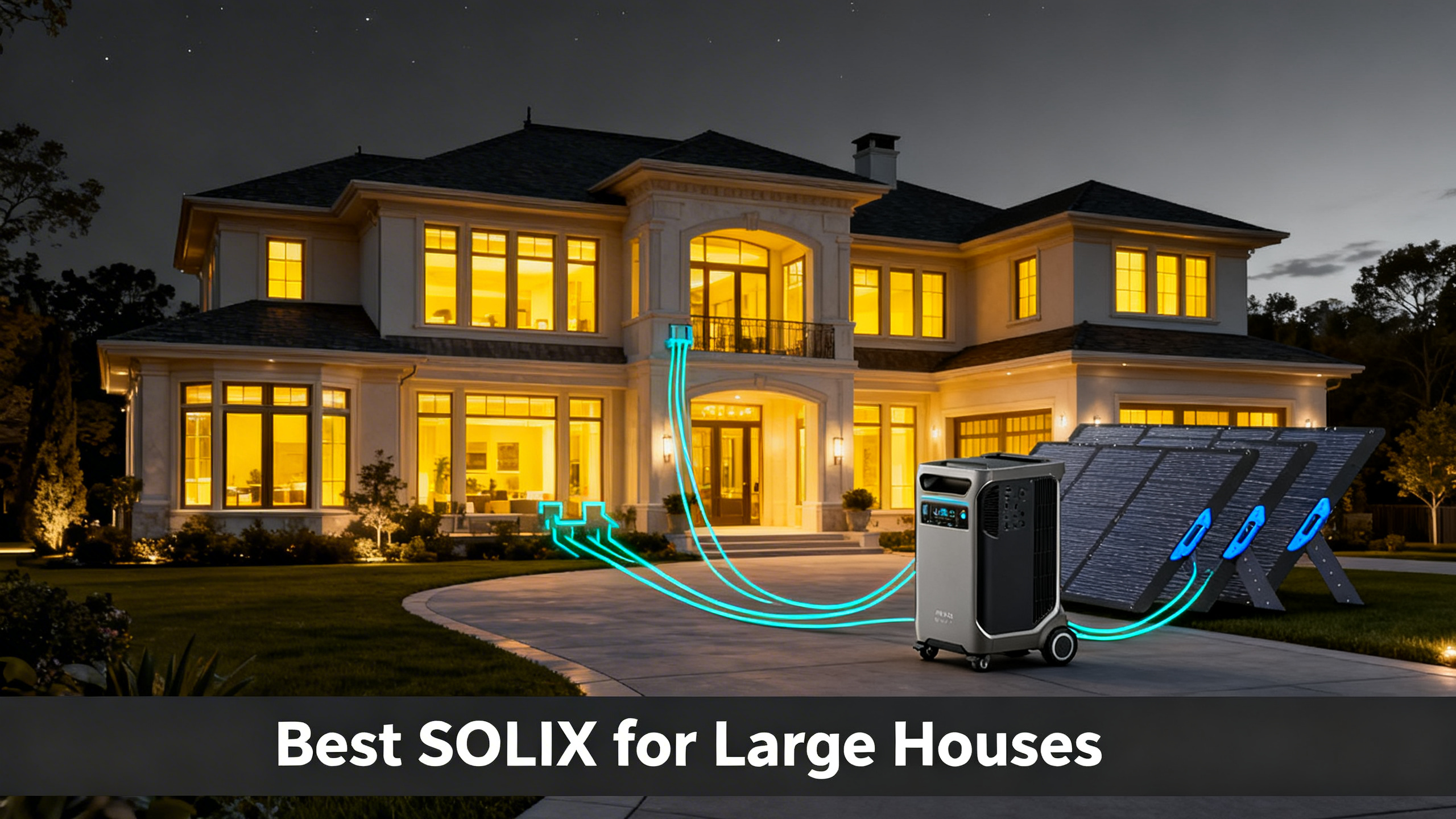
Choosing backup power for a large home is a different problem than choosing a camping unit. The square footage matters. The load profile matters. Whether you want a permanent install or a portable system matters. And with Anker SOLIX now offering four distinct configurations for home backup, the decision tree has grown considerably more complex.
This roundup ranks the top Anker SOLIX systems specifically for large-home applications, comparing the E10 whole-home battery, the F3800 portable flagship, the stacked dual-F3800 configuration, and the F3000 as a budget-flexible alternative. For a broader look at the full lineup, the full Anker SOLIX brand review covers all models from compact to flagship.
The short answer: there is no single right answer. Each system targets a different combination of home size, budget, and installation preference. If you’re also evaluating other brands, the best stations for large houses roundup puts Anker against EcoFlow, Bluetti, and Jackery side by side.
Which Anker SOLIX System Fits Your Home?
Whole-Home Modular
E10
From $4,299
Best for: 2,500+ sq ft, dedicated backup circuits, indoor install
Portable Flagship
F3800 Solo
From $1,799
Best for: 1,500–2,500 sq ft, no install, expandable with battery
Stacked System
2× F3800 + Hub
From $4,127
Best for: 3,000+ sq ft, 12kW output, max portability
Budget Flexible
F3000
From $1,399
Best for: 1,000–2,000 sq ft, stackable

Editor’s Pick: Best for Large Homes
Anker SOLIX E10 Whole-Home Backup
$4,299 UL9540A Certified
- 6kWh base, expandable with B6000 modules
- UL9540 & 9540A dual-certified for indoor install
- Works with Power Dock or Smart Inlet Box
Get our Black Friday alerts for Anker SOLIX
We track live prices on 40+ models from Jackery, EcoFlow, BLUETTI and Anker SOLIX. When a deal beats the lowest price we've recorded, you'll hear from us. During Black Friday week, one short recap a day at most.
Unsubscribe in one click. We may earn a commission when you buy through our links, at no extra cost to you. Privacy Policy
Our Top Picks at a Glance
Before diving into the individual systems, here’s how all four configurations stack up on the specs that matter most for large-home backup: capacity, output, installation requirements, and price.
#1 Best Overall: Anker SOLIX E10 Whole-Home Backup ($4,299)
The Anker SOLIX E10 whole-home system earns the top spot in this category for good reason. It’s the only Anker SOLIX system in this roundup carrying dual UL9540 and UL9540A fire-safety certification, which matters considerably if you plan to install a battery system inside a garage, utility room, or living space rather than outdoors.
Published specifications from Anker confirm the E10 starts at 6kWh of usable capacity and scales with B6000 Battery Modules at $2,499 each, adding 6kWh increments on demand. That modular architecture is what separates it from the portable F-series: the E10 is designed to grow with your home’s energy needs over years, not just cover a weekend outage.
Why the E10 Leads for Large Homes
The E10 integrates with Anker’s Power Dock or Smart Inlet Box, which means it can feed dedicated backup circuits rather than just running extension cords across the house. For a 2,500+ sq ft home with critical loads (HVAC, refrigerator, medical devices, security systems), that kind of circuit-level integration is a meaningful advantage over a plug-and-play portable unit.
The 120V/240V split-phase output covers the full range of home appliances, including central air conditioning, electric dryers, and EV charging, all of which require 240V. The portable F-series units also offer 240V output, but the E10’s certified indoor install path and fixed installation make it more suitable for permanent whole-home deployment.
E10 Key Specs and Certifications
The E10 holds both UL9540 (energy storage systems) and UL9540A (fire safety for indoor use) certifications. The UL9540A is particularly significant: it’s the certification that enables installation in occupied structures without special variance. See the E10 official product page for the full certification documentation and compatible installation accessories.
Keep in mind that the E10 requires professional installation. It isn’t a plug-and-go solution. Factor electrician costs into the total investment when comparing it against the portable F-series options.
Get our Black Friday alerts for Anker SOLIX
We track live prices on 40+ models from Jackery, EcoFlow, BLUETTI and Anker SOLIX. When a deal beats the lowest price we've recorded, you'll hear from us. During Black Friday week, one short recap a day at most.
Unsubscribe in one click. We may earn a commission when you buy through our links, at no extra cost to you. Privacy Policy
#2 Best Portable Option: Anker SOLIX F3800 ($1,799)
Our F3800 flagship review covers the full spec breakdown. Here, the focus is on how the F3800 performs specifically for large-home backup scenarios, and whether a single unit is enough.
Spec analysis confirms the F3800 delivers 3,840Wh of base capacity and 6,000W of continuous AC output with 120V/240V split-phase capability. It charges fully in under 2 hours via AC, or accepts up to 2,400W of solar input through dual 60V MPPT inputs. On paper and in practice, that’s a compelling package for partial-home backup.

F3800 Performance for Large-Home Backup
For a home between 1,500 and 2,500 sq ft, a single F3800 covers essential circuits comfortably. Capacity data confirms the F3800 can sustain a full-size refrigerator (150W average) for roughly 20+ hours, or run a window AC unit (1,200W) for around 2.5 hours on a single charge. Add an expansion battery to push that runtime further.
The 6,000W continuous output handles simultaneous loads that would overwhelm smaller units: refrigerator plus microwave plus TV plus lighting, for instance, running well under the output ceiling. Where single-F3800 coverage falls short is central HVAC at startup surge and full-house loads in larger homes. That’s where the stacked configuration takes over.
Scaling the F3800 with Expansion Batteries
Anker’s expansion battery ecosystem allows the F3800 to scale from its 3.84kWh base to 26.9kWh with compatible expansion packs. That’s meaningful runtime: at 26.9kWh, runtime calculations show the system can power essential loads in a medium-to-large home for multiple days without grid or solar recharge.

The F3800’s LFP (lithium iron phosphate) battery chemistry contributes to a 10+ year product lifespan, backed by Anker’s 5-year warranty. LFP chemistry is more thermally stable than standard lithium-ion, which matters for a unit that may remain plugged in and cycling regularly over years. The Anker SOLIX F3800 also includes NEMA 14-50 and L14-30 ports for direct EV and RV charging, which adds flexibility for households with electric vehicles.
#3 Best High-Capacity System: 2x Anker SOLIX F3800 + Double Power Hub ($4,127)
Two F3800 units linked through Anker’s Double Power Hub form a different class of system entirely. Published output data shows the stacked configuration delivers 12,000W of combined split-phase power, double what a single F3800 provides. Base capacity jumps to 7.68kWh, with expansion potential reaching 53.8kWh through 12 compatible expansion batteries.
That 53.8kWh ceiling is the largest portable battery capacity available in Anker’s lineup. For context, a 3,000+ sq ft home running essential loads (HVAC, refrigerator, lighting, devices) typically draws 30–60kWh per day. At maximum expansion, the stacked system approaches multi-day autonomy even without solar recharge.

What the Stacked System Delivers
The 12kW combined output is the headline number, but what it enables in practice is worth spelling out. Central air conditioning units typically require 3,500–5,000W at startup surge and 1,500–3,500W continuous. A 12kW system handles HVAC startup alongside simultaneous kitchen and lighting loads without tripping the output limit. A single F3800 at 6,000W handles that more cautiously, and the E10’s rated output depends on the specific installation configuration.
Solar recharge scales proportionally. Each F3800 accepts up to 2,400W of solar input, so the stacked system can absorb up to 4,800W combined from solar panels, enabling meaningful daytime recharge during extended outages. The dual MPPT controllers run independently, which means panel arrays can be positioned differently to capture light throughout the day.
Who Should Stack vs. Go Modular
The stacked F3800 system’s core advantage over the E10 is portability and the absence of required installation. No electrician, no permit process, no fixed infrastructure. If you rent, plan to move within a few years, or want backup power that travels with you, the stacked configuration preserves flexibility that the E10 cannot.
The tradeoff is UL9540A certification. The portable F-series units lack this fire-safety certification for indoor stationary use. For permanent indoor installation in a garage or utility room, the E10’s certification matters. For a setup that lives in a covered outdoor area or is moved out during storms and outages, that distinction is less relevant.

#4 Best Budget-Flexible Option: Anker SOLIX F3000 (From $1,399)
The F3000 enters the roundup at a notably lower price point: currently $1,399 versus $1,799 for the F3800. What changes at that price? Output drops to 3,600W continuous, capacity to 3,072Wh, and solar input remains capable at 2,400W dual MPPT. For homes between 1,000 and 2,000 sq ft with modest backup priorities, that profile works.

Two features distinguish the F3000 in this context. First, its ultra-low idle power draw (125 hours AC standby) means it can remain on standby with minimal self-discharge during long periods of non-use. Second, it costs less than the F3800 while matching its 2,400W of solar input.
The F3000 is stackable and expandable to 24kWh, and pairing two units unlocks 240V output. The Anker SOLIX F3000 also supports Anker’s Power Saver Kit for smart energy management, which can reduce household electricity costs during non-outage periods.
E10 vs Stacked F3800: Which Architecture Wins?
This is the most nuanced decision in the roundup, because the price points converge while the use cases diverge. The E10 starts at $4,299. The 2× F3800 + Double Power Hub configuration starts at $4,127. At comparable investment levels, the architectural differences become the deciding factor.
Installation and Safety Certification
The E10’s UL9540A certification enables compliant indoor stationary installation without special variance in most jurisdictions. The stacked F3800 system, while powerful, is classified as portable equipment and lacks this certification for permanent indoor battery storage applications. If your local building code, homeowner’s insurance, or HOA requires certified indoor battery systems, the E10 is the only compliant option in this roundup.
Installation also affects integration. The E10 connects through a Power Dock or Smart Inlet Box to feed your home’s backup circuits directly. The stacked F3800 system requires a transfer switch for similar circuit-level integration, which adds installation complexity and cost that partially closes the price gap.
Scalability and Long-Term Cost
Both systems are expandable, but through different mechanisms. The E10 scales with B6000 modules at $2,499 each, adding 6kWh increments indefinitely. The stacked F3800 scales with compatible expansion batteries up to 53.8kWh total. At maximum capacity, the stacked system offers the larger ceiling. For most homes, though, neither system needs to reach maximum capacity to handle a multi-day outage on essential loads.
Who Should Buy Each System?
E10: Choose if…
- You own a 2,500+ sq ft home
- You want certified indoor installation
- You plan to add solar for long-term savings
- You want professional install with Power Dock
F3800 Solo: Choose if…
- You want portable backup, no install
- Your home is 1,500–2,500 sq ft
- You may move in the next few years
- You want to start at $1,799 and expand later
Stacked 2x F3800: Choose if…
- You need 12kW for HVAC + appliances
- Your home is 3,000+ sq ft
- You want maximum capacity (53.8kWh)
- You want flexibility without permanent install
F3000: Choose if…
- Budget is a priority ($1,399 entry)
- Home is 1,000–2,000 sq ft
- You want smart energy savings with Power Saver Kit
For a deeper technical breakdown, the E10 vs F3800 head-to-head article covers installation complexity, scalability, and cost over time in more detail.
Matching the System to Your Home Size
Square footage is a useful starting point for system sizing, but it’s imprecise. A 2,000 sq ft all-electric home with HVAC, induction range, and EV charging draws substantially more power than a similarly sized gas-heated home. Use the square footage tiers below as a starting framework, then adjust based on your actual load profile.
1,000–1,500 sq ft: F3000 or F3800 Solo
At this size, essential load backup (refrigerator, lighting, devices, window AC or fans) typically falls in the 2–4kW continuous range. The F3000 at 3,600W and the F3800 at 6,000W both cover that range comfortably. The F3000’s lower price makes it the stronger starting point if budget matters.
1,500–2,500 sq ft: F3800 + Expansion Battery
A single F3800 with one expansion battery reaches approximately 7.68kWh and 6,000W output, which covers most partial-home backup scenarios in this size range. If central HVAC is a priority, verify the startup surge requirement of your specific unit before committing.
💡 Pro Tip: Check your HVAC system’s nameplate for “Locked Rotor Amps” (LRA). Multiply by voltage to get startup surge wattage. Most central AC units surge to 2–3× their running wattage for 1–2 seconds at startup.
2,500–4,000 sq ft: E10 or 2× F3800 Stacked
At this size, the decision comes down to installation preference. The E10 at $4,299 provides certified whole-home integration. The stacked F3800 at $4,127 provides comparable capacity and higher combined output, without the installation commitment. For step-by-step model selection across budgets, the complete Anker SOLIX buying guide covers every configuration in detail.
Adding Solar to Your Large-Home Setup
Every system in this roundup supports solar input, though the E10’s solar compatibility operates through external integrations rather than built-in MPPT inputs. The F-series units are more direct: plug solar panels into the MC4 input ports, configure via the Anker app, and the dual MPPT controllers optimize panel output automatically.

The stacked F3800 system’s 4,800W combined solar input is the highest in this roundup for portable configurations. On a sunny day with a properly sized array, that’s enough to cover typical daytime household consumption (2–4kW average) while simultaneously recharging the batteries. Pairing any of these systems with solar shifts the calculus from short-term backup to long-term energy independence.
Don’t count on the 30% federal clean energy tax credit for either one: it ended for systems installed after December 31, 2025.
FAQ: Anker SOLIX for Large Houses
Is the Anker SOLIX E10 worth it for a large house?
The E10 earns its price for homes above 2,500 sq ft that need dedicated circuits, indoor installation, and long-term scalability. Its UL9540A certification enables indoor use that the portable F-series models cannot provide. If you want a permanently installed system that integrates directly with your home’s electrical panel via Power Dock, the E10 is the right architecture. If you want flexible backup without installation complexity, the F3800 serves better at a lower entry cost.
Can the Anker SOLIX F3800 power an entire large house?
A single F3800 covers partial-home backup for homes up to roughly 2,000 sq ft, focusing on essentials: refrigerator, lighting, devices, and possibly window AC units. Stacking two units with the Double Power Hub brings output to 12kW and capacity up to 53.8kWh with expansion batteries, which covers whole-home backup for most large residences. Whether one or two units is right depends on your specific critical load list and home size.
What is the difference between the E10 and 2× F3800 stacked?
The E10 is a dedicated whole-home battery system with modular B6000 packs, UL9540A certification for indoor stationary use, and Power Dock integration for circuit-level backup. The 2× F3800 stacked configuration is portable, requires no permanent install, offers a higher output ceiling (12kW vs the E10’s installation-dependent rating), and reaches a higher maximum capacity (53.8kWh vs the E10’s modular scaling). The stacked F3800 lacks fire-safety certification for indoor stationary use. Both provide 120V/240V split-phase output and are expandable.
How much does it cost to power a 3,000 sq ft house with Anker SOLIX?
Entry point for a 3,000 sq ft home with serious backup coverage starts at around $4,127 for the 2× F3800 + Double Power Hub, or $4,299 for the E10 base configuration. Full whole-home coverage with solar integration typically ranges $6,000 to $12,000 depending on capacity expansion and panel count. Factor in electrician costs for the E10 installation, which are not included in the base price.
Does Anker SOLIX qualify for the 30% federal tax credit?
Not for home systems installed in 2026. The 30% federal Residential Clean Energy Credit, which covered home batteries like the F3000, F3800 and E10, ended for systems installed after December 31, 2025. A system installed by then can still be claimed on a 2025 return. Our E10 tax credit guide explains what changed.
Can I expand the Anker SOLIX E10 over time?
Yes. The E10 uses modular B6000 Battery Modules priced at $2,499 each. The base system starts at 6kWh and adds capacity in 6kWh increments as your energy needs grow. This makes it one of the most scalable residential battery systems in Anker’s lineup, suitable for households that want to start with essential backup and expand toward whole-home or solar storage over time.
Final Verdict
For most owners of large homes above 2,500 sq ft who want a permanent, certified, whole-home backup solution, the E10 is the right system. It’s the only option here with UL9540A certification, Power Dock integration, and a modular architecture designed for long-term residential use.
For homeowners who want serious backup power without installation commitment, the 2× F3800 + Double Power Hub delivers comparable capacity and higher combined output at a marginally lower entry price. It’s a more flexible system, just not a permanently installed one.
The F3800 solo is the practical starting point for homes in the 1,500–2,500 sq ft range, with a clear upgrade path through expansion batteries and eventual stacking. And the F3000 earns its place as the budget-conscious entry for smaller large homes. For a comprehensive look at the full Anker SOLIX ecosystem beyond these four systems, the full Anker SOLIX brand review covers the complete lineup.
Anker SOLIX E10 Whole-Home Backup
$4,299
Best modular whole-home backup for 2,500+ sq ft homes
Price verified April 2026. Free shipping available
Originally published: April 6, 2026