
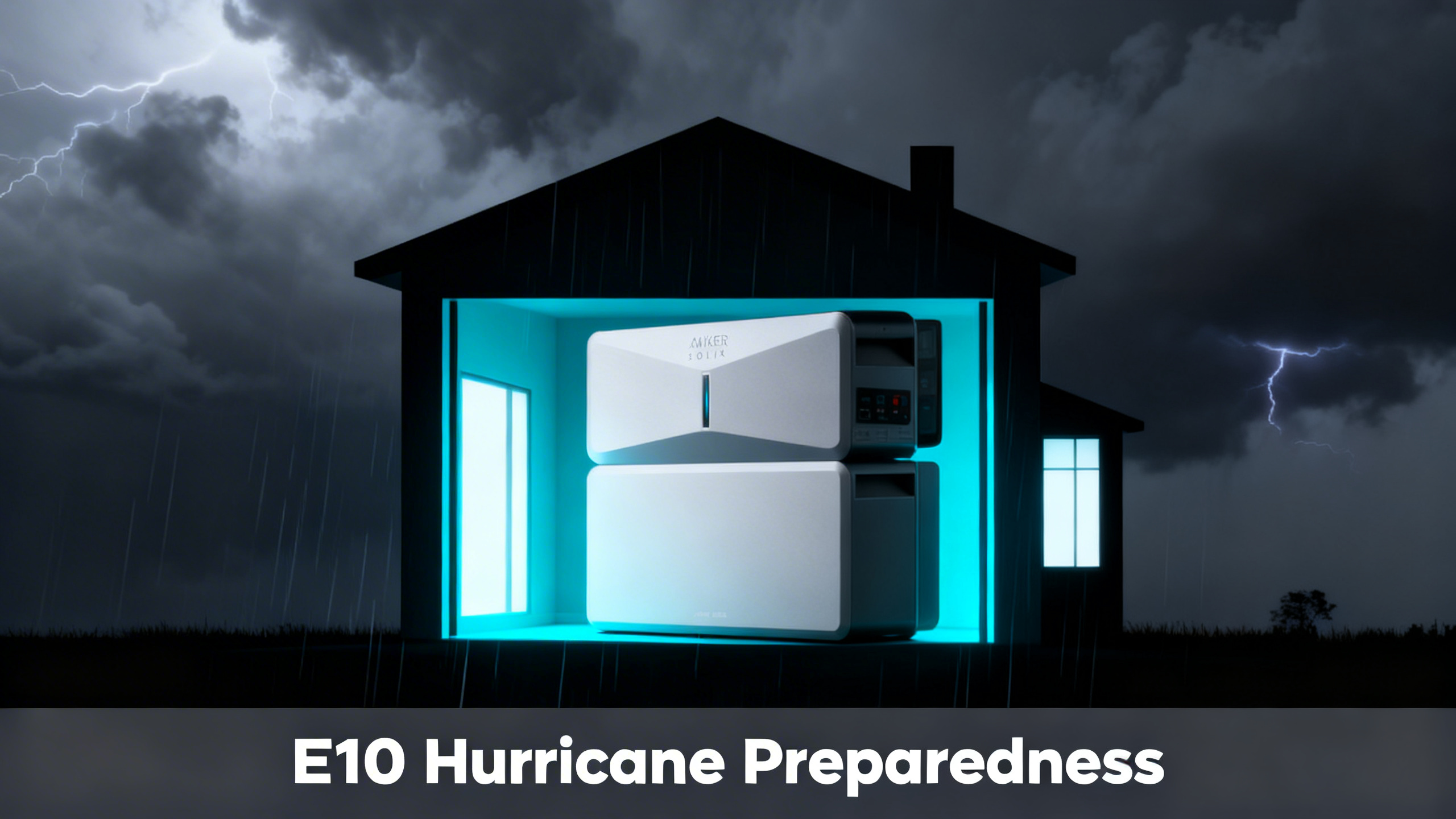
Hurricane season doesn’t give you much warning. When a Category 3 storm is 48 hours out, you’re not shopping for power solutions, you’re executing a plan you already made. For homeowners along the Gulf Coast, Southeast Atlantic, and Hawaii, that plan increasingly centers on whole-home battery backup rather than the fuel-dependent generators that defined the last generation of hurricane prep.
The Anker SOLIX E10 is one of the first residential battery systems to make whole-home backup genuinely accessible, starting at $4,299 with a modular architecture that scales from 6.1kWh to 36.6kWh. This guide covers what the E10 actually delivers in a hurricane context: capacity planning by home size, which configuration makes sense for your situation, and how to extend runtime when a storm parks over your region for five days, backed by a brand with a growing home backup lineup, as covered in our full Anker SOLIX brand review.

Anker SOLIX E10 Whole-Home Backup
$4,299 UL9540A Certified
- Modular: 6.1kWh base, expandable to 36.6kWh
- Whole-home 120V/240V output, no fuel needed
- LiFePO4 chemistry: 6,000-cycle rated lifespan
Get the 1-page outage plan
What to plug in first, how long a fridge really runs on a battery, and the 3 safety rules for connecting a power station to your home. Printable, sent by email.
About one email a week. Unsubscribe in one click. We may earn a commission when you buy through our links, at no extra cost to you. Privacy Policy
Why the E10 Is Built for Hurricane Season
As a homeowner in a hurricane-prone region, your power needs during a storm are fundamentally different from those of someone weathering a winter ice storm or a grid hiccup. Hurricanes bring sustained outages. According to NOAA hurricane season forecasts, major landfalls routinely leave coastal communities without power for 5 to 14 days. That timeline changes everything about how you should size and configure a backup system.
Traditional generators address the runtime problem with fuel, but introduce a different set of problems: fuel scarcity before landfall, outdoor-only operation that becomes dangerous in flood conditions, carbon monoxide risk if run near living spaces, and the logistical burden of storing 15 to 25 gallons of gasoline for a week-long outage. For a broad look at all Anker SOLIX home backup configurations, see our Anker home backup hub.
The Real Cost of Going Without Backup Power
The financial and safety stakes of a multi-day outage are significant. Spoiled food in a full refrigerator and freezer runs $500 to $1,500. Hotel stays for a family of four, at $150 to $250 per night over five nights, add another $750 to $1,250. For households with medical equipment, a CPAP machine, home oxygen, or powered mobility devices, unplanned outages aren’t inconvenient: they’re dangerous.
A battery backup system shifts the calculation. Instead of absorbing recurring outage costs after each storm, you’re making one capital investment that delivers whole-home coverage across multiple hurricane seasons. The E10’s LiFePO4 chemistry carries a 6,000-cycle rating, which translates to a decade or more of useful life under normal cycling patterns.
How the E10 Differs from a Traditional Standby Generator
The fundamental difference is architecture. A standby propane or natural gas generator is a combustion engine that produces electricity on demand. The E10 is a battery system that stores electricity and delivers it through your home’s existing wiring. That distinction matters in four practical ways: installation location (indoors, no exhaust), operation during flooding (no outdoor exposure required), noise profile (silent), and fuel logistics (solar or grid, no tank to fill).
The practical limitation the data makes clear: battery systems are finite. A 6.1kWh E10 base unit holds roughly the energy equivalent of half a gallon of gasoline. For short outages or essential-load coverage, that’s sufficient. For week-long outages with full home loads, you need either more capacity, solar recharging, or a generator hybrid approach. The E10’s modular design and Smart Generator 5500 compatibility address both scenarios.
E10 Capacity Planning: How Much Backup Do You Need?
Specs referenced throughout this section draw from our in-depth E10 system review, covering the full technical breakdown. The starting point for any E10 sizing conversation is your actual daily energy consumption, not a rough estimate. Most homeowners significantly underestimate their load when AC cycling is factored in. Our E10 buying guide breaks down which bundle and configuration fits different household sizes and budgets.
The table below shows typical appliance draws and daily watt-hour consumption for common hurricane-season loads:
| Appliance | Wattage | Daily Hours | Daily Wh |
|---|---|---|---|
| Refrigerator | 150W | 8h cycling | 1,200Wh |
| Central AC (3-ton) | 3,500W | 4h cycling | 14,000Wh |
| Window AC (5,000 BTU) | 500W | 6h | 3,000Wh |
| LED Lighting (whole home) | 200W | 8h | 1,600Wh |
| Internet Router | 15W | 24h | 360Wh |
| Phone/Laptop Charging | 60W | 4h | 240Wh |
| Medical Device (CPAP) | 30W | 8h | 240Wh |
The numbers reveal a key insight: central AC is the dominant load by far. A single day of managed central AC cycling (not constant-on, but on/off as needed) consumes 14,000Wh, more than twice the base E10’s capacity. That’s not a flaw in the E10: it’s the fundamental physics of cooling large air volumes. It does mean that capacity planning conversations always start with a single question: are you keeping the AC on, or are you managing without it?
Typical Daily Power Consumption by Home Size
For homes under 1,500 square feet, essential load management (refrigerator, lights, phone charging, router, one window AC unit) runs approximately 5,000 to 6,500Wh per day. The 6.1kWh base E10 covers roughly 22 to 28 hours before needing recharge. For 1,500 to 3,000 square foot homes with central AC cycling, daily consumption climbs to 15,000 to 20,000Wh on full loads, or 5,000 to 8,000Wh with AC restricted to morning and evening hours. Homes above 3,000 square feet with pool pumps, home offices, and larger HVAC systems should plan for 20,000Wh or more per day under storm conditions.
Scaling Up: B6000 Battery Modules Explained
The E10’s modular architecture centers on the B6000 Battery Module ($2,499 each), which adds 6.1kWh per unit. The base system ships with one Power Module and one B6000. You can stack up to five B6000 modules for a total of 36.6kWh, sufficient for 2 to 3 days of full home coverage in a large residence. Each module integrates with the same Power Dock or Smart Inlet Box, requiring only an electrician visit to add capacity rather than a full system replacement.
How Much E10 Capacity Does Your Home Need?
Light Coverage
6.1 kWh
E10 Base: $4,299
Good for:
- Up to 1,500 sq ft home
- Fridge + lights + phone charging
- 24-36 hours on essentials
- Apartments or small homes
Full Coverage
12.2 kWh
E10 + 1× B6000 (~$6,800)
Good for:
- 1,500-3,000 sq ft home
- AC (central, on/off cycling)
- 2-3 days of full home loads
- Most suburban homeowners
Extended Coverage
18.3+ kWh
E10 + 2× B6000 (~$9,300)
Good for:
- 3,000-4,500 sq ft home
- Full HVAC, EV charger, pool pump
- 5-7 days on managed loads
- Large families and home offices
Estimates based on published E10 specs and typical residential load profiles. Actual runtime varies by appliance usage patterns.


Anker SOLIX E10, From $4,299
UL9540A Certified. Modular from 6.1kWh to 36.6kWh.
Get the 1-page outage plan
What to plug in first, how long a fridge really runs on a battery, and the 3 safety rules for connecting a power station to your home. Printable, sent by email.
About one email a week. Unsubscribe in one click. We may earn a commission when you buy through our links, at no extra cost to you. Privacy Policy
Which E10 Configuration Do You Need?
The E10 comes in three entry configurations, each suited to a different installation scenario. The right choice depends primarily on whether your home already has a transfer switch and how hands-off you want the backup process to be during a storm.


Best for Most Homeowners
E10 + Smart Inlet Box
Requires existing transfer switch
$4,599
E10 Base + Smart Inlet Box: Best for Most Homeowners
At $4,599, the E10 with Smart Inlet Box bundle is the configuration most homeowners in hurricane zones choose. The Smart Inlet Box connects to your home’s existing transfer switch (manual or automatic), creating a dedicated input for the E10. If your home already has a generator transfer switch installed, this is the most cost-efficient path to whole-home E10 integration.
The SIB doesn’t include an automatic transfer switch of its own. In practice, that means you or your electrician configure which circuits the E10 covers, and the transition between grid and battery can be slightly less seamless than the Power Dock configuration. For most homeowners, that’s an acceptable trade-off given the $1,200 price difference.
E10 + Power Dock: Cleanest Installation with Automatic Transfer
The Power Dock bundle at $5,799 includes a built-in automatic transfer switch (ATS) that detects a grid outage and switches to battery power in milliseconds. There’s no manual intervention, no delay, and no configuration of existing transfer hardware. For households with medical equipment or home offices where even a brief interruption causes data loss or medical risk, the Power Dock’s seamless transfer is worth the premium.
The Power Dock is also the recommended path for new installations where no transfer switch exists. Your electrician installs the Power Dock as a single integrated unit, which simplifies the permitting and inspection process in most jurisdictions.
| Configuration | Price | Capacity | Best For |
|---|---|---|---|
| E10 Base | $4,299 | 6.1kWh | Small homes, essentials only |
| E10 + Smart Inlet Box | $4,599 | 6.1kWh | Homes with existing transfer switch |
| E10 + Power Dock | $5,799 | 6.1kWh | New installs, automatic transfer preferred |
| E10 + 2× Battery + SIB | $6,599 | 12.2kWh | Medium homes, 2-3 day outage coverage |
| E10 + 2× Battery + Power Dock | $7,799 | 12.2kWh | Large homes, seamless whole-home coverage |
Extending Your E10 Runtime During Extended Outages
A 6.1kWh or 12.2kWh system covers most Category 1 and 2 outage windows. But hurricanes that stall over a region, or that trigger widespread grid damage, can leave coastal communities without utility power for 7 to 14 days. For those scenarios, the E10 needs a recharging strategy.
Solar Recharging: Your Best Hurricane Insurance
Solar recharging is the most resilient long-term strategy for hurricane-prone homeowners. The E10 is compatible with Anker’s rigid solar panels (440W) as well as the portable PS400 panels, which can be deployed in the yard or driveway when roof mounting isn’t practical during storm recovery. Even partial-cloud solar input during post-storm recovery days can meaningfully extend runtime. A 2kW solar array producing a conservative 6 hours of effective generation per day adds 12kWh of daily recharge capacity, roughly doubling your net available energy relative to a base 6.1kWh system running on stored capacity alone.
Smart Generator 5500 Tri-Fuel: When Solar Isn’t Enough
For prolonged outages where cloud cover, storm debris, or shading limits solar input, the Anker SOLIX Smart Generator 5500 ($1,999) bridges the gap. Anker’s tri-fuel option, detailed in our Smart Generator 5500 fuel backup review, charges the E10 via a direct DC connection, eliminating the efficiency losses of AC-to-DC conversion typical of standard generator hookups. The tri-fuel capability (gasoline, propane, or natural gas) is particularly valuable in a hurricane context, where gasoline shortages are predictable but propane tanks can be pre-staged and natural gas lines (where available) typically remain operational through most storm scenarios.

Building Your Complete Hurricane Power Plan
The framework below aligns with the scenarios covered in our guide to multi-day outage planning, adapted specifically for hurricane contexts. Having the right hardware is necessary but not sufficient. The homeowners who navigate multi-day outages most effectively combine the right equipment with a load management plan developed before the storm arrives.
✅ The E10 is right for you if…
- You own a home in a hurricane-prone region (Gulf Coast, Southeast Atlantic, Hawaii)
- You’ve experienced outages lasting 3 or more days in recent years
- You have medical equipment, home office gear, or a family requiring continuous power
- You want to avoid the noise, fumes, and fuel logistics of a traditional generator
- You plan to add solar panels for grid-independent recharging
❌ Consider other options if…
- You rent your home or cannot install a fixed system with electrical work
- Your budget is under $3,000 (a portable power station may suit short outages better)
- You only need power for a few hours and have no critical loads
- Your area sees only short, predictable outages under 12 hours
- You’re not prepared to work with a licensed electrician for installation
Pre-Storm Checklist: Charging the E10 Before Landfall
The E10 should enter every storm season at full charge and topped up again 24 to 48 hours before predicted landfall. Grid power is your cheapest and fastest charging source. At typical residential electricity rates, filling a 12.2kWh system costs $1.50 to $2.50. If you have solar, run it at maximum output in the days before the storm. Verify the system’s state of charge through the Anker app and confirm the transfer switch or Power Dock is functioning correctly before you lose the ability to troubleshoot.
Pair this equipment guide with our hurricane preparedness checklist for a complete storm-season action plan covering supplies, communications, and evacuation planning alongside your power setup.
Managing Loads During Multi-Day Outages
Load management is the highest-leverage skill in a multi-day outage. Turning off the central AC and using a single window unit reduces daily consumption from 14,000Wh to 3,000Wh: a 79% reduction that can extend a 12.2kWh system from less than 24 hours to more than 4 days. Unplugging idle electronics, running the dishwasher and laundry only when the grid briefly restores, and scheduling cooking around peak solar hours if panels are available: these behaviors compound across a 5 or 7-day outage into meaningfully different outcomes.
💡 Pro Tip: Pre-program your E10’s load priority settings through the Anker app before storm season. Set refrigeration and medical devices as protected circuits so they stay powered even if the system automatically sheds lower-priority loads at low battery levels.
FAQ: Anker SOLIX E10 for Hurricane Preparedness
How long will the Anker SOLIX E10 power my home during a hurricane outage?
Runtime depends on the capacity configuration and your load management. The base 6.1kWh system powers essentials (refrigerator, lights, phone charging) for approximately 24-36 hours. A 12.2kWh configuration with one added B6000 module extends this to 48-72 hours on managed loads. Adding the Smart Generator 5500 removes the runtime cap entirely for prolonged outages.
Does the Anker SOLIX E10 qualify for the federal tax credit?
Not if it’s installed in 2026. The 30% federal Residential Clean Energy Credit ended for systems installed after December 31, 2025, with or without solar. An E10 installed by then can still be claimed on a 2025 return. See our dedicated article on Anker SOLIX E10 tax credit eligibility for a full breakdown.
Can the E10 power my central air conditioner during a hurricane outage?
The E10 provides 120V and 240V output sufficient to power a standard central AC system through its Power Dock or Smart Inlet Box. A 3-ton central AC draws approximately 3,500W while running, cycling on for 15-20 minutes per hour. On a 12.2kWh system, expect 4-6 hours of active cooling. For multi-day coverage with AC, the 18.3kWh (2× B6000) or larger configuration is recommended.
How is the E10 different from a portable power station during a hurricane?
The E10 is a fixed whole-home system, not a portable station. It integrates directly with your home’s electrical panel via a transfer switch (Smart Inlet Box) or built-in ATS (Power Dock), delivering power to all circuits simultaneously. Portable stations require running individual extension cords to specific appliances. For hurricane preparedness where multi-day coverage and full household loads matter, the fixed architecture is a significant advantage.
Is the Anker SOLIX E10 certified for residential installation?
The E10 carries UL9540 and UL9540A certifications, which are the standard safety certifications for stationary battery energy storage systems in residential settings. These certifications are typically required by local building departments and homeowner’s insurance policies for fixed battery installations.
Can the E10 be installed outdoors in a hurricane-prone region?
The E10 is designed for indoor or sheltered installation (garage, basement, utility room). For flood-prone areas, Anker offers the E10 Wall Bracket ($249) that mounts the unit above flood levels, and the E10 Metal Pad ($199) that elevates it off the ground. Outdoor enclosures are not listed in the official E10 installation specifications.
How much does a complete E10 hurricane backup system cost to install?
Hardware costs start at $4,299 for the base E10 unit. Most homeowners add a Smart Inlet Box ($4,599 bundle) or Power Dock ($5,799 bundle). Installation by a licensed electrician typically adds $500-$1,500 depending on your panel and region. A fully specified 12.2kWh system with Power Dock and professional installation runs approximately $8,000-$9,000 total.
Is the E10 the Right Hurricane Backup for Your Home?
For homeowners in hurricane-prone regions who’ve lived through multi-day outages, the E10’s value proposition is concrete. It eliminates the fuel logistics problem, operates silently from inside the home, delivers whole-home 120V/240V output through existing wiring, and scales from a manageable $4,299 entry point to a 36.6kWh system capable of covering a large home for an extended storm recovery period.
The limitations worth acknowledging: the E10 requires professional installation, a meaningful commitment of wall or floor space (garage or utility room), and an upfront investment that’s substantially higher than a portable power station. If your household has medical equipment, a home office with sensitive electronics, or has experienced outages lasting more than three days, the case for a whole-home fixed system is strong. If your exposure is limited to occasional short outages with no critical loads, a quality portable station may be the more practical starting point.
For complete technical specifications and a deeper look at all E10 variants, see the official E10 product page.
Anker SOLIX E10
From $4,299
Best whole-home hurricane backup system for 2026
Price verified April 2026. Free shipping available
Originally published: April 6, 2026