
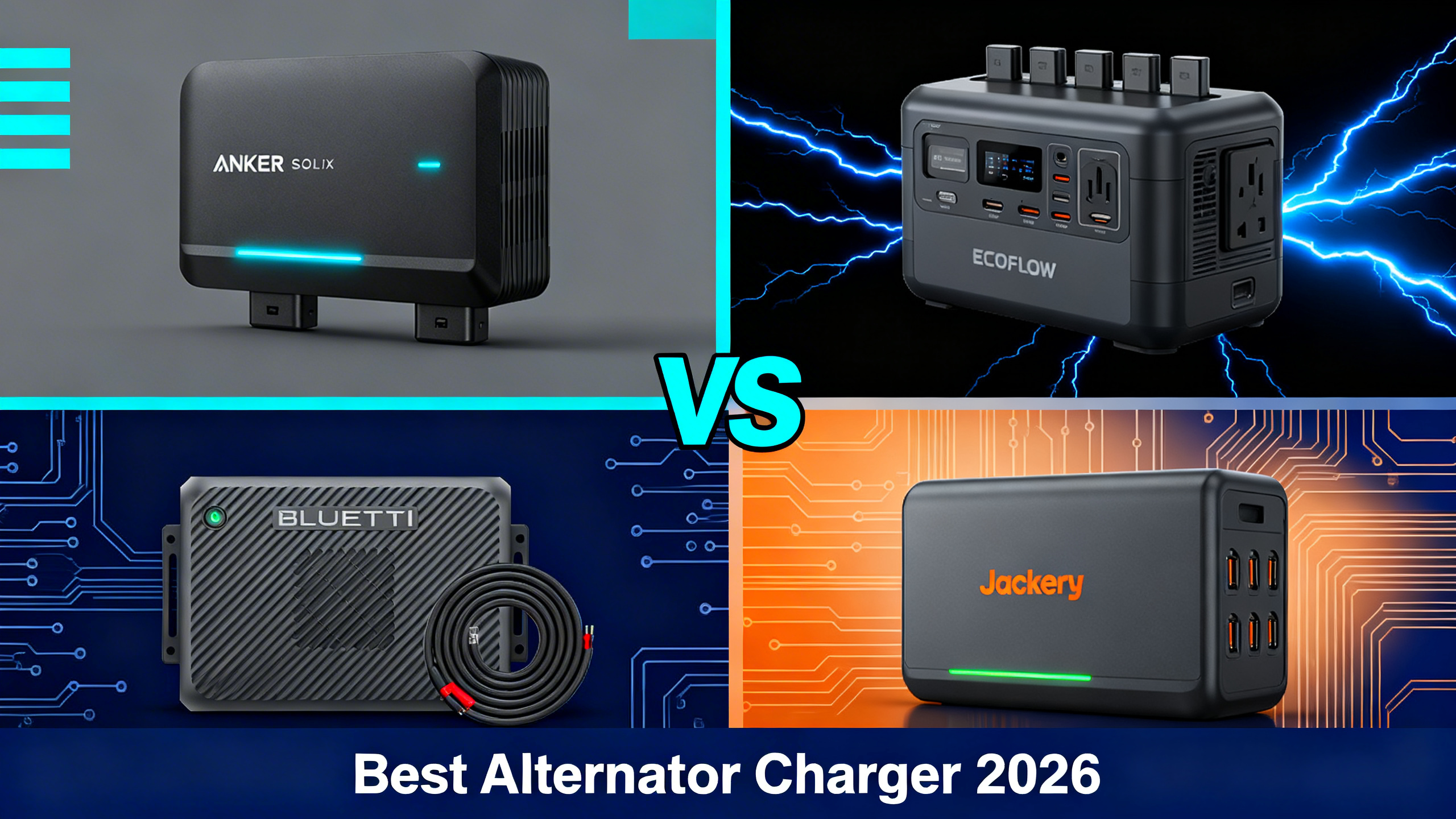
Driving 300 miles with a dead power station in the back of your rig is a frustrating experience. Standard cigarette lighter ports top out around 100W, which means a 2kWh station would take 20-plus hours to refill from your vehicle. Alternator chargers solve this by tapping directly into your vehicle’s DC system, delivering 600W to 800W of charging power while you drive.
Four major brands now offer dedicated alternator chargers for their portable power station ecosystems: Anker SOLIX, EcoFlow, BLUETTI, and Jackery. Each targets a slightly different buyer. Spec analysis across all four reveals meaningful differences in output power, compatibility, and value. Here’s what the data shows.

Editor’s Pick: Best Overall
Anker SOLIX Alternator Charger
$599.00
- Up to 8x faster than car auxiliary port
- 3-in-1: PPS charging, RV expansion, vehicle battery recharge
- App control via Bluetooth and Wi-Fi
Get our Black Friday alerts for power stations
We track live prices on 40+ models from Jackery, EcoFlow, BLUETTI and Anker SOLIX. When a deal beats the lowest price we've recorded, you'll hear from us. During Black Friday week, one short recap a day at most.
Unsubscribe in one click. We may earn a commission when you buy through our links, at no extra cost to you. Privacy Policy
Quick Comparison: All 4 Alternator Chargers at a Glance
Before diving into individual reviews, here’s how all four units stack up on the specs that matter most for RV and van life applications. Output power, price, and ecosystem compatibility drive most buying decisions in this category.
How Alternator Charging Works
Your vehicle’s alternator generates electricity while the engine runs. Standard 12V auxiliary ports (cigarette lighters) can only draw around 100W from this system, which makes them impractical for charging large power stations. An alternator charger bypasses this limitation by connecting directly to the vehicle’s battery terminals.
The DC-to-DC conversion process is the key. Your vehicle runs at 12V or 24V depending on the type (most passenger vehicles use 12V; many diesel trucks and RVs run 24V). The alternator charger accepts this voltage and steps it up to the optimal charging voltage for your power station, typically in the 50-58V range. This direct connection allows for substantially higher sustained amperage than any 12V accessory port could handle.
Battery protection is built into every unit reviewed here. Smart voltage sensing ensures the charger won’t pull down your starter battery below safe thresholds. Published specifications for all four units confirm automatic cutoff logic that monitors vehicle battery voltage and pauses charging if it drops too low. This is not a theoretical feature: owner feedback patterns across van life communities consistently confirm these protection mechanisms work as described.
How Fast Does Each Charger Fill a 2kWh Battery?
⚡
Anker SOLIX (800W)
~3 hrs
$599 | 8x car port
⚡
EcoFlow 800W
~2.6 hrs
$299 | 8x car port
⚡
BLUETTI Charger 1 (600W)
~3.3 hrs
$299 | 6x car port
⚡
Jackery DC-DC (600W)
~3.3 hrs
$259 | 6x car port
Estimates based on rated output power and 2,000Wh station capacity at 85% efficiency.
Get our Black Friday alerts for power stations
We track live prices on 40+ models from Jackery, EcoFlow, BLUETTI and Anker SOLIX. When a deal beats the lowest price we've recorded, you'll hear from us. During Black Friday week, one short recap a day at most.
Unsubscribe in one click. We may earn a commission when you buy through our links, at no extra cost to you. Privacy Policy
Anker SOLIX Alternator Charger: Best for Large RV Setups
The Anker SOLIX Alternator Charger is the brand’s flagship mobile charging accessory. For context on the full ecosystem, see our full Anker SOLIX brand review. At $599, it sits at the top of this comparison on price, and the spec sheet justifies the premium for the right buyer.
Key Specs
Output: 800W. Charging modes: Ultrafast PPS charging, seamless RV expansion, and vehicle battery recharge. Compatibility: 99% of RVs and fuel vehicles, with full integration across the SOLIX portable ecosystem. App control: Bluetooth and Wi-Fi via the Anker app. Price: $599.00.
The three-in-one functionality is the headline. Most DC-DC alternator chargers in this category do one thing: charge your power station while you drive. The Anker SOLIX adds two more modes: it can act as a maintainer for your vehicle battery when the engine is off, and it integrates with the SOLIX F3000 ecosystem to support up to 12kWh of expanded capacity across three expansion batteries.
Who It’s For
Analysis of the spec sheet points clearly to full-time RVers running large SOLIX builds. Pairing this charger with the F3000 and three expansion batteries creates a 12kWh mobile system that recharges in approximately three hours of highway driving. That’s a genuinely compelling setup for long-haul travel. A full breakdown of specs, installation, and real-world performance is available in our dedicated Anker alternator charger deep-dive.
Remote monitoring via Bluetooth and Wi-Fi also distinguishes this unit from the BLUETTI and Jackery options, which offer no app connectivity at all. For RVers who want to check charge status from outside the vehicle or start and stop charging remotely, this matters.
One Limitation
The price is the honest barrier. At $599, it costs twice as much as the EcoFlow and BLUETTI options, and more than twice the Jackery. Spec-for-spec analysis confirms the premium is justified by the 3-in-1 functionality and expansion ecosystem depth, but buyers without a large SOLIX setup won’t extract full value from it. For context on official specifications, visit the official Anker SOLIX Alternator Charger page.
EcoFlow 800W Alternator Charger: Best Value Pick
At $299 (down from $599), the EcoFlow 800W Alternator Charger delivers the same peak output as the Anker SOLIX at half the price. The value case is straightforward: 800W of alternator charging for a budget that also leaves room for the rest of your build.

Key Specs
Output: 800W. Functions: Charger, battery maintainer, and jump starter (3-in-1). Charge rate: 1kWh in approximately 1.3 hours of driving. Compatibility: DELTA Pro and DELTA 2 Max (DELTA Pro requires a Smart Generator Adapter, sold separately). Price: $299.00 (original $599.00). For the complete product details, visit the EcoFlow 800W Alternator Charger product page.
The jump starter function is a meaningful differentiator. None of the other three units in this comparison include jump start capability. For solo van lifers or remote travelers who want a single device that handles multiple emergency scenarios, this adds genuine utility beyond the charging use case.
Who It’s For
EcoFlow DELTA Pro and DELTA 2 Max users will find this the clearest path to fast alternator charging within the EcoFlow ecosystem. Published charge speed data confirms you can add roughly 1kWh for every 1.3 hours of driving, which means most users will arrive at camp with a meaningfully fuller station than they left with.
The EcoFlow 800W Alternator Charger also supports RV house battery expansion, making it a functional fit for semi-permanent van and RV installations rather than just weekend camping.
Compatibility Note
DELTA Pro and DELTA Pro 3 owners need to budget for an additional Smart Generator Adapter. Published EcoFlow specifications confirm the adapter is not included with the charger. This is the main friction point flagged consistently in owner communities: buyers who skip the adapter step end up with a charger they can’t connect. If you’re running a DELTA Pro, factor the adapter cost into your total before purchasing.
BLUETTI Charger 1: Best for BLUETTI AC Series Users
The BLUETTI Charger 1 is a DC-DC alternator charger priced at $299 (down from $399), designed specifically for the BLUETTI AC series ecosystem. At 600W output, it sits below the 800W ceiling of the Anker and EcoFlow units, but the spec analysis shows it delivers what most AC series users actually need.

Key Specs
Output: 600W DC-DC. Compatible stations: BLUETTI AC180, AC240, and Apex 300 (with DC input cable). Vehicle support: 12V and 24V systems. Price: $299.00 (original $399.00).
The installation profile is straightforward. No app is required, no complex mode switching. Published BLUETTI documentation describes a direct connection workflow that most van builders with basic electrical knowledge can complete without professional help. The simplicity is intentional and appropriate for the target buyer.


Who It’s For
BLUETTI AC series owners on a budget who want alternator charging without spending $599. The 600W output means a 2kWh station takes approximately 3.3 hours to fill, which covers most day-trip driving routes. Budget-conscious van lifers running an AC180 or AC240 will find this a practical, no-frills option that integrates cleanly with their existing setup.
The BLUETTI Charger 1 also supports select models for RV expansion, which adds flexibility for users who want to grow their system over time without replacing the charger.
Jackery DC-DC Alternator Charger: Most Compact Option
The Jackery DC-DC Alternator Charger enters this comparison as the most affordable option at $259 (down from $329) and the only unit with an IP40 dustproof rating. For outdoor-focused builds where the charger needs to handle harsh environments, that certification matters.

Key Specs
Output: 600W. IP rating: IP40 (dustproof). Operating range: -4 to 140 degrees Fahrenheit. Vehicle support: 12V and 24V systems. Smart start/stop: ACC signal plus voltage detection to protect the starter battery. Compatible models: Jackery Explorer DC8020 series. Price: $259.00 (original $329.00).
The smart auto start and stop logic is worth noting. Published spec data confirms the unit uses both ACC signal detection and battery voltage monitoring to decide when to charge. This dual-layer protection means it won’t accidentally draw down your vehicle battery in situations where the ignition is on but the engine isn’t running.


Who It’s For
Jackery Explorer DC8020 owners who prioritize durability and a lower entry price. The IP40 rating makes it the standout choice for overlanding vehicles, dusty desert environments, or any build where the charger sits in an exposed engine bay or cargo area. Published performance data confirms stable output across the full -4 to 140F range, which covers most North American climates year-round.
Compatibility Limitation
This is the most ecosystem-locked unit in the comparison. The Jackery DC-DC Alternator Charger works only with DC8020-compatible Explorer models. A recurring pattern in owner feedback across forums and community groups confirms that buyers who don’t verify model compatibility before purchasing end up with a connector mismatch. Check your Explorer model’s spec sheet before ordering.
Alternator vs Solar: Can You Use Both?
Combining alternator charging and solar is the standard approach for serious mobile setups, not an edge case. Many RV setups combine alternator charging with solar for maximum flexibility. Our roundup of RV solar combos covers the best integrated setups. The logic is simple: alternator charging fills the station while you drive, and solar continues the process while parked.
Most modern power stations support simultaneous DC and solar inputs without conflict. Published specifications for the DELTA Pro, SOLIX F3000, and BLUETTI AC240 all confirm combined input support. If you’re also considering a gas generator as a backup input method, the principles of generator pairing in RV setups apply equally here. The key is confirming your specific station’s maximum combined input wattage so you don’t accidentally exceed it when all sources are active simultaneously.
💡 Pro Tip: Check your power station’s combined input limit before running alternator and solar simultaneously. Most 2kWh-class stations cap combined input at 1,000W to 1,200W, so running a 800W alternator charger alongside a 400W solar array may require throttling one source.
Who Should Buy an Alternator Charger?
Alternator chargers make the most sense for users who spend significant time driving between locations and arrive at camp needing power. The use case profiles break down clearly across four groups: full-time RVers, van lifers, boondockers, and serious weekend warriors.
Full-time RVers and seasonal snowbirds represent the clearest use case. Learn how each model stacks up in our guide to Anker for RV living. For this group, an alternator charger pays for itself quickly by reducing or eliminating the need for generator runtime during transit. Van lifers benefit similarly, especially on long highway driving days where a 600W or 800W charger can add 1-2kWh before reaching the campsite.
Which Alternator Charger Is Right for Your Setup?
Anker SOLIX ($599)
Best for:
- Full-time RVers with SOLIX ecosystem
- Large capacity (F3000 + expansion)
- Remote app monitoring on the road
EcoFlow 800W ($299)
Best for:
- EcoFlow DELTA Pro / DELTA 2 Max users
- Best price-to-power ratio (800W at $299)
- 3-in-1 with jump start capability
BLUETTI Charger 1 ($299)
Best for:
- BLUETTI AC series users (AC180, AC240, Apex 300)
- Budget-conscious van lifers
- Simple plug-and-charge installs
Jackery DC-DC ($259)
Best for:
- Jackery Explorer DC8020 owners
- Lightweight van builds with less amperage
- IP40-rated dustproof environments
Our Verdict: Which Alternator Charger Wins?
The data points to different winners depending on what you’re optimizing for, which is the right answer for this category. There’s no single unit that outperforms across all criteria.
Best overall: Anker SOLIX. The 3-in-1 functionality, 12kWh expansion capability, and app monitoring justify the $599 price tag for full-time RVers with a large SOLIX ecosystem. For context on where this fits in the broader brand lineup, our full Anker SOLIX brand review covers the complete product range.
Best value: EcoFlow 800W. At $299, it delivers the same 800W output as the Anker SOLIX at half the price, adds jump start capability, and integrates cleanly with the DELTA ecosystem. The adapter requirement for DELTA Pro is a friction point, but not a dealbreaker. Spec analysis confirms this is the strongest price-to-performance ratio in the comparison.
Best budget: BLUETTI Charger 1. For BLUETTI AC series owners who want a straightforward, no-app alternator charger at $299, this delivers exactly what it promises. The 600W output is adequate for most daily driving charge windows.
Most compact and durable: Jackery DC-DC. The IP40 dustproof rating and wide operating temperature range make it the right pick for harsh outdoor environments. Ecosystem lock-in to DC8020-compatible models is the constraint to verify before purchasing.
Spoiler: if you’re not already in one of these four ecosystems, the EcoFlow 800W at its current $299 price represents the clearest entry point for alternator charging.
Anker SOLIX Alternator Charger
$599.00
Best alternator charger for serious RV and van builds
Price verified April 2026. Free shipping available
Frequently Asked Questions
What is an alternator charger for a power station?
An alternator charger is a DC-to-DC charging device that converts power from your vehicle’s alternator into usable current for a portable power station. It connects directly to the 12V or 24V battery system and charges the station significantly faster than a standard cigarette lighter port. Where a cigarette lighter port delivers around 100W, a dedicated alternator charger delivers 600W to 800W, cutting charge times by a factor of six to eight.
Which alternator charger is compatible with the most power stations?
The Anker SOLIX and EcoFlow 800W units offer the broadest compatibility within their respective ecosystems. The Anker SOLIX Alternator Charger works with 99% of RVs and fuel vehicles, while the EcoFlow 800W is compatible with the DELTA Pro and DELTA 2 Max (with a separately purchased adapter for DELTA Pro). BLUETTI Charger 1 supports the AC series, and Jackery’s DC-DC unit is limited to DC8020-compatible models. Compatibility is ecosystem-specific across all four brands.
Can I use an alternator charger and solar panels at the same time?
Spec data confirms that most modern power stations support simultaneous inputs. Combining alternator charging while driving with solar charging at camp is the standard setup for full-time RVers. Always verify the specific combined input limits for your station model before running both sources at full output simultaneously, as some stations cap combined input at 1,000W to 1,200W regardless of individual source ratings.
Do I need a professional to install an alternator charger?
Jackery explicitly recommends professional installation for their DC-DC unit. Anker and EcoFlow publish DIY-friendly installation guides, though connecting directly to the vehicle battery requires basic electrical knowledge, including fuse sizing and terminal crimping. If you’re not comfortable with fuse wiring or battery terminal connections, professional installation is the safer route. BLUETTI’s documentation also describes a relatively accessible installation process for users with moderate electrical familiarity.
Is the EcoFlow 800W compatible with the DELTA Pro?
Yes, but a DELTA Pro to Smart Generator Adapter is required and must be purchased separately. Published EcoFlow specifications confirm that without the adapter, the 800W Alternator Charger cannot connect to DELTA Pro or DELTA Pro 3 units. The adapter is not included in the charger package. Factor this additional cost into your total budget if you’re running a DELTA Pro system.
What is the fastest alternator charger for a 2kWh power station?
Data analysis places the EcoFlow 800W as the fastest for a 2kWh fill at approximately 2.6 hours, followed by the Anker SOLIX at approximately 3 hours. Both deliver 800W of output power. BLUETTI Charger 1 and Jackery DC-DC, at 600W each, require approximately 3.3 hours for the same capacity. These estimates assume 85% system efficiency and a fully depleted 2,000Wh station at the start of the drive.
Originally published: April 6, 2026