
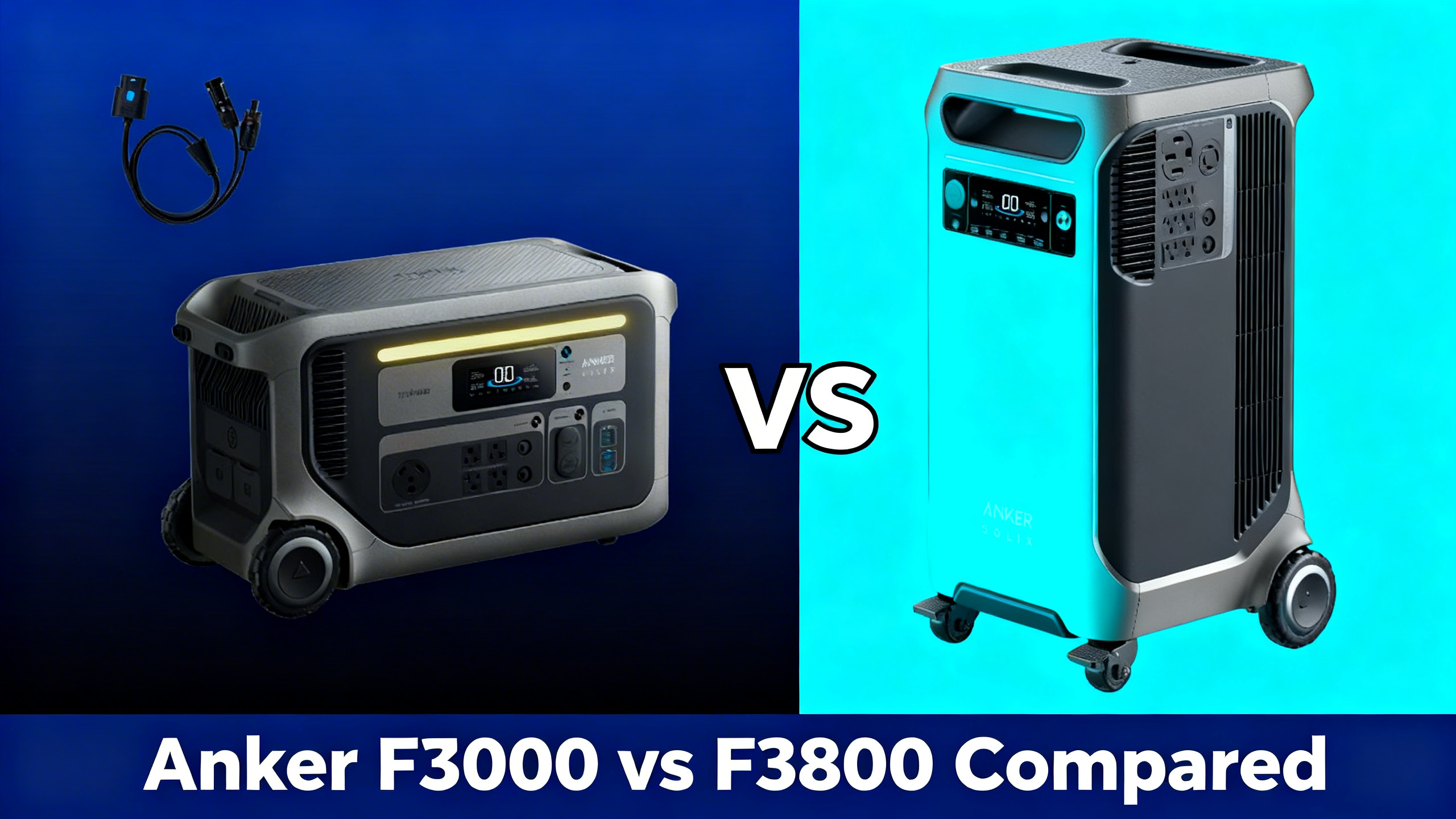
Choosing between the Anker SOLIX F3000 and F3800 feels straightforward on paper, yet the specs tell a more nuanced story. Both units run LFP batteries, accept up to 2,400W of solar, and carry 5-year warranties. But one delivers 3,600W at 120V, while the other pushes 6,000W across 120V/240V split-phase. That gap shapes everything: which appliances you can run, how you expand capacity, and whether you need an adapter for your RV or EV charging.
This comparison breaks down each model across output, capacity, scalability, price, and real-world use cases. The goal is a clear answer: which station belongs in your setup?
Get our Black Friday alerts for Anker SOLIX
We track live prices on 40+ models from Jackery, EcoFlow, BLUETTI and Anker SOLIX. When a deal beats the lowest price we've recorded, you'll hear from us. During Black Friday week, one short recap a day at most.
Unsubscribe in one click. We may earn a commission when you buy through our links, at no extra cost to you. Privacy Policy
Quick Verdict: Which One Should You Buy?
Both the F3000 and F3800 rank among the top Anker SOLIX models ranked, sitting at the high-capacity end of the portable lineup. But they target different buyers with different power profiles.
Spoiler: there’s no universal winner here. The right choice depends on whether you need 240V output and how far you plan to scale your capacity. Let’s break each model down.
Anker SOLIX F3000 Overview

The F3000 is Anker SOLIX’s newer high-capacity portable unit, positioned as a more accessible entry into the 3,000Wh tier. With 3,072Wh of LFP capacity and 3,600W continuous AC output, it targets users who want serious power without crossing into home battery territory.
For a complete spec-by-spec breakdown of the F3000 alone, the F3000 full review covers charging behavior, runtime scenarios, and ecosystem compatibility in detail. Here, we’ll focus on how it stacks up against its larger sibling.
The F3000 carries UL9540 certification, Bluetooth and Wi-Fi connectivity via the Anker app, and supports dual 2,400W solar input. It can charge an RV via the optional TT-30 adapter and connects to a generator through the 120V Generator Input Adapter accessory.
F3000 Key Specifications
Get our Black Friday alerts for Anker SOLIX
We track live prices on 40+ models from Jackery, EcoFlow, BLUETTI and Anker SOLIX. When a deal beats the lowest price we've recorded, you'll hear from us. During Black Friday week, one short recap a day at most.
Unsubscribe in one click. We may earn a commission when you buy through our links, at no extra cost to you. Privacy Policy
Anker SOLIX F3800 Overview

The F3800 is Anker SOLIX’s flagship portable-to-home-backup unit. At 3,840Wh and 6,000W continuous AC output with 120V/240V split-phase capability, it operates in a different category than any 120V-only station. That split-phase output is what lets it run central air conditioning, well pumps, and direct EV charging without external step-up equipment.
The F3800 flagship review digs into expansion battery configurations, transfer switch options, and real-world home backup scenarios in full detail. For this comparison, the key F3800 differentiators are output voltage, native EV ports, and scalability depth.
The F3800 carries a 5-year warranty and a stated 10+ year product lifespan, backed by EV-grade LFP cells. Via the Anker app, you can monitor charging and discharging remotely. Battery expansion through the BP3800 units takes the system from 3.84kWh to a maximum of 26.9kWh (with 6 BP3800 packs).
F3800 Key Specifications
- Capacity: 3,840Wh (expandable to 26.9kWh with 6 BP3800 units)
- AC Output: 6,000W continuous, 120V/240V split-phase
- Solar Input: 2,400W dual 60V, 0-80% charge in under 2 hours in optimal conditions
- EV/RV Ports: NEMA 14-50 and L14-30 built-in (no adapter needed)
- Battery Type: LFP, 5-year warranty, 10+ year product lifespan
- Scalability: Up to 53.8kWh / 12kW with Double Power Hub and 2 F3800 units
- Certification: UL9540 (via Smart Home Power Kit)
- Connectivity: Bluetooth + Wi-Fi, Anker app
- Price: $2,199.99 (standalone, Go Without Solar option)
F3000 vs F3800: Specs Head-to-Head
Let’s put the key figures side by side. Both models share LFP chemistry, the same solar input ceiling, and the same app platform. The differences are concentrated in output power, voltage capability, native port selection, and expansion depth.
Sources: official F3000 specs page | official F3800 product page

Capacity and Runtime
The 768Wh capacity gap between these two units (3,072Wh vs 3,840Wh) is meaningful for extended outages, but less decisive for typical camping or short-term backup use. Runtime calculations based on published capacity show what that difference translates to in practical appliance hours.
Runtime Comparison: F3000 (3,072Wh) vs F3800 (3,840Wh)
❄️
Mini-Fridge (80W)
~38h / ~48h
F3000 / F3800
💻
Laptop (65W)
~47h / ~59h
F3000 / F3800
🌬️
Window AC (1,500W)
~2h / ~2.5h
F3000 / F3800
🏠
Central AC (5,000W)
Not possible
F3800 only: ~0.7h
Runtime calculations based on published capacity. Actual results vary with appliance efficiency and temperature.
For low-draw appliances like refrigerators and laptops, the capacity difference between the two models is modest in practice. Where it matters more: multi-day outages where every additional kilowatt-hour extends how long you can avoid running a generator.
Output and Voltage
This is the most consequential difference between the two models. The F3000 operates at 120V only. That covers the vast majority of common appliances: refrigerators, freezers, sump pumps, window AC units, medical devices, and most power tools. Its 3,600W output handles substantial simultaneous loads.
The F3800’s 6,000W split-phase output adds the entire 240V tier: central air conditioning systems, well pumps, electric dryers, EV charging at higher rates, and any appliance that draws from both legs of your home’s electrical panel. If any of those are on your critical load list, the F3000 simply can’t serve them. The F3800 is the only viable path.
The output wattage gap also matters for high-draw 120V appliances. Running a portable air compressor, a laser cutter, or multiple high-draw appliances simultaneously at 3,600W leaves less headroom than the F3800’s 6,000W ceiling. For most residential emergency scenarios, 3,600W is more than adequate. For demanding parallel loads, the F3800 provides significantly more margin.
Solar Charging

Solar charging specs are identical across both units: both accept up to 2,400W of solar input via dual 60V inputs. Published data indicates the F3800 reaches 0-80% charge in under 2 hours under optimal sunlight conditions. The F3000’s larger panels of optimal solar would deliver proportionally comparable performance given its smaller 3,072Wh capacity.
For off-grid setups where you’re counting on solar to replenish daily, neither unit has an advantage over the other in terms of maximum solar absorption rate. The determining factor becomes which unit’s capacity and output voltage fits your load profile.
Scalability and Ecosystem
Both units live within the broader Anker SOLIX ecosystem, but their expansion paths diverge considerably. Understanding those paths helps clarify which platform makes more sense for long-term investment.

The F3000 expands through the Double Power Hub: link two F3000 units together for 6,144Wh and 7,200W combined output. The ecosystem also includes the Bi-Directional Inlet Box, Smart Meter, and Transfer Switch (6-Circuit), making whole-home critical circuit management possible. That’s a solid setup for moderate home backup needs.

The F3800 goes further through the BP3800 expansion battery. One BP3800 brings the system to 7,680Wh. Six BP3800 units push it to 26.9kWh, covering days rather than hours of whole-home backup. Via the Double Power Hub and two F3800 units, you can reach 53.8kWh and 12kW, which approaches genuine off-grid territory. For comprehensive planning on these configurations, the full breakdown of Anker SOLIX home backup solutions maps out the exact hardware combinations.

The F3800 also supports the Smart Home Power Kit for UL9540-certified whole-home integration, along with 6-circuit and 10-circuit transfer switch options. If whole-home integration is where you’re headed, the F3800 offers a more complete pathway.
Price and Value Analysis
At current pricing, the F3000 comes in at $1,399.99 versus the F3800 at $2,199.99.
On a cost-per-watt-hour basis: the F3000 calculates to approximately $0.46/Wh, while the F3800 comes out to approximately $0.57/Wh. The F3800’s higher price buys more capacity, but also output power and voltage flexibility.
The 30% Residential Clean Energy Credit under IRS Section 25D, which Anker highlighted for the F3800, ended for systems installed after December 31, 2025. Compare the two models on their current prices.
⚠️ Important: Prices shown are checked automatically on Anker SOLIX’s US store. Verify current pricing before purchase, as promotional pricing can change without notice.
Who Should Buy the F3000?
The F3000 is the right choice when your load profile stays within 120V, when portability or mobility is a factor, and when the price difference versus the F3800 is meaningful to your decision.
✅ Buy the F3000 if…
- Budget is a key factor ($1,399.99 vs $2,199.99)
- You power 120V appliances only (no central AC, no well pump)
- You want a portable solution for camping or van life
- A 3,000Wh range covers your critical circuits
- You plan to link 2 units via Double Power Hub later
✅ Buy the F3800 if…
- You need 240V appliances: well pumps, central AC, EV charging
- You want native NEMA 14-50 / L14-30 without adapters
- You need expandable capacity (up to 26.9kWh with BP3800)
- Home backup with transfer switch is the primary use case
The F3000 full review covers specific runtime scenarios across common use cases for anyone who wants to dig further into single-unit performance before committing.
Best Value for Most Buyers
Anker SOLIX F3000
$1,399.99
3,072Wh | 3,600W | UL9540 Certified
Price checked automatically on Anker SOLIX’s US store. Free shipping available
Who Should Buy the F3800?
The F3800 is the right call when 240V output is non-negotiable, when you want the deepest expansion path, or when whole-home integration via transfer switch is the goal. Users planning a whole-home or multi-circuit setup will find the complete breakdown of Anker SOLIX home backup solutions essential before choosing a configuration.
The native NEMA 14-50 and L14-30 ports also make the F3800 the cleaner solution for full-time RVers or anyone who regularly needs to charge an EV from a portable power station, since it eliminates the need to source and carry adapter hardware. The F3800 flagship review covers the Smart Home Power Kit integration and BP3800 expansion in detail for buyers planning those configurations.
F3000 vs F3800: Which Should You Choose?
If neither model perfectly matches your load requirements, the full Anker SOLIX buying guide maps every model to specific use cases and budgets. But for most buyers, the decision comes down to one question: do you need 240V output?
If the answer is no, the F3000 delivers 3,072Wh and 3,600W at a lower price point, with a clean ecosystem path through the Double Power Hub. It’s capable, well-certified, and positioned well for portable and moderate backup use.
If the answer is yes, including running central air conditioning, a well pump, or direct EV charging, the F3800 is the only choice of the two. Its 6,000W split-phase output, native 240V ports, and BP3800 expansion path make it a fundamentally different instrument than the F3000. For a complete look at the brand’s lineup and history, the full Anker SOLIX brand review covers every model family from entry-level to flagship.
Top 5 Anker SOLIX Models Ranked
See how the F3000 and F3800 compare across the full Anker SOLIX portable lineup.
Frequently Asked Questions
What is the main difference between the Anker SOLIX F3000 and F3800?
The core difference is output power and voltage. The F3000 delivers 3,600W at 120V, while the F3800 outputs 6,000W with 120V/240V split-phase capability. Capacity also differs: 3,072Wh vs 3,840Wh. For users who need to run 240V appliances such as central AC, well pumps, or EV charging, the F3800 is the only viable option of the two.
Is the Anker SOLIX F3000 compatible with the same expansion ecosystem as the F3800?
Both models support the Anker Double Power Hub for linking two units together. However, the F3800 has its own dedicated expansion battery (BP3800), enabling up to 26.9kWh of total capacity. The F3000 does not support the BP3800 expansion battery, making the F3800 the better platform for long-duration whole-home backup scenarios.
Can the Anker SOLIX F3000 charge an RV or EV?
Yes, but with an adapter. The F3000 requires the optional TT-30 charging cable or generator input adapter for RV shore power connections. The F3800 includes NEMA 14-50 and L14-30 outlets natively, making RV and EV charging possible without additional accessories or added cost.
Which model qualifies for the federal tax credit?
Neither, for a home installation in 2026. The 30% Residential Clean Energy Credit under IRS Section 25D ended for systems installed after December 31, 2025. A system installed by then can still be claimed on a 2025 return.
Is the F3000 price permanent or a limited promotion?
The F3000 currently sells for $1,399.99 on the Anker SOLIX store. Promotional pricing can change at any time without notice. Verify current pricing directly on the Anker SOLIX product page before making a purchase decision.
Final Thoughts
The Anker SOLIX F3000 and F3800 are both serious high-capacity stations backed by LFP chemistry, 5-year warranties, and a capable app ecosystem. The choice between them isn’t about quality: it’s about what your loads actually require.
For portable use, 120V critical circuits, and value-focused buyers, the Anker SOLIX F3000 at $1,399.99 is a compelling platform. For home backup that includes 240V appliances, the Anker SOLIX F3800 at $2,199.99 is the only option that covers those needs natively.
Originally published: April 6, 2026