
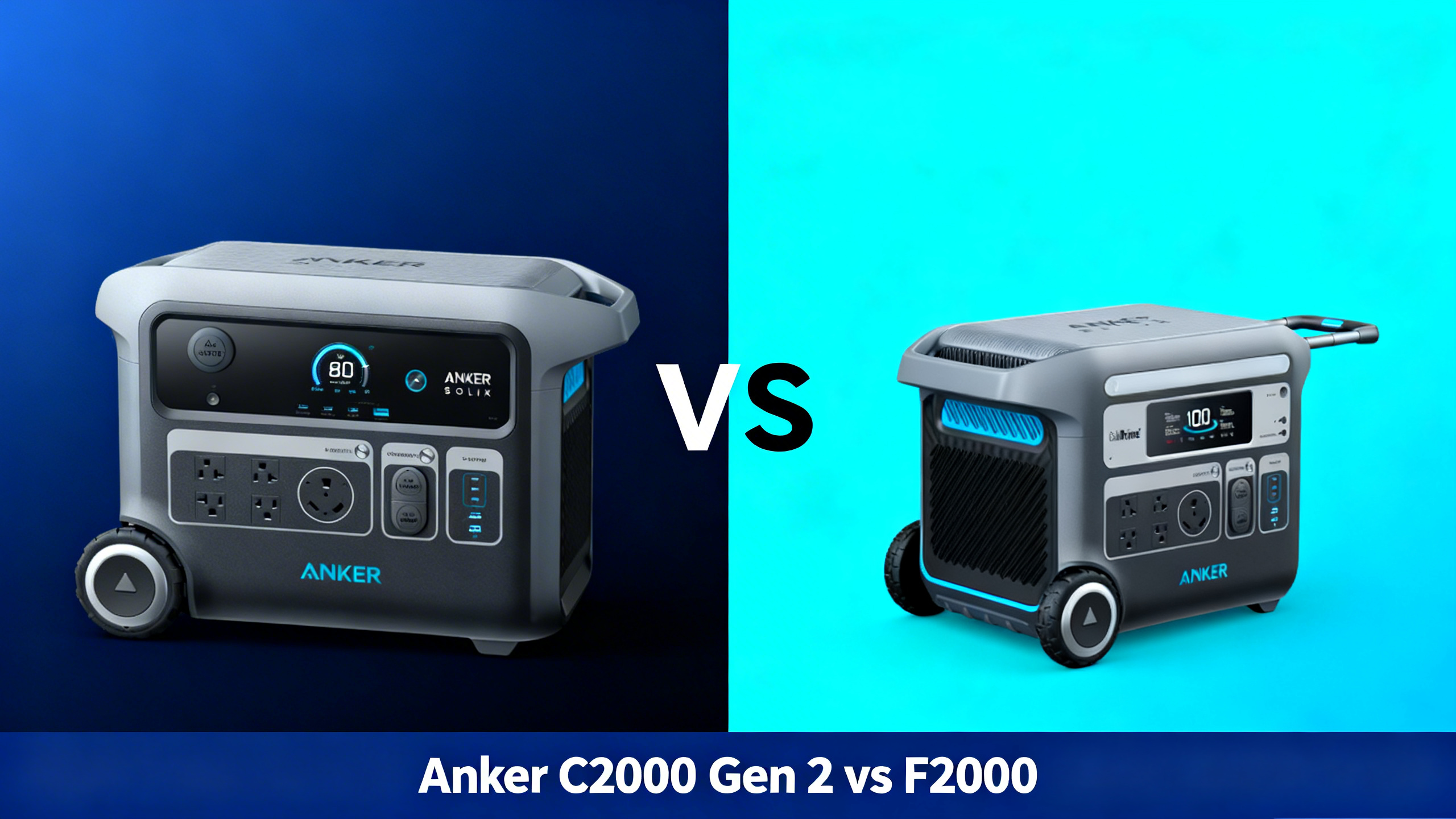
Choosing between the Anker SOLIX C2000 Gen 2 and the F2000 feels straightforward on paper: both carry a 2,048Wh capacity and a 2,400W rated AC output. But the specs diverge sharply the moment you dig into charging speed, idle efficiency, and portability. One is Anker’s latest compact powerhouse; the other is a proven flagship from 2022 that still commands a $99 premium.
The C2000 Gen 2 belongs to Anker SOLIX’s C-series, engineered around efficiency and fast recharge. The F2000 was the original high-capacity flagship when it launched, built for maximum output and longevity. For a full picture of the Anker SOLIX lineup, start with our full Anker SOLIX brand review before diving into this head-to-head.
This comparison covers the five metrics that matter most for a buying decision: charge speed, portability, expandability, idle efficiency, and overall value. The data tells a clear story on four of those five.
Spoiler: the C2000 Gen 2 wins on price, charge speed, weight, and runtime efficiency. The F2000 holds its ground for one specific buyer profile.


Get our Black Friday alerts for Anker SOLIX
We track live prices on 40+ models from Jackery, EcoFlow, BLUETTI and Anker SOLIX. When a deal beats the lowest price we've recorded, you'll hear from us. During Black Friday week, one short recap a day at most.
Unsubscribe in one click. We may earn a commission when you buy through our links, at no extra cost to you. Privacy Policy
At a Glance: Key Differences
Same capacity, same rated output. The efficiency gap between these two units is significant. Here’s how they compare across every major specification.
Three takeaways stand out immediately: the C2000 Gen 2 charges nearly three times faster, weighs 27% less, and consumes half the idle power. The F2000 reaches slightly higher maximum expanded capacity (4,608Wh vs 4kWh), though that only matters if you already own its BP2600 battery.
Anker SOLIX C2000 Gen 2 Overview
The C2000 Gen 2 is Anker SOLIX’s current compact flagship, built around a fundamental efficiency advantage: just 9W idle power consumption. That figure translates directly to runtime. The published spec of 32 hours on a dual-door fridge isn’t marketing; it’s a consequence of genuine efficiency engineering at the inverter level.
Charging speed is the headline specification here. Published data from Anker confirms 80% capacity in 45 minutes and full charge in 58 minutes via AC. For context, the F2000 takes 1.4 hours to reach the same 80% threshold. The C2000 Gen 2 also supports six charging methods including 800W UltraFast alternator charging, which reaches 100% in approximately 3 hours from a vehicle, roughly 8 times faster than a standard car socket.
At 41.7 lb, the C2000 Gen 2 is 25% lighter than the industry average for 2,000Wh-class stations. Its dimensions (18.1 x 9.8 x 10.1 inches) make it meaningfully more compact than the F2000, which matters for trunk storage, van life setups, and general portability. Peak output reaches 4,000W, giving it an edge over the F2000’s 3,600W surge ceiling. For the C2000 Gen 2 detailed review covering long-term runtime analysis, see our dedicated page.
Get our Black Friday alerts for Anker SOLIX
We track live prices on 40+ models from Jackery, EcoFlow, BLUETTI and Anker SOLIX. When a deal beats the lowest price we've recorded, you'll hear from us. During Black Friday week, one short recap a day at most.
Unsubscribe in one click. We may earn a commission when you buy through our links, at no extra cost to you. Privacy Policy
Anker SOLIX F2000 Overview
The F2000 launched as Anker SOLIX’s first serious high-capacity portable in 2022. It established the template for what a premium 2,000Wh station should look like: LiFePO4 chemistry (lithium ferro-phosphate), a broad port selection, and a 5-year warranty that remains industry-leading today. At 3,000 charge cycles, the F2000’s InfiniPower battery technology is rated for a 10-year lifespan under regular use, according to LiFePO4 cycle life data from Battery University.
Where the F2000 distinguishes itself is port density. It offers 12 output ports, which is genuinely useful for base-camp setups or tailgate situations where multiple users need simultaneous access. Surge output reaches 3,600W, which handles most heavy-draw appliances and tools reliably. The F2000 expands via the BP2600 battery module to a maximum of 4,608Wh, slightly above the C2000 Gen 2’s 4kWh ceiling.
However, AC charging takes approximately 1.4 hours to reach 80%, solid by older standards, but clearly behind the C2000 Gen 2’s 45-minute benchmark. Weight is estimated at approximately 57 lb, which remains manageable but noticeably heavier than the newer compact design. Our F2000 review covers all the practical runtime scenarios in detail.

Head-to-Head: Charging Speed
AC Charging
This is where the generation gap becomes undeniable. Spec analysis confirms the C2000 Gen 2 charges from 0 to 80% in 45 minutes and reaches full capacity in 58 minutes via AC. The F2000 reaches 80% in approximately 1.4 hours and full charge in roughly 2 hours. That’s a 60-85% speed advantage for the Gen 2, depending on which benchmark you apply.
For practical use, this gap matters most in two scenarios: you’re charging overnight and want a full unit before sunrise without timing it precisely, or you’re quick-charging during a lunch stop on a road trip. The C2000 Gen 2’s sub-hour full charge removes the anxiety of partial charges. The F2000’s 2-hour full charge is perfectly acceptable, but it’s a meaningful step down.
Solar Input
The F2000 accepts up to 1,000W solar input, which is strong for a portable station. Both units include WiFi and Bluetooth app connectivity for monitoring charge status remotely. Solar performance depends heavily on panel selection and conditions, so the input ceiling matters more than the theoretical maximum.

Head-to-Head: Portability and Design
A spec-for-spec weight comparison shows the C2000 Gen 2 at 41.7 lb versus the F2000 at approximately 57 lb. That’s roughly 15 lb lighter, a 27% reduction that’s immediately noticeable when loading into a vehicle or carrying to a campsite. Anker’s published figures indicate the C2000 Gen 2 is 25% lighter than the industry average for this capacity class, and 29% smaller in volume.
The C2000 Gen 2’s dimensions (18.1 x 9.8 x 10.1 inches) make it genuinely compact for 2,000Wh. It fits in a mid-size car trunk alongside other gear without dominating the space. The F2000, while not oversized for its category, reflects the older design philosophy where weight and output took priority over compactness.

Head-to-Head: Expandability
Both units support battery expansion, but through different modules that are not cross-compatible. The C2000 Gen 2 pairs with the BP2000 Gen 2 expansion battery to reach a total of 4kWh: enough to sustain a dual-door fridge for up to 64 hours in a continuous setup. The F2000 uses the BP2600 module to reach 4,608Wh, a slightly higher ceiling that becomes relevant if you’re running an extended off-grid stay or need to power larger appliances overnight.
For new buyers, neither system has a meaningful advantage here. Both require a separate purchase, and the capacity difference is marginal for most use cases. For existing F2000 owners who already have the BP2600, this is the one scenario where sticking with the F2000 ecosystem makes clear financial sense.

What Can the C2000 Gen 2 Power? (2,048Wh, 9W idle)
🧊
Dual-door fridge
~32h
~60W
💡
LED lighting
~340h
~6W
💻
Laptop (65W)
~27 charges
~65W
📱
Smartphone
~190 charges
~10Wh/charge
Head-to-Head: Idle Efficiency and Runtime
Idle power draw is one of the most underreported specs in this category. The C2000 Gen 2 consumes just 9W at idle, half of the F2000’s approximately 18W. Why does that matter? Because every watt the inverter consumes in standby reduces your effective runtime, even when no load is connected.
Runtime calculations based on capacity and idle load show the C2000 Gen 2 sustaining a dual-door fridge (drawing roughly 60W average) for up to 32 hours. The same calculation applied to the F2000’s idle overhead brings fridge runtime to approximately 16 hours at comparable loads. That’s a direct consequence of inverter efficiency, not just capacity. For a home backup or multi-day outage scenario, this difference is significant.

Head-to-Head: Output Ports and Features
Port count goes to the F2000: 12 output ports across its panel versus the C2000 Gen 2’s more focused selection. If you’re running a multi-device setup at a base camp or tailgate where several people are charging simultaneously, the F2000’s port density is a genuine advantage. The C2000 Gen 2’s port count covers the majority of real-world use cases, but the F2000 simply offers more simultaneous connections.
On peak power, the C2000 Gen 2 edges ahead with a 4,000W peak versus the F2000’s 3,600W surge. Both handle high-draw appliances like air compressors and power tools reliably. Both units include WiFi and Bluetooth app control for remote monitoring. UPS (Uninterruptible Power Supply) functionality is available on both, making either unit viable for sensitive electronics during outages.

Head-to-Head: Value Analysis
At $799.99 for the Anker SOLIX C2000 Gen 2 and $899.00 for the F2000, the price-per-Wh calculation comes out to approximately $0.39/Wh for the C2000 Gen 2 versus $0.44/Wh for the F2000. The Gen 2 is not just cheaper: it’s delivering a more efficient and faster-charging unit at that lower price point.
Long-term cost parity exists on the battery side: both use LiFePO4 chemistry rated for 3,000+ cycles. Based on verified specs, both units should deliver a 10-year service life under regular use. The F2000’s 5-year full-device warranty matches what the C2000 Gen 2 offers, so there’s no difference in coverage. Both units appear in our roundup of the best premium power stations alongside competition from Jackery and Bluetti.
✅ Choose the C2000 Gen 2 if…
- Fast recharging matters (45 min to 80%)
- Weight is a concern (41.7 lb vs ~57 lb)
- Budget is $799 vs $899
- Long fridge runtime is a priority
- You want 4kWh expandability via BP2000 Gen 2
✅ Choose the F2000 if…
- You already own the BP2600 expansion battery
- You need up to 3,600W surge for heavy tools
- You want F2000/F2600 accessory ecosystem compatibility
- A portable-with-wheels setup is preferred
- You prioritize the 12-port output count
Winner by Use Case
Not sure which 2,000Wh-class model fits your setup? Our complete buying guide matches every Anker SOLIX model to specific use cases. Here’s how the two compare across the most common buyer profiles.
Best for Camping and Outdoor
The C2000 Gen 2 wins on portability and charge speed. At 41.7 lb, it’s significantly easier to load and unload from a vehicle. The 45-minute-to-80% AC charge means you can top it up at a rest stop or site hookup quickly rather than waiting hours. For weekend camping where you’re powering a cooler, lights, and devices, the C2000 Gen 2’s efficiency advantage also extends effective runtime between charges.
Best for Home Backup
The C2000 Gen 2 again. The 9W idle draw and 32-hour fridge runtime translate directly to outage coverage. A power outage that lasts 20-24 hours is common in storm-affected areas; the C2000 Gen 2 keeps your refrigerator running through that scenario where the F2000 may fall short at comparable loads. Add the BP2000 Gen 2 expansion for extended coverage.
Best for RV and Van Life
The C2000 Gen 2 edges ahead here too. Its native 800W UltraFast alternator charging is a practical advantage for van life, where recharging from the vehicle while driving is a daily workflow. Lighter weight also matters in a vehicle build where every pound counts. The compact dimensions fit more easily into custom battery compartments.
Best for Power Tool Users
The F2000 holds its own here. At 3,600W surge, it handles high-inrush-current tools like circular saws and compressors reliably. The C2000 Gen 2’s 4,000W peak is technically higher, but the F2000’s robust build and port selection make it the preferred choice for contractor or workshop scenarios where 12 simultaneous output connections are genuinely useful.
Best for Existing F-Series Owners
If you already own a BP2600 expansion battery paired with an F2000, the math changes. The combined F2000 system reaches 4,608Wh, and the BP2600 you’ve already paid for doesn’t transfer to the C2000 Gen 2. Staying in the F-series ecosystem makes sense in this scenario. For everyone else buying fresh, the C2000 Gen 2 is the clear choice.
Final Recommendation
A head-to-head spec comparison shows the Anker SOLIX C2000 Gen 2 winning on four of the five core metrics: price ($799.99 vs $899), charge speed (58 min vs ~2 hours to full), weight (41.7 lb vs ~57 lb), and idle efficiency (9W vs ~18W). The F2000 retains relevance for existing owners with the BP2600 battery, and for users who specifically need 12 simultaneous output ports.
For new buyers choosing between these two units today, the C2000 Gen 2 is the stronger purchase in nearly every scenario. It’s the newer design, it’s cheaper, and it’s more efficient. The C2000 Gen 2 is also the unit we’d recommend if you’re comparing this class against options from other Anker SOLIX models.
The F2000 isn’t a bad station. It’s simply an older flagship that the C2000 Gen 2 has surpassed at a lower price point.
Anker SOLIX C2000 Gen 2
$799.99
Best 2,048Wh portable: faster charge, lighter, lower price
Price verified April 2026. Free shipping available
Is the Anker SOLIX C2000 Gen 2 actually better than the F2000?
On 4 out of 5 key metrics including price, charge speed, weight, and idle efficiency, the C2000 Gen 2 outperforms the older F2000. The F2000 retains an advantage only for users who already own its BP2600 expansion battery, since that system reaches 4,608Wh versus the C2000 Gen 2’s 4kWh maximum. For new buyers, the C2000 Gen 2 is the stronger choice at $99 less.
Can the C2000 Gen 2 use the F2000’s BP2600 expansion battery?
No. The C2000 Gen 2 uses the BP2000 Gen 2 expansion battery, which is specific to the C-series system. The BP2600 is compatible with the F2000 and F2600 only. Cross-series battery swapping is not supported by Anker SOLIX. If you already own a BP2600, staying with the F2000 ecosystem makes better financial sense.
How much faster does the C2000 Gen 2 charge compared to the F2000?
Significantly faster. Published specs confirm the C2000 Gen 2 reaches 80% in 45 minutes and 100% in 58 minutes via AC. The F2000 takes approximately 1.4 hours to reach 80% and around 2 hours to fully charge, making the Gen 2 roughly 60-85% faster depending on which charging benchmark you use.
Which model is better for a refrigerator during a power outage?
The C2000 Gen 2, by a wide margin. Its 9W idle power draw allows the published 2,048Wh capacity to sustain a dual-door fridge for up to 32 hours. The F2000’s higher idle draw reduces effective runtime to approximately 16 hours at comparable loads. For home backup scenarios, the C2000 Gen 2’s efficiency engineering makes a meaningful practical difference.
Is the Anker SOLIX F2000 still worth buying in 2026?
For new buyers at full price, the C2000 Gen 2 offers better value at $99 less with superior efficiency. The F2000 remains relevant if you already own BP2600 expansion batteries or find discounted units under $700. At that price point, the F2000’s 5-year warranty and 12-port output become more competitive. For full-price purchases, the C2000 Gen 2 is the better buy.
What does “Mid-Range vs Budget Flagship” mean in this comparison?
The C2000 belongs to Anker SOLIX’s compact C-series, designed around efficiency and portability rather than maximum output. The F2000 was positioned as a flagship portable when it launched in 2022. At current pricing, the C2000 Gen 2 delivers more modern technology at a lower price point, effectively inverting the original hierarchy. “Budget Flagship” reflects that the newer, cheaper unit now outperforms the original premium model on most metrics.
Originally published: April 6, 2026