
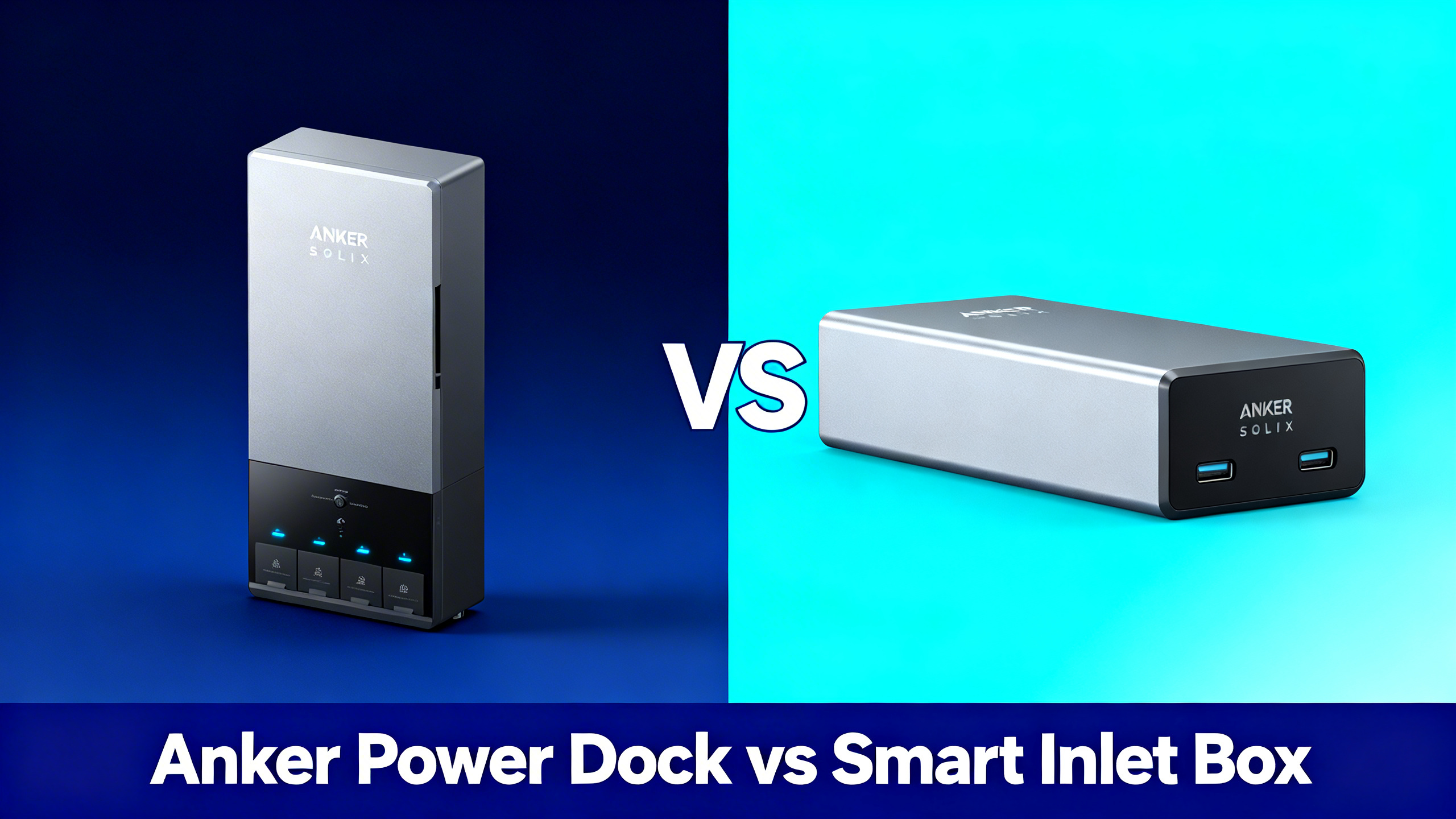
Choosing the right connection component for your Anker SOLIX E10 system feels straightforward until you realize the two options differ by $1,600. The Power Dock ($1,999) and the Smart Inlet Box ($399) both physically link the E10 to your home electrical panel, yet the experience of owning one versus the other is entirely different. For a complete picture of the E10 system before diving into accessories, the E10 system overview covers the full hardware ecosystem in detail.
This guide breaks down exactly what separates the two products, which homeowner profiles should prioritize each option, and how the total cost of ownership shifts once installation is factored in. The right choice depends less on brand loyalty and more on how you need your home backup system to behave during a power outage.

Best for: Seamless Backup
Anker SOLIX Power Dock
$1,999
Automatic transfer switch

Best for: Budget Setup
Anker SOLIX Smart Inlet Box
$399
Manual switching required
Get our Black Friday alerts for Anker SOLIX
We track live prices on 40+ models from Jackery, EcoFlow, BLUETTI and Anker SOLIX. When a deal beats the lowest price we've recorded, you'll hear from us. During Black Friday week, one short recap a day at most.
Unsubscribe in one click. We may earn a commission when you buy through our links, at no extra cost to you. Privacy Policy
What Is the Anker SOLIX E10 System?
Before choosing between these two accessories, it helps to understand the E10 system overview : both components exist solely to connect the E10 to your home electrical panel. The Anker SOLIX E10 is a modular whole-home battery backup system built around a Power Module (inverter + management unit) paired with one or more Battery units. It targets homeowners who need continuous power for essential circuits or the entire home during grid outages.
The E10 does not connect directly to your electrical panel. It requires a separate interface device to manage the relationship between the battery system and your home’s grid connection. That interface is either the Power Dock or the Smart Inlet Box. Without one of them, the E10 cannot function as a home backup system. For a complete picture of every model in the lineup, the full Anker SOLIX brand review covers the full ecosystem in detail.
What Is Each Product? Quick Definitions
The naming overlap in Anker’s documentation creates genuine confusion. Both the Power Dock and the Smart Inlet Box perform the same fundamental role: bridging the E10 battery system to your home electrical panel. The difference lies in how they manage the transition when grid power fails.
Anker SOLIX Power Dock
The Power Dock ($1,999) functions as a full automatic transfer switch (ATS). When grid power drops, it detects the outage and switches your home circuits to battery power without any input required from you. Integration is native to the E10 system: the Power Dock manages the 200A connection to your electrical panel, handles grid-tie communication, and coordinates the E10’s charging and discharging cycles automatically. The Anker SOLIX Power Dock is compatible exclusively with the E10 system. Professional installation is required, and Anker offers an installation service separately at $2,000. See the transfer switch options guide for a full breakdown of ATS solutions in the Anker SOLIX lineup.
Anker SOLIX Smart Inlet Box
The Smart Inlet Box ($399) provides the physical connection interface between the E10 (or F3000) and your home circuit, but without automatic switching. When a power outage occurs, you manually activate the switchover. This requirement is not a design flaw. It reflects a deliberate trade-off between cost and automation. The Smart Inlet Box is compatible with both the E10 and the F3000 portable power station, which expands its utility for owners of multiple Anker SOLIX products. An optional Smart Meter add-on ($249) enables grid-tie energy monitoring and solar prioritization for homeowners looking to maximize utility savings.
Get our Black Friday alerts for Anker SOLIX
We track live prices on 40+ models from Jackery, EcoFlow, BLUETTI and Anker SOLIX. When a deal beats the lowest price we've recorded, you'll hear from us. During Black Friday week, one short recap a day at most.
Unsubscribe in one click. We may earn a commission when you buy through our links, at no extra cost to you. Privacy Policy
Power Dock vs Smart Inlet Box: Key Differences
Both accessories are covered in our Anker home backup hub alongside full system comparisons. The core distinction between the two products comes down to a single variable: does your backup need to activate itself, or are you comfortable doing it manually? Every other difference (price, compatibility, installation scope) flows downstream from that question.
Spec-for-spec analysis reveals a $1,600 gap between the two devices, with a corresponding difference in installation costs that widens the real-world delta to approximately $2,800 when total ownership cost is calculated. The Power Dock requires $2,000 in professional installation; the Smart Inlet Box carries a $800 service fee for the same professional setup. Neither device supports DIY electrical work without a licensed electrician involved.
Power Dock vs Smart Inlet Box: Head-to-Head
The compatibility gap matters for one specific group: homeowners who already own or plan to purchase an F3000 portable power station. The Smart Inlet Box works with both systems; the Power Dock does not. That cross-compatibility can represent meaningful value if the E10 + F3000 combination is part of a phased home backup plan.
Power Dock Deep Dive
The Power Dock’s defining feature is zero-action outage response. Published specifications confirm a 200A automatic transfer switch rated for whole-home electrical panels, with native integration into the E10 management system. When grid power drops, the Power Dock identifies the failure and reroutes your home circuits to battery power without requiring any manual intervention. This matters most in two scenarios: when occupants cannot physically perform a manual switch (medical needs, elderly household members), and when outages occur during sleep or absence from the home.
Grid-tie capability is built in. The Power Dock manages bidirectional energy flow between the E10 battery, solar input, and the utility grid, making it the correct choice for homeowners planning a solar-plus-storage installation. It also supports energy optimization through the Anker SOLIX app, allowing time-of-use charge scheduling and monitoring. A full breakdown of transfer switch options for the Anker SOLIX lineup is available for homeowners comparing manual and automatic solutions.

A limitation the total cost makes clear: once installation is included, the Power Dock adds approximately $3,999 on top of the base E10 system price. For buyers entering the E10 ecosystem at the $4,299 level (single battery configuration), the Power Dock nearly doubles the connection cost relative to the Smart Inlet Box. That math is worth factoring before committing to the automatic option.
Anker SOLIX Power Dock
Automatic transfer switch, whole-home E10 integration
$1,999
Smart Inlet Box Deep Dive
The Anker SOLIX Smart Inlet Box positions itself as the entry point to home backup integration for the E10 and F3000 ecosystems. At $399, it provides the physical and electrical interface needed to connect either system to your home panel. The core trade-off is explicit in its design: automation is sacrificed for affordability, and the result is a device that requires the homeowner’s active participation when switching power sources.
Compatibility with the F3000 is a meaningful differentiator. Owner data consistently reports that households running both the E10 and F3000 benefit from a single connection interface rather than two separate setups. The Smart Inlet Box handles both systems, which translates to simplified panel work and a lower total installation footprint. For F3000 users specifically, the Smart Inlet Box is the only compatible connection option. The Power Dock does not support the F3000.

The optional Smart Meter ($249) extends the Smart Inlet Box’s capabilities substantially. Adding the Smart Meter enables AI-based energy monitoring every 15 seconds, solar input prioritization, and grid-tie savings of up to $1,560 per year according to Anker’s published figures. For homeowners with solar panels, the Smart Meter transforms the Smart Inlet Box from a basic connection device into an energy management platform. Grid-tie functionality is not exclusive to the Power Dock. The Smart Inlet Box reaches parity with an additional $249 investment.
Installation: What Each Option Requires
Neither product is a plug-and-play installation. Both the Power Dock and the Smart Inlet Box require a licensed electrician to complete the panel connection. The difference is scope: the Power Dock’s 200A ATS integration is more involved than the Smart Inlet Box’s connection process, which is reflected directly in the service fee difference ($2,000 vs $800).
Both options require the on-grid connection cable ($149), which serves as the physical link between the E10 system and the connection device. This cable is compatible with both the Power Dock and the Smart Inlet Box, so switching from one to the other at a later stage does not require replacing it. Step-by-step procedures for both options are covered in the installation guide for the E10 system.

The practical implication for homeowners: budget the service fee into your comparison from the start. The device cost alone ($1,999 vs $399) understates the real difference. Once installation is included, the Power Dock path costs approximately $3,999 in connection infrastructure; the Smart Inlet Box path costs approximately $1,199. For homeowners on tighter budgets, the $2,800 gap is substantial enough to influence the overall E10 purchasing decision.
Which Bundle Should You Choose?
For homeowners comparing whole-home backup systems across brands, the decision between Power Dock and Smart Inlet Box mirrors a broader choice between fully automated and manual setups. The automation question is binary: either it matters enough to justify the cost, or it does not. There is no middle ground with these two products.

Which Option Is Right for You?
✅ Choose the Power Dock if…
- You need automatic power restoration during outages (no manual action)
- Medical equipment or critical appliances require zero-interruption backup
- You have elderly family members or run a home office that cannot tolerate outages
- Budget allows for ~$4,000 total installation cost
- You want the cleanest, most integrated E10 installation possible
✅ Choose the Smart Inlet Box if…
- You are comfortable manually switching over during an outage
- You also own (or plan to own) an F3000 portable power station
- Budget is a priority and saving $1,600+ on the connection component matters
- You want to add the Smart Meter later for grid-tie solar savings
- A lower $800 service fee for professional installation is appealing
If You Need Automatic Backup
The Power Dock is the correct choice when outage response cannot depend on a person being present and alert. Medical devices, CPAP machines, home offices with sensitive equipment, and households with elderly residents all represent scenarios where automatic switching is not a luxury but a functional requirement. The $3,999 total cost is a premium for peace of mind, and the data from E10 owners in these situations consistently supports that framing.
If Budget Is a Priority
The Smart Inlet Box delivers 90% of the E10’s functional capability at roughly 30% of the connection cost. An upgrade path to the Power Dock exists. Anker’s E10 ecosystem is designed for modular upgrades, and the on-grid connection cable ($149) is compatible with both devices. Starting with the Smart Inlet Box is a viable strategy for homeowners who want to evaluate the E10 system before committing to the full automation investment.
Bundle Pricing and What You Get
Anker structures the E10 ecosystem through several pre-configured bundles that pair the E10 hardware with either connection option. The entry-level E10 + Smart Inlet Box bundle is available at $4,599, making it the most accessible whole-home backup configuration in the lineup. The flagship E10 + Power Dock bundle tops out at $7,799 for the full two-battery automatic configuration.
E10 Bundle Costs at a Glance
E10 + Smart Inlet Box
$4,599
Entry configuration
E10 + Power Dock
$7,799
Automatic backup config
SIB Install Service
$800
Professional install
Power Dock Install
$2,000
Professional install
The E10 + Smart Inlet Box bundle ($4,599) represents the most cost-effective entry into Anker’s whole-home backup ecosystem. The bundle pricing typically reflects a slight discount relative to purchasing components separately, though the on-grid connection cable ($149) is generally sold separately in both configurations.
Verdict: Power Dock vs Smart Inlet Box
The analysis points to two distinct buyer profiles rather than a single universal recommendation. The Power Dock earns its $3,999 total cost for homeowners who require zero-action outage response: the automation premium is justified by the scenarios where manual switching is impractical or unsafe. The Smart Inlet Box delivers strong value at $1,199 total for the majority of E10 buyers who are present during outages and comfortable with a brief manual switchover.
The upgrade path is real and accessible: the on-grid connection cable transfers between both devices, so starting with the Smart Inlet Box does not permanently foreclose the Power Dock option. For most homeowners entering the E10 ecosystem, the Smart Inlet Box is the rational starting point, with the Power Dock as a targeted upgrade for those whose life circumstances demand full automation.
Anker SOLIX Power Dock
$1,999
Best for whole-home automatic backup with E10
Price verified April 2026. Professional installation available
FAQ
Can I use the Smart Inlet Box without the E10?
Yes. The Smart Inlet Box is also compatible with the Anker SOLIX F3000 portable power station. It creates a connection between the F3000 and your home circuit, enabling limited home circuit backup. The Power Dock, by contrast, is designed exclusively for the E10 system.
Does the Power Dock include an electrician installation?
The Power Dock itself ($1,999) does not include installation. A separate professional installation service is available through Anker for $2,000, covering the 200A ATS connection to your home panel. Total cost with installation comes to approximately $3,999.
Can I upgrade from a Smart Inlet Box to a Power Dock later?
Yes. Anker’s E10 ecosystem is designed for modular upgrades. Homeowners who start with the Smart Inlet Box can replace it with the Power Dock at a later stage. The on-grid connection cable ($149) is compatible with both devices, so it does not need to be replaced during an upgrade.
What is the difference between the Smart Inlet Box and the Bi-Directional Inlet Box?
These are the same product, referred to by different names in Anker’s documentation. The “Smart Inlet Box” is the current retail name. The “Bi-Directional Inlet Box” is the technical term used in older product listings, notably for the F3000 Power Saver Kit. Both refer to the AS211141 SKU.
Do I need the Smart Meter in addition to the Smart Inlet Box?
The Smart Inlet Box alone provides the physical connection. Adding the Smart Meter ($249) enables AI-based energy monitoring every 15 seconds, solar prioritization, and grid-tie energy savings of up to $1,560 per year according to Anker’s published figures. The Smart Meter is optional but recommended for homeowners with solar panels.
Is the Power Dock compatible with the F3000?
No. The Power Dock is designed exclusively for the Anker SOLIX E10 whole-home system. For F3000 compatibility, the Smart Inlet Box is the correct connection device.
Originally published: April 6, 2026