
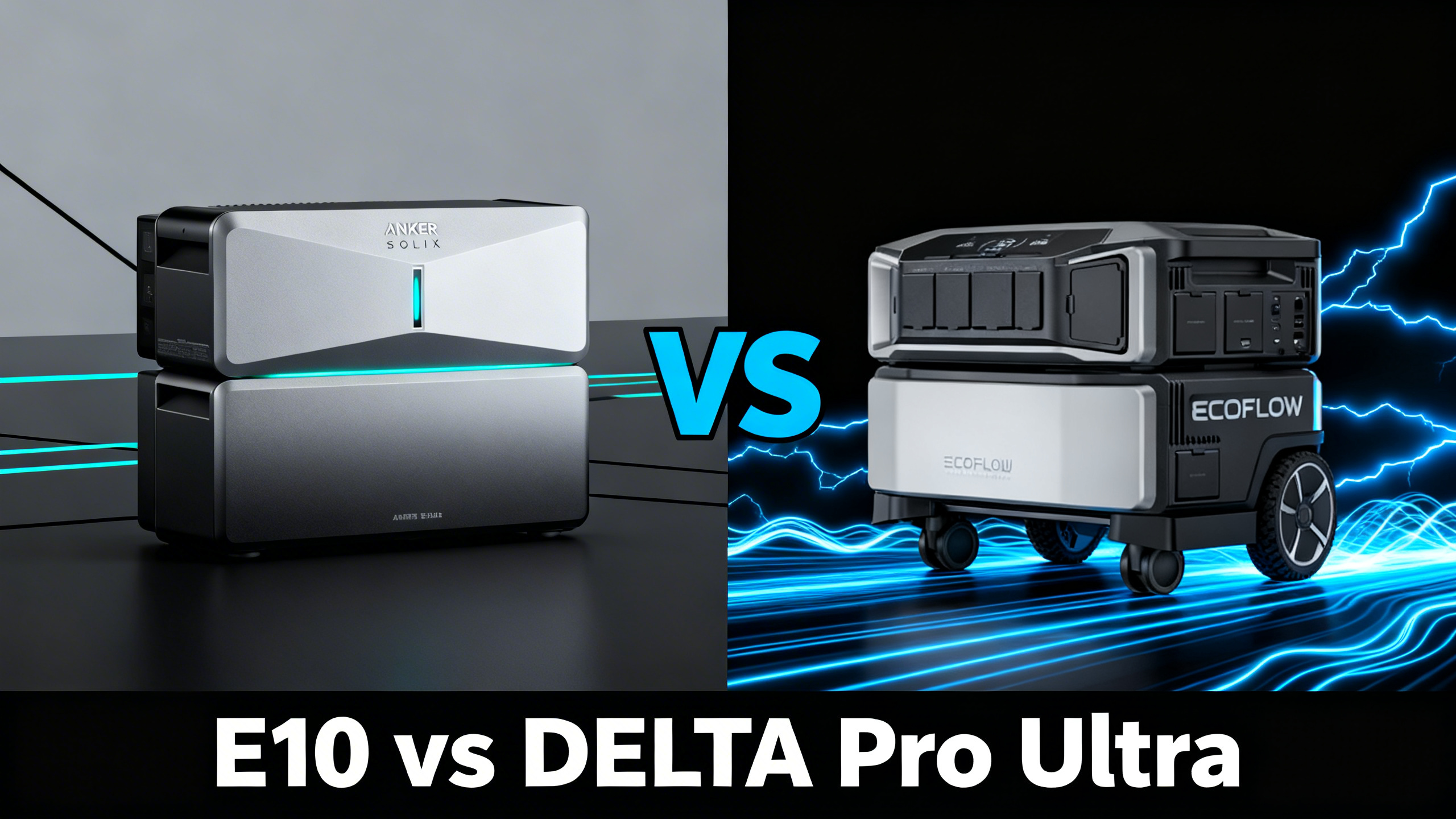
Two whole-home battery systems, both UL9540-certified, both starting in the same price bracket, and both designed to keep your home running when the grid goes down. Choosing between the Anker SOLIX E10 and the EcoFlow DELTA Pro Ultra is one of the more nuanced decisions in the home backup space right now.
The E10 arrives as Anker’s first serious residential system, built around a modular architecture with UL9540 and UL9540A dual certification. The DELTA Pro Ultra has been on the market since late 2023 and holds the distinction of being the only power station simultaneously certified to both UL1973 and UL9540. Both start at similar price points ($4,299 and $3,989 respectively) but diverge significantly in how they grow and integrate with your home. For a broader look at the brand’s full lineup, the full Anker SOLIX brand review covers every model currently available.

This comparison covers specs, pricing configurations, scalability, installation requirements, and real-world performance analysis. The goal is a clear decision framework for homeowners who have narrowed their shortlist to these two systems.
Editor’s Pick: Modular
Best Value: UL Dual-Certified

Get our Black Friday alerts for power stations
We track live prices on 40+ models from Jackery, EcoFlow, BLUETTI and Anker SOLIX. When a deal beats the lowest price we've recorded, you'll hear from us. During Black Friday week, one short recap a day at most.
Unsubscribe in one click. We may earn a commission when you buy through our links, at no extra cost to you. Privacy Policy
What Are These Two Systems?
The Anker SOLIX E10 is Anker’s first residential whole-home battery system, launched in 2025-2026. It uses a modular Power Module plus B6000 Battery Module architecture, designed for floor, wall-mount, or outdoor installation. The E10 carries both UL9540 and the stricter UL9540A certification, the latter specifically addressing fire and explosion risk in occupied residential structures. Native 240V output is available via two connection options: a Power Dock with integrated automatic transfer switch, or a Smart Inlet Box for manual switchover.
The EcoFlow DELTA Pro Ultra launched in late 2023 as the brand’s flagship residential system. It holds a unique position: it is the only power station simultaneously certified to both UL1973 (battery safety) and UL9540 (overall system). The base configuration pairs one inverter with one battery module, delivering 7.2kW of output. Grid integration runs through EcoFlow’s Smart Home Panel 2, which handles automatic load switching and energy management.
Both systems use LiFePO4 (LFP) battery chemistry, which offers superior longevity compared to standard lithium-ion. Both require professional electrician installation. And both start with approximately 6kWh of base capacity. The similarities end there.
Specs Head-to-Head
For the full spec breakdown of the E10 on its own, the E10 detailed review goes deeper into certifications and install requirements. Below is the complete spec-for-spec comparison of the two systems in their base configurations.
Full Spec Comparison: Base Configurations
Both systems share the same 6kWh starting point, which translates to meaningful backup for essential loads: lighting, refrigerators, phone charging, and CPAP machines. That 6kWh baseline runs a typical refrigerator (150W average draw) for roughly 30 to 35 hours, or keeps a home office running for two to three days. For context, the average U.S. household consumes around 30kWh per day, so a 6kWh base is a foundation, not a complete solution.
Output power at the base configuration is where the E10 has a slight edge: 7.68kW versus 7.2kW for the DELTA Pro Ultra. In practice, both numbers handle the same household loads comfortably, including most central AC systems. The gap becomes more meaningful when you stack units. The DELTA Pro Ultra scales to 21.6kW with three inverters, while E10’s multi-module configurations follow a different architecture that Anker’s published spec sheets address per configuration.
Certification differences matter more than they appear in a spec table. UL9540A is a supplementary standard that tests specifically for fire containment during thermal runaway events in occupied buildings. Some jurisdictions and some contractors specifically require it. The DELTA Pro Ultra’s UL1973 certification covers battery safety at the cell and module level, which some insurers weight differently. Neither is strictly superior: they address different aspects of a whole-home system’s safety profile.
Get our Black Friday alerts for power stations
We track live prices on 40+ models from Jackery, EcoFlow, BLUETTI and Anker SOLIX. When a deal beats the lowest price we've recorded, you'll hear from us. During Black Friday week, one short recap a day at most.
Unsubscribe in one click. We may earn a commission when you buy through our links, at no extra cost to you. Privacy Policy
Pricing & Configuration Options
The E10’s modular pricing can be confusing; the E10 configuration guide walks through every bundle option available. Here is a direct breakdown of both pricing ladders.
How Pricing Stacks Up by Configuration
Entry Config
1x Module + 1x Battery
E10: $4,299
DPU: $3,989
Both start at ~6kWh
+ Grid Integration
With auto-transfer system
E10 + Power Dock: $5,799
DPU + SHP2: varies
Comparable range
+ 2nd Battery
1x Module + 2x Battery
E10: $6,299
DPU: $3,989 + extra battery
Both reach ~12kWh
+ Generator Backup
Battery + tri-fuel generator
E10 + Smart Gen: $5,899
DPU: 3rd-party gen
E10 ecosystem advantage
Anker SOLIX E10 Pricing Breakdown
The E10 entry configuration (one Power Module plus one B6000 Battery Module) starts at $4,299. From there, configuration options build in meaningful increments. Adding a Smart Inlet Box for a manual 240V connection brings the total to $4,599. Upgrading to the Power Dock, which includes an integrated automatic transfer switch, costs $5,799. Expanding to two battery modules adds capacity and pushes the price to $6,299 for the base module bundle.
Individual B6000 Battery Module add-ons are priced at $2,000 to $2,499 depending on bundle. This per-battery pricing model lets homeowners start at the entry level and add capacity incrementally, which is a meaningful advantage for budget planning over a multi-year horizon.


EcoFlow DELTA Pro Ultra Pricing Breakdown
The DELTA Pro Ultra base bundle (one inverter plus one battery) starts at $3,989, down from a retail price of $5,799, representing a 31% discount from MSRP. That discount reflects EcoFlow’s aggressive positioning in a competitive market. Additional battery modules run $1,899 to $2,099 depending on bundle selection. The Smart Home Panel 2, required for automatic load transfer, is sold separately with its own installation cost. EcoFlow’s discount pricing makes the DELTA Pro Ultra competitive at essentially every capacity tier, particularly at the $3,989 entry point compared to the E10’s $4,299.
Scalability: How Far Can Each System Grow?
Scalability is where these two systems diverge most clearly, and where a homeowner’s long-term plans become the deciding factor. The E10’s modular architecture allows stacking up to five B6000 Battery Modules per Power Module. Multiple Power Modules can be added to a single installation, creating a flexible path from entry-level backup to a comprehensive whole-home energy storage system built around your actual expansion budget.

The DELTA Pro Ultra scales by stacking battery modules up to a published maximum of 90kWh with 15 batteries, and output scales to 21.6kW with three inverters stacked. That 90kWh ceiling is one of the highest available in any residential system on the market, enough to sustain a typical U.S. home for three days without any recharge input.
Verdict on scalability: the E10 wins on flexibility and incremental expansion, letting homeowners add one battery at a time as their budget allows. The DELTA Pro Ultra wins on raw ceiling capacity if you intend to build toward a large-scale installation from the start. If you plan to max out the system over several years, the DELTA Pro Ultra’s 90kWh ceiling and 21.6kW output potential represent a more capable long-term platform.
Installation & Setup
Both systems require professional installation; our whole-home backup guide explains what to expect from the process. Neither is a plug-and-play system, and both require coordination with a licensed electrician and, in many cases, a local building permit.
The E10 offers more physical installation flexibility than most competitors. Published installation options include floor mounting, wall mounting, and outdoor installation, plus a trolley option for portable setups. This flexibility is meaningful for homeowners with constrained interior space or specific utility room layouts. Grid connection happens through either the Power Dock (which bundles automatic transfer switching) or the Smart Inlet Box (which requires manual intervention during an outage).
💡 Pro Tip: The choice between Power Dock and Smart Inlet Box affects your experience during an actual outage. The Power Dock handles transfer automatically (within milliseconds). The Smart Inlet Box requires a manual connection step. For whole-home backup where you may not be home when a grid failure occurs, the Power Dock’s automated switchover is worth the additional cost.
The DELTA Pro Ultra integrates with EcoFlow’s Smart Home Panel 2 for automatic load transfer. The panel connects to your home’s electrical system and manages circuit-level switching, allowing you to prioritize which circuits draw from the battery during an outage. Installation is standard residential electrical work but does require proper permitting in most jurisdictions. Published guidance from EcoFlow recommends certified installers familiar with their ecosystem.
Both manufacturers publish explicit guidance that these systems must be installed by licensed electricians. Budget accordingly: installation costs vary significantly by region and electrical panel configuration, but quotes of $500 to $2,000 are common for systems in this class.
Real-World Performance Analysis
Output and capacity specs tell part of the story. Real-world performance data, published configuration analysis, and the pattern of owner-reported results add the rest.


At the base configuration, both systems offer a nearly identical value proposition on a per-kWh basis. The price difference between the two entry bundles is the primary financial differentiator at this tier. Capacity-per-dollar calculations based on published pricing show the DELTA Pro Ultra holds a small advantage at entry, which narrows as capacity expands.
Output performance data for both systems positions them competitively for the same core use cases. The E10’s 7.68kW and the DELTA Pro Ultra’s 7.2kW are both sufficient to run central air conditioning systems in the 3-ton to 5-ton range, whole-home well pumps, and simultaneous operation of kitchen appliances. The ~7% output edge the E10 holds at base is unlikely to be a deciding factor for most residential applications.
Battery chemistry analysis confirms both systems use LiFePO4 cells. LFP chemistry delivers a significant longevity advantage over standard lithium-ion, with cycle-life data from both manufacturers in the 3,000 to 6,000 charge cycle range. Real-world ownership timelines of 10-plus years are consistent with published degradation specifications from both brands.
App and monitoring ecosystems diverge. The Anker SOLIX app handles system monitoring, load management, and smart automation with the broader SOLIX ecosystem. EcoFlow’s app provides similar functionality, with documented support for smart grid features including time-of-use optimization when paired with the Smart Home Panel 2. Owner feedback patterns on both systems indicate the apps function reliably for monitoring and configuration, with EcoFlow’s having a longer track record given the DELTA Pro Ultra’s earlier market launch.
One DELTA Pro Ultra specification worth flagging: published specs confirm the system includes an auto-heating feature for the battery below 32°F, within a rated operating range of -4°F to 113°F (-20°C to 45°C). Cold-climate installations benefit meaningfully from this capability. Anker’s E10 documentation should be consulted for cold-weather operating specifications if installation in a low-temperature environment is planned.
Who Should Buy the Anker SOLIX E10?
Choose Your System Based on Your Situation
Choose the Anker SOLIX E10 if…
- You want to add battery modules one at a time as your budget grows
- Your contractor prefers UL9540A (stricter residential install standard)
- You plan to pair with the Smart Generator 5500 for tri-fuel backup
- You want wall-mount or outdoor installation options
- Multiple power modules for a very large home are in scope
Choose the EcoFlow DELTA Pro Ultra if…
- You want the lower base price ($3,989 vs $4,299) with a bigger discount from retail
- You plan to scale to very high capacity (up to 90kWh)
- The EcoFlow Smart Home Panel 2 ecosystem is already part of your plan
- You want dual UL1973+UL9540 certification (battery safety layer)
- EcoFlow’s app and monitoring ecosystem appeals to you
The E10 is built for homeowners who prioritize incremental expansion. If your plan is to start with one battery module and add capacity over the next two to three years as budget allows, the E10’s modular architecture is a genuine advantage. Contractors who have worked with Anker’s residential systems and are familiar with UL9540A requirements will find the E10’s certification profile straightforward to navigate with local building authorities.
The E10’s native compatibility with the Smart Generator 5500 Tri-Fuel is a meaningful differentiator for homeowners who want a true multi-source backup strategy: grid charging, solar, and a generator that runs on gasoline, propane, or natural gas. That tri-fuel flexibility addresses extended outage scenarios that battery-only systems cannot cover indefinitely. Homeowners planning a permanent installation will find more context in our Anker home backup hub.
Who Should Buy the EcoFlow DELTA Pro Ultra?
The DELTA Pro Ultra targets homeowners who want the most established whole-home battery system at the lowest entry price. The $3,989 starting price, combined with a 31% discount from retail MSRP, positions it as the most accessible option in the UL9540-certified whole-home backup category.

Homeowners who want to scale aggressively will find the DELTA Pro Ultra’s 90kWh ceiling compelling. If the goal is a system capable of supplying the entire home for two to three days without grid input or solar recharge, the DELTA Pro Ultra’s maximum configuration is one of the few residential paths to that outcome. The 21.6kW output ceiling with three inverters stacked also handles large, power-intensive homes with multiple HVAC zones or substantial electrical loads.
The dual UL1973 plus UL9540 certification profile is relevant for homeowners working with insurers who specifically credit battery-level safety certification. Some home insurance policies and financing programs for residential storage systems distinguish between systems certified at the battery module level versus the overall system level. The DELTA Pro Ultra’s UL1973 certification covers the former.
If EcoFlow equipment is already part of your energy setup (DELTA Pro, Smart Home Panel 2, or EcoFlow solar panels), the DELTA Pro Ultra integrates natively with that ecosystem, simplifying monitoring and management through a single app interface.
Verdict: Which System Wins?
Based on published specifications and configuration data, neither system is a clear universal winner. They target the same customer segment from different angles.
The E10 wins on modular flexibility, UL9540A certification, and native generator ecosystem integration. The DELTA Pro Ultra wins on entry price, maximum capacity ceiling, and dual battery-level UL1973 certification. If Bluetti is also on your shortlist, our three-way whole-home comparison adds the EP900 into the mix.
Frequently Asked Questions
Is the Anker SOLIX E10 better than the EcoFlow DELTA Pro Ultra?
Neither system is universally “better.” Published specs show the E10 has an advantage in modular expansion (adding one battery at a time) and carries UL9540A certification, which is a stricter residential standard. The DELTA Pro Ultra offers a lower base entry price and scales to a higher theoretical maximum (90kWh). The right choice depends on your home size, installer preference, and expansion budget.
Can the Anker SOLIX E10 power a whole house?
Configuration data from Anker indicates the E10 is designed for whole-home backup in residential settings. With multiple Power Modules and B6000 Battery Modules stacked, the system can cover typical household loads including central AC. Specific load coverage depends on total wattage of circuits connected and system configuration chosen.
What is the EcoFlow DELTA Pro Ultra’s actual output?
Published specifications from EcoFlow show a base output of 7.2kW per inverter, expandable to 21.6kW with three inverters stacked. This makes the DELTA Pro Ultra capable of running large appliances including central air conditioning. Verified specs are available on the EcoFlow product page.
What does UL9540A certification mean for the Anker SOLIX E10?
UL9540 certifies the overall energy storage system, while UL9540A is a supplementary test standard that addresses fire and explosion risk mitigation for battery systems installed in occupied buildings. The E10 carries both, which is relevant for local building code compliance in some jurisdictions. Always consult your local Authority Having Jurisdiction (AHJ) for specific requirements.
How much does it cost to install the Anker SOLIX E10 vs EcoFlow DELTA Pro Ultra?
Installation costs for both systems vary by region, electrical panel configuration, and whether a transfer switch or smart panel is needed. Published guidance from both manufacturers recommends licensed electrician installation. Anker’s Power Dock includes an integrated automatic transfer switch; EcoFlow’s Smart Home Panel 2 serves a similar function and is sold separately. Get multiple quotes from certified installers before committing.
Can I add more batteries to the EcoFlow DELTA Pro Ultra over time?
Yes. EcoFlow’s published configuration data shows the DELTA Pro Ultra supports up to 15 additional battery modules, bringing total system capacity to approximately 90kWh. Individual battery add-ons are available at $1,899 to $2,099 depending on bundle. This modular expansion is one of the system’s key selling points for homeowners with growing power needs.
Conclusion
The Anker SOLIX E10 and EcoFlow DELTA Pro Ultra are the two most capable whole-home backup systems you can buy from established brands with UL9540 certification in 2026. The DELTA Pro Ultra wins on entry price and raw capacity ceiling. The E10 wins on modular flexibility and the stricter UL9540A certification profile that some jurisdictions and contractors require.
If your priority is getting into a certified whole-home system at the lowest possible cost, with room to scale to 90kWh over time, the DELTA Pro Ultra at $3,989 is the right choice. If your priority is incremental expansion with strong contractor support for UL9540A and native tri-fuel generator integration, the E10 at $4,299 builds a more complete long-term ecosystem.
Ready to Choose Your Whole-Home Backup?
E10 prices verified April 2026; DELTA Pro Ultra price checked automatically on EcoFlow’s US store. Free shipping available on both.
Both systems represent a serious commitment in the $4,000 to $15,000 range depending on configuration. Take the time to consult with a certified installer before deciding. For a comprehensive look at everything Anker SOLIX offers across its full residential lineup, the full Anker SOLIX brand review covers every model currently available.
Originally published: April 6, 2026