
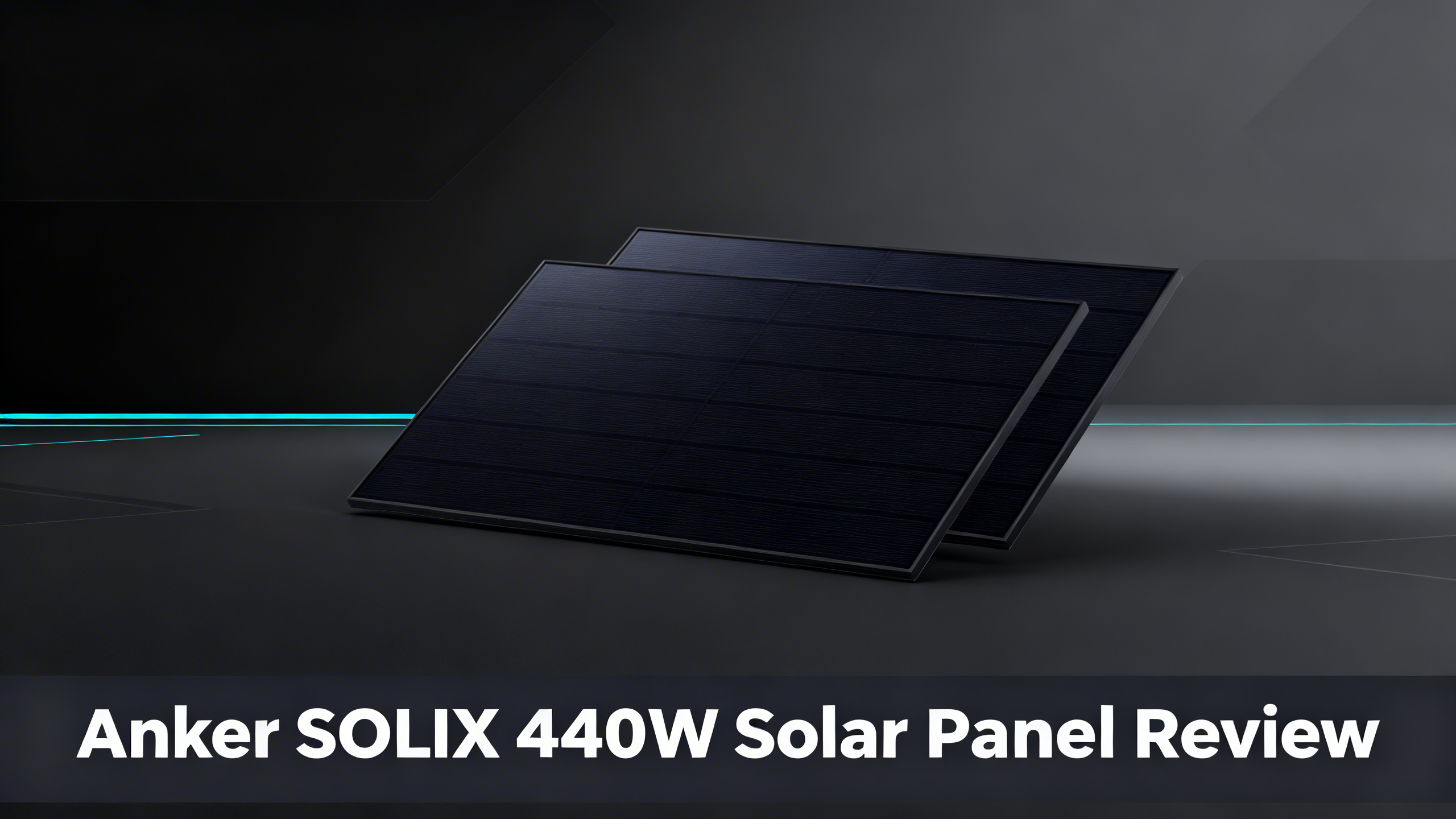
When Anker SOLIX replaced its 410W rigid panel with a new 440W model, the obvious question was whether the update is a genuine leap forward or a simple rebadge with a slightly higher number. Spec analysis tells a clearer story: the 440W introduces bifacial technology that the previous generation never offered, which changes the value proposition for permanent installations significantly.
This review covers everything buyers need to evaluate the 440W: verified specs, efficiency context, compatibility with every current Anker SOLIX station, real-world charging time estimates, and a direct 440W vs 410W breakdown. Whether you are planning a rooftop array for your F3800 or evaluating ground-mount options for an E10 whole-home system, the data below makes the decision straightforward.

Anker SOLIX 440W Rigid Solar Panel (2-Pack)
$999 ($499.50/panel)
- Up to 25% conversion efficiency
- Bifacial: captures up to 30% more from rear
- IP68 rated, 10-year warranty, 30-year performance guarantee
Get our Black Friday alerts for Anker SOLIX
We track live prices on 40+ models from Jackery, EcoFlow, BLUETTI and Anker SOLIX. When a deal beats the lowest price we've recorded, you'll hear from us. During Black Friday week, one short recap a day at most.
Unsubscribe in one click. We may earn a commission when you buy through our links, at no extra cost to you. Privacy Policy
Specifications at a Glance
The 440W panel arrives with a concise but impactful spec sheet. Certified specifications confirm a rated output of 440W, a conversion efficiency of up to 25%, and an all-black monocrystalline bifacial design. IP68 weather resistance means the panel is fully sealed against dust and sustained water immersion, which is relevant for outdoor permanent installations exposed to rain and humidity.
Connectivity is handled by the standard MC4 format, with an MC4 to XT-60i adapter cable included in the box. This cable makes direct connection to every current Anker SOLIX station plug-and-play, without a separate adapter purchase. The 10-year product warranty and 30-year linear performance guarantee round out a spec set that targets buyers thinking in terms of long-term installation value. See the official Anker SOLIX 440W product page for the complete technical datasheet.
440W vs 410W: Is the Upgrade Worth It?
A deeper side-by-side breakdown is available in the 440W vs 410W comparison, but the key differences are outlined below. The headline number (+30W, or a 7.3% increase in rated output) understates the actual improvement. The more significant change is technological: the 440W adds bifacial construction, which the 410W never featured.
The bifacial rear side captures light reflected from the installation surface, adding up to 30% more energy yield on top of the rated 440W output. That translates to a meaningful real-world gain in environments with high surface reflectivity, such as white gravel, snow, or light-colored roofing material. The 410W, as a single-face panel, captured none of that reflected energy.
The efficiency gap also widens. Spec analysis places the 440W at up to 25% conversion efficiency, compared to an estimated 22-23% range for the 410W generation. On the warranty side, Anker SOLIX extended the linear performance guarantee from 25 years to 30 years on the new model, a meaningful signal for buyers planning installations with 10-plus year horizons. The conclusion: for permanent fixed installations, the 440W is a clear upgrade. For occasional portable setups, the distinction matters less.

Get our Black Friday alerts for Anker SOLIX
We track live prices on 40+ models from Jackery, EcoFlow, BLUETTI and Anker SOLIX. When a deal beats the lowest price we've recorded, you'll hear from us. During Black Friday week, one short recap a day at most.
Unsubscribe in one click. We may earn a commission when you buy through our links, at no extra cost to you. Privacy Policy
Efficiency and Bifacial Technology Explained
Bifacial solar panels place photovoltaic cells on both the front and the rear face of the panel. The front captures direct solar irradiance, while the rear captures light reflected from whatever surface sits beneath it. Ground albedo (the reflectivity of the surface below the panel) is the critical variable: white gravel, fresh snow, or a light-colored roof can push the rear gain toward the stated 30% ceiling, while dark soil or asphalt provides minimal additional output.
The 25% efficiency claim places the 440W at the upper edge of commercially available rigid monocrystalline panels. For reference, the NREL solar cell efficiency records show that laboratory silicon cell efficiencies can exceed 29%, but commercial module efficiencies in the 22-25% range represent current production-grade best practice. A 25% rating is not a marketing floor: it reflects genuine monocrystalline cell advancement.
The practical implication: if you are installing the 440W on a rooftop with white membrane or over light gravel, the real energy yield can meaningfully exceed the 440W nameplate. If the panels are flat on dark ground without tilt or a reflective surface below, the bifacial gain is minimal. Elevation on a tilt mount, which naturally exposes more rear area to reflected light, optimizes bifacial performance.

Compatibility: Which Anker SOLIX Stations Support the 440W?
Not every Anker SOLIX station is a suitable match for the 440W panel. The solar input limit of the receiving station determines how many 440W panels you can connect before hitting diminishing returns. For a full breakdown of pre-configured setups, the complete solar generator kits guide covers every certified bundle. The table below maps each station to its maximum solar input and the resulting panel count ceiling.
The C800X and C200X are ruled out entirely: their maximum solar inputs (200W and 100W respectively) fall far below the 440W panel’s rated output, creating an input mismatch that wastes panel capacity and can cause charging irregularities. Owners of those stations are better served by the PS200 or PS100 portable panels. Homeowners pairing with the E10 whole-home backup will find the complete pairing walkthrough in the 440W panels with E10 system guide.

Real-World Output Scenarios
Published wattage specs provide the foundation for charging time estimates. Two 440W panels deliver 880W of peak combined input. Applying an 80% system efficiency factor (accounting for MPPT conversion, cable losses, and temperature derating) yields approximately 704W of usable average power during optimal sun hours. With 4 to 6 peak sun hours per day depending on location and season, the numbers become concrete.
The bifacial rear gain adds a variable on top of these estimates. In high-albedo environments (snow-covered ground, white gravel under ground-mount systems), verified performance data from bifacial installations consistently shows a 10 to 20% yield improvement in practice, reaching toward the stated 30% ceiling under ideal reflective conditions.
Estimated Charging Times by Station (2× 440W = 880W input, optimal sun)
⚡
F3800 (3,840Wh)
~4.4 hrs
0 to 80%
🏠
E10 (12,288Wh base)
~11.2 hrs
2-panel input
🔋
C2000 Gen 2 (2,048Wh)
~2.3 hrs
0 to 80%
🌿
C1000 Gen 2 (1,024Wh)
~1.2 hrs
Full charge
*Estimates based on published wattage specs and 80% efficiency factor under optimal conditions.


Installation and Wiring Considerations
The included cabling setup covers the connection chain from panel to station without additional purchases. Each 2-pack includes four MC4 cables and one MC4 to XT-60i adapter, which plugs directly into the solar input port on the F3800, E10, C2000 Gen 2, and C1000 Gen 2. No proprietary connector adapter is required for the core Anker SOLIX lineup.
Mounting is fixed by design: the rigid aluminum frame is built for rooftop, ground mount, or RV roof installation, not for portability. This is not a panel you fold up and carry to a campsite. Whether to wire panels in series or parallel affects total voltage and amperage delivered to the station: the series vs parallel wiring guide explains the tradeoffs for each configuration, including how each affects MPPT input compatibility.
💡 Pro Tip: Before ordering additional panels, verify your station’s maximum solar input voltage as well as wattage. Series wiring increases voltage, which can exceed the MPPT input ceiling of some stations even before the wattage limit is reached.
The all-black frame aesthetic suits flush rooftop installations where panel visibility matters. At IP68, the enclosure rating exceeds most permanent outdoor requirements, including sustained rainfall, coastal humidity, and dust exposure. This rating reflects direct immersion resistance, which means occasional flooding scenarios (ground-mount panels in flood-prone areas) are covered by the sealing standard.

Package Options and Pricing
The 440W panel is sold exclusively in multi-panel packs, which makes sense given the fixed-installation use case. Price-per-panel is consistent across all bundle sizes at approximately $499.50, regardless of quantity. The full 2026 panel lineup comparison places the 440W in context alongside the PS100, PS200, PS400, and 625W options from the Anker SOLIX catalog.
The flat per-panel price across all bundle sizes means there is no volume discount incentive to over-purchase. Buy what your station’s maximum solar input actually justifies. For an F3800 (2,400W input ceiling), five panels are the hard ceiling: a 6-pack adds a sixth panel whose output would be throttled. The 4-pack is typically the most economical configuration for a single F3800.
Who Should Buy the Anker SOLIX 440W Rigid Panels?
The 440W is not a universal recommendation. It is the right panel for a specific installation profile. Buyers comparing multiple rigid panel options across brands should also consult the rigid panel buying guide before purchasing. The summary below distills the core decision into clear terms.
✅ Buy this if…
- You own an F3800, E10, or F3000 and want maximum solar input
- You are installing panels permanently (roof, ground mount, RV roof)
- Long-term ROI matters: the 30-year performance guarantee reduces replacement risk
- You need bifacial gains from reflected light (snow, gravel, light-colored roofs)
❌ Skip this if…
- You need portability: rigid panels do not fold and weigh significantly more
- Your station has a low max solar input (C800X: 200W, C200X: 100W)
- You are camping or traveling and need a transportable setup
- Budget is tight: the PS400 flexible panel ($549) costs less and suits portable use
For F3800 and F3000 owners planning permanent home backup installations, the 440W is the strongest option in the current Anker SOLIX rigid panel catalog. For E10 installations, it is the only rigid panel that scales efficiently across the E10’s substantial solar input capacity. For owners of smaller stations or anyone prioritizing portability, the PS-series flexible panels are a better fit.
Anker SOLIX Solar Generator Kits Guide
Full breakdown of certified solar bundles and pre-configured panel setups for every Anker SOLIX station.
Verdict
The 440W rigid panel represents a meaningful step forward from the 410W generation. The addition of bifacial technology is not cosmetic: it changes the energy yield profile of the panel in real installation conditions and extends the value proposition for permanent setups that benefit from ground albedo. The 25% efficiency rating, IP68 sealing, and 30-year linear output guarantee position this panel competitively in the rigid solar segment.
At $499.50 per panel (in any bundle size), the Anker SOLIX 440W rigid panel sits at a price point that delivers strong long-term value for F3800, F3000, and E10 owners. The 30-year performance guarantee is the clinching argument for permanent installations where panel replacement costs matter over the system’s lifetime. For portable users, better-matched alternatives exist in the Anker SOLIX lineup. For fixed installs, this is the strongest panel the brand currently offers.
Anker SOLIX 440W Rigid Panel (2-Pack)
$999
Best rigid panel for F3800, E10 and home backup systems
Price verified April 2026. Free shipping available.
Frequently Asked Questions
What is the difference between the Anker SOLIX 440W and the old 410W rigid solar panel?
The 440W model adds bifacial technology (capturing up to 30% more energy from reflected light on the rear side), increases rated output by 30W, improves efficiency to up to 25%, and extends the linear performance guarantee from 25 years to 30 years. The 410W panels are discontinued in the current Anker SOLIX catalog.
Is the Anker SOLIX 440W panel compatible with the F3800?
Yes. The F3800 accepts up to 2,400W of solar input, so it supports up to five 440W panels connected in parallel or series-parallel configurations. The included MC4 to XT-60i cable connects directly to the F3800 solar input port without any additional adapter.
Can I use the 440W panel with the Anker SOLIX C800X or C200X?
Not ideally. The C800X supports a maximum of 200W solar input and the C200X a maximum of 100W, both well below the 440W panel’s rated output. Pairing them would waste capacity and could cause input mismatch. The PS200 or PS100 portable panels are better matches for those stations.
What does bifacial mean and why does it matter?
Bifacial panels have photovoltaic cells on both the front and rear faces of the panel. The rear side captures reflected and diffuse light from the surface beneath (ground, gravel, snow, white roofing), generating up to 30% additional energy compared to a single-face panel under the same conditions. The real gain depends on the albedo (reflectivity) of the installation surface.
Does the Anker SOLIX 440W panel qualify for the federal solar tax credit?
Not for a home installation in 2026. The 30% Residential Clean Energy Credit (IRS Form 5695), which covered residential solar panels, ended for systems installed after December 31, 2025. Panels installed by then can still be claimed on a 2025 return.
How many 440W panels do I need to fully charge an F3800 in one day?
With 6 hours of peak sun, two 440W panels deliver approximately 4,224Wh of theoretical energy (880W x 6h x 0.80 efficiency factor). The F3800 holds 3,840Wh, so two panels in optimal conditions can complete a full charge in a typical sunny day. Four panels cut that time roughly in half.
Originally published: April 6, 2026