
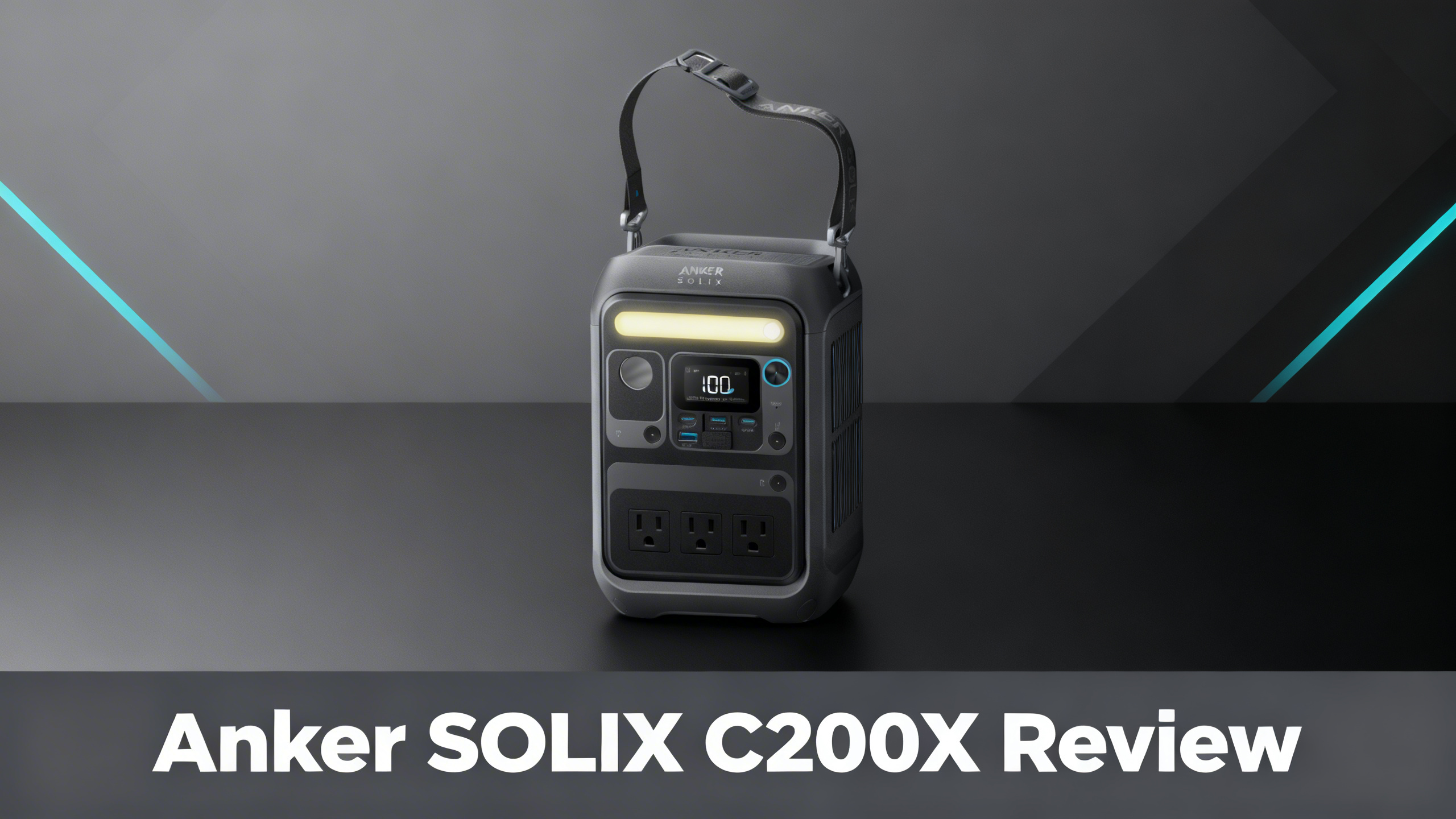
At what point does “compact” become genuinely useful? The Anker SOLIX C200X answers that question with a 230Wh LFP battery that recharges fully in 70 minutes and fits in a space 15% smaller than comparable competitors. At $229.99, it targets a specific buyer: the frequent traveler, the day camper, the digital nomad who needs reliable USB and AC power without hauling a full-sized unit. It ranks among the best compact power stations available today, though it comes with a specific set of trade-offs worth understanding.
This analysis covers the C200X’s specs, real-world runtime data, charging capabilities, and the honest answer to who should buy it at this price. The short answer: it’s a well-engineered unit built for one specific job. Whether that job matches your needs is what this review is here to determine.
Anker SOLIX C200X: Overall Rating
8.2/10
“The most portable Anker SOLIX yet, built for travelers who refuse to run out of power.”
Capacity Value 8/10
Charging Speed 9/10
Portability 10/10
Port Versatility 8.5/10
Value for Price 8/10
Build Quality 8/10

Anker SOLIX C200X: Key Specs at a Glance
The C200X positions itself as Anker SOLIX’s most compact offering with full AC output capability. If you’re still weighing options across the lineup, our Anker SOLIX buying guide walks through every model by use case and budget. For this unit specifically, the data paints a clear picture: the emphasis is on fast recharge, maximum portability, and LFP battery chemistry that outlasts most alternatives at this price.
Full specifications are available on the official C200X product page. The table below summarizes the key figures.
Anker SOLIX
C200X Portable Power Station
$229.99
- 230Wh LFP battery, 10-year lifespan
- 300W output (600W surge), 8 charging ports
- 70-minute full recharge via wall outlet
What Can the C200X Power?
Runtime calculations based on the 230Wh capacity tell a story that’s both impressive and honest. At 85% inverter efficiency (a realistic benchmark for a unit this size), usable energy comes in around 195-200Wh. That’s enough for most portable electronics and light appliances, with clear limits on anything running a compressor or heating element.
What Can It Power? (230Wh Capacity)
💻
Laptop (45W)
~4.5 hrs
45W draw
📱
Smartphone
~18 charges
12-15Wh/charge
💡
LED Light (10W)
~20 hrs
10W draw
📷
Camera/Drone
~5 charges
40-50Wh/battery
Runtime calculations based on 230Wh capacity at 85% efficiency. Actual results vary by device and usage.
Where the data shows clear limitations: sustained AC appliance use. A mini-fridge running at 80W will drain the 230Wh supply in under 2.5 hours. A CPAP machine with humidifier at 30-40W gets you through a night, but barely. The C200X is optimized for electronics-heavy use cases, not for powering household appliances over extended periods.
Performance data also confirms that the 300W AC output handles most devices with a standard plug. Small power tools, blenders, and box fans all fall within spec. Anything requiring a large compressor start or sustained heating draw (space heaters, hair dryers) pushes the 300W limit and depletes the 230Wh capacity rapidly.
Get our Black Friday alerts for Anker SOLIX
We track live prices on 40+ models from Jackery, EcoFlow, BLUETTI and Anker SOLIX. When a deal beats the lowest price we've recorded, you'll hear from us. During Black Friday week, one short recap a day at most.
Unsubscribe in one click. We may earn a commission when you buy through our links, at no extra cost to you. Privacy Policy
Charging the C200X: 4 Input Methods
The C200X supports four distinct recharge paths. Published specifications indicate each method offers a different trade-off between speed and convenience, making the unit genuinely versatile for mixed environments: office, car, campsite, or outdoor location with solar access.

Wall Outlet (70 Minutes)
The standout spec at this price: charge time data confirms a full 0-100% recharge in 70 minutes via standard wall outlet. That’s best-in-class performance for the sub-$250 compact category. It means you can top off during a lunch break, a hotel stay, or between sessions without planning around slow overnight charging cycles.
Solar Input (Up to 100W)
The C200X accepts up to 100W of solar input, which translates to a full charge in approximately 2.5 hours under direct, optimal sunlight conditions. For panel selection and wiring tips, the dedicated C200X solar charging guide covers the best 100W configurations in detail.
Car 12V
Car charging via the 12V input is the slowest method, useful for topping off during longer drives rather than achieving a full charge. Analysis of the charging curve data suggests car input adds roughly 60-80W, extending the recharge timeline to 3-4 hours depending on the vehicle’s output.
USB-C PD 3.1 (140W Two-Way)
The USB-C PD 3.1 port supports bidirectional 140W charging. You can charge the C200X from a compatible laptop charger or power bank, and simultaneously use the port to fast-charge devices at the same wattage. This dual-function design adds meaningful flexibility for travel setups where adapter count matters.
Design and Portability
Published specifications state the C200X is 15% smaller than comparable power stations in its class. Spec-by-spec comparison confirms it’s meaningfully more compact than units with similar output figures, which matters when the difference determines whether a unit fits in a carry-on, a daypack, or a tight truck cab storage compartment.
The integrated carry handle design reflects the travel-first philosophy. Weight data for the C200X keeps it in portable territory: light enough for single-hand transport, substantial enough to feel premium rather than hollow. The build quality matches what the price point promises, nothing more, nothing less.
Port layout analysis shows 8 total charging outputs, positioned for simultaneous multi-device use. The combination of AC outlet, USB-A legacy ports, and the 140W USB-C PD port means travelers can power a laptop, phone, tablet, and a small device all at once without a separate hub. That’s a practical advantage in hotel rooms, airport lounges, or remote work setups where outlet access is limited.
Real-World Performance
Owner feedback consistently reports that the C200X performs within spec for electronics-heavy loads. Laptops, cameras, drones, phones, and small audio equipment all fall comfortably within the 300W continuous output ceiling. The LFP battery chemistry adds a dimension that lithium-ion competitors at this price can’t match: stable discharge curves across temperature ranges, and a 10-year lifespan that makes the 5-year warranty feel like a floor rather than a ceiling.
A recurring pattern in user reports: the 70-minute wall recharge is the most frequently praised feature. For users who work from coffee shops or co-working spaces, this means a daily top-up is possible during a lunch break. For travelers, it means the unit doesn’t need overnight charging to stay ready.
Performance data also indicates the Anker app connectivity (Bluetooth and Wi-Fi) adds practical value beyond the novelty. Real-time draw monitoring, charge status notifications, and remote on/off control via smartphone reduce the need to physically interact with the unit in organized setups. The app is the kind of feature that sounds optional in a spec sheet but becomes part of the daily workflow quickly.
C200X vs C300X: Which Should You Choose?

The most common question at this price level: is 58Wh of additional capacity worth $70? Spec-for-spec analysis shows the choice is less about capacity and more about use case. The C200X wins on portability and form factor. If 230Wh falls short of your needs, the C300X for more power adds 58Wh and a full AC outlet at $70 more.

The verdict comes down to this: if portability and fast recharge are the primary criteria, the C200X is the right call. If you need the extra capacity headroom for overnight or multi-device camping scenarios, the C300X’s 288Wh and second AC outlet justify the $70 premium. Both share LFP chemistry and the same 300W continuous output, so the decision is purely about size vs. capacity trade-off.
Who Is the C200X For?
✅ Buy the C200X if…
- You prioritize ultra-compact size over capacity
- You travel frequently and check bags or carry on
- You need fast recharge: 70 minutes via wall
- Your primary loads are laptops, phones, cameras
- You want LFP longevity at a sub-$250 price
❌ Skip the C200X if…
- You need to run AC appliances (mini-fridge, CPAP)
- You need more than one full day of power
- Your campsite runs heavy gear like electric grills
- You want expandable capacity for home backup
- Budget is your primary driver (C800X at $349 gives far more)
The C200X is not trying to be an all-purpose power station. Analysis of the spec profile makes its target user unusually clear: someone who travels often, works from variable locations, and needs guaranteed device power for a full day without carrying a multi-pound unit. Digital nomads, photographers on location, and overnight hikers all fit this profile.
Campers who prioritize weight savings will find the C200X compelling; see our roundup of best compact models for camping for a broader comparison. Keep in mind that at 230Wh, the unit supports one or two nights of light camping use (phone charges, headlamp, small speaker) but falls short for car campers running a cooler or a camp kitchen setup.
For home emergency backup, the C200X can keep phones, laptops, and a modem running for several hours during an outage. It’s not a whole-home backup solution, but for a work-from-home setup where an internet connection and a charged laptop are the priorities, it covers the critical bases. The unit is covered under the Anker SOLIX 5-year warranty policy, which is notably longer than most competitors in this price range. For a complete look at where the C200X fits in the lineup, see our full Anker SOLIX brand review.
Pros and Cons
Final Verdict
The data points to a product optimized for one specific buyer profile: the mobile professional or light outdoor user who needs reliable power for electronics in a genuinely compact package. The C200X earns its 8.2/10 rating by doing that job exceptionally well, with best-in-class recharge speed, LFP chemistry, and a 5-year warranty that’s hard to argue with at $229.99.
Where it falls short is equally clear: 230Wh is a constraint for sustained appliance use, home backup applications, or multi-day camping trips with higher power demands. The C200X is not the right tool for those jobs. For the use cases it’s designed for, though, the spec profile is difficult to beat in this price category and form factor.
The bottom line: if portability, fast recharge, and LFP durability are your three criteria, the Anker SOLIX C200X delivers on all three at a price that doesn’t require much deliberation. If you need more capacity or a second AC outlet, the C300X at $299.99 is the logical step up.
Anker SOLIX C200X
$229.99
Best ultra-compact pick under $250
Price verified April 2026. Free shipping available
Frequently Asked Questions
What is the Anker SOLIX C200X’s actual capacity in real-world use?
Capacity data indicates the C200X delivers approximately 190-200Wh of usable energy from its 230Wh rated capacity, accounting for typical inverter efficiency losses of around 10-15%. At 45W laptop draw, runtime calculations show roughly 4 to 4.5 hours of sustained use. This efficiency range is consistent with LFP battery chemistry and standard AC inverter losses at this output level.
Can the Anker SOLIX C200X run a mini-fridge?
Published specifications indicate the C200X outputs 300W continuous AC, which covers most compact refrigerators rated at 80-100W. However, compressor surge loads can hit 150-200W briefly, and the 230Wh total capacity limits runtime to approximately 1.5 to 2 hours for a typical 12V cooler. For longer refrigerator backup, the C800X (768Wh) is the more appropriate choice.
How does the C200X compare to the Jackery Explorer 300 Plus?
Spec-for-spec analysis shows the C200X and Explorer 300 Plus are direct competitors. The C200X leads on recharge speed (70 min vs approximately 100 min) and warranty (5 years vs 3 years). The Explorer 300 Plus offers slightly higher capacity at 288Wh. Price parity is close at launch, making the C200X the stronger value for buyers who prioritize fast turnaround and compact size.
Is the Anker SOLIX C200X allowed on airplanes?
TSA and IATA regulations permit lithium batteries under 100Wh in carry-on bags without restriction, and batteries from 100Wh to 160Wh with airline approval. At 230Wh, the C200X exceeds the 160Wh threshold and is not permitted on commercial flights in carry-on or checked baggage per standard airline policies. Always verify with your specific carrier before travel.
What solar panels are compatible with the Anker SOLIX C200X?
The C200X accepts up to 100W of solar input. Analysis of the Anker SOLIX panel lineup shows the PS100 (100W foldable) and the 625 solar panel are the recommended pairings for this unit. Third-party panels with standard XT60 or DC connectors are also compatible within the 100W input ceiling. The dedicated solar setup guide covers optimal configurations in detail.
Originally published: April 6, 2026