
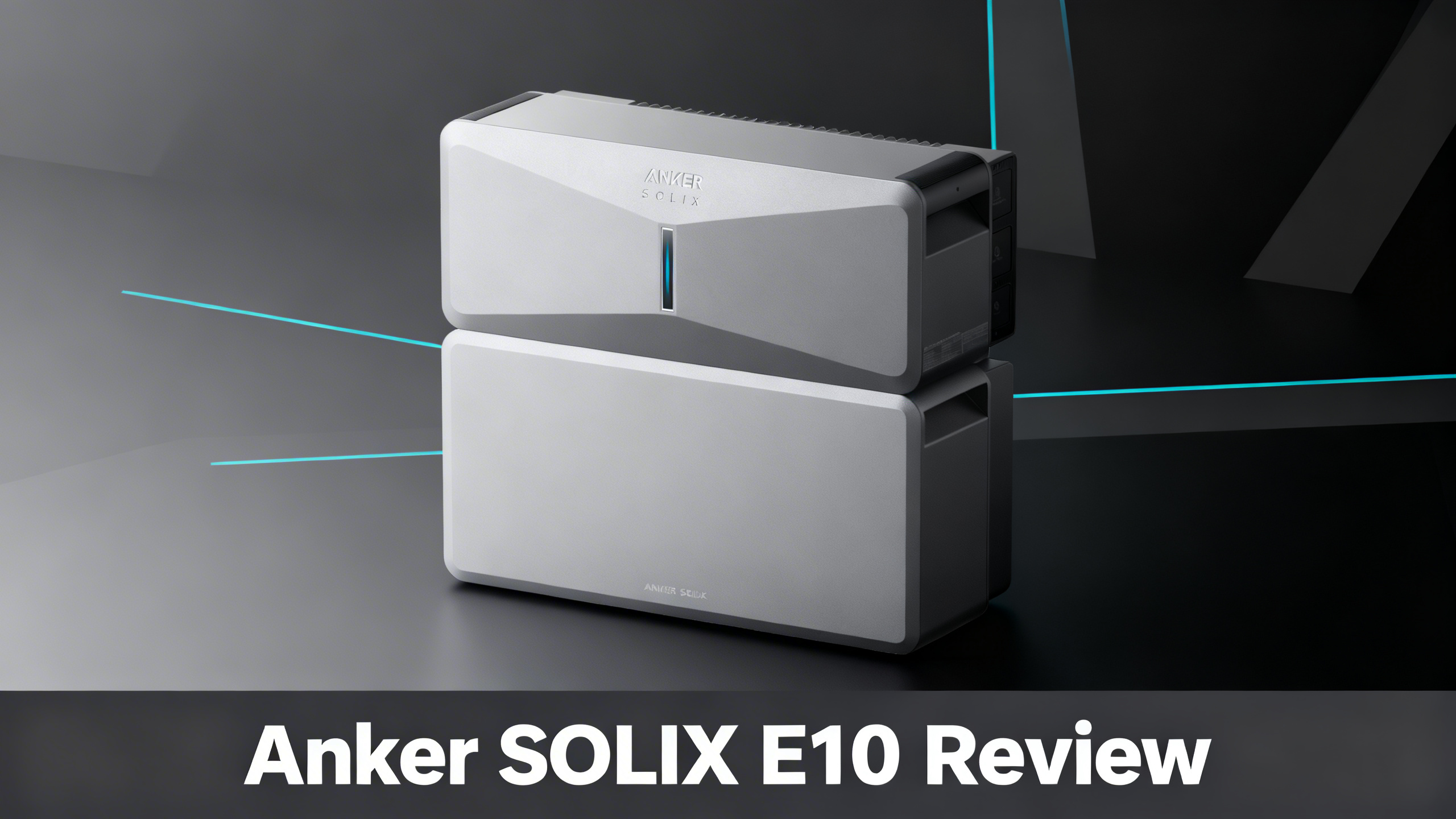
Power outages lasting more than 48 hours expose a gap that no portable power station can fill. When the grid fails for days, you need a system built for the whole house, not just a few essential devices. The Anker SOLIX E10 is designed specifically for that gap: a modular, UL9540A-certified whole-home backup system that scales from 3.84kWh up to 53.76kWh depending on how much protection you need.
At $4,299 for the base configuration (1 Power Module plus 1 B6000 Battery Module), the E10 positions itself as a genuine alternative to Powerwall-class residential storage. It connects to your electrical panel via either a Smart Inlet Box (manual transfer, $4,599 bundle) or the Power Dock (automatic failover, $5,799 bundle), and it can pair natively with the Smart Generator 5500 for extended outage coverage. For context on how the E10 fits within the full lineup, see our Anker SOLIX brand overview.
This analysis draws on published certification data, manufacturer specifications, Anker’s official documentation, and patterns reported by the owner community. What follows covers specs, configuration options, scalability, who the E10 is built for, and how it stacks up against the competition.

Get our Black Friday alerts for Anker SOLIX
We track live prices on 40+ models from Jackery, EcoFlow, BLUETTI and Anker SOLIX. When a deal beats the lowest price we've recorded, you'll hear from us. During Black Friday week, one short recap a day at most.
Unsubscribe in one click. We may earn a commission when you buy through our links, at no extra cost to you. Privacy Policy
Real-World Look: The Anker SOLIX E10 in Use
Studio renders only tell part of the story. Here is the Anker SOLIX E10 as it actually looks in a real owner’s hands, away from the polished marketing shots.
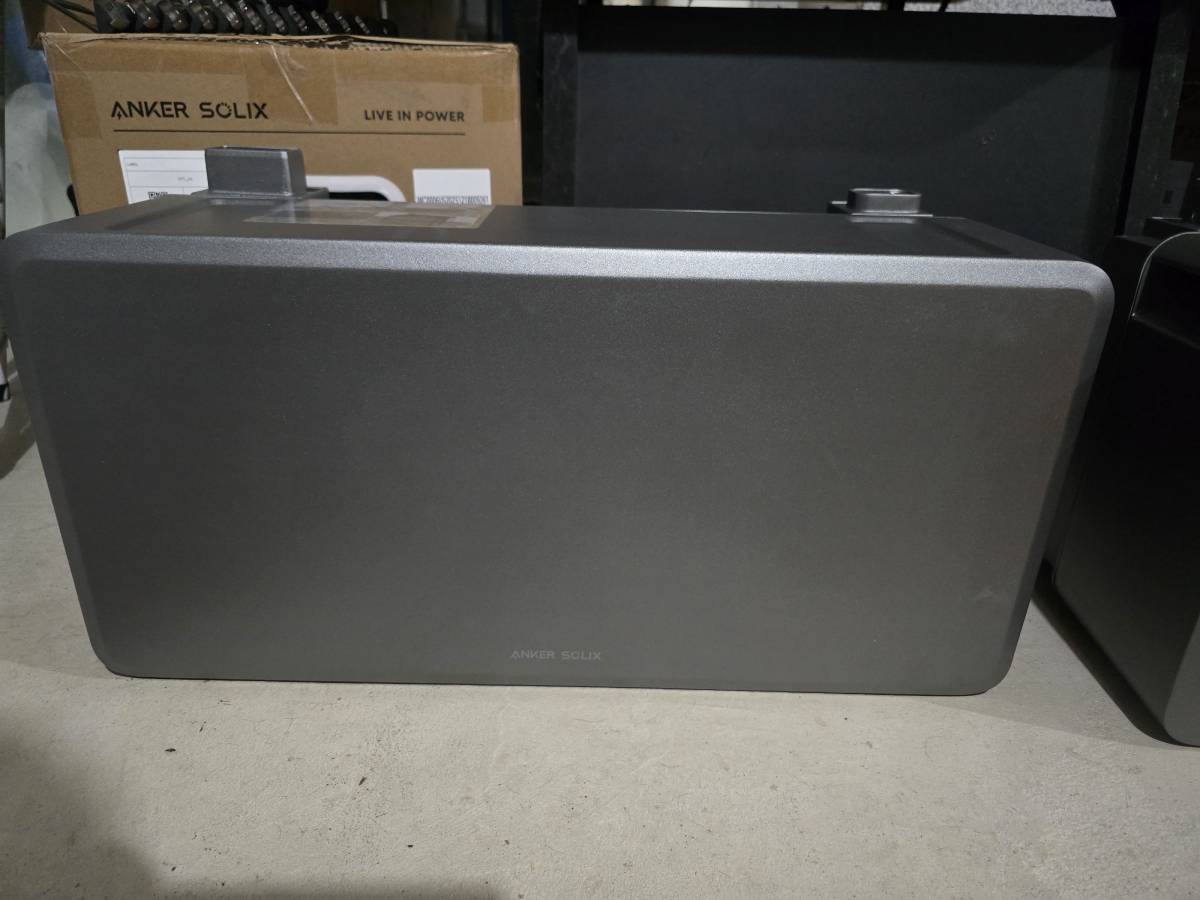
Real-world photos of the Anker SOLIX E10.
Anker SOLIX E10 Whole-Home Backup
$4,299
- UL9540 & UL9540A certified (insurance and HOA compliant)
- Scalable from 3.84kWh to 53.76kWh with B6000 modules
- Works with Power Dock (auto-switching) or Smart Inlet Box
Quick Specs: What the E10 Delivers on Paper
Before diving into real-world applications, it’s worth grounding the analysis in what the published specifications actually promise. The E10 is a residential-class energy storage system, not a portable power station with panel-connection capability. The architecture is fundamentally different, and the specs reflect that.
Complete technical documentation is available on the official E10 product page. Here’s what the numbers show at a glance.
💡 Certification Note: UL9540A certification specifically addresses fire and thermal propagation testing for energy storage systems, the standard that most HOAs and some insurance carriers now require. This is separate from and more stringent than basic UL9540 system-level certification.
Get our Black Friday alerts for Anker SOLIX
We track live prices on 40+ models from Jackery, EcoFlow, BLUETTI and Anker SOLIX. When a deal beats the lowest price we've recorded, you'll hear from us. During Black Friday week, one short recap a day at most.
Unsubscribe in one click. We may earn a commission when you buy through our links, at no extra cost to you. Privacy Policy
UL9540A Certification: Why It Actually Matters
Most residential battery systems carry a UL9540 certification. Fewer carry UL9540A. The distinction matters more than most buyers realize, and it directly affects whether your HOA will approve installation and whether your insurance carrier will cover the system.
What UL9540 vs UL9540A Cover
UL9540 is a system-level standard. It evaluates whether an energy storage system functions safely as a complete unit: electrical connections, inverter behavior, control systems. Think of it as the baseline requirement for any residential battery installation.
UL9540A goes further. It tests thermal propagation, specifically whether a fire or thermal runaway event in one battery cell will spread to neighboring cells and beyond. This is the test that determines whether a system is safe enough for indoor installation in occupied structures. Published certification data confirms the E10 meets this thermal propagation standard, which represents a significantly higher bar than UL9540 alone.
HOA Compliance and Insurance Implications
An increasing number of HOAs across the US now explicitly require UL9540A certification before approving home energy storage installations. Some homeowners insurance policies follow the same requirement. The UL9540A test method explained outlines in detail why this certification has become the insurance-grade standard for residential systems.
For homeowners in communities with HOA restrictions, the E10’s dual certification removes a significant installation barrier that many competing systems can’t clear. It also provides a documented paper trail should questions arise during insurance claims or local permit reviews.
E10 Configurations Explained: Which Bundle Do You Need?
The E10 is not a single product. It’s a system you configure based on your installation goals and budget. Anker sells the base hardware separately and as pre-built bundles with different transfer mechanisms. Understanding what each option delivers (and what it doesn’t) is critical before committing to a purchase at this price point.
Anker SOLIX E10: Configuration Price Spectrum
🏠
Base System
$4,299
3.84kWh / No transfer
🔌
+ Smart Inlet Box
$4,599
3.84kWh / Manual transfer
⚡
+ Power Dock
$5,799
3.84kWh / Auto failover
🏭
2× Battery + Power Dock
$7,799
11.52kWh / Auto failover
Base System ($4,299): Power Without Transfer
The base E10 package includes one Power Module and one B6000 Battery Module, providing 3.84kWh of stored energy with up to 9,600W output at 240V. What it doesn’t include is any transfer switch mechanism. This configuration is appropriate for users who plan to add a third-party transfer switch or who are integrating the E10 into an existing electrical setup where a transfer switch is already present.
E10 + Smart Inlet Box ($4,599): Subpanel Backup
The Smart Inlet Box bundle adds $300 to the base price and enables backup power for a dedicated subpanel. During an outage, a homeowner manually initiates the switch. The system doesn’t detect outages and respond automatically. This configuration suits users who want to protect specific essential circuits (refrigerator, lights, medical equipment) without committing to full whole-panel coverage.

E10 + Power Dock ($5,799): Whole-Home Automatic Failover
The Power Dock configuration is the most capable option for true whole-home protection. It connects to the main electrical panel and provides automatic transfer during an outage, with no manual intervention required. Published specs indicate the switchover is near-seamless, protecting sensitive electronics and appliances that can’t tolerate interruption. For most homeowners prioritizing comprehensive protection, this is the configuration the data points to.
Multi-Battery Bundles ($6,299–$29,999)
Beyond the three core bundles, Anker offers pre-configured multi-battery packages that combine additional B6000 modules with transfer switch options. The entry multi-battery bundle at $6,299 adds a second B6000 for 7.68kWh total with the Smart Inlet Box. Scaling up to $7,799 gets you 11.52kWh with the Power Dock, roughly three days of essential circuit coverage for most households.

Best Value
E10 + Smart Inlet Box
Manual transfer, installer hooks to subpanel
$4,599
Full Automation
E10 + Power Dock
Auto-transfer, whole-panel protection, seamless failover
$5,799
The Power Dock vs Smart Inlet Box comparison goes deeper into installation requirements, electrical permitting, and which option suits renters vs homeowners.
How Expandable Is the E10?
Scalability is one of the E10’s most compelling selling points. Unlike systems that require full hardware replacement to increase capacity, the E10 uses a modular battery architecture: you add B6000 Battery Modules to the existing Power Module, and the system scales accordingly.
The B6000 Battery Module ($2,499 per unit)
Each B6000 module adds 3.84kWh of LiFePO4 capacity to the E10 system. Published specs confirm a single Power Module supports up to a specific number of B6000 units, and the full three-Power-Module configuration scales to 14 total B6000 modules, reaching 53.76kWh. This is a ceiling that few competing residential systems can match without a full system swap.

Maximum Configuration: 53.76kWh Explained
The 53.76kWh ceiling comes from 14 B6000 modules, each contributing 3.84kWh. To reach that maximum, you need 3 Power Modules, which significantly increases the total system cost. For the majority of residential users, a configuration in the 7.68–15.36kWh range covers realistic multi-day outage scenarios. The key is that the system grows with your needs over time, without stranding your initial investment.

Cost Per kWh Analysis
Expansion cost data shows each additional B6000 adds 3.84kWh at $2,499, yielding a per-kWh cost of approximately $651. That’s competitive with premium home battery systems like the Tesla Powerwall 3, which comes in at roughly $852 per kWh at base pricing (before installation). The E10’s modular expansion path gives budget-conscious homeowners a way to scale incrementally rather than committing to maximum capacity upfront.
Our B6000 expansion module guide walks through pricing per kWh, compatibility, and the maximum 53.76kWh ceiling with 14 stacked modules. For current pricing on the base E10 system, see the Anker SOLIX E10 product page.
What Can the E10 Power?
Calculating which circuits to protect requires understanding home power load management: essential reading before sizing your E10 configuration. That said, capacity calculations based on the base 3.84kWh show what’s realistic with the entry-level system.
Essential Circuits (3.84kWh Base)
Runtime calculations based on 3.84kWh and typical appliance draws show the base E10 is well-suited for protecting essential circuits rather than powering the entire home. A refrigerator running at 150W average will run for approximately 25 hours. LED lighting across 10 circuits (400W total) gets you nearly 10 hours. These figures reflect published capacity data and typical appliance consumption. Real-world results vary based on efficiency settings and simultaneous loads.
Whole-Home Coverage (11.52kWh+)
Scaling to 11.52kWh (3 B6000 modules) changes the calculus significantly. At that capacity, you’re looking at roughly 76 hours for a refrigerator, over 3 days of essential lighting, and realistic partial AC coverage during moderate weather. For households averaging 25–50 kWh/day, a 15–20kWh E10 configuration provides meaningful multi-day coverage on essential circuits while keeping high-draw appliances like electric dryers and large HVAC systems on a managed load schedule.
Extended Backup: Pairing with the Smart Generator 5500
When outages extend beyond what battery storage alone can cover, the E10 integrates with Anker’s Smart Generator 5500 for sustained power generation. This pairing is notable because the Smart Generator connects via DC (not just AC), enabling more efficient charging and tighter system integration than a generic generator connected via AC adapter.
DC vs AC Generator Charging
The DC charging path between the Smart Generator 5500 and the E10 bypasses the efficiency losses associated with AC-to-DC conversion. Published specs confirm the Smart Generator integrates natively via this path, while any third-party generator can still charge the E10 through a standard AC Adapter. The native DC connection is the more efficient option for extended outages where fuel economy matters.
Tri-Fuel Flexibility (Gas, Propane, Natural Gas)
The Smart Generator 5500 supports gasoline, propane, and natural gas, a meaningful advantage when one fuel type is unavailable after a major weather event. The tri-fuel capability is built into the hardware, not an add-on, which simplifies planning for extended emergency preparedness scenarios.

SOLIX App and Smart Energy Management
The E10 integrates with Anker’s SOLIX App, which provides real-time monitoring and remote control over WiFi and Bluetooth. For a residential system at this price point, the app quality matters: it’s the primary interface for managing charge schedules, monitoring stored energy, and configuring the system’s response to grid events.
Real-Time Monitoring
Published feature data confirms the SOLIX App shows live power flow (solar input, grid draw, battery state, and load consumption) in a dashboard view. Owner feedback consistently reports the interface is clear and accessible without technical background required. Remote monitoring means you can check system status during a trip and verify the battery is charged ahead of a forecast storm.
AI Energy Optimization (with Smart Meter)
Adding the optional SOLIX Smart Meter ($249) upgrades the system’s intelligence significantly. Anker’s published documentation indicates the Smart Meter monitors energy consumption every 15 seconds and uses AI-based optimization to prioritize solar charging and minimize grid draw. Projected savings data from Anker suggests up to $1,560/year for solar-paired households, though actual savings depend heavily on local utility rates and solar production.
💡 Pro Tip: The SOLIX Smart Meter adds AI-based 15-second energy monitoring and can save up to $1,560/year by prioritizing solar power. It’s available as an add-on at $249 and is worth factoring into your total system budget if you have existing solar panels.
What We Like About the E10
Modular Scalability Without Replacing the Core Unit
A consistent strength reported across the owner community is the add-as-you-go architecture. Starting at 3.84kWh and expanding incrementally through B6000 modules means your initial $4,299 investment isn’t stranded when your needs grow. Most competing whole-home systems require you to commit to your maximum capacity upfront or replace hardware entirely to expand.
UL9540A: Insurance-Grade Safety Credentials
Where the certification data shows a clear advantage is in the E10’s dual UL9540/UL9540A status. This is not a marketing claim. it’s a documented, third-party verified test result that carries real-world implications for HOA approval and insurance coverage. In markets where these requirements are becoming standard, the E10’s certification set removes friction that cheaper systems can’t overcome.
Flexible Transfer Options for Different Budgets
The tiered transfer mechanism structure is well-designed. Homeowners who don’t need whole-panel automation can start with the Smart Inlet Box at $4,599, protecting essential circuits without the $1,200 premium for the Power Dock. Upgrading the transfer mechanism later is also possible as needs evolve, without replacing the battery or power module hardware.
Native Generator Integration (DC and AC)
Published specs confirm the E10 accepts both DC input from the Smart Generator 5500 and AC input from any standard generator via adapter. This dual-path charging gives the system genuine flexibility for extended outages where battery-only coverage is insufficient.
Where the E10 Falls Short
Requires Professional Installation: No DIY Option
A limitation the architecture makes clear: every E10 configuration requires a licensed electrician. There’s no plug-and-play option, no generator-style setup. For comparison, a portable station like the Anker SOLIX F3800 can be deployed by anyone in minutes. The E10’s permanent installation requirement adds $500–$1,500 to the total system cost depending on your electrical panel and local permitting, which meaningfully changes the value calculation versus portable alternatives.
⚠️ Important: The E10 requires a licensed electrician for installation in all configurations, and budget $500–$1,500 for labor costs when calculating total system cost, this is not optional and cannot be self-installed.
Base Capacity (3.84kWh) Is Limited Without Expansion
Published specs reveal the base E10 configuration delivers just 3.84kWh, roughly comparable to a high-end portable station. For whole-home backup, that figure is tight. A single central AC cycle can consume more than 3kWh. Households expecting meaningful whole-home coverage should budget for at least two B6000 modules (7.68kWh minimum), which pushes the entry cost toward $6,300 before installation.
Power Dock Bundle Adds Significant Cost
The jump from the Smart Inlet Box ($4,599) to the Power Dock ($5,799) is $1,200 for automatic failover capability. Whether that premium is justified depends on your situation: households with medical equipment, young children, or home offices where brief interruptions cause real problems will find the automatic transfer worth it. Others may find the manual transfer adequate.
Who Should Buy the E10?
Homeowners exploring the full range of Anker’s residential solutions will find our Anker SOLIX home backup guide covers every tier from the C1000 Gen 2 up to the E10. For this specific system, the buyer profile is fairly well-defined by the specs and certification requirements.
✅ Buy the E10 if…
- You need UL9540A certification for HOA or insurance purposes
- You want a system that scales beyond 10kWh without replacing hardware
- You’re pairing with solar and want true grid-tied optimization
- You want whole-panel backup with automatic failover (Power Dock)
- Your household averages 25–50 kWh/day and multi-day outages are a real risk
❌ Skip the E10 if…
- You only need backup for a few essential circuits (a portable station suffices)
- Your budget is under $3,000 and you don’t need whole-panel coverage
- You’re renting, the E10 requires professional, permanent installation
- You only face occasional 4–8 hour outages (F3800 is cheaper and portable)
How Does the E10 Compare?
In our roundup of whole-home backup systems compared, the E10 ranks among the top UL9540A-certified residential solutions available in 2026. Here’s how it stacks up on paper against the closest alternatives.
E10 vs EcoFlow DELTA Pro Ultra
Spec-for-spec, the DELTA Pro Ultra enters at $3,989 for its base 6kWh configuration, more capacity at entry than the E10’s 3.84kWh. The E10’s UL9540A certification is the clearest point of differentiation; the DELTA Pro Ultra’s certification status should be verified with current EcoFlow documentation as it may have evolved. Our full E10 vs DELTA Pro Ultra comparison dives deeper into capacity scaling, transfer switch options, and long-term cost per kWh.
E10 vs Tesla Powerwall 3
Compared to the Powerwall 3 on paper, the E10’s $4,299 base price is substantially lower than the Powerwall’s approximately $11,500 fully installed cost. The Powerwall 3 delivers 13.5kWh at its base, more capacity than the E10’s entry configuration, but the Powerwall requires Tesla Solar or a Tesla-authorized installer, limiting who can access it. The E10’s installer-agnostic design is a practical advantage.
E10 vs Anker SOLIX F3800 (portable alternative)
The F3800 at $2,199.99 delivers 3,840Wh, nearly identical base capacity to the E10 at a lower price with no installation requirement. The critical difference: the F3800 can’t provide whole-panel coverage, can’t scale to 53kWh, and doesn’t carry UL9540A certification. For renters and users who want portable flexibility, the F3800 wins. For homeowners who want permanent, scalable, certified protection, the E10 is in a different category.
Final Verdict
Based on our analysis, the Anker SOLIX E10 is the most accessible UL9540A-certified whole-home backup system available under $5,000 in 2026. The certification data and scalability specs point to a product that’s genuinely well-positioned for homeowners who need both insurance-grade safety credentials and the ability to grow capacity over time.
The base 3.84kWh capacity is a limitation worth acknowledging honestly. Most households serious about whole-home protection will need at least one or two additional B6000 modules, pushing the realistic total into the $6,300–$7,800 range before installation. At those levels, the per-kWh cost is competitive, and the expandability path remains open without hardware replacement.
Anker SOLIX E10, Overall Rating
8.7/10
“The most accessible UL-certified whole-home backup system in 2026”
Capacity & Scalability 9.2/10
Safety Certification 9.5/10
Value for Money 7.8/10
Ease of Installation 7.5/10
Smart Features 8.8/10
Ecosystem Integration 9.0/10
For a breakdown of which E10 bundle fits your situation, our E10 buying guide covers configurations, pricing, and our recommended setup for different home sizes.

Anker SOLIX E10
$4,299
Best UL-certified whole-home backup under $5K
Price verified April 2026, Free shipping available
Frequently Asked Questions
Is the Anker SOLIX E10 UL9540A certified?
Yes. Published certification data confirms the E10 holds both UL9540 (system-level) and UL9540A (thermal propagation) certifications, meeting requirements for HOA approval and most homeowners insurance policies. UL9540A is the more rigorous of the two standards, specifically addressing fire spread behavior in energy storage systems, the test that insurers and HOAs increasingly require for indoor residential installations.
How much capacity does the base E10 system include?
The base E10 package (1 Power Module plus 1 B6000 Battery Module) provides 3.84kWh. Each additional B6000 module adds another 3.84kWh. The system scales up to a maximum of 53.76kWh with 14 B6000 modules across 3 Power Modules. For most households, a 7.68kWh to 11.52kWh configuration (2–3 B6000 modules) strikes the best balance between cost and multi-day outage coverage.
What is the difference between the Power Dock and the Smart Inlet Box?
The Smart Inlet Box requires manual switching during an outage and connects to a subpanel for essential circuit protection. The Power Dock provides automatic whole-panel failover with no manual intervention required. The $1,200 price difference between the two bundles reflects this automation capability. Our E10 installation guide walks through the full process, electrician requirements, and what to expect from each bundle’s setup.
Does the E10 require professional installation?
Yes. All E10 configurations require a licensed electrician. Installation labor typically adds $500–$1,500 depending on your electrical panel configuration and local permitting requirements. Budget for this cost when comparing the E10 to portable alternatives like the Anker SOLIX F3800, which requires no installation. The professional installation requirement is consistent with whole-home residential battery systems at this capacity level.
Can I pair the E10 with existing solar panels?
Yes. The E10 supports both grid-tied and off-grid solar input. Our E10 solar setup guide covers compatible panels, wiring configurations, and optimal tilt angles for maximum charging speed. For AI-driven solar optimization, Anker’s Smart Meter ($249) integrates directly and performs energy monitoring every 15 seconds, prioritizing solar charging to minimize grid draw. Published data from Anker projects potential savings of up to $1,560/year for solar-paired households, though actual results depend on local utility rates and solar production capacity.
How does the E10 compare to the Anker SOLIX F3800 for home backup?
The F3800 ($2,199.99) is portable, requires no installation, and delivers 3,840Wh, comparable base capacity to the E10. However, the F3800 can’t provide whole-panel coverage, can’t scale beyond its base capacity without an additional battery unit, and doesn’t carry UL9540A certification. The F3800 is better suited for renters, apartment dwellers, or homeowners who want portable flexibility. The E10 is the right choice for homeowners who need permanent, scalable, insurance-grade whole-home protection.
Originally published: April 6, 2026