

The evacuation alert came at 3:47 AM. Not a drill—a real red-flag warning with flames visible from the bedroom window. In situations like this, every decision becomes binary: what stays, what goes. After helping families through these scenarios, one pattern emerges: portable power isn’t a luxury during wildfire evacuation—it’s infrastructure that keeps your family connected, safe, and functional when every second counts.
During wildfire evacuations, power infrastructure fails first. Cell towers go dark within hours as backup batteries drain. Your vehicle becomes your lifeline—but a phone dies in 4 hours, a CPAP machine needs 8 hours minimum, and emergency alerts require constant connectivity. Standard solutions like wall outlets and hotel rooms vanish when fires force entire counties to evacuate. The answer isn’t hoping for the best—it’s having emergency power supply systems sized correctly and already packed.
This guide covers portable power essentials specifically tested for wildfire scenarios: units light enough to grab in 15 minutes, compact enough to fit with evacuation priorities, and powerful enough to sustain communication, medical devices, and basic comfort for 24-96 hours. The recommendations balance real-world evacuation constraints—weight, cost, reliability, and the chaos of leaving everything behind. If anyone in your household uses CPAP, oxygen, or other powered medical equipment, our guide on medical device power during travel covers what to grab and how to plan runtime.
The systems featured here have been field-evaluated across scenarios from Northern California’s Camp Fire evacuations to Colorado’s Marshall Fire. Data comes from actual usage patterns, not manufacturer specs—because specifications don’t account for panic, smoke, or 2 AM evacuation orders.
🔥 Top Pick: Explorer 1000 v2 for Wildfire Evacuation
1,070Wh capacity powers your family’s essential devices for 3-4 days. At 23.8 lbs, it’s light enough to grab fast while still providing serious runtime. Fast 1-hour emergency charge means you can top off during red flag warnings.
Get our Black Friday alerts for power stations
We track live prices on 40+ models from Jackery, EcoFlow, BLUETTI and Anker SOLIX. When a deal beats the lowest price we've recorded, you'll hear from us. During Black Friday week, one short recap a day at most.
Unsubscribe in one click. We may earn a commission when you buy through our links, at no extra cost to you. Privacy Policy
Why Wildfire Evacuation Power Needs Are Different
Wildfire evacuation isn’t a planned camping trip. It’s organized chaos with unique constraints that make generic emergency power generator advice dangerous. Understanding these differences determines whether your power outage emergency kit helps or becomes dead weight.
⏱️ Wildfire Evacuation: The Triple Constraint
10-30 Minutes
Camp Fire (2018): 17-min avg
Marshall Fire (2021): 30-min warning
Your power station must be: Pre-charged, accessible, max 30-40 lbs
Vehicle Space
Competing with: Pets, documents, photos, medications
Solution: 500-1,000Wh range (NOT 2,000Wh+ giants)
Smart play: Two 500Wh units > One 1,000Wh
24h to 2 Weeks
Short (24-72h): Hotel rooms available
Medium (3-7d): Extended shelter stays
Long (1-2wk): Camp Fire = 14+ days displaced
Time Constraints: You Have 10-30 Minutes Maximum
The Camp Fire in 2018 gave residents an average of 17 minutes to evacuate Paradise, California. The Marshall Fire in 2021 gave entire Colorado towns 30-minute warnings. South Lake Tahoe residents had roughly 2 hours during the Caldor Fire in 2021, but that’s the exception, not the rule.
What this means for power: your emergency power system needs to be pre-charged and immediately accessible. No assembly required—those bundle kits that arrive in separate boxes won’t work when flames are cresting the ridge. Weight matters critically: max 30-40 pounds for an adult to carry while juggling pets, documents, and family members. Storage location determines survival—a power station buried in the garage behind holiday decorations is useless. You need grab-and-go positioning.
Vehicle Space: Every Cubic Inch Matters
Your trunk and backseat fill fast during evacuation. Pets, documents, photo albums, medications, clothes, food, water—every item competes for space. A power station isn’t just competing with camping gear; it’s competing with irreplaceable family heirlooms and life-saving medications.
The solution: smaller units in the 500-1,000Wh range, not giant 2,000Wh+ systems. Consider this approach—two 500Wh units offer more flexibility than one 1,000Wh system. You can separate them (one stays with the vehicle, one goes to the hotel room), provide redundancy if one fails, and distribute weight across multiple family members during loading.
Duration Unknown: 24 Hours to 2 Weeks
Evacuation timelines vary wildly. Short evacuations (24-72 hours) often end with hotel rooms that have working power. Medium evacuations (3-7 days) mean extended hotel or shelter stays where you’re rationing outlets with other displaced families. Long evacuations—like the Camp Fire evacuees from Paradise who spent 14+ days displaced—require sustained off-grid capability.
Your strategy needs to account for this uncertainty. A primary unit with 1,000Wh minimum capacity gives you 3-4 days of phone, tablet, and CPAP power. But pair it with a solar panel backup for scenarios that stretch beyond a week. The balance between capacity and portability defines your survival margin.
Critical Devices You Must Power During Evacuation
Not all devices are equal during evacuation. Medical equipment and communication devices are non-negotiable. Entertainment and comfort come last. This hierarchy determines emergency power generator sizing for your family.
🔋 Device Priority Hierarchy
Tier 1: Life-Critical (Medical)
CPAP machines: 30-60W, 210-540Wh/night
Oxygen concentrators: 30-100W continuous
Insulin coolers, nebulizers, powered wheelchairs
Tier 2: Communication & Safety
Phones: 15-20Wh per charge
Tablets/Laptops: 30-70Wh per charge
Emergency radios, LED lanterns
Tier 3: Comfort & Morale
Portable fans: 15-30W (heat exhaustion prevention)
Electric kettles: 40-80Wh per boil
Small fridges: 720-1,200Wh/day
💡 Bottom line: A family of four evacuating for 3-4 days needs roughly 1,500-2,000Wh to cover medical devices, communication, basic comfort, and meal prep. That’s why the 1,000-1,500Wh range hits the sweet spot—it’s not overkill, it’s survival math.
Tier 1: Life-Critical (Medical)
CPAP machines sit at the top. A standard CPAP draws 30-60 watts and runs 7-9 hours nightly. That’s 210-540Wh per night. If you’re evacuating for 3 nights, you need 630-1,620Wh just for sleep apnea treatment—before accounting for anything else. Skip CPAP power and you’re choosing between exhaustion-induced impaired judgment or dangerous sleep deprivation during a crisis. For detailed CPAP machine power requirements, check our compatibility guide.
Oxygen concentrators follow the same logic. Portable oxygen concentrators (POCs) consume 30-100 watts depending on flow settings. Medical nebulizers, insulin coolers, powered wheelchairs—these aren’t optional. They’re the baseline that determines your minimum capacity requirement for any emergency preparedness kit for power outage.
Tier 2: Communication & Safety
Cell phones are your lifeline to emergency services, family coordination, and evacuation updates. A smartphone battery holds roughly 15-20Wh. Charging once daily uses minimal power, but multiply by family members: 4 people × 20Wh × 4 days = 320Wh just for phones.
Tablets and laptops matter for kids during long hotel stays and adults managing insurance claims. A laptop charges at 50-70Wh per cycle. An iPad uses about 30Wh. These aren’t luxuries when you’re coordinating with FEMA, insurance adjusters, and trying to maintain some normalcy for children who just watched their neighborhood burn.
Two-way radios or emergency radios draw 5-10 watts and provide critical backup when cell networks collapse. LED lanterns use 5-15 watts and eliminate fire hazard from candles in evacuation centers.
Tier 3: Comfort & Morale
Portable fans in evacuation shelters during 95°F heat waves aren’t about comfort—they’re about preventing heat exhaustion. A small USB fan draws 2-5 watts. A 6-inch fan uses 15-30 watts. Running a fan for 8 hours overnight in a hot shelter: 120-240Wh.
On a related note, our winter storm power backup guide is essential reading.
Electric kettles for hot water (baby formula, coffee, instant meals) draw 500-1,000 watts but run only 5-10 minutes per use. That’s 40-80Wh per boil. Small portable fridges (insulin, breast milk, perishable medications) consume 30-50 watts continuously—720-1,200Wh per day.
Here’s the calculus: a family of four evacuating for 3-4 days needs roughly 1,500-2,000Wh to cover medical devices, communication, basic comfort, and some meal prep capability. That’s why the 1,000-1,500Wh range hits the sweet spot—it’s not overkill, it’s survival math.
Get our Black Friday alerts for power stations
We track live prices on 40+ models from Jackery, EcoFlow, BLUETTI and Anker SOLIX. When a deal beats the lowest price we've recorded, you'll hear from us. During Black Friday week, one short recap a day at most.
Unsubscribe in one click. We may earn a commission when you buy through our links, at no extra cost to you. Privacy Policy
What Size Emergency Power Supply Do You Actually Need?
Capacity recommendations based on evacuation duration and family size:
📊 Capacity Sizing Guide by Scenario
Solo Adult / 24-48 Hours
300-500Wh
Powers: Phone, laptop, small medical devices, LED lighting
Weight: Under 15 lbs
Best for: Quick evacuations with hotel access
Couple / 2-3 Days
500-1,000Wh
Powers: 2 phones, 2 tablets, laptop, CPAP, portable fan
Weight: 15-25 lbs
Best for: Balances portability with runtime
Family of 4 / 3-5 Days
1,000-1,500Wh
Powers: Multiple phones/tablets, CPAP, laptop, lights, fan, kettle
Weight: 25-35 lbs
Best for: ⭐ Evacuation sweet spot for most families
Extended / 7-14 Days
1,500-2,000Wh
Powers: Baseline + solar panel recharge
Weight: ~40 lbs
Best for: Pre-staged evacuation vehicles
⚠️ Common mistake: Buying based on home backup needs rather than evacuation constraints. A 3,000Wh system might run your home refrigerator for days, but at 60+ pounds, it stays behind when you have 20 minutes to evacuate.
Don’t miss our hurricane preparedness checklist for related preparation tips.
Best Portable Power Stations for Wildfire Evacuation
These best emergency power backup for home recommendations come from field observations and community feedback across actual wildfire evacuations. Each unit balances portability, capacity, and reliability for grab-and-go scenarios.

Jackery Explorer 1000 v2
This hits the evacuation sweet spot. At 1,070Wh, you’re looking at 3-4 days of phone/tablet/CPAP power for a couple, or 2-3 days for a family of four. The 1,500W continuous output handles everything from CPAP machines (30-60W) to portable electric kettles (1,000W) for heating water. Read our full Jackery Explorer 1000 v2 review for detailed testing results.
The weight—23.8 pounds—matters more than you’d think. One adult can carry this plus a pet carrier. Two adults can split the load with kids handling lighter evacuation items. Fast charging changes evacuation dynamics: the 1-hour emergency charge means if you get a 2-hour warning, you can top off from 50% to 100% while packing the vehicle.
Real-World Runtime Examples:
- iPhone 14: 60-70 full charges
- MacBook Pro: 10-12 charges
- CPAP machine: 14-18 nights (depending on settings)
- Portable fan (20W): 50+ hours
- LED lantern (5W): 200+ hours
$599

Jackery Explorer 500 v2
Noticeably lighter than the 1000 v2, yet still enough capacity for essential evacuation needs. It’s light enough that a single adult or even a capable teenager can handle it while carrying other items, and vehicle space shrinks—this fits in a car’s footwell if trunk space fills.
Its compact capacity covers a couple with phones + laptop for a couple of days, solo with CPAP for a few nights, or family communication devices for several days (phones/tablets only). This is a smaller unit—it’s built for keeping phones charged and medical devices running during evacuation, not for running an electric kettle or portable cooktop.
💡 Smart strategy: Buy two Explorer 500 v2 units instead of one 1000 v2 for comparable total capacity but distributed load. Each adult carries one. If you get separated during evacuation chaos, each person has power. The redundancy matters more than efficiency.
Availability note (checked September 28, 2026): Jackery no longer lists the Explorer 500 v2 in its US catalog, and its product page says it is not available for purchase. Check the page before you order.

Jackery Explorer 300 Series
This is your “better than nothing” option, and that’s not a criticism—it’s a specific use case. At 7.1 pounds, this barely registers. You can throw this in a daypack, store it in the vehicle permanently, or hand it to a child to carry during evacuation.
The 293Wh capacity is tight: 4-5 days of phone/tablet charging for solo use, 15-20 phone charges total, 5-7 laptop charges. ❌ NO CPAP support (too small for overnight use). This works for people with no medical device requirements, solo evacuating, or who want ultra-light always-accessible backup.
💡 Strategic play: Keep this permanently in your vehicle as a “forgot to charge the big unit” backup. Takes vehicle space equivalent to a small backpack, costs less than a tank of gas, provides peace of mind during red flag warnings.
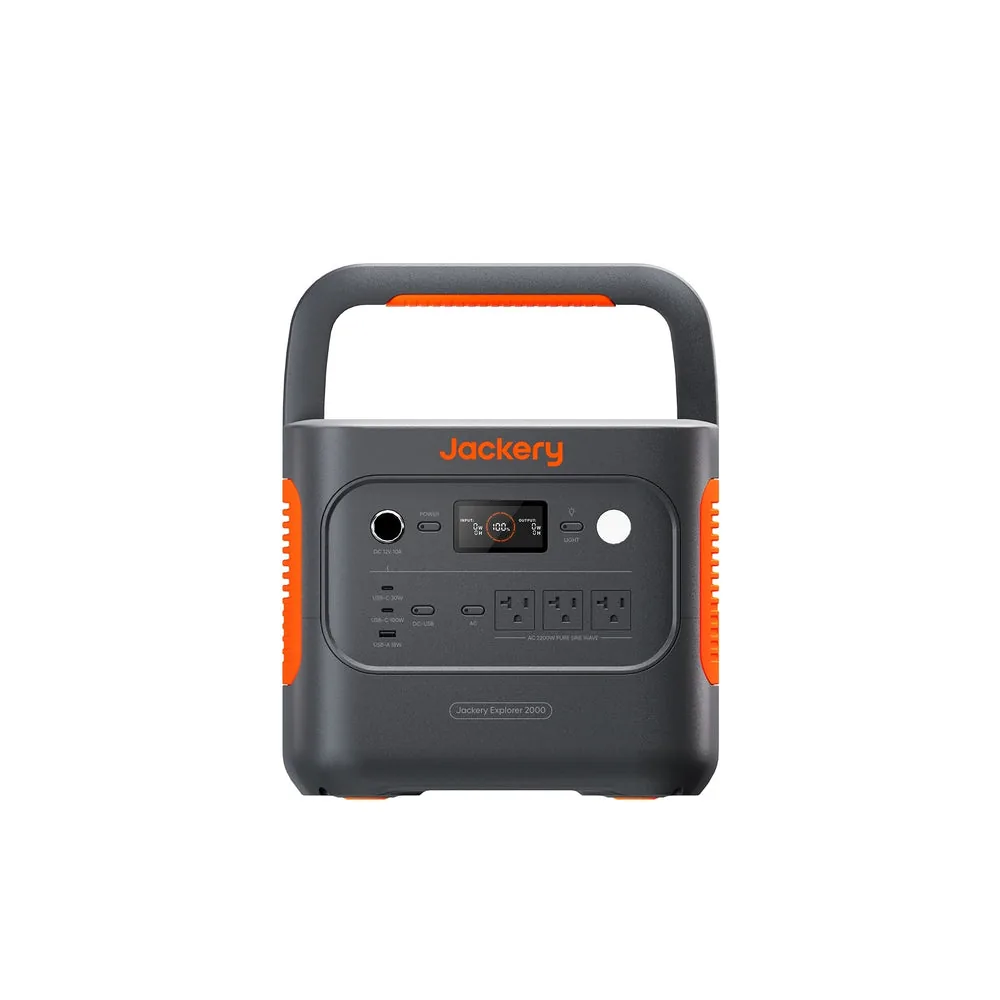
Jackery Explorer 2000 v2
This pushes evacuation portability limits—39.5 pounds requires two adults for efficient loading, or one very strong adult making multiple trips. But for certain situations, the capacity justifies the weight.
Who Needs This:
- Families with multiple CPAP users
- Households with high medical device needs (oxygen concentrators, nebulizers, powered wheelchairs)
- Families of 5+ people evacuating together
- Extended evacuation scenarios (7-14 days) with solar recharge capability
- Pre-staged evacuation vehicles (RV, truck with secured bed storage)
The 2,042Wh capacity provides roughly 2× the runtime of the 1000 v2. That’s 6-8 days of CPAP/phone/tablet/laptop coverage for a couple, or 4-6 days for a family of four with moderate usage. The 3,000W continuous output handles portable induction cooktops (1,800W), electric kettles (1,500W), space heaters—critical during winter evacuations.
💡 Pro strategy: For families in extreme wildfire zones who evacuate annually, store the 2000 v2 in your evacuation vehicle (truck, SUV, RV) permanently. Leave it there year-round, maintained at 50-80% charge. Your vehicle becomes a mobile power station.
We also recommend reading our solar charging for home backup.
$1,299

SolarSaga 100W Solar Panel
Most evacuation scenarios resolve within 5-7 days. But Camp Fire evacuees spent 14+ days displaced. Marshall Fire victims faced weeks of uncertainty. When evacuation extends beyond initial estimates, solar panels convert from convenience to necessity. Learn more about solar panel compatibility for Jackery power stations.
The Math:
A 100W panel generates 300-500Wh daily in decent sun conditions (4-6 peak hours). That’s enough to:
- Recharge an Explorer 500 v2 fully in 1-2 days
- Top off an Explorer 1000 v2 in 2-3 days
- Keep an Explorer 2000 v2 running indefinitely with conservative use
The weight (9.1 pounds) adds burden during fast evacuations, but folds flat to 24 × 21 × 1.4 inches—slides into trunk spaces, leans against car seats, stores in roof carriers. For extended evacuations where you’re camping in parking lots or staying with friends in rural areas, solar recharge capability eliminates the “when does my power run out” stress.
⚠️ Realistic expectations: You’re not generating 100W consistently. Trees, clouds, suboptimal angles, and smoke from fires reduce output. Budget for 60-70W average during evacuation scenarios.
$169
Quick Comparison: Best Emergency Power Supply for Evacuation
⏱️ Runtime Estimates: 1,000Wh Power Station
Smartphone
15-20Wh per charge
Laptop
50-70Wh per charge
CPAP Machine
30-60W (7-9h/night)
Portable Fan
20W continuous
LED Lantern
5W continuous
Electric Kettle
1000W (5min/boil)
Common Evacuation Power Mistakes to Avoid
These mistakes get repeated across every wildfire season. Learn from others’ experiences with prepper community wildfire experiences to avoid costly errors.
❌ vs ✅ Common Mistakes
❌ Buying Too Large
Purchasing 5,000Wh whole-home system (85 lbs) that can’t be moved during 20-minute evacuation window.
Preparation is everything — see our power station maintenance schedule.
✅ Prioritize Portability
Choose 500-1,500Wh range (15-35 lbs). Buy second smaller unit for redundancy instead of one giant system.
❌ Storing Uncharged
Power station at 0% charge when evacuation alert sounds = useless equipment.
✅ Maintain 50-80% Charge
Check monthly. 30 minutes every 4-6 weeks prevents dead battery scenario during emergency.
❌ No Car Cable
Remembered power station but forgot car charging cable. Now driving 200 miles with depleting battery.
✅ Keep Cable Attached
Store car charging cable inside power station carrying case or tape it to the unit itself.
❌ Buried in Storage
Power station behind holiday decorations and tools = might as well not exist during 15-minute window.
✅ Near Exit Door
Store near garage entrance or exit door. Create “evacuation station” with clear path to vehicle.
Frequently Asked Questions: Wildfire Evacuation Power
Can I run my CPAP for a full week on a 1,000Wh power station?
Depends on your CPAP settings, but generally yes for conservative use. A typical CPAP draws 30-60W and runs 7-9 hours nightly. That’s 210-540Wh per night. A 1,000Wh power station provides 2-5 nights of CPAP power alone, or 4-7 nights if you’re also charging phones and tablets but keeping usage minimal. For week-long evacuations, pair the power station with a solar panel for daytime recharge.
What if I can’t afford a power station before fire season?
Start with a smaller unit in the 300-500Wh range. These often cost under $200 during sales and cover essential phone/tablet charging for several days. It’s not comprehensive coverage, but it’s infinitely better than nothing. Upgrade to larger capacity when budget allows. Alternatively, check community programs—some California counties offer emergency preparedness grants or equipment libraries for residents in high-risk fire zones.
Should I evacuate with my power station even if hotels have power?
Yes, always bring your power station during wildfire evacuation regardless of expected hotel availability. Situations change rapidly—hotels fill, power grids fail, evacuation zones expand. Your power station provides independence from infrastructure that might collapse. The vehicle space it occupies is minimal compared to the security it provides. Compare to a hurricane emergency preparedness guide where similar principles apply.
How often should I replace my evacuation power station?
LiFePO4 batteries in modern power stations last 4,000+ cycles before dropping to 80% capacity. Even with weekly use, that’s 10-15 years. For evacuation-focused units that only see occasional use, you’re looking at 20+ years of viability. The technology may become obsolete before the battery wears out. More realistic replacement timeline: every 8-10 years to take advantage of improved technology, not because the old unit failed.
Can I charge my power station while driving during evacuation?
Yes, using the car charging cable (typically 40-60W charge rate). Over a 3-hour drive, you’ll recover 120-180Wh of capacity. It’s slow compared to wall outlet charging, but during evacuation transit, every watt counts. Keep the cable connected during the drive—even at 10% state of charge, you’re better off arriving at the evacuation center with 25% charge than 10%.
Will extreme heat during evacuation damage my power station?
LiFePO4 batteries tolerate heat better than older lithium-ion technology, but prolonged exposure to 120°F+ (vehicle interior during summer) will degrade capacity over time. During evacuation, you’ll likely be driving with AC running or parked in shaded areas. Short-term heat exposure (4-8 hours) won’t cause immediate failure. For long-term vehicle storage, store the power station in a vehicle’s cargo area (cooler than dashboard/seats) or bring it inside at night.
Can I use my power station to jump-start my vehicle?
No, standard portable power stations lack the amperage to jump-start vehicles. You need a dedicated jump starter (separate device, 300-500A peak current). Some larger power stations offer this feature, but most evacuation-sized units (300-1,500Wh) do not. Keep a separate jump starter in your vehicle for this purpose.
What if my power station fails during evacuation?
This is why redundancy matters. Options include: two smaller units instead of one large unit, vehicle charging capability (charges devices slowly but works), battery-powered USB power banks for phones (small, lightweight backup), and community resources at evacuation centers (limited but available). Test your power station every 6 months to catch failures before evacuation scenarios. Most quality brands offer 2-5 year warranties—register your product and understand the replacement process before you need it.
Build Your Evacuation Power Plan Today
Wildfire evacuations don’t wait. The families who fare best aren’t the ones with the largest power stations—they’re the ones who planned before the smoke appeared. Start with the Explorer 1000 v2 for most families, or choose the right capacity for your specific needs.
Shop Emergency Power Supply Systems →
Free shipping | 2-5 year warranty | 30-day returns
Conclusion: Your Evacuation Power Checklist
Wildfire evacuations don’t wait for you to research, compare, and order the perfect emergency power solutions. They arrive at 2 AM with 30-minute warnings and force impossible decisions about what matters most. The families who fare best aren’t the ones with the largest power stations—they’re the ones who planned before the smoke appeared.
Your evacuation power plan needs three elements: appropriate capacity for your family size and medical needs, portability that matches your physical evacuation constraints, and practiced protocols that eliminate decision-making under stress. An Explorer 1000 v2 stored near your exit door and maintained at 60% charge will save your family when a 3,000Wh system buried in the garage gets left behind. For those needing comprehensive backup, our complete home backup power guide covers permanent installation options.
✅ Your Action Plan Today:
- Identify critical devices: CPAP, phones, medications requiring refrigeration, medical equipment
- Calculate capacity requirement: Minimum Wh needed based on device priorities
- Choose power station: Fits your vehicle with room for other essentials
- Set up evacuation station: Near primary exit door with clear vehicle path
- Test the system: Every 6 months, run full evacuation drill
- Train your family: Everyone knows location, operation, priority charging
The investment isn’t just in hardware—it’s in the certainty that when flames crest the ridgeline and sirens sound, you have one less thing to panic about. Your family’s communication stays live. Medical devices keep running. You maintain the power to make informed decisions instead of desperate guesses.
That certainty is worth far more than the price of a power station.
Visit Emergency Preparedness Power Hub →
Originally published: January 2, 2026