
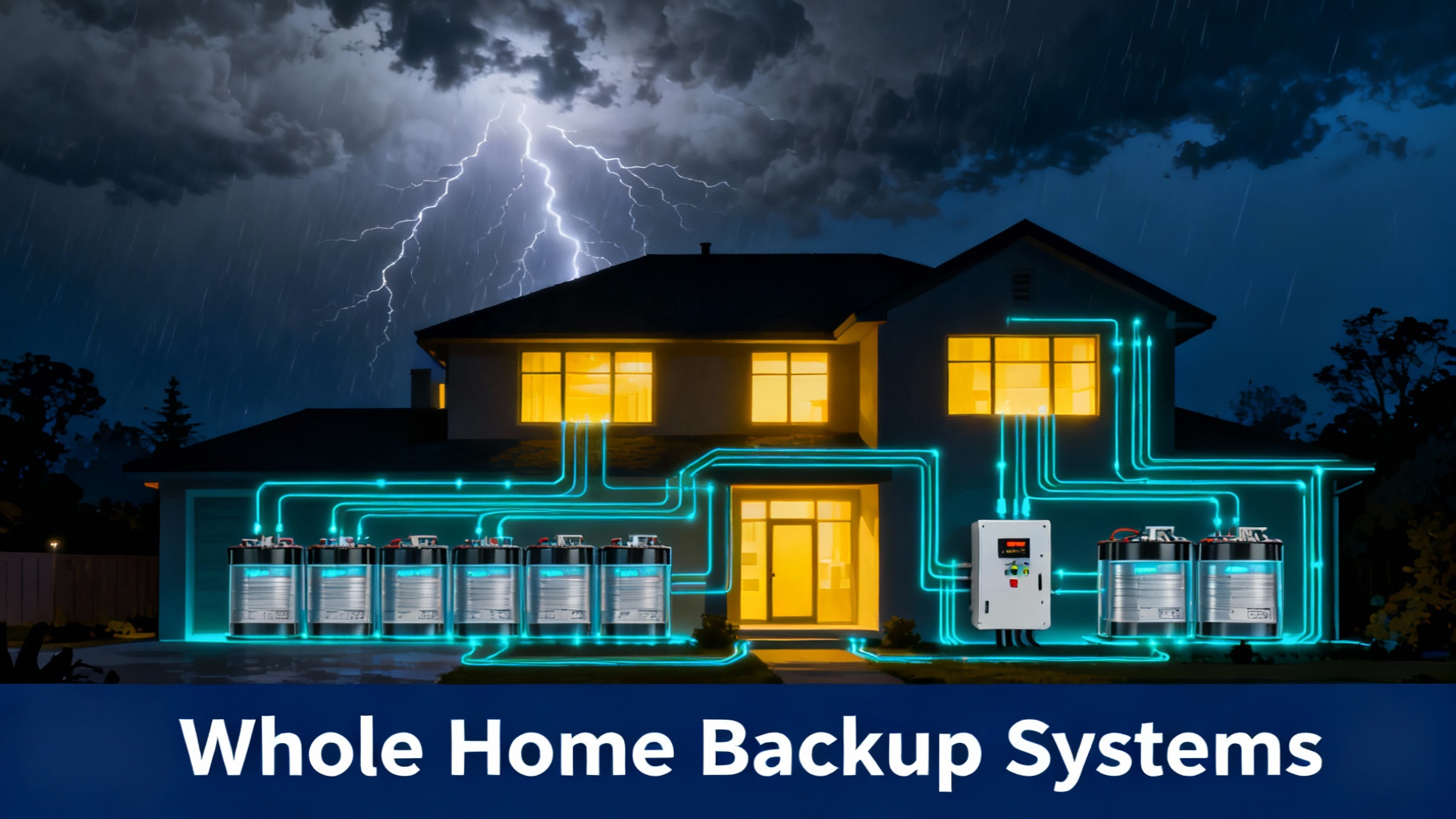
The last major storm in your area probably reminded you why backup power matters. When the grid fails, you’re looking at $150-500 per day in costs—spoiled food, missed work, hotel stays, and the stress of uncertainty. For families relying on medical devices or home-based businesses, the stakes climb even higher.
Power outages hit harder now than ever before. Over 70 million Americans experienced significant outages in 2024, with average durations stretching to 8 hours. Climate change, aging infrastructure, and increased demand mean these numbers keep climbing. Traditional generators offer a solution, but they’re loud, require fuel storage, need regular maintenance, and produce emissions you’d rather avoid.
Modern battery-based home backup systems changed this equation. Today’s portable power stations with whole-home capability deliver silent, maintenance-free backup that integrates with solar panels and transfer switches. You can power essential circuits—refrigerators, freezers, furnaces, well pumps, lighting, and electronics—for hours or days depending on your setup.
💰 Featured System:
Anker SOLIX F3800 now $2,199.99 on Anker SOLIX
| 3,840Wh | 6,000W split-phase
This guide walks you through everything you need to plan a complete whole home backup battery system. We’ll cover how to calculate your home’s actual power requirements, what features separate basic units from true whole-home systems, and how leading options like the Anker SOLIX F3800 compare against alternatives from EcoFlow, Jackery, and Bluetti. You’ll also learn about transfer switch installation, solar integration, costs, and what changed with the federal tax credit.
By the end, you’ll know exactly which system fits your home, how much capacity you actually need, and what your total investment looks like.
Get the 1-page outage plan
What to plug in first, how long a fridge really runs on a battery, and the 3 safety rules for connecting a power station to your home. Printable, sent by email.
About one email a week. Unsubscribe in one click. We may earn a commission when you buy through our links, at no extra cost to you. Privacy Policy
Why Whole Home Backup Systems Matter in 2025
Weather-related power disruptions increased 67% over the past decade. NOAA reports on power outages show an average of 8 major power events per state annually, ranging from brief afternoon outages to multi-day blackouts following severe storms. Your location determines specific risks—hurricanes in coastal regions, ice storms across the Midwest and Northeast, wildfires forcing preventive shutoffs in the West, or grid overload during summer heat waves.
The financial impact adds up quickly. A typical family loses $200-400 in spoiled refrigerated food during a 24-hour outage. If you work from home, each day without power costs $150-300 in lost productivity. Medical considerations become priceless—CPAP machines, oxygen concentrators, refrigerated medications, and powered wheelchairs require reliable electricity.
💸 The True Cost of Power Outages
Home systems face additional risks during extended outages. Frozen pipes from disabled heating systems can cause $5,000-15,000 in damage during winter. Sump pumps failing during storms lead to flooded basements. Security systems go dark, leaving homes vulnerable.
Traditional backup solutions carry their own problems. Portable generators require gasoline storage (fire hazard), produce carbon monoxide (safety risk), and wake the neighborhood with 70+ decibel noise. Permanent standby generators cost $5,000-15,000 installed, run on natural gas or propane, and need annual maintenance contracts.
Modern battery systems solve these issues while offering new advantages. LiFePO4 chemistry provides 10-year lifespans with minimal degradation—vastly superior to older lead-acid batteries that lasted 3-5 years. Solar integration means you can recharge during extended grid failures, turning a 1-2 day backup into week-long self-sufficiency. Smart monitoring apps let you track consumption and adjust usage remotely.
The 30% federal tax credit that used to offset these costs ended for systems installed after December 31, 2025, so budget for the full price. Avoided generator fuel and maintenance costs still count in a battery system’s favor over time.
But here’s the critical distinction: not all portable power stations qualify as “whole home” systems. The difference lies in specific capabilities we’ll explore next.
Understanding Your Home’s Power Requirements
Sizing a home battery backup system starts with understanding what you actually need to power. Most homeowners overestimate requirements because they imagine running everything simultaneously. Reality looks different—you prioritize essential loads and manage high-draw appliances strategically.
Want to calculate your exact power needs? Our detailed load management guide walks you through the complete process.
Essential vs Non-Essential Loads
Essential loads keep your home functional and safe during outages. These typically include refrigerators, freezers, well pumps, furnace blowers, a few lighting circuits, WiFi routers, phones, laptops, and any medical devices. The average 2-3 bedroom home needs 2,000-3,000W of continuous power for essentials.
⚡ Typical Home Power Consumption by System
Non-essential loads include central air conditioning (3,000-5,000W), electric ranges (3,000-5,000W), clothes dryers (3,000-5,000W), electric water heaters (4,000-5,500W), and power tools. You can survive without these during short outages, though longer disruptions might require strategic use.
The key decision: Do you want to power everything, or manage loads intelligently? Most homeowners choose the latter, saving thousands on system costs while maintaining comfort and safety.
Peak vs Sustained Power Draw
Understanding the difference between startup surge and running watts prevents undersizing your system. Electric motors—found in refrigerators, freezers, well pumps, and furnace blowers—draw 2-3x their running wattage for 1-3 seconds during startup.
A refrigerator might draw 800W starting but only 200W running. Your well pump could surge to 3,000W starting while running at 1,200W. Furnace blowers typically surge to 1,800W before settling at 600W.
This matters because your power station must handle these simultaneous surges. If your refrigerator and well pump start within seconds of each other, you need capacity for both surge loads at once—potentially 4,000-5,000W combined, even though their sustained draw totals only 1,400W.
Analysis of real-world installations shows systems sized for 1.5x calculated essential loads handle surge demands reliably. If your essential circuits draw 2,500W sustained, target 3,500-4,000W minimum output capacity. This buffer prevents overload shutdowns when multiple devices cycle on.
120V vs 240V Requirements
Your home’s electrical panel distributes two types of power—standard 120V circuits for most outlets and lights, plus 240V circuits for high-draw appliances. Understanding which devices need 240V determines whether you need split-phase capability.
Standard 120V circuits power wall outlets, lighting fixtures, TVs, computers, small appliances, refrigerators, freezers, and garage door openers.
High-power 240V circuits typically serve well pumps (critical for rural homes), central air conditioning, electric ranges and ovens, clothes dryers, EV chargers, some hot water heaters, and large workshop tools.
Here’s where it gets important: basic portable power stations only provide 120V output through standard AC outlets. To power 240V appliances, you’d need two units connected through a special combiner box, adding complexity and cost.
True whole-home systems offer split-phase 240V output natively. They generate proper 120V/240V split-phase power matching your home’s electrical panel—no adapters, no workarounds, no limitations. This single feature determines whether you have genuine whole-home capability or just a large portable power station.
For homeowners with well pumps, this becomes non-negotiable. Your well pump won’t run without 240V power, meaning you’ll lose water within hours during outages. City water customers have more flexibility, but split-phase capability still provides future-proofing and full-home compatibility.
Get the 1-page outage plan
What to plug in first, how long a fridge really runs on a battery, and the 3 safety rules for connecting a power station to your home. Printable, sent by email.
About one email a week. Unsubscribe in one click. We may earn a commission when you buy through our links, at no extra cost to you. Privacy Policy
Critical Features of Whole Home Backup Systems
Not all high-capacity power stations qualify as true whole-home systems. Four specific features separate convenient backup options from genuine home-powering capability. Understanding these distinctions helps you avoid expensive mistakes and ensures your system actually delivers when the grid fails.
For a more specific use case, see our multi-day outage planning guide.
Split-Phase 240V Output (Deal-Breaker Feature)
This single capability separates real whole-home systems from oversized camping batteries. Your home’s electrical panel delivers split-phase power—two 120V “legs” that combine to create 240V for high-draw appliances. True whole-home backup must replicate this exact configuration.
Systems without native split-phase force you into workarounds. You might chain two units together through special combiners, adding $300-600 in equipment plus complexity. Or you install separate 120V and 240V systems, effectively doubling your investment. Neither approach matches the elegance and reliability of built-in split-phase output.
Analysis of installation data shows systems without split-phase capability struggle with modern homes. Well pumps won’t run. Central HVAC systems stay offline. EV chargers sit idle. You end up with expensive equipment that can’t power the circuits you need most during emergencies.
Current market leaders offering native split-phase include the Anker SOLIX F3800 with 6,000W output, EcoFlow Delta Pro Ultra at 7,200W, and Jackery’s 5000 Plus delivering 7,200W. Bluetti’s Apex 300 also delivers 120/240V from a single unit through its NEMA 14-50R outlet, at 3,840W.
Expandable Capacity
The beauty of modern systems lies in scalability. You start with a base unit sized for immediate needs, then add battery packs as budget allows or requirements grow. This flexibility transforms a $4,000 initial investment into a $10,000-15,000 system over time without replacing core components.
The mathematics work in your favor. The Anker F3800 starts at 3,840Wh capacity, enough for 12-24 hours of essential loads. Add one BP3800 expansion battery and you double to 7,680Wh—now you’re looking at 1-2 days. Six expansion batteries bring you to 26,880Wh total, providing 3-5 days of runtime with solar recharge capability. For a broader perspective, our whole-home system comparison 2026 covers the top three contenders.
This matters financially because few homeowners can invest $12,000-15,000 upfront. Starting with a base unit plus one expansion battery gets you operational. Add batteries annually as budget permits.
Transfer Switch Compatibility
The transfer switch solves a critical safety problem: how do you connect your backup power to your home’s electrical panel without killing utility workers or frying your equipment? This device physically isolates your home from the grid during outages, then safely switches between grid and backup power.
Two types dominate the residential market: Manual transfer switches ($500-1,200 installed) require you to physically flip switches when power fails. Automatic transfer switches (ATS, $1,500-2,500 installed) detect outages and switch automatically within seconds.
The Anker solution integrates this functionality into their Smart Home Power Kit. Instead of hiring electricians for separate transfer switch installation, you get a complete backup panel with built-in switching, sub-panel for essential circuits, and professional installation support. Learn more about transfer switch installation guide for detailed instructions.
⚠️ Important: Attempting to backfeed your home through a standard outlet is illegal and deadly. A proper transfer switch installation by a licensed electrician is non-negotiable for whole home backup. Field reports from electricians emphasize this as the only legal, safe method. Follow National Electrical Code standards for all installations.
We also cover this in depth in our best power stations for camping.
Solar Charging Capability
Extended outages reveal the limitation of battery-only systems—once depleted, you’re back to darkness. Solar integration transforms finite backup into indefinite self-sufficiency. As long as the sun shines, you can recharge and continue operations.
Practical solar charging requires adequate input capacity. Systems accepting only 400-600W solar struggle with the math—a 4,000Wh battery needs 6-10 hours of optimal sunlight for full recharge. Reality involves clouds, suboptimal angles, seasonal variations, and shade. Real-world recharge times often double theoretical calculations.
Look for 1,200W minimum solar input for practical whole-home systems. The F3800’s 2,400W capability means optimal conditions deliver 0-80% charge in 1.5 hours. Even with 50% efficiency losses due to weather, you still achieve full daily recharge with 3-4 panels.
Our complete solar charging guide for home backup covers panel sizing, positioning, and integration strategies in depth.
Top Whole Home Backup Systems Compared (2025)
Four manufacturers currently dominate the whole-home backup market, each targeting slightly different priorities. Understanding their strengths and trade-offs helps you match systems to your specific situation—home size, budget, desired features, and expansion plans.
Anker SOLIX F3800 — Best Overall Modern System ⭐

The F3800 represents the current generation of whole-home thinking. Anker entered the power station market recently but brought expertise from charging technology and battery management. The result combines cutting-edge features with a 5-year warranty.
At its core sits 3,840Wh of LiFePO4 battery capacity delivering 6,000W continuous output through true split-phase 120V/240V. This configuration handles typical 2-3 bedroom homes running all essential circuits—refrigerators, freezers, furnace, well pump, lighting, electronics, and medical devices.
Key technical advantages set the F3800 apart. The 2,400W solar input through dual 60V MPPT controllers means you can connect up to eight 300W panels for optimal charging speed—0-80% in just 1.5 hours under good conditions. Performance data from similar installations indicates the F3800 handles sustained 4,500W loads without thermal throttling, important during hot summer days when multiple systems run simultaneously.
Expandability scales to 26,880Wh through six BP3800 expansion batteries. Each battery adds 3,840Wh for $1,799.99, letting you grow the system as needs or budget evolve. Base unit plus two batteries delivers 11,520Wh, enough to power a full home for 2-3 days.
The InfiniPower™ technology backing the system promises 3,000 cycles to 80% capacity, translating to a 10-year functional lifespan under typical use patterns. Anker backs this with a 5-year warranty. See how it stacks up in our Anker E10 vs EcoFlow head-to-head review.
⚡ Anker SOLIX F3800 – Current Best Price
$2,199.99
Need more guidance? Our best Jackery for home backup has you covered.
- ✅ 3,840Wh expandable to 26,880Wh with 6x batteries
- ✅ 6,000W split-phase (120V/240V) for whole home backup
- ✅ 2,400W solar input — 0-80% charge in 1.5 hours
- ✅ InfiniPower™ 10-year lifespan guarantee + 5-year warranty
Check Current Price on Anker →
💡 Price checked automatically on Anker SOLIX’s US store | Free shipping on orders $50+
Real-world application for a 2-3 bedroom home shows 12-24 hours runtime on essential loads from the base 3,840Wh capacity. Add solar panels and that extends to 3-5 days of indefinite operation as long as weather cooperates. For homeowners in areas with 1-2 day typical outages, the base unit alone provides sufficient coverage.
Price positioning sits at $2,199.99 for the base F3800 unit and $1,799.99 per BP3800 expansion battery.
This system fits homeowners who want premium features, long warranty protection, future expansion capability, and bleeding-edge technology. Its value comes from longevity, expandability, and performance.
🔋 Expand Your System: BP3800 Expansion Battery
$1,799.99: Double your capacity to 7,680Wh
3,840Wh LFP battery | 3,000 cycles | Seamless F3800 integration
EcoFlow DELTA Pro Ultra: Maximum Capacity
EcoFlow’s flagship targets serious whole-home requirements where capacity trumps other considerations. The DELTA Pro Ultra starts at 6,144Wh base capacity, 60% more than the F3800. One inverter takes up to five batteries for about 30kWh, and three inverters paired with EcoFlow’s Smart Home Panel 2 reach 90kWh.
The 7,200W continuous output (10.8kW surge) ties with the Jackery 5000 Plus for the highest continuous output in this comparison. This matters for homes running central air conditioning, electric ranges, or other high-draw appliances simultaneously. Wall charging reaches 1,800W on a 120V outlet and 3,000W on 240V.
Trade-offs appear in other areas. The DELTA Pro Ultra sells for $3,989 with one inverter and one battery, considerably more than the F3800. Its inverter (70 lb) and battery (111.8 lb) make positioning and transport more challenging. EcoFlow matches Anker with a 5-year warranty.
You can find tailored recommendations in our best Bluetti for home backup.
This system makes sense for larger homes (2,500+ sq ft), extended off-grid applications, or homeowners prioritizing maximum capacity and output over price efficiency. For properties running full-time off-grid, our off-grid homestead power solutions guide covers the complete planning process.
Jackery Explorer 5000 Plus: Modular Flexibility

Jackery pioneered the portable power station category and maintains market leadership through brand recognition, retail availability, and established reliability. The 5000 Plus represents their whole-home offering, balancing proven technology with modern features.
The 5,040Wh base capacity sits between the F3800 and the Delta Pro Ultra, offering solid middle-ground positioning. The 7,200W rated output (14,400W surge) comes in both 120V and 240V from a single unit, through NEMA 14-50 and L14-30R outlets alongside four 120V outlets. At about 134.5 lb, it is heavy to move.
Modular expansion accepts up to five Battery Pack 5000 Plus units (5,040Wh each, $2,599 apiece), for about 30kWh per unit, and Jackery says two units with ten packs reach 60kWh. The solar input reaches 4,000W with high-voltage panels, for a recharge in about 2 hours according to Jackery; through the Smart Transfer Switch, Jackery quotes 1.7 hours.
Where Jackery excels: customer service reputation, extensive retail presence (available at Costco, Home Depot, Best Buy), and established track record. You’re buying proven technology with known reliability, not bleeding-edge features that might reveal issues over time. The Explorer 5000 Plus sells for $2,899 on Jackery’s US store, which works out to $0.58 per watt-hour, against $0.57 for the F3800.
Bluetti Apex 300: Modular 120/240V Backup
Bluetti’s current whole-home option is the Apex 300, a single unit with 2,764.8Wh of LiFePO4 capacity and 3,840W of output (7,680W lifting power). Unlike the older AC500, which Bluetti no longer sells in the US, it has a built-in NEMA 14-50R outlet (120/240V, 50A) next to a TT-30R and four 20A outlets, so it runs 120V and 240V loads at the same time without an adapter.
Expansion is modular. Each Apex 300 takes up to six B300K batteries (2,764.8Wh each, $1,199 apiece), for about 19.4kWh per unit, and Bluetti links up to three units with 18 batteries for 58kWh and 11.52kW of output. The Apex 300 itself sells for $1,499 (list $1,699). For the full breakdown, see our Apex 300 review.
Trade-offs appear in a few areas. Solar input tops out at 2,400W per unit (2 x 1,200W, 12-60V) unless you add Bluetti’s SolarX 4K controller. The unit has no USB or 12V DC ports of its own: those require the Hub D1 add-on, rated at 700W. And at 83.8 lb, it’s heavy to move. On the plus side, turbo charging reaches 3,840W, 80% in about 45 minutes according to Bluetti, and Bluetti backs it with a 5-year warranty and 6,000+ cycles to 80%.
Real-world fit: homeowners who want 240V from a single unit, plan to grow capacity over time, or need TT-30R and 14-50R outlets for an RV. If you want USB and 12V outputs at the unit, budget for the Hub D1 ($299 as of October 2026).
| Feature | Anker F3800 | EcoFlow DPU | Jackery 5000 Plus | Bluetti Apex 300 |
|---|---|---|---|---|
| Base Capacity | 3,840Wh | 6,144Wh | 5,040Wh | 2,764.8Wh |
| Max Expansion | 26,880Wh | 30,720Wh (90kWh with 3 units) | 30,240Wh (60kWh with 2 units) | 19,354Wh (58kWh with 3 units) |
| AC Output | 6,000W | 7,200W | 7,200W | 3,840W |
| Split-Phase 240V | ✅ Native | ✅ Native | ✅ Native | ✅ Native (14-50R) |
| Solar Input | 2,400W | 5,600W | 4,000W | 2,400W |
| Charge Time (0-80%) | 1.5 hrs | ~2 hrs for 2 batteries (8.8kW) | 1.7 hrs (Smart Transfer Switch) | 0.75 hrs (turbo) |
| Warranty | 5 years | 5 years | 5 years (from Jackery.com) | 5 years |
| Base Price | $2,199.99 | $3,989 | $2,899 | $1,499 |
The comparison reveals no universal winner. Your home size, power requirements, budget constraints, and feature priorities determine the best fit. For a deeper comparison between two popular brands, see our Jackery vs Anker for home backup analysis.
System Costs and Budget Planning
Understanding total home battery backup system cost requires looking beyond the power station’s price tag. A complete whole-home backup installation includes multiple components, each adding to your investment. Breaking down costs helps you budget accurately and identify areas for phased implementation.
Related reading: our best power stations for refrigerator backup goes deeper on this topic.
💰 Complete System Investment Breakdown
Entry Level System
- Bluetti Apex 300 + 1x B300K
- Manual 6-circuit switch
- 2x portable solar panels
- 1-2 day backup
Mid-Range System ⭐
- Anker F3800 + 1x BP3800
- Manual 10-circuit switch
- 4x portable solar panels
- 2-3 day backup
Premium System
- Anker F3800 + 2x BP3800
- Smart Home Power Kit
- 6x roof-mounted panels
- 3-5+ day backup
Few homeowners can invest $10,000-15,000 upfront. Smart approach involves phasing: Year 1 covers core system ($4,000-7,000), Year 2 adds solar expansion ($1,500-3,000), Year 3 increases capacity ($2,500-5,000). This spreads the investment across three years.
What Happened to the 30% Federal Tax Credit
From 2023 through 2025, home battery systems of at least 3kWh qualified for the 30% federal Residential Clean Energy Credit, with or without solar. The 2025 tax law known as the One Big Beautiful Bill Act ended it early: the credit is not allowed for systems installed after December 31, 2025, even if they were paid for in 2025.
If your system was installed by December 31, 2025, you can still claim the credit on your 2025 return using IRS Form 5695 attached to your standard Form 1040 tax return.
💡 Pro Tip: The credit is non-refundable but carries forward. If your 2025 credit is larger than the tax you owe, the unused amount carries forward to reduce tax in later years. Tax situations vary significantly, so consider consulting tax professionals familiar with renewable energy credits.
Frequently Asked Questions
Can a portable power station really power my whole house?
Yes, but with important caveats. “Whole home” means your essential circuits, not running everything simultaneously. Modern split-phase systems like the Anker F3800 (6,000W) can power refrigerators, freezers, furnaces, well pumps, lighting, and electronics—covering 80-90% of needs during outages. You’ll manage high-draw appliances like central AC strategically rather than running continuously.
How long will a whole home backup system actually run my house?
Runtime depends on battery capacity, consumption rate, and solar recharge capability. A base F3800 (3,840Wh) running 2,000W of essential loads provides roughly 12-24 hours managed intelligently. Add expansion batteries and that extends to 2-3 days. With solar panels actively recharging during daylight, you can operate indefinitely with careful load management.
Do I need an electrician to install a whole home backup system?
Yes, for proper transfer switch installation connecting your backup system to your home’s electrical panel. While the power station itself requires no installation (plug and play), safely integrating with house circuits demands licensed electrical work. Attempting DIY transfer switch connections violates electrical codes, voids warranties, and creates deadly backfeeding risks. Professional installation typically costs $500-1,500 depending on transfer switch complexity.
Will these systems work during winter or in cold weather?
LiFePO4 batteries perform well in cold weather, though available capacity temporarily decreases below freezing. At 32°F, expect 80-90% of rated capacity. At 0°F, capacity drops to 60-70%. Performance returns fully when temperatures rise—cold causes no permanent damage. The more significant challenge involves solar panel output during winter. Plan battery capacity generously for winter outage scenarios in cold climates.
How does this compare to a traditional generator?
Battery systems offer silent operation, zero emissions, no fuel storage, and zero maintenance compared to generators’ noise, fumes, regular maintenance, and fuel management. Generators provide unlimited runtime as long as fuel lasts and typically cost less upfront ($3,000-6,000). Battery systems cost more initially but eliminate ongoing fuel costs ($50-100 per outage) and maintenance expenses ($200-400 annually).
Can I run my central air conditioning on a backup power station?
Technically yes, but practically challenging. Central AC units draw 3,000-5,000W continuously, quickly depleting even large battery banks. A 4,000W central AC running on an F3800 (3,840Wh) would drain the battery in under an hour—impractical for extended outages. Realistic expectation: battery systems excel at essential loads, struggle with sustained high-draw appliances like AC without very large (20kWh+) battery banks.
What maintenance do these systems require?
Minimal compared to generators. Battery-based systems need no oil changes, no spark plugs, no fuel system maintenance. Recommended maintenance includes: quarterly functionality testing, annual comprehensive discharge/recharge cycle, periodic firmware updates through companion apps, occasional solar panel cleaning (every 2-3 months), and annual inspection by electricians verifying transfer switch integrity ($100-200).
Will this save money on my electricity bills?
Potentially, depending on your utility rate structure and solar integration. If your utility charges time-of-use rates, you can charge batteries during cheap off-peak hours and discharge during expensive peak hours—saving $20-60 monthly. With solar panels, you reduce grid consumption, lowering bills by $50-150 monthly. However, these savings typically take 8-12 years to offset the system’s cost. Most homeowners purchase primarily for backup security, viewing bill savings as a bonus.
What happens if the system runs out of power during an outage?
The power station shuts down automatically when batteries reach minimum safe voltage (typically 10-15% remaining capacity) to protect batteries from damage. You’ll lose power to connected circuits until you can recharge—either when grid power returns or through solar panels the next day. Modern systems provide low-battery warnings through companion apps and audible alarms, giving you 1-2 hours notice to reduce consumption or prepare for shutdown.
Can I install this system myself or do I need professionals?
The power station itself requires no installation—unbox, charge, and use. However, whole-home integration demands professional electrical work. You can legally use your power station with extension cords during outages, manually connecting essential devices. But proper whole-home backup through your electrical panel requires transfer switch installation by licensed electricians. Some homeowners DIY the power station purchase and solar panel setup, then hire electricians specifically for transfer switch work.
Final Verdict: Choosing Your System
After examining capabilities, costs, and trade-offs, the decision comes down to matching systems to your specific situation. No universal “best” exists—only best home battery backup system for your home, budget, and priorities.
For most homeowners seeking comprehensive modern backup, the Anker SOLIX F3800 delivers optimal balance. The 6,000W split-phase output handles genuine whole-home loads including well pumps and 240V circuits. The 2,400W solar input provides fastest recharge times, critical during multi-day outages with intermittent sun. InfiniPower™ technology and 5-year warranty offer peace of mind for what becomes a decade-long investment.
The expandability from 3,840Wh to 26,880Wh means you start at a comfortable price point ($2,199.99 for the base unit, plus $1,799.99 per expansion battery) and grow capacity as needs or budget evolve. If you’re thinking longer-term, our article on scaling up your off-grid power system walks through the expansion planning process step by step.
🎯 Which System Is Right for You?
- You want a 5-year warranty and Anker’s 10-year InfiniPower lifespan claim
- Fast solar charging (2,400W) is priority
- Budget allows $2,199.99 or more for a starter system
- You value expandability to 26,880Wh
- Native split-phase 240V is essential (well pumps, etc)
- Maximum capacity (90kWh expansion) is priority
- Your home exceeds 2,500 sq ft with higher demands
- Budget permits a $3,989 base price
- 7,200W output and 10.8kW surge for large loads
- Brand recognition and retail availability matter
- You value proven reliability over newest features
- Customer service reputation influences decisions
- You want 7,200W of 120/240V output and room to grow to 30kWh per unit
- You want 120V and 240V outlets, including a NEMA 14-50R, in one unit
- You plan to grow capacity in steps (up to six B300K per unit)
- Fast turbo charging (80% in about 45 minutes) matters
- You don’t need USB or 12V ports at the unit, or will add the Hub D1
Power outages will continue increasing as infrastructure ages and weather events intensify. The question isn’t whether you’ll experience outages, but whether you’ll be prepared when they happen. A properly sized whole home backup battery system transforms outages from crisis events into minor inconveniences—your home stays powered, your family stays comfortable, and your food stays fresh while you wait for utility crews to restore service. If you’re weighing whether to stay grid-connected or go fully independent, our breakdown of off-grid vs grid-tied solar systems can help clarify the decision.
Start by calculating your essential load requirements using our Home Backup Power Stations guide. Identify which circuits must stay powered. Select a power station sized for 1.5x that load. Plan transfer switch installation with licensed electricians. Add solar panels matching your battery capacity for extended outage capability.
Ready to Secure Your Home’s Power?
The Anker SOLIX F3800 is currently $2,199.99, our top-rated whole home backup system
✓ Free shipping | ✓ 5-year warranty
Disclosure: This article contains affiliate links. As an Anker SOLIX affiliate, we earn commissions from qualifying purchases at no cost to you. We only recommend products we believe provide value for whole-home backup applications. All opinions reflect our analysis of specifications, features, and real-world applicability.
Anker, EcoFlow and Jackery prices are checked automatically on each brand’s US store; other amounts are estimates. Consult licensed electricians and tax professionals for your specific situation. The 30% federal tax credit ended for systems installed after December 31, 2025.
Originally published: December 23, 2025
I truly enjoy reading on this site, it holds excellent content.
thank you very much